Category Archives: The Debt Imperative

The Great Unraveling—Entering Stage Two

There has been very little recognition of the Debt/Growth Imperative that is built into our global system of money, banking, and finance. As I have been preaching for many years, the creation of money as interest-bearing debt requires that indebtedness, in either the private sector or the public sector, must be continually increased at an accelerating rate in order for the system to continue to function. When the private sector is fully “loaned up,” government must step in as “the borrower of last resort.” That was clearly manifested in the latest bubble-bust cycle with the massive bank bailouts and the assumption by governments of enormous amounts of their “toxic debt.”

The aggregate debt burden is destined to ultimately become unbearable, and no amount of government or central bank intervention can save this flawed system (such is the nature of exponential growth). The fiscal crisis that is now confronting national governments around the world signals the imminent collapse. How that will play out is difficult to assess, but it behoove us to use our available resources to enhance the resilience of our communities and build new systems that can be relied on to provide the things we need in order to thrive and build a world that works for all.

One prominent commentator who “gets it” is Chris Martenson. His recent observations (below) are worth considering.—t.h.g.

The Breakdown Draws Near

Tuesday, April 19, 2011, 12:22 pm, by Chris Martenson

Things are certainly speeding up, and it is my conclusion that we are not more than a year away from the next major financial and economic disruption.

Alas, predictions are tricky, especially about the future (credit: Yogi Berra), but here’s why I am convinced that the next big break is drawing near.

In order for the financial system to operate, it needs continual debt expansion and servicing. Both are important. If either is missing, then catastrophe can strike at any time. And by ‘catastrophe’ I mean big institutions and countries transiting from a state of insolvency into outright bankruptcy. [emphasis added]

In a recent article, I noted that the IMF had added up the financing needs of the advanced economies and come to the startling conclusion that the combination of maturing and new debt issuances came to more than a quarter of their combined economies over the next year. A quarter!

I also noted that this was just the sovereign debt, and that state, personal, and corporate debt were additive to the overall amount of financing needed this next year. Adding another dab of color to the picture, the IMF has now added bank refinancing to the tableau, and it’s an unhealthy shade of red: Banks face $3.6 trillion “wall” of maturing debt: IMF

Read the rest of Martenson’s post here.

#     #     #
The banker’s con job, MSNBC’s Dylan Ratigan gets it, sort of.

With the thievery becoming so blatant, even the mainstream media can no longer ignore it. Some reporters are actually beginning to understand how the con job works. In this video Ratigan takes a shot at explaining it.

Yes, bankers run the government, yes, the Federal Reserve is a private company operated by and for the banking establishment, yes, they are robbing us blind by means of their control of the money creation process.

The thing that almost no one understands yet is the fundamental flaw in the system, which is the creation of money on the basis of interest-bearing debt loaned to individuals, businesses, and governments.   The interest burden creates the necessity of ever-expanding debt so that the money supply does not collapse, hence, the dot-com bubble, the real estate bubble, and every other financial bubble throughout our history. That debt imperative gives rise to a growth imperative, which drives artificial growth of the economy, resource consumption, and virtually everything else, for that matter.

Don’t believe it? Well, just look at the empirical evidence. The phenomenon I describe is clearly seen in the worldwide debt statistics of the past several decades. We’ve reached the point of no return.–t.h.g.

Usury, Interest, and Islamic Banking

One of the most popular posts on this site has been David Pidcock’s View on the State of Islamic Money, Banking, and Finance, which was posted in January of 2008. Over the past few years, these subjects have continued to draw increasing attention, and interest in interest-free financing has continued to grow in both the east and the west. It is not only on the basis of religious belief that the subject of usury is once again being debated (mainly in the Islamic world), but increasingly on account of the obvious and overwhelming expansion of debt throughout the world.

In November of last year (2010) the First World Conference on Riba was held in Kuala Lumpur, Malaysia. (Riba is the Islamic term for usury). In recent correspondence from David, he argued that there still are no truly Islamic banks. He also sent along one of his papers that he presented at the Riba conference. Whatever your preconceived opinions about the subject might be, I think you will find his paper to be interesting and informative. I have made it a permanent part of this website, which can be found in the sidebar under Other Resources, or just click on the title here, Riba? Part 1.

–t.h.g.

Exponential growth-a key concept

In all of my writings I’ve tried to make clear that there is inherent in the political money system a growth imperative. That results from the fact that money is created by banks as interest-bearing debt. The compounding of interest causes debt to grow as time passes, not at a steady rate, but at an ever-increasing rate. At some point the amount of debt increases so rapidly that it overwhelms the ability of the real economy to carry it. We now seem to have reach that point and our civilization is in crisis.

This growth imperative based on debt compounding is the primary engine that is driving us to destruction, but debt is not the only thing that is growing exponentially. This video is part of Chris Martenson’s Crash Course. In it, he explains very clearly how compounding works. His entire Crash Course is highly recommended. –t.h.g.

Dumping U.S. Debt

According to Reuters, a major U.S. bond fund has dumped it’s U.S. government related debt holdings in expectation of higher interest rates and further dollar inflation. Read the full article, titled, PIMCO Total Return dumps U.S. government-related debt.

Chris Martenson: Inflation Is So Much Worse Than We’re Told

Chris Martenson, author of Crash Course, in this recent article, provides an update on his analysis of the Consumer Price Index (CPI) and argues that the world is in for big trouble. He says, “…fiscal and inflationary train-wrecks are the most probable outcome for the US — and, by extension, the globe.” I agree.

One point needs to be clarified. When speaking about inflation, one must distinguish between currency inflation and price inflation. Price inflation or cost of living can be affected by a number of causes, but the usual and primary cause is currency inflation, that is the debasement of a currency by the monetary authorities by creating money on an unsound basis, notably, the monetization of government debt.

The recent policies of “quantitative easing” followed by the Federal Reserve amount to counterfeiting U.S. dollars under color of law. The ultimate effects will be to steal the value of your savings, and the destruction of the middle class.

Plunder beyond belief, FED reluctantly shows the smoking gun.

I have for decades been trying to explain the parasitic nature of the global financial regime and the political order that has become subservient to it. Now, the evidence has become so overwhelmingly obvious that even the most dubious and somnambulistic amongst us cannot ignore its meaning.

On December 5 I posted an item that included Senator Bernie Sanders’ courageous speech about the class war that is being waged against virtually everyone by the super-wealthy elite. In that speech, the Senator referenced the long awaited report from the FED that Congress has demanded. This report has started a firestorm involving even the mainstream financial media.

In this recent article, David DeGraw, lays it all out in detail (Wall Street’s Pentagon Papers: Biggest Financial Scam in World History) with numbers and quotes from various sources. Please read it.

Now it is up to us to do something about it.

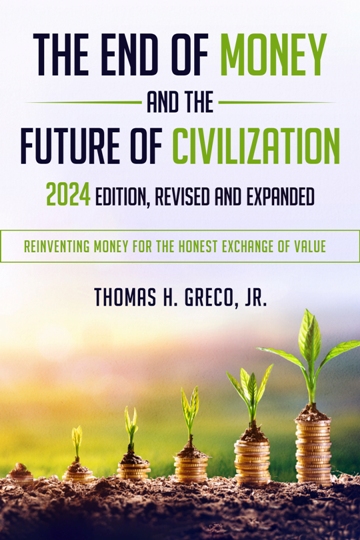
What can be done? My book, The End of Money and the Future of Civilization, lays out prescriptions for communities, grassroots organizations, businesses, and governments. The time to act is now!

Financial terrorism by bankers put Greece in the noose. Who is next?

Max Keiser interviews a Greek economist who explains how an artificial crisis was created  by banks and institutions to force Greece to accept IMF conditions. It is a pattern that is being repeated over and over.

The dark side of micro-credit.

The flaws inherent in micro-lending are now becoming apparent. Recent articles in The New York Times (“Indian Microcredit Faces Collapse from Defaults”) and Good Business report the sad case of India where numerous borrowers, unable to repay are reported to have committed suicide.

Now it becomes all too obvious, Quoting from the Good Business report:

Merely offering credit to more people doesn’t lead to poverty alleviation. It is a service that the poor should have access to, just like the rest of us. But, it is not a game-changer; it is one tool in the poverty alleviation toolbox.

Micro-credit allows poor people to play the game, but that game is still rigged against the poor and in favor of the lender. Interest is still interest, and micro-credit lures the poor into the debt trap–equal opportunity to play a losing game. Yes, a few may win, just as a few win at the casino, but in the end the “house” wins at the expense of the clients. Poverty alleviation requires, first of all, a fair game, sharing both the rewards and the risks of an enterprise. Revenue sharing would be a better approach than interest (usury) on debt. — t.h.g.

When will the dollar die?

As I’ve said before, the debt-money system has a built-in debt/growth imperative, based as it is on compound interest.
Exponential growth cannot be sustained forever.

If debt MUST expand over time, it must be heaped upon either the private sector or the public sector.
When the debt carrying capacity of the private sector has been reached (as it has been now), the public sector must pick up the slack (as it has been doing for most of the past 100 years, but especially since 2008).
That is why I call government the “borrower of last resort.”
National governments are unique in being able to play this role because of their collusive arrangement with the banking cartel.
Once the government has absorbed all the available savings from the private sector, or if government debt cannot be marketed at acceptable rates of interest, the central bank will monetize the debt. That is the essence of inflation; generally rising prices are the result.