This is the latest chapter to be published of my new 2024 edition of The End of Money and the Future of Civilization. It continues the story begun in the previous chapter of how money has evolved and changed its character over time.
Here is a brief excerpt:
Money has become merely an accounting system, a way of “keeping score” in the economic “game” of give and take. —Thomas H. Greco, Jr.
Let us begin by summarizing the evolution of the various kinds of money that have been used to mediate reciprocal exchange:
The circulation of gold and silver coins gave way to paper banknotes that were redeemable for gold or silver coins, which made the notes essentially warehouse receipts for gold on deposit.
Then, banks began to lend bank notes into circulation based on the pledge of collateral assets (some valuable and others not) other than gold, some of which included government obligations (bonds, notes, etc.).
But ALL notes were redeemable in gold. This became known as the “fractional reserve banking” system.
Bank account balances (checkable bank “deposits”) increasingly took the place of paper bank notes, and bank customers began to write checks against their deposits instead of using bank notes to make payments.
As banks created ever greater amounts of non-bona-fide money based on national government debts and other illegitimate collateral assets, the fiction of gold-backing and redeemability could no longer be supported, and governments reneged on their promise to redeem their currency for gold. This broke the final link between political fiat money and the real economy of valuable goods and services.
But, despite that, the emergence of credit clearing to offset credit obligation against credit claims was a major leap forward in facilitating the reciprocal exchange of value.
For now, you can read or listen to the entire chapter at Future Brightly:
It will also be published soon here, and on my own Substack channel. Further chapters will continue to be posted as they are completed. Watch for Chapter 11 to be posted soon.
As always, your comments and suggestions are welcomed, Thomas
The latest chapter in my new 2024 edition ofThe End of Money and the Future of Civilization, has now been widely published. Here is an excerpt:
Erecting the ‘wall of separation between church and state’… is absolutely essential in a free society. — Thomas Jefferson
The established beliefs about money in today’s world have become a sort of religion in which a fundamental tenet holds that government must, either directly or indirectly, have power over the system of money creation and circulation. This erroneous belief has taken the world to the brink of disaster which will surely ensue unless we take steps to depoliticize money by achieving the separation of money and state.
It should be obvious by now that there will never be peace in the world so long as those who control our national governments are able to conjure up out of thin air the seemingly endless amounts of pseudo-money they need to pay for wars and whatever else might bolster their political and economic interests.
Give me the power to create the money and make it legal tender and I can become owner of the entire world. — T. H. Greco, Jr.
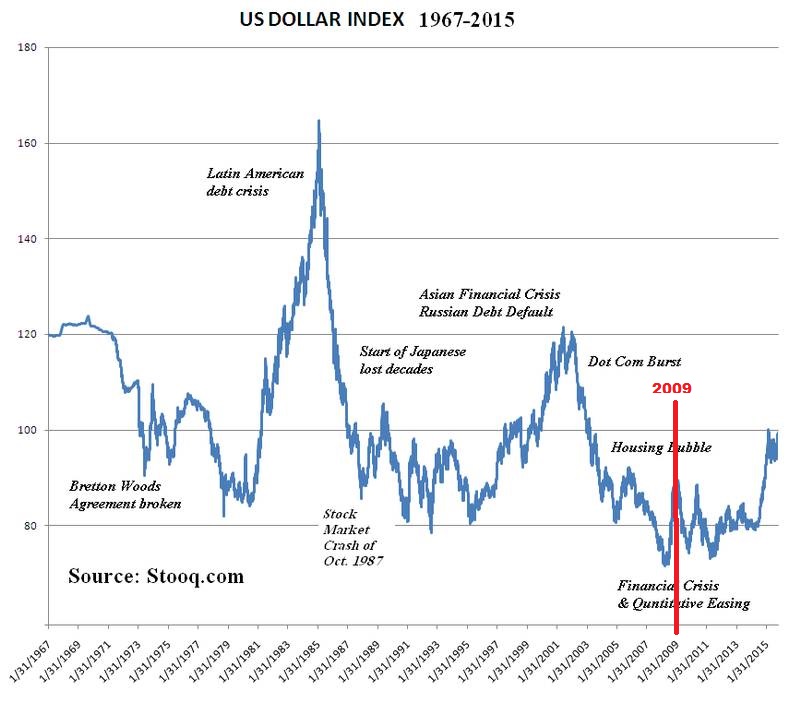
In 2009, while in the process of making the final edits to my book, The End of Money and the Future of Civilization, my editor took issue with my assertion that the declining value of the US dollar would continue indefinitely. He cited the increase in “value” of the dollar in the foreign exchange markets that was occurring at that time as evidence of my “error.”
I responded that the “value” of the dollar compared to other political currencies did not reflect its true value in relation to the real economy, i.e., what a dollar could buy, because all national currencies suffer from the same defects (improper and excessive issuance and the “growth imperative”), and virtually all of them are losing “purchasing power” because of it. The fluctuations in their market values relative to one another result from political and monetary policy decisions taken in their respective countries, not from any increase in their real value.
I argued that what the world has been experiencing in recent years is unprecedented. Never before in recorded human history has there been such a unitary system of money, banking and finance upon which the economies and peoples of virtually every nation of the world have come to depend.
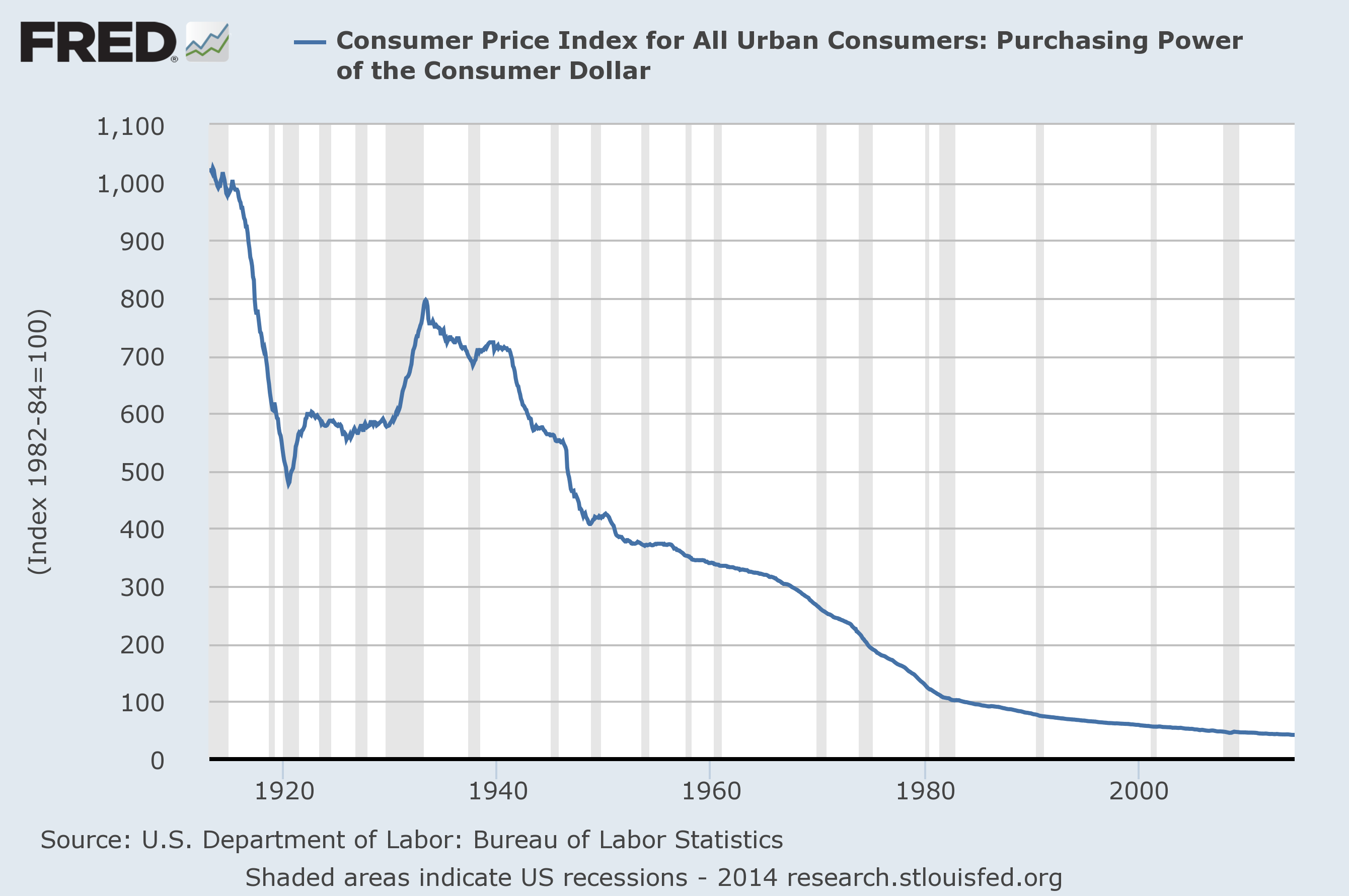
The long-term trends were, and remain, clearly evident and even worse than shown in the above graph. I referred my editor, among other things, to this Max Keiser video to drive home that point and to show that the Consumer Price Index (CPI) is being manipulated to make the decline in purchasing power look less bad than it actually is. Fortunately, that video is still available on YouTube. The mountain of evidence that has been accumulated during the years since the publication of my book has made it patently clear that my assertions were correct. The cost of living due to the debasement of the US dollar has not only continued to increase but has accelerated with the extreme measures that were taken during the pandemic years. Thus, the real value of the dollar, i.e., its purchasing power, has continued to decline even more rapidly than before, as indicated by the recent upturn in the CPI shown in the graph below.
If a strong dollar is in the interests of maintaining confidence and perpetuating the global system, the central banks of the western alliance will rally to support it. If currency inflation is causing prices to rise too rapidly in one place, the effects will be shifted to another place. In efforts to limit inflation overall, the productive sectors of the economy will be starved for credit, causing sound businesses to fail and more jobs to be sacrificed. People who have lost their livelihood are in no position to demand higher wages. Indeed, they will fight with one another to get whatever they can garner from a weakened economy. I argued at the time, and still maintain that the businesses that survive will be the huge corporations that enjoy favored treatment in receiving government bailouts and credit from banks and that those corporations will continue to grow ever larger through acquisitions, consolidations, and market dominance.
Cancer and the Debt Growth Imperative
One of humanity’s most dreaded diseases is cancer, which is tissue growth that has become uncontrolled and purposeless. It is growth of the wrong sort and in the wrong places which eventually kills itself as it kills the body of its host. Such has also been the nature of much of the economic growth that the world economy has experienced over the past many decades.
The debt-growth, economic-growth imperative that I have written so much about and summarized in The Usury Conjecture, can be visualized by thinking of the financial economy as a balloon that is attached to an air tank that is relentlessly filling the balloon with air. If you squeeze the balloon at one point to try to stop its expansion, it will simply bulge out somewhere else. In this analogy the air is debt, and the pressure in the air tank is generated by the interest that is applied to the “loans” that banks make to create fiat debt-money. The ever-growing debt must show up either in the private sector or in the public sector.
Those few who control the interest-based, debt-money regime have historically been given everything they’ve asked for to keep this flawed and destructive system alive. They have amassed enormous financial, economic and political power and are intent on owning and controlling everything. Nothing is sacrosanct; all will be sacrificed on the altar of Mammon because of this Faustian bargain between the money powers and the political powers that was struck centuries ago.
But despite the powerful tools at their disposal, they cannot forever avoid the inevitable. As the long-term negative trends continue and the symptoms become ever more severe, the people, communities, and independent producers who are adversely affected will get serious about rediscovering and inventing ways to escape. They will deploy their own honest and effective means of exchange and finance that will ultimately displace the old dysfunctional and destructive political system of money and finance.
Fortunately, the honest and effective systems of exchange and finance that I’ve long been describing in my books, The End of Money and the Future of Civilization, and Money: Understanding and Creating Alternatives to Legal Tender, are already available and are being employed at the margins of the economy. While their scale of operation is still relatively modest, it is inevitable that as improvements are made and their necessity becomes ever more evident, efforts to decouple from the dominant monetary and financial regime will continue to intensify, money banking and finance will be reinvented, and the chaos that now reigns will give way to a better world for all.
The first edition of my book, The End of Money and the Future of Civilization, was published by Chelsea Green Publishing in 2009. While it remains as relevant today as it was when first published the printed book has been out of print for several years. But, having had the rights reverted to me by my publisher, I am making the entire book available for free in PDF format. You can read it or download it HERE. If you would like a hard copy of the first edition used copies can still be found on Amazon.com, Abe books, Thrift books and elsewhere.
Better still, you can avail yourself of the new revised and expanded 2024 edition which I have been working on for almost two years and is almost complete. Eighteen chapters have already been posted and can be freely read or download HERE.
My previous books, as published, may be freely accessed in digital format by clicking the title below.




 Beyond Money