Monthly Archives: August 2024

Now published, Chapter 11—Credit Clearing, the “UnMoney”

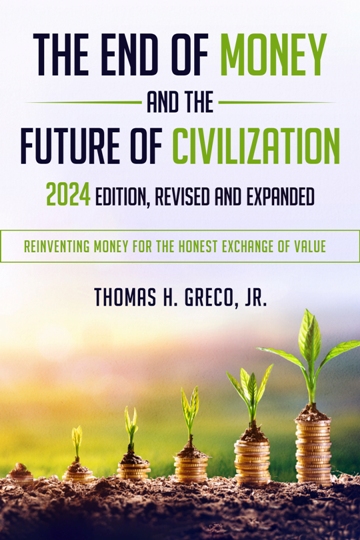
This is the latest chapter to be published of my new 2024 edition of The End of Money and the Future of Civilization. It continues the story about “credit clearing” that was begun in the previous chapter and shows how it will revolutionize trade and payments and make money, as we have known it, obsolete.  

Here is a brief excerpt:

If there were no money, any system of crediting sellers and debiting buyers would be fully competent to accomplish the work now performed by money. – Hugo Bilgram, 1914

In Chapter 10 we explained that the highest stage in the evolution of reciprocal exchange is “credit clearing,” and that banks have been using it for the past few hundred years to settle obligations amongst themselves.  In this chapter we will further describe the history and applications of credit clearing, and we will show how clearing can be used to offset claims among not only groups of banks, but also among any persons or entities that have financial claims against one another. Most significantly, it is a process that may be applied among buyers and sellers of goods and services to directly offset their respective claims without involving banks as middle-men and without the need for conventional bank- or government-created currencies.

Direct Clearing Among Buyers and Sellers

Credit clearing is actually an ancient process. During the Middle Ages, credit played a major role in the various European “market towns” which hosted, at regular intervals, trading fairs in which merchants from widely scattered areas would gather to trade their goods. It is reasonable to conclude that the process of credit clearing would have been fundamental in their trading activities. This is evidenced by the fact that these market towns typically provided market courts for settling disputes under “merchant law” that was separate from common law and could be adjudicated in a matter of hours or days. James Davis points out that, “At the pettiest level of sales credit, many traders appear to have acted both as creditors and debtors, and there is evidence for running accounts, reciprocal dealings and a ‘complex of claims and counterclaims,’” and that, “Credit oiled the wheels of trade, and market courts dealt in small-scale sales debts that were integral to local retail and wholesale commerce. A market court ostensibly lowered transaction costs and thus attracted more traders by aiding a perception of the market as ‘fair, affordable, efficient’”. 

The possibilities of direct credit clearing among buyers and sellers have long been recognized. In modern times, as early as 1914, Hugo Bilgram and L. E. Levy noted that, “If there were no money, any system of crediting sellers and debiting buyers would be fully competent to accomplish the work now performed by money.”  They further suggested that:

“Were a number of businessmen to combine for the purpose of organizing a system of exchange, effective among themselves, they could clearly demonstrate how simple the money system can really be made. The greater the number of businessmen that would thus cooperate, the more complete would be their own emancipation from the obstruction to commerce and industry which existing currency laws impose.”

They then went on to propose such a system and describe how it might operate, which I summarized in one of my previous books and in a website post.  I’ll not repeat that here because the context today is much different from what it was in 1914, but we will present a similar proposal based on what has since been learned and tailored to our current realities. I believe that it is no exaggeration to say that the creation and operation of such credit clearing systems is crucial to reversing the present trend toward economic ruin and global tyranny and changing the course toward realizing our human potential and the emergence of a peaceful, convivial civilization in which all can thrive.

You can read or listen to the entire chapter here.

Newsletter, August 2024 – Weathering the storm and emerging together

In this issue:

  • Breaking Together
  • Symbiotic Culture
  • Chapter 10, The Third Evolutionary Stage—The Emergence of Credit Clearing

Breaking Together

Jem Bendell, former professor and founder of the Initiative for Leadership and Sustainability (IFLAS) at the University of Cumbria (UK) has a highly credentialed background that is impressive by any measure. After a life changing experience, he embarked upon a different life path, delving deeply into diverse disciplines, including the latest climate science, that led to his writing, in 2023, his book, Breaking Together: A freedom-loving response to collapse, in which he summarized his startling conclusions:

“The collapse of modern societies has begun. That is the conclusion of two years of research by the interdisciplinary team behind Breaking Together. How did it come to this? Because monetary systems caused us to harm each other & nature to such an extent it broke the foundations of our societies. So what should we do? This book describes people allowing the full pain of our predicament to liberate them into living more courageously & creatively. They demonstrate we can be breaking together, not apart, in this era of collapse. Jem Bendell argues that reclaiming our freedoms is essential to soften the fall & regenerate the natural world. Escaping the efforts of panicking elites, we can advance an ecolibertarian agenda for both politics & practical action in a broken world.

Jem has since abandoned academia and his “illustrious career of delusion” in favor of a different path that embraces reality and includes practical decentralized actions of adaptation. Breaking Together is available as a free download, but if you would like to get a taste of it before plunging into his 500 page volume, I highly recommend that you listen to this two-part interview in which he quite articulately explains his main ideas, and how we can, by working together, adapt to the inevitable and ongoing collapse of our present version of civilization, and in the process build a better one. Interview Part 1; Part 2.

____________

Symbiotic Culture

The work of Richard Flyer puts my own work, and that of Jem Bendell and others within a more comprehensive and foundational context.

In a recent message, Richard Flyer alerts readers to a short video that he posted a couple years ago on his YouTube channel to explain his work of empowerment and societal change. By his own description, “It not only provides solid content about building Symbiotic Cultures and Networks, but it really captures the Spirit, enthusiasm, and hope we need now more than ever—the possibility and reality of Fractal Community Empowerment. It was released more than a year before the book Birthing the Symbiotic Age: An Ancient Blueprint for a New Creation came out on Substack as a weekly series. It shares many of the stories of on-the-ground grassroots movements I have been affiliated with, including San Diego, CA, and Reno, NV, as well as the Sarvodaya Shramadana movement of Sri Lanka – and their relevance today.”

I highly recommend that you take a few minutes to watch his inspiring message, and read the 2-minute synopsis of his book

____________

Chapter 10, The Third Evolutionary Stage—The Emergence of Credit Clearing

This is the latest chapter to be published of my new 2024 edition of The End of Money and the Future of Civilization. It continues the story begun in the previous chapter of how money has evolved and changed its character over time.

Here is a brief excerpt:

Money has become merely an accounting system, a way of “keeping score” in the economic “game” of give and take. Thomas H. Greco, Jr.

Let us begin by summarizing the evolution of the various kinds of money that have been used to mediate reciprocal exchange:

  1. The circulation of gold and silver coins gave way to paper banknotes that were redeemable for gold or silver coins, which made the notes essentially warehouse receipts for gold on deposit.
  2. Then, banks began to lend bank notes into circulation based on the pledge of collateral assets (some valuable and others not) other than gold, some of which included government obligations (bonds, notes, etc.).
  3. But ALL notes were redeemable in gold. This became known as the “fractional reserve banking” system.
  4. Bank account balances (checkable bank “deposits”) increasingly took the place of paper bank notes, and bank customers began to write checks against their deposits instead of using bank notes to make payments.
  5. As banks created ever greater amounts of non-bona-fide money based on national government debts and other illegitimate collateral assets, the fiction of gold-backing and redeemability could no longer be supported, and governments reneged on their promise to redeem their currency for gold. This broke the final link between political fiat money and the real economy of valuable goods and services.
  6. But, despite that, the emergence of credit clearing to offset credit obligation against credit claims was a major leap forward in facilitating the reciprocal exchange of value.

You can now read or listen to the entire chapter at Future Brightly:

Chapter 10—The Third Evolutionary Stage—The Emergence of Credit Clearing-Text

Chapter 10—The Third Evolutionary Stage—The Emergence of Credit Clearing-Audio narration

____________

The pieces are now all coming together. In what way will you participate in the great adventure?

Thomas

Now published, Chapter 10—The Third Evolutionary Stage—The Emergence of Credit Clearing

This is the latest chapter to be published of my new 2024 edition of The End of Money and the Future of Civilization. It continues the story begun in the previous chapter of how money has evolved and changed its character over time.

Here is a brief excerpt:

Money has become merely an accounting system, a way of “keeping score” in the economic “game” of give and take. Thomas H. Greco, Jr.

Let us begin by summarizing the evolution of the various kinds of money that have been used to mediate reciprocal exchange:

  1. The circulation of gold and silver coins gave way to paper banknotes that were redeemable for gold or silver coins, which made the notes essentially warehouse receipts for gold on deposit.
  2. Then, banks began to lend bank notes into circulation based on the pledge of collateral assets (some valuable and others not) other than gold, some of which included government obligations (bonds, notes, etc.).
  3. But ALL notes were redeemable in gold. This became known as the “fractional reserve banking” system.
  4. Bank account balances (checkable bank “deposits”) increasingly took the place of paper bank notes, and bank customers began to write checks against their deposits instead of using bank notes to make payments.
  5. As banks created ever greater amounts of non-bona-fide money based on national government debts and other illegitimate collateral assets, the fiction of gold-backing and redeemability could no longer be supported, and governments reneged on their promise to redeem their currency for gold. This broke the final link between political fiat money and the real economy of valuable goods and services.
  6. But, despite that, the emergence of credit clearing to offset credit obligation against credit claims was a major leap forward in facilitating the reciprocal exchange of value.

For now, you can read or listen to the entire chapter at Future Brightly:

Chapter 10—The Third Evolutionary Stage—The Emergence of Credit Clearing-Text
Chapter 10—The Third Evolutionary Stage—The Emergence of Credit Clearing-Audio narration

It will also be published soon here, and on my own Substack channel. Further chapters will continue to be posted as they are completed. Watch for Chapter 11 to be posted soon.

As always, your comments and suggestions are welcomed,
Thomas

Social Credit and the End of Meta-Feudalism

I am pleased to present this guest editorial by my long-time friend and correspondent, Christopher Quigley. Christopher in an expert in market analysis, and a proponent of the Social Credit philosophy of C. H. Douglas. I think you will find it useful.  —  T.H.G.

Excerpt:

Social Credit and the End of Meta-Feudalism

The King is dead long live the King” so goes the feudal aristocratic mantra establishing power continuity. Death and birth are a part of reality and amidst the pain of death the love of life must prevail. Currently many say that American society is dying but in fact it is experiencing a transformation.  
—  Major Clifford Douglas

The quote above, made in 1934, perhaps would have been more correct if Douglas had said that America was going through a “paradigm shift” rather than a transformation. This shift was in essence a revolution at the time, a revolution based on growing consciousness, labour unrest, social dysfunction and expanding poverty. Today this trend is still emerging with other forces driving the trend, forces such as the growth of internet learning networks and the diminished effectiveness of mass broadcasting. Thus, average Americans are finally starting to think as sovereigns again. Their enlightened thinking had stopped following the disaster of the civil war of 1861-1865. This national cessation of practical awareness allowed the then Federal micro-system to usurp the Union macro-system through credit power. As a result, today the Federal Government is now macro, and the Union of States micro, but this could change over the next 50 years.

The global elites want the real American economy to contract. They desire a constrained and hobbled society which is more dependent and demanding, more complex, more controlled, more diverse, more fractured, more locally ineffective— In a word, meta-feudal. To understand a world that is meta-feudal you should watch movies such as “Brazil,” “Rollerball,” and “Blade Runner.” These worlds are technologically advanced but disintegrated and astonishingly unequal.

The meta-powers work through fabricated “crises.” The elite set up the last economic “crisis” through the “originate to distribute” Basel banking agreement of 1998. From this model evolved the hyper property bubble of post-2000, the “credit” collapse of 2007-2008, and the market-fixing credit derivative system and asset laundering off-balance-sheet accounting protocols currently in place. The credit collapse eventually led to the new “improved” post-Covid, bailed-out banking oligarchy now in place. This club involves far fewer players than existed heretofore but the financial club that is in power is now manifestly more globally influential.

Please read the entire editorial HERE.