It has long been my position that a real alternative to fiat money as a means of payment requires reclaiming the “credit commons,” i.e. establishing community control over credit. It is producers and sellers of real value who are the ones who are actually qualified to issue a currency into circulation. They can do so individually by using their own private voucher currencies redeemable for the goods and services they are ready, willing, and able to provide, or they can do it in cooperation with others by pooling their commitments and jointly issuing a common voucher currency. Such a currency can then circulate generally for other to use to pay one another instead of using dollars. Euros, pounds, or other government fiat currencies.
My paper titled, Invoice Factoring as the Basis for a Digital Token Currency, presented at the RAMICS Conference in Rome on November 6, 2024, describes how that can be achieved by creating a digital token currency that, unlike present-day crypto currencies, is based on, and redeemable for real goods and services. This presentation describes the structure, processes, and protocols for creating and circulating a digital voucher token currency on a continuous recurrent basis. I’ve summarized my proposal in this 12-minute video posted on YouTube.
This column first appeared in The San Francisco Chronicle on May 27, 1973 and was reprinted July 22, 1999
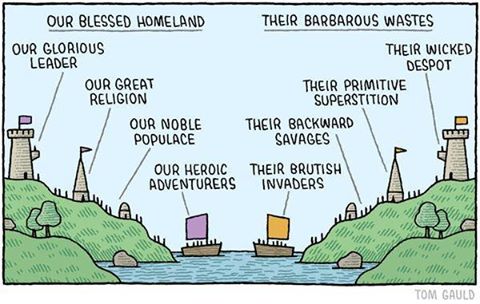
Once upon a time there was a country that was very small and, on the whole, very good.
Its citizens were proud and independent and self-reliant and generally prosperous. They believed in freedom and justice and equality. But, above all, they had faith. They had faith in their religion, their leaders, their country and themselves.
And, of course, they were ambitious. Being proud of their country, they wanted to make it bigger. First they conquered the savage tribes that hemmed them in. Then they fought innumerable wars on land and sea with foreign powers to the east and west and south. They won almost all the battles they fought and conquered foreign lands.
It took many generations, but at last the good, little country was the richest, mightiest nation in the whole, wide world — admired, respected, envied and feared by one and all.
“We must remain the mightiest nation,” said its leaders, “so that we can insure universal peace and make everyone as prosperous and decent and civilized as we are.”
At first, the mightiest nation was as good as its word. It constructed highways and buildings and pipelines and hygienic facilities all over the world. And for awhile, it even kept the peace.
But being the mightiest nation in the world, its leader was the mightiest man in the world. And, naturally, he acted like it.
He surrounded himself with a palace guard of men chosen solely for their personal loyalty. He usurped the powers of the Senate, signing treaties, waging wars and spending public funds as he saw fit.
When little countries far away rebelled, he sent troops without so much as a by-your-leave. And the mightiest nation became engaged in a series of long, costly, inconclusive campaigns in far away lands. So some disillusioned soldiers refused to obey orders and some sailors mutinied, even though the leader raised their pay. And in some places the mightiest nation hired mercenaries to do its fighting.
And because it was the richest nation, it worshiped wealth and the things wealth bought. But the rich grew richer and the poor grew poorer through unfair tax laws. And in the capital 1 in 5 were idle and on welfare.
When the poor grumbled, they were entertained by highly paid athletes and the firing of expensive rockets into the air which sometimes fizzled. But the poor often rioted and looted and burned in their frustrated rage.
Many citizens lost faith in their old religion and turned to Oriental mysticism. And the young, wearing long hair and sandals, became Jesus freaks. Bare-breasted dancers, lewd shows and sex orgies were increasingly common. And the currency was debased again and again to meet the mounting debts.
Worst of all, the citizens came to learn their leaders were corrupt — that the respected palace guard was selling favors to the rich and sending spies among the people, creating fear and distrust.
So it was that the people lost faith. They lost faith in their leaders, their currency, their rockets, their postal system, their armies, their religion, their laws, their moral values, their country and, eventually, themselves.
And, thus, in 476 A.D., Rome fell to the barbarians and the Dark Ages settled over Western civilization.
Moral: For what is a nation profited if it shall gain the whole world and lose its own soul.
Chapter 16 is the latest Chapter in my new updated and expanded edition of The End of Money and the Future of Civilization. The link to this chapter is now listed along with the other previously published chapters on the book page along with links to the audio narrations by Ken Richings. Scroll down to find Chapter 16 there or click here to go directly to the PDF file.
Here are the Chapter contents:
Figure 16.1 A Typical Small Boat Harbor (Drawing by Dennis Pacheco)
The Orthodox Approach to Community Economic Development
A Comprehensive Community Economic Development Plan
Stage I: Map the Local Actors and Assets & Promote Import Substitution
Stage II: Support Structures for Localization—Saving, Investment, Finance, and Education
Stage III: New Liquidity Through Trust—Mutual Credit as a Way to Pay How It Works Key Benefits The Generation and Allocation of Trade Credits
Stage IV: The Credit of “Trusted Issuers” Can Provide a Local Alternative Currency for General Circulation
Stage V and Beyond: Transition to an Objective Measure of Value and Unit of Account
If the BRICS ever hope to escape the orbit and dominance of the Western Empire they will need to organize an international clearing Union under their own control, along the lines of the Bancor proposal of John Maynard Keynes which he put forth in 1944 at the Bretton Woods conference. If that proposal had been adopted it might have saved the world 80 years of grief and violent conflict.
Further pertinent information from Alistaire Crooke
The first edition of my book, The End of Money and the Future of Civilization, was published by Chelsea Green Publishing in 2009. While it remains as relevant today as it was when first published the printed book has been out of print for several years. But, having had the rights reverted to me by my publisher, I am making the entire book available for free in PDF format. You can read it or download it HERE. If you would like a hard copy of the first edition used copies can still be found on Amazon.com, Abe books, Thrift books and elsewhere.
Better still, you can avail yourself of the new revised and expanded 2024 edition which I have been working on for almost two years and is almost complete. Eighteen chapters have already been posted and can be freely read or download HERE.
My previous books, as published, may be freely accessed in digital format by clicking the title below.



 Beyond Money