Category Archives: Banking

British MP George Galloway exposes the culprits and their geopolitical “crimes against humanity”

Six times elected to the British Parliament, now running for Mayor of London, George Galloway, in this video interview lays the truth on the line, describing the “crimes against humanity” that continue to be perpetrated by financial capitalists and their top-level political minions all around the world.

Wave of Action to focus on central banks


There are instances where demonstrations can be useful, at least in raising public consciousness. Most people in Western countries are still delusional about money and politics. As David DeGraw puts it “democracy” is an illusion for propagandized minds.

The reality is that our political systems have been captured by elite bankers who are bent on concentrating ever more power and wealth in their own hands. DeGraw is calling for a worldwide Wave of Action to focus attention on central banks, the institutions that are the primary instruments of control over money and economics. He says, “On June 20th, we will rally at US Federal Reserve banks, the Bank of England and central banks worldwide to focus mass consciousness on the crimes against humanity perpetrated by global bankers.”

Read his call and join the ‘wave” here.

A Monetary Reform Proposal for Iceland

I have recently received from several sources word of a new monetary reform proposal. This one, commissioned by the Prime Minister of Iceland, is titled, MONETARY REFORM A BETTER MONETARY SYSTEM FOR ICELAND, and is authored by Frosti Sigurjonsson.

I’ve taken the time to read only the Overview and summary portion, but that is sufficient to discern the crux of the Sigurjonsson proposal, which is this:

The Central Bank will be exclusively responsible for creating the money necessary to support economic growth. Instead of relying on interest rates to influence money creation by banks, the Central Bank can change the money supply directly. Decisions on money creation will be taken by a committee that is independent of government and transparent in its decision-making, as is the current monetary policy committee.

New money, created by the Central Bank, will be transferred to the government and put into circulation in the economy via increased government spending, by reduction in taxes, by repaying public debt or by paying a citizen dividend.

The Central Bank will also be able to create money for lending to banks for onward lending to businesses outside the financial sector.

Sigurjonsson indicates that his proposal draws heavily upon an earlier proposal titled, A Monetary Reform for the Information Age, by Joseph Huber and James Robertson (New Economics Foundation (2001)), which I critiqued early in 2002. That critique, along with subsequent dialog between the authors and myself, can be found at http://reinventingmoney.com/monetary-reform-information-age/.

Since both the Sigurjonsson proposal or the Huber/Robertson proposal advocate the same basic approach, I strongly believe that any serious consideration of either, should also consider my above mentioned earlier critique and subsequent dialog.

While I agree with much of what Huber and Robertson (and presumably, Sigurjonsson) say about the defects in the present money system, I believe that their proposed centralized “solution” does not go nearly far enough in solving those defects. Continuation of the money monopoly in (presumably) different hands does not get to the root of the problem. It is my view that the key to achieving more equitable and sustainable economic interrelationships lies in liberating the exchange process from monopolized money and banking, enabling the creation of competing currencies and credit clearing exchanges, and allowing the needs of traders themselves to determine the supply of exchange media (money) in circulation at any given point in time.

#     #     #

The scam that is the global money system

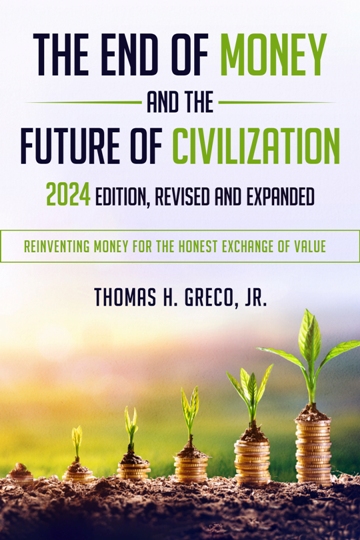
It is a story that I have told in my own writings and presentations, particularly in my book, The End of Money and the Future of Civilization, but the video below is well worth viewing. I’ve not been a big fan of Glen Beck, and I abhor the Fox network, which I consider to be a propaganda instrument of the global elite, but this particular program is ironically quite good at telling the story of the creation of the Federal Reserve, the banking cartel, and the collusive arrangement between the bankers and the politicians (that pattern was actually established with the founding of the Bank of England in 1694). Beck’s featured guest, G. Edward Griffin, the author of The Creature From Jekyll Island, is particularly astute in his observations. The conversation only goes astray toward the end when it turns to gold backing, a proposal that is based on a still naive conceptualization of what money is and how it works.

Interestingly, Beck was fired by the Fox network shortly after this program aired, presumably for exposing the scam of the elite cabal that Fox is there to serve.

Canadian court ruling–a solid punch to the private central bankers?

In the video below, Bill Still reports on a recent court ruling that could, if it is upheld, stagger the global banking cartel.

http://youtu.be/40Jz0LPQAQY

Bank of Japan announces plan for massive inflation of the Yen, as US Fed curtails dollar monetization (QE). What does it mean for you?

A recent article in the Guardian (UK) reports that the Japanese central bank has announced plans to “inject ¥80tn (£447bn) a year into the financial system, mainly through the purchase of government bonds, in a bid to ward off the threat of deflation.”

Thus, Japan takes over much of the burden of keeping a flawed global money system alive, as the US central bank (the Federal Reserve) ends its own program of dollar inflation.

Bloomberg provides a “quick take” on the FED policy saying, “It was the biggest emergency economic stimulus in history and now it’s over. The U.S. Federal Reserve’s once-in-a-lifetime program to buy immense piles of bonds, month after month, in an extraordinary effort to restart a recession-deadened economy came to an end in October after adding more than $3.5 trillion to the Fed’s balance sheet – an amount roughly equal to the size of the German economy. The bond-buying program, called quantitative easing or QE, had been controversial since its start in 2009, as had the Fed’s decision in 2013 to gradually reduce the monthly economic boost, a plan that became known as the taper. Whether the Fed tapered too soon, given global economic weakness, or too late, given signs of bubbles in some markets, was hotly debated. But even after the taper’s end the Fed continued to pump support into the economy the old-fashioned way, by holding its interest rates near zero.”

As I’ve pointed out before, “Quantitative easing” is simply a euphemism for inflation of the currency (mainly by central banks buying government bonds and other uncollectable debt). Other things being equal, currency inflation eventually leads to price inflation. But other things are not equal. The US has indeed seen significant inflation of prices in some sectors, especially food, but other prices are being kept down, primarily because of layoffs and underemployment, leaving consumers with lower incomes and reduced purchasing power. If income from wages and interest on savings are held down, people must either do without or borrow more money to maintain their levels of spending. The following table from the Federal Reserve shows the growth in consumer credit over the past few years.

Consumer Credit Outstanding ($ Billions)
2009 2010 2011 2012 2013 2014
As of 8/31
2,552.8 2,647.4 2,755.9 2,923.6 3,097.9 3,225.3

These figures cover most short- and intermediate-term credit extended to individuals, excluding loans secured by real estate.

Those figures show a more than a 26% increase in consumer credit just over the past four and one half years, much of it high-interest credit card debt. Although credit card debt has declined somewhat from its 2009 peak, according to nerdwallet.com, falling indebtedness is largely due to defaults rather than repayment.

The same site reports that, in total, American consumers owe:

  • $11.63 trillion in debt, an increase of 3.8% from last year
  • $880.5 billion in credit card debt
  • $8.07 trillion in mortgages
  • $1,120.3 billion in student loans, an increase of 11.5% from last year

Central banks find currency inflation necessary in order to offset the reductions in the money supply caused by charging interest on money that banks create when they make “loans.” There is never enough money in circulation to enable repayment of the aggregate of principal plus accrued interest of money created as bank “loans.” Thus the “natural” tendency of the usury-based debt-money system is toward deflation. Central governments then must become the borrowers of last resort and central banks become the lenders of last resort as bankers and politicians continue their absurd dance that is a death spiral of recurrent and ever more extreme financial crises.

The real solution to our monetary, financial, and economic problems is to end the usury-based debt-money system. But the bankers, the rulers of the world, will not stand for that. By control of the money creation process, they have extended their power to tightly control the political process, as well. Thus, the wealth and purchasing power of the vast majority of people will continue to decline as the system continues to pump up the wealth and power of the few who control the money system, and their minions.

According to the Fed, between 2010 and 2013, “mean (overall average) family income rose 4 percent in real terms, but median income fell 5 percent, consistent with increasing income concentration during this period.” And “Families at the bottom of the income distribution saw continued substantial declines in average real incomes between 2010 and 2013, continuing the trend observed between the 2007 and 2010 surveys.”

So, what can people and communities do to counter these trends and regain control of their economic fortunes and enhance their political power?

Considering the dynamics of power that prevail in the so-called democratic countries today, reliance on the political process to effect systemic reforms seems futile. So, while it is necessary to continue to protest the status quo and reframe the political dialog, it is even more important to take action to rebuild society from the bottom upward. We must reduce our dependence upon the very systems that are being used to disempower us, of which the political money system is foremost.

That is not so daunting as it might first appear, and conceptually it is not very complicated. It is what my work of the past quarter century as been all about. The biggest difficulties have had to do with dispelling erroneous myths about money and banking and helping people to see beyond the orthodox. This, and the lack of adequate tools have retarded the process of taking promising alternatives to scale, but that is quickly changing as new technologies that enable moneyless trading become available.

But don’t sit idly by waiting for things to happen “out there.” Start with your own personal development and empowerment, while working to strengthen your various communities and networks, your city, state, and region. Some tips to get you started can be found here. –t.h.g.

#     #     #

Mobile money transfers in Kenya help the poor and unbanked

M-Pesa, is a mobile-phone based money transfer service that was started up in Kenya 2007.  Since then it’s usage has grown by leaps and bounds. This recent article provides a thorough understanding of how it works and the benefits it provides: 10 Myths About M-PESA: 2014 Update.

Dollar decline accelerates as political alliances are being reshaped

Whether you’re a Democrat, Republican, Independent, Green, LaRouchite, or consider yourself apolitical, you need to pay attention to what is happening on the money and banking front, because that is the realm in which World War III is now being fought.

We can’t afford to tune out messengers that wear a different party label or with whom we might disagree on other issues. Listen carefully to what Ron Paul has to say in this Alex Jones interview and use your common sense to separate the “wheat from the chaff.”

http://youtu.be/yDSX3XvqkjE

How do central banks control interest rates?

Question: How do central banks control interest rates?

Answer: By creating counterfeit money.

Of course, they will never admit that. They see their “purchases” of debt instruments, mainly those of governments, as being legitimate. But such purchases violate sound monetary principles, and even their legality is questionable.

The obvious question that must be asked is “Where do central banks get the money with which to buy those debt instruments?” The answer is, they do not “get” the money, they create it–by fiat. This is  their celebrated “quantitative easing,” which is actually currency inflation. The new “high powered money” thus created puts new “reserves” into the banking system, which banks use to multiply their own purchases of government bonds and other assets.

Without this “monetization” of debts by the banking system, newly offered debt instruments, like government bonds, would have to offer higher rates of interest to attract buyers from the general public.

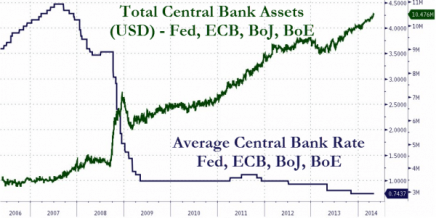
Interest rates on the ever-increasing amounts of sovereign debts can only be kept low by this sort of central bank intervention. As I put it, central banks are the “buyers of last resort” for bonds that cannot be sold at artificially low rates of interest. The chart below show just how desperate the situation has become since the financial crisis of 2008.

Interest Rate Elephant In The Room


Initially, however,  in the case of the Fed, the purchases were of “junk” that the banks had created during the real estate bubble. That was the bailout that saved the banks but put the squeeze on people through foreclosures, layoffs, and loss of income on their savings.

As shown in this chart and others I posted previously, all he major central banks are doing the same thing, so foreign exchange rates are not too adversely affected–yet. But keep your eye on Brazil, Russia, India, China, and other countries that show signs that they may not be willing to play along./ t.h.g.

An open letter to the Financial Times

Dear Martin Wolf,
Your article, Strip private banks of their power to create money, highlights some of the problems of the global money and banking system, but falls short in the proposed solution.

The problem is not private money creation, per se, but the monopolization of credit (money creation) in the hands of a private banking cartel and the collusive arrangement between bankers and politicians.

In today’s world, banks get to lend our collective credit back to us and charge interest for it while central governments get to spend more than they earn in overt tax revenues, relying on the banking system to monetize government debts. These two parasitic drains on the economy, interest and inflationary government debt monetization, create a growth imperative that is destroying the environment, shredding the social fabric, and creating ever greater disparities of income and wealth.

Turning over the money monopoly to politicians (what I call the “Greenback solution”) will not change things very much. It will be the same people wearing different hats. The political process has been so thoroughly corrupted and taken over by this small elite class that political approaches to solving the money problem have no chance of passage anyway. I articulated that argument a few years ago in my Alternet article, The End of Money: Take Power Back From the Money and Banking Monopoly.

True solutions must emerge, and are emerging, from society and from associations of small and medium-sized businesses. Money is first and foremost a medium for facilitating the exchange of goods and services and other forms of real value, but the exchange function can be effectively and efficiently provided outside the banking system and without the use of conventional political money. This is being done for associated businesses through credit clearing exchanges and through the issuance of private currencies or vouchers by businesses that produce real value. Both approaches have the capacity to provide exchange media that can be used by general public as well.

So, rather than ban private issuance of currencies, such private issuance needs to be proliferated and encouraged. There needs to be competition in currency so that there will be a sufficient amount of exchange media, and so that political currencies cannot be abused without losing patronage in the market. Rather than establishing the state as the money power, we need to have a separation of money and state. That argument is more fully developed in my latest book, The End of Money and the Future of Civilization.

Best wishes,

Thomas H. Greco, Jr.