Category Archives: Basic Concepts

New Pages on Credit Clearing Basics

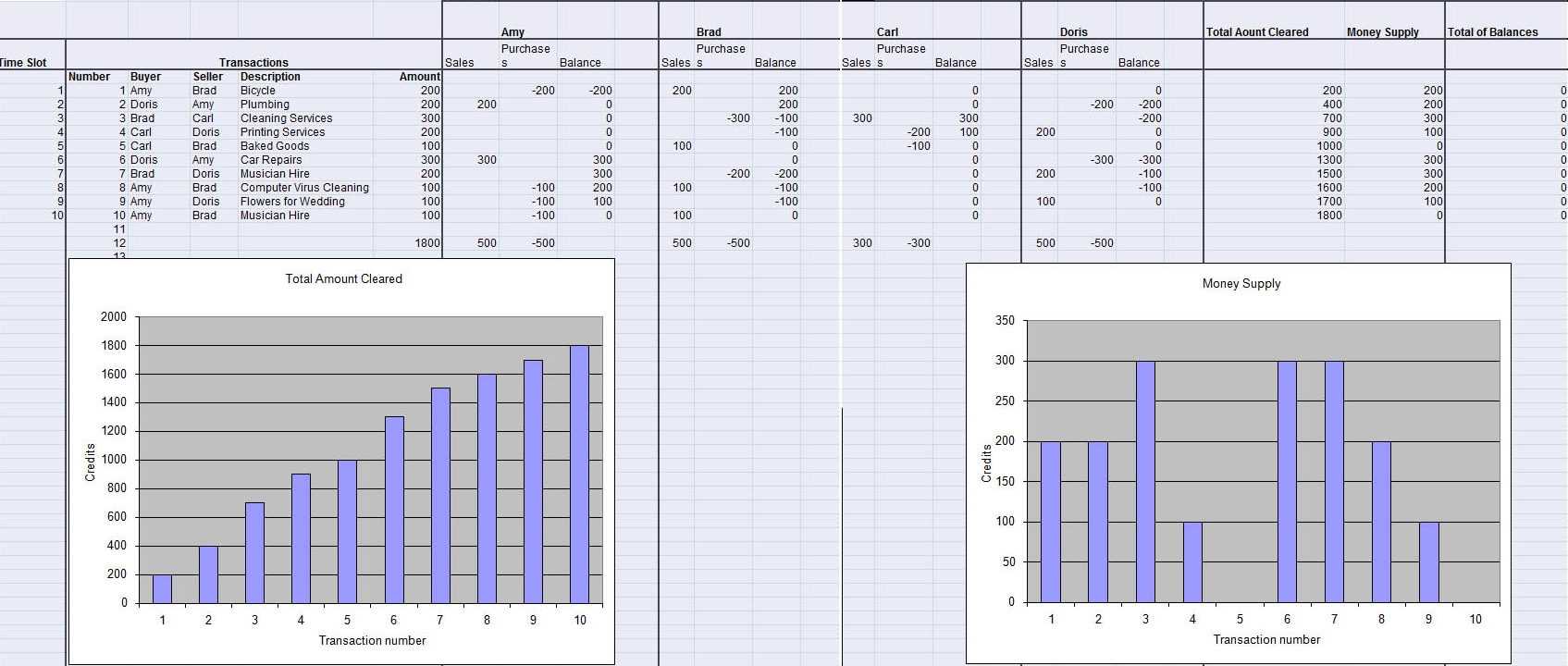
I’ve created a new page here that uses a simple illustration to explain the credit clearing process. It is listed here to the right under Pages,” “New Chapters.”

Central Banking, Usury, and the Growth Imperative

It seems a difficult thing for people to accept, but the present global debt-money system contains within it a growth imperative. Because money is created by banks as interest-bearing loans, debt grows exponentially as time goes on (the compound interest formula is exponential).

How is it possible for every debtor to pay their loans WITH INTEREST when the money supply does not grow except by the creation of more debt by the banks?

Every actor in the economy must then compete for that insufficient supply of money in order to keep from defaulting. Hence, they must do all they can to expand production, sales, and profits. They must control their markets, both markets in which they sell their products and markets in which they buy their inputs.

That is why the environment is being destroyed, the social fabric is being torn asunder, and the economic product is being increasingly maldistributed. This monetary system REQUIRES that there be many losers.

Under central banking, there are two choices:
1. Keep the money supply pumped up by making additional credit (money) easily available, or
2. Let the economy contract as defaults mount.

The first leads to hyperactivity and inflation. This hurts those on fixed incomes.
The second leads to depression. This hurts small businesses and those who have little financial net worth and live from paycheck to paycheck.

The central banking usury system puts us between a rock and a hard place.

Interest (usury) between two parties to a loan is one thing; interest built into the foundation of a credit-based monetary system is quite another.

There’s a good economic reason why three major religions (Judaism, Christianity, and Islam) have banned usury. Now the economists need to understand it.

First Report From California – Addendum – Sources & Resources

Sources and Resources on Money and Exchange Alternatives

Compiled by Thomas H. Greco, Jr.

P.O. Box 42663 * Tucson, AZ 85733 * Email: thg@mindspring.com

Key Concepts

Credit clearing

Credit clearing is the process by which credits arising from sales are used to directly offset debits arising from purchases without the use of conventional money. This process takes place within an organized circle of associated trading partners. In accounting terminology, Accounts Receivable are offset against Accounts Payable.

Monetization

Monetization is the process of converting the value of fixed collateral assets into credit that can be spent. In conventional banking, a bank monetizes the value of collateral assets when it creates a deposit by granting a loan. For example, when a bank grants a mortgage, it essentially converts the value of a house into a demand deposit that the borrower can then spend. The process of monetization can also be effected within a credit clearing circle when a member is granted a line of credit or overdraft privilege based on the goods and services they offer for sale.

Websites and Blogs

Reinventing Money: http://www.ReinventingMoney.com
Community Information Resource Center: http://circ2.home.mindspring.com
Beyond Money Blog: https://beyondmoney.wordpress.com
Tom’s News and Views: http://tomazgreco.wordpress.com

The Infography about Community Currencies: http://www.infography.com/content/507632641358.html

The Online Database of Complementary Currency Systems Worldwide. Stephen DeMeulenaere, Complementary Currency Resource Center. http://www.complementarycurrency.org/ccDatabase/les_public.html

Community Exchange System. South African New Economics Network (SANE). A web-based currency exchange platform and network. http://www.ces.org.za/index.asp

Books – Primary (mostly available at the website http://www.ReinventingMoney.com)

Greco, Thomas H., Jr., Money: Understanding and Creating Alternatives to Legal Tender. Chelsea Green Publishers (VT), 2001.

—, New Money For Healthy Communities. Thomas H. Greco, Publisher, P.O. Box 42663, Tucson, AZ 85733, 1994.

—, Money and Debt: A Solution to the Global Crisis. Second edition, Thomas H. Greco, Publisher, P.O. Box 42663, Tucson, AZ 85733, 1990.

Riegel, E. C., Private Enterprise Money. New York: Harbinger House, 1944.

—, The New Approach to Freedom. San Pedro, CA: The Heather Foundation, 1976.

__, Flight From Inflation. San Pedro, CA: The Heather Foundation, 1978.

Private Enterprise Money is out of print but may be found online through our website, http://www.ReinventingMoney.com.

The other two books by E. C. Riegel may be obtained from Mike Aldana at the E.C. Riegel School of Money, 1430 Mountain View Lane, Idaho Falls, Idaho 83402. Phone 208-522-5050. The prices are $12 for one book, $22 for two, plus postage and handling of $4 for one book, $1 more for each additional book. Acceptable payment forms are cash, check, or money order only.


WIR and the Swiss National Economy. Beard, Philip, trans. Philip Beard and Tobias Studer. Available at http://www.lulu.com/phbeard.

Other

Jacobs, Jane, Cities and the Wealth of Nations: Principles of Economic Life. New York: Vintage Books, 1985.

Kennedy, Margrit, Interest and Inflation Free Money. New Society Publishers, 1995.
http://userpage.fu-berlin.de/~roehrigw/kennedy/english/

Linton, Michael, and Thomas Greco, “The Local Employment and Trading System.” Whole Earth Review, No. 55, Summer 1987.

Modern Money Mechanics. Federal Reserve Bank of Chicago, 1992. Online at http://www.ReinventingMoney.com

Timberlake, Richard H., and Kevin Dowd (eds.), Money and the Nation State. New Brunswick, NJ: Transaction Publishers, 1998.

Zander, Dr. Walter, “A Way Out Of The Monetary Chaos”. From The Annals of Collective Economy, Geneva, 1938.

Available at http://www.reinventingmoney.com/zanderChaos.php

Zander, Dr. Walter, “Railway Money and Unemployment.” From The Annals of Collective Economy, Geneva, 1934.

Available at http://www.reinventingmoney.com/zanderRailway.php

Video Documentaries

Money as Debt by Paul Grignon. Website: http://www.moneyasdebt.net/

http://video.google.com/videoplay?docid=-9050474362583451279&q=%22money+as+debt%22&hl=en

Money: Who creates it? Who controls it? Who profits? A film by Isaac Isitan. Les productions ISCA, Montreal, Quebec. http://www.lesproductionsisca.ca

The Money Masters. http://www.themoneymasters.com/. 1-888-the-plot

Pertinent Quotes

When businessmen resolve to set up a money system, they agree to hold in trust for each other goods and services that are pledged against the drafts which they have issued in the form of money. These values—that are held in trust by all for any who may present a money draft therefore—constitute a vast pool, not housed at one place, but scattered throughout the trading sphere. This vast pool of goods and services is the basis or backing for the outstanding money supply. “Reserves” and metal hoards are but window dressing. Only that which is purchasable is back of money.

– E. C. Riegel, Private Enterprise Money, Chapter 6.

Should We Go back to Using Gold as Money?

Many people these days are arguing for a return to using gold (or silver) as the primary exchange media.

This would be a mistake.

While commodities like gold or silver may have a role to play in defining the unit of measure of value, to revert to using such commodities as means of payment would create more problems that it would solve. (Part III of my book, Money and Debt explains the need to segregate the typical monetary functions and shows how to do it).

Credit money is a higher stage of evolution than commodity money (including gold and silver). For more on this, see my slide show on the Evolution and Transformation of Money.

Just because credit money has been monopolized and perverted, that is no reason to abandon it and revert to more primitive forms. Credit money instead needs to be liberated and perfected.

Demanding gold as payment means you are not willing to trust your trading partners. Sure, that trust must be well considered. It should be based on relationship history, past performance, prudent judgment, and a willingness to take some risk. By organizing this process within credit clearing association, we can liberate the “credit commons” and mitigate the risks of default, while at the same time, reducing our dependence upon the dysfunctional political money and banking system.

An Annotated Précis, Review, and Critique of Prof. Tobias Studer’s WIR and the Swiss National Economy by Thomas H. Greco, Jr. and Theo Megalli

An Annotated Précis, Review, and Critique of WIR and the Swiss National Economy by Prof. Tobias Studer (translation by Prof. Philip Beard).

This is a summary and discussion of important points relating to the operations of the Swiss WIR Bank.

Dr. Studer’s book was originally written in German under the title, “WIR in unserer Volkswirtschaft”

Point and Counterpoint on Economic Exchange

Cash is scarce.
Credit is abundant.

Cash comes from banks.
Credit is something we can give each other.

Why ask for payment in the form of something we DON’T control when we can pay each other using something we DO control.

Actually, goods and services pay for other goods and services in the process of reciprocal exchange. Money is just an intermediary device we use to overcome the “barter limitation.”*
Money bridges a gap in time and space so that reciprocity can be achieved in the normal course of commerce.

Is there another way to bridge the gap?

Everyone is both a consumer and a producer, both a buyer and a seller.

Mutual credit provides the “space” within which wants and offers can find each other. It addresses the question, When, and from whom, can the desired item be found? This space is what I call “the credit commons.”

All it takes is organization — a way to “clear” debits arising from purchases against credits arising from sales.

How can goods and services pay for other goods and services without using money?
Not with primitive barter, but through an evolved process called credit clearing.
This is the service that both commercial “barter” companies and grassroots LETS systems provide.

Just as the present networking of personal computers on the internet provides unprecedented power for peer-to-peer communications and access to information, the outlook for the future is for networks of credit clearing services that provide easy and efficient non-cash payment possibilities for all kinds of purchases and sales.

* Barter is a trade between two parties in which each one is simultaneously both a buyer and a seller. Each has something the other wants. A swap is made, and each is satisfied. This coincidence of wants is unusual; that’s why money was invented.

t.h.g. September 28, 2006