Category Archives: The Political Money System

US following Greece to financial hell

This video by Peter Schiff gives a pretty good explanation of the parallels between Greece’s current dilemma and the  disaster that will eventually overtake Americans.

Unfortunately, neither Schiff nor anyone else in the financial spotlight is talking about the only real solution, which is to end the debt imperative and the growth imperative by taking usury/interest out of the money system. It needs to be recognized that the entire system of global money, banking, and finance is bankrupt and cannot be sustained. I wrote about that more than twenty years ago in my first book, Money and Debt: A Solution to the Global Crisis which can be downloaded for free.

The Global Economic Crisis–a deeper look

Here’s a book that seems to get to the root of the matter. I’ve only read the Preface, but it seems to offer worthwhile insights into the dimensions of the geo-political juggernaut. It may be lacking in solutions, but hopefully my own books help to fill that gap. — t.h.g.

The Global Economic Crisis: The Great Depression of the XXI Century

Michel Chossudovsky and Andrew Gavin Marshall (Editors)

Montreal, Global Research Publishers. Centre for Research on Globalization (CRG), 2010.
ISBN 978-0-9737147-3-9   (416 pages)

PREFACE

In all major regions of the world, the economic recession is deep-seated, resulting in mass unemployment, the collapse of state social programs and the impoverishment of millions of people. The economic crisis is accompanied by a worldwide process of militarization, a “war without borders” led by the United States of America and its NATO allies. The conduct of the Pentagon’s “long war” is intimately related to the restructuring of the global economy.

We are not dealing with a narrowly defined economic crisis or recession. The global financial architecture sustains strategic and national security objectives. In turn, the U.S.-NATO military agenda serves to endorse a powerful business elite which relentlessly overshadows and undermines the functions of civilian government.

This book takes the reader through the corridors of the Federal Reserve and the Council on Foreign Relations, behind closed doors at the Bank for International Settlements, into the plush corporate boardrooms on Wall Street where far-reaching financial transactions are routinely undertaken from computer terminals linked up to major stock markets, at the touch of a mouse button.

more…

Senate rejects bid to audit the Federal Reserve

Why are we not surprised? Senators voted down the Vitter Amendment to audit the Fed, 62 to 37.

Who does your senator work for?

Wall Street Financial Rapists Try to Stay Hidden

In an interesting turn of events, Bloomberg News has filed a suit that would require the Fed to release details of where $2 trillion of bailout money went. Now the banks are trying to block a court order that would force release of that information. You can read all about it in this article:

Banks Threaten To Go To Supreme Court To Prevent Fed From Disclosing Details Of $2 Trillion In Bailout Loans They Received

U.S. Likely to Move from Fractional Reserve Banking to No-reserve Banking

Fed Chairman, Ben Bernanke is calling for an end to bank reserves.

In the footnotes of a speech U.S. Federal Reserve Bank Chairman Ben Bernanke would have given to the House Financial Services Committee on Feb. 10, lies a unique and startling disclosure.

Hosted on the Federal Reserve’s own servers, the written testimony of the bank’s chairman explains in plain text what expanding the Fed’s powers will do.

“The Federal Reserve believes it is possible that, ultimately, its operating framework will allow the elimination of minimum reserve requirements, which impose costs and distortions on the banking system,” footnote number nine, at the bottom of the page, explains without additional qualification.

This marks the end of even the pretense that reserves mean anything in today’s banking system, or that there are any effective controls on the abusive issuance of money as debt. Read the full article here.

Prof. Simon Johnson on the (Financial) Doom Cycle

Simon Johnson is a professor of entrepreneurship at MIT. In this video he explains that the financial crisis is no accident but a continuing cycle in which the big banks get ever richer and more powerful. He does not seem to recognize the debt imperative and growth imperative that is a feature of our debt-money and banking system but his charts clearly show its effects.–t.h.g

Banks Starving Business While Monetizing Government Debt

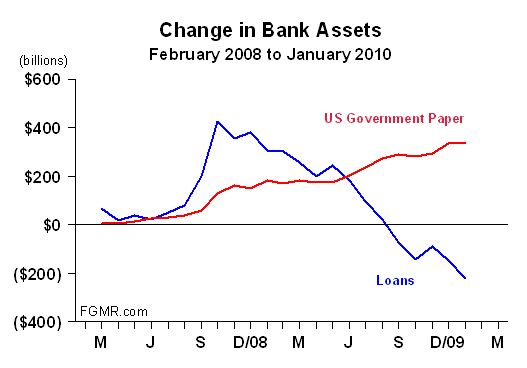
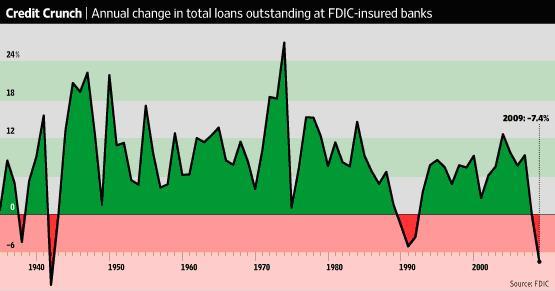
As usual, credit (money) is being lavished on the parasitic elements of the economy while the productive sector is being starved. A report from James Turk’s Free Gold Money Report draws upon a Wall Street Journal article (Lending Falls at Epic Pace) which includes two charts that make that plain. Here they are below along with a couple quotes. –t.h.g.

What Are Banks Doing with Their Depositors’ Money?

“So if the banks are not making loans, what are they doing with depositor money?

Well, they are still lending, but not to businesses and consumers.  They are lending to the federal government.

Banks don’t lend directly to the federal government of course, but buying US government paper accomplishes the same thing in the end.”

“Instead of depositor money being used to stimulate economic activity in the private sector by lending to businesses and consumers, the banks are helping to fund the growing federal deficits.  This re-allocation of resources has a negative long-term impact on the economy.  Depositor money is not being used for productive purposes like building manufacturing plants and making other investments that will create jobs and grow the economy.  It is being spent by the government, which consumes in the present and does not invest for the future.”

The Bailout Scam in Simple Language

The following is an allegorical story that has been circulating recently. I don’t know who wrote it or where it originally came from, but it does a pretty good job of explaining the scam of the recent banking/finance bailout. –t.h.g.

Econ 101 Heidi’s Bar

Heidi is the proprietor of a bar in Detroit. She realizes that virtually all of her customers are unemployed alcoholics and, as such, can no longer afford to patronize her bar. To solve this problem, she comes up with new marketing plan that allows her customers to drink now, but pay later. She keeps track of the drinks consumed on a ledger (thereby granting the customers loans).

Word gets around about Heidi’s “drink now, pay later” marketing strategy and, as a result, increasing numbers of customers flood into Heidi’s bar. Soon she has the largest sales volume for any bar in Detroit

By providing her customers’ freedom from immediate payment demands, Heidi gets no resistance when, at regular intervals, she substantially increases her prices for wine and beer, the most consumed beverages. Consequently, Heidi’s gross sales volume increases massively. A young and dynamic vice-president at the local bank recognizes that these customer debts constitute valuable future assets and increases Heidi’s borrowing limit. He sees no reason for any undue concern, since he has the debts of the unemployed alcoholics as collateral.

At the bank’s corporate headquarters, expert traders figure a way to make huge commissions, and transform these customer loans into DRINKBONDS, ALKIBONDS and PUKEBONDS. These securities are then bundled and traded on international security markets. Naive investors don’t really understand that the securities being sold to them as AAA secured bonds are really the debts of unemployed alcoholics. Nevertheless, the bond prices continuously climb, and the securities soon become the hottest-selling items for some of the nation’s leading brokerage houses.

One day, even though the bond prices are still climbing, a risk manager at the original local bank decides that the time has come to demand payment on the debts incurred by the drinkers at Heidi’s bar. He so informs Heidi.

Heidi then demands payment from her alcoholic patrons, but being unemployed alcoholics they cannot pay back their drinking debts. Since, Heidi cannot fulfill her loan obligations she is forced into bankruptcy. The bar closes and the eleven employees lose their jobs.

Overnight, DRINKBONDS, ALKIBONDS and PUKEBONDS drop in price by 90%. The collapsed bond asset value destroys the banks liquidity and prevents it from issuing new loans, thus freezing credit and economic activity in the community.

The suppliers of Heidi’s bar had granted her generous payment extensions and had invested their firms’ pension funds in the various BOND securities. They find they are now faced with having to write off her bad debt and with losing over 90% of the presumed value of the bonds. Her wine supplier also claims bankruptcy, closing the doors on a family business that had endured for three generations, her beer supplier is taken over by a competitor, who immediately closes the local plant and lays off 150 workers.

Fortunately though, the bank, the brokerage houses and their respective executives are saved and bailed out by a multi-billion dollar no-strings attached cash infusion from their cronies in Government. The funds required for this bailout are obtained by new taxes levied on employed, middle-class, non-drinkers who have never been in Heidi’s bar.

Now, do you understand?

I must correct that final statement. The funds required for the bailout are mostly obtained, not from taxes, but are CREATED by the government and the banking system as new massive government debts are monetized. This is the classic inflation of the money supply, i.e., debasement of the currency.–t.h.g.

Secret Banking Cabal Emerges From AIG Shadows: David Reilly

The most amazing thing about this story is that it appeared in Bloomberg, a mainstream financial news service. The second most amazing thing is that it acknowledges what critics  of central banks (including the Federal Reserve) have been complaining about for decades.

Here are a couple tidbits from the article, with my comments in italics. — t.h.g.

Jan. 29 (Bloomberg) — The idea of secret banking cabals that control the country and global economy are a given among conspiracy theorists who stockpile ammo, bottled water and peanut butter. After this week’s congressional hearing into the bailout of American International Group Inc., you have to wonder if those folks are crazy after all.
Well, duh…

As Representative Marcy Kaptur told Geithner at the hearing: “A lot of people think that the president of the New York Fed works for the US government. But in fact you work for the private banks that elected you.”
It is the bankers who have long dictated who would serve as Treasury Secretary, and most who have held that post had been top level bankers.

Yet when unelected and unaccountable agencies pick banking winners while trying to end-run Congress, even as taxpayers are forced to lend, spend and guarantee about $8 trillion to prop up the financial system, our collective blood should boil.
Indeed, but then what? The corrupt global system of money, banking and finance cannot be reformed. It needs to be transcended. My book, The End of Money and the Future of Civilization, describes effective action that can be taken by individuals, businesses, governments, and NGOs to achieve that outcome.

Read the full article here…