
In this issue
November travel to Turkey and beyond
Summer tour report, Part 2. Sweden and England
Bangla-Pesa Charges Dropped
The Geo-political Struggle
On the move again
I’ve been invited to give a presentation at the 4th Green Economy Conference, Green Economy and Commons, 16-17 November 2013, in Istanbul, Turkey. As a panel member on the 16th, my topic will be, Reclaiming the Credit Commons: the Key to a Green Economy and Global Harmony.
Now, as we approach the end of a very busy and demanding year, I’m feeling the need for rest and renewal, so my intention is to travel onward from Turkey to southeast Asia where I will take a lengthy sabbatical. I will try to remain in touch, but don’t be surprised if email messages are not answered promptly. If your communication is really important, mark it “urgent” and keep trying, or Skype me.
European tour report — Part 2, Sweden and England
Following the Hague conference, I travelled to Sweden for a two week stay (June 24 to July 8) during which time I gave presentations and met with community currency activists in Gothenborg, Lindsberg, Gotland, and Stockholm.
My Gothenborg presentation, titled The Economics of Peace, Justice and Sustainability: Toward a New Convivial World Order, was held in a lovely old church that has been converted into a community center and café that provides, among other things, services to the city’s homeless population. One of my Swedish hosts and main tour organizer, Marianne Påsse, sent out a report on that event. Here is an slightly adapted version of it:
We had a wonderful evening yesterday! We were around 50 people, including us. I was content with that (I had no idea of how many might come)! The evening started with a mini-concert; a leading violinist (Helga Hussel) accompanied by Barbro Fridén on accordion, playing Pearls of World Music. It was lovely listening to them in that very nice building, good acoustics!
After that I spoke a little…making a bridge between Charles Eisenstein’s recent presentation (Approx. 25% of the audience were listening to him in the same building some weeks ago) and Thomas. I also asked the audience to raise their hands if they needed translation of some expressions (happened just 2 or three times…once at the very first picture).
Thomas presented a power point show with very well selected pictures. He spoke about them and…it is good to be able to read at the same time (Microphone is necessary). He spoke for approximately one hour, and people were very interested and kept him busy for another ½ hour, until I closed the session (it was late). The questions were very accurate and in depth. People came up to me afterwards and thanked for a very interesting evening. Afterwards Yoshi and Jackie had an evening meal and chat at our place. And today we pack for Lindsberg! So, we are very pleased!
At a summer gathering at an intentional community in Lindsberg I lead two workshops on successive days, each one beginning with a slide presentation. These were titled, Building Resilient Communities: A New Paradigm for Community Development, and The Global Financial Meltdown: Its Causes, and Opportunities for Localized Restructuring. The participants in each of these sessions were few in number but enthusiastic.
As it happened, I was in Sweden at the right time to participate in the Almedalen Week on the island of Gotland. This has become an annual event that brings together a wide variety of business people, politicians, academics, grassroots activists and ordinary folks. You can learn more about this remarkable event at http://www.almedalsveckan.info/.
I had no official role in the Almedalen proceedings, but was able to attend a few of the 2,000+ organized sessions and got to shake hands and chat a bit with the U.S. Ambassador to Sweden, Mark Brzezinski (son of Zbigniew Brzezinski who was National Security Adviser to President Jimmy Carter).
I finished up my Sweden tour in Stockholm, where I was hosted by an American friend who has been living there for several years with his Swedish wife and young son. In Stockholm I got to meet some of the main figures in the JAK Bank, a unique financial institution that since 1970 has been providing interest-free loans. They together with a few other groups organized an event for me which attracted a sizeable crowd, where I repeated the presentation I gave in Gothenborg.
My photos from Sweden can be found at Sweden 1, and Sweden 2.
England (July 8 – July 20)
I may at times complain about it, but I love Britain, and this time I had the opportunity to be in the Lake District at a time when the weather was simply superb (“the first real summer we’ve had in seven years,” the locals told me).
The focal point of my visit was a full day workshop (July 12), Unlocking Local Wealth, held at Cumbria University in Lancaster, an event organized by the Institute for Leadership and Sustainability (IFLAS) of the University of Cumbria Business School, in association with the New Economics Foundation, the United Nations Non-Governmental Liaison Service, and Impact International. The event was billed as “a one day workshop with world experts on alternative currencies and exchange systems.”
That workshop was preceded the day before by a gathering in which most of the same “world experts” came together to “clarify an action research agenda, explore ideas for collaboration, begin grant mapping,” and provide “feedback on one key new initiative (Eurocat).” Then, that evening, there was a public event titled, Starting Your Own Currency: Why and How? sponsored by (IFLAS ) in association with Lancaster’s Ethical Small Traders Association. This event featured a keynote presentation by John Rogers followed by my response and a general discussion.
Here are the links to videos that were recorded during that event:
Jem Bendell introduces the keynote
Keynote by John Rogers, co-author of People Money
Keynote response by Tom Greco, author of The End of Money and the Future of Civilization
Along with a few other colleagues, I had the pleasure of enjoying a few more days of discussions and Jem’s hospitality at his home overlooking Lake Windermere.
My England photos are here:
I’ll report the final portion of my tour (Greece (July 20 – August 21)) in the next edition of my newsletter
Bangla-Pesa Charges Dropped
I reported earlier that one our close associates, Will Ruddick, along with several of the local currency activist there in Kenya had been arrested and their Bangla-Pesa currency project shut down. I’m happy to report that finally, the charges against them have been dropped. You can read about it here. (A very interesting earlier account that describes their ordeal can be found here.
This is great news, not only because the threat of punishment has been removed, but because this important development project may again have a chance to improve the lot of poor micro-entrepreneurs in Kenya and to demonstrate the power of the local credit clearing model in alleviating poverty. The Bangla-Pesa project is the most significant complementary currency project that I am aware of and has the potential to become THE model for other communities to follow. It deserves strongest support.
[Update. This just in from Will: We won! The official court order to release us was just released last week and can be seen here: http://koru.or.ke/Bangla-Pesa-Dream-Nov Not only have we been acquitted but we’ve been given a relaunch date of November 23rd to restart the program
Will adds, We’ve also created this 3 minute cartoon to explain how these programs form an effective barrier against poverty and market stagnation: http://www.youtube.com/watch?v=UaspBGmsdLE Please share widely.
The Geo-political Struggle
Alvin Toffler observed more than 30 years ago that the power of nation states was in decline and predicted that the trend would continue. It is clear that national governments are ceding sovereignty, not to global democratic institutions, but to transnational corporate entities resulting in a New (fascist) World Order that bypass all the checks on power that have been built into democratic governments over the past three centuries. George Monbiot’s recent article, Elite Insurgency, articulates some current features of that shift.
And Karen Hudes has revealed that World Bank corruption is an inherent element in the global Elite takeover. After Twenty one years at the World Bank, she has blown the lid off the cover-up of the corrupt global financial regime. Watch this interview with Karen: http://youtu.be/M4VGoXV5vYg . A longer interview in four part can be seen here.
These are a few pertinent quotes from her interviews:
“This is a massive cover-up; this makes Watergate look like tidally-winks.”
“Big boys who think they own the world.”
“We don’t have a democracy here.”
“The Federal Reserve has “gamed” the capital markets.”
“This whole country is so corrupt, you can’t begin to imagine. I can’t tell this to the people because the press is owned by those thugs”
“Stakeholder analysis” identifies a “super entity” of ownership and control.
All of that is very troubling, but we have a choice—to build our own (democratic) new world order from the bottom up, community-by-community. 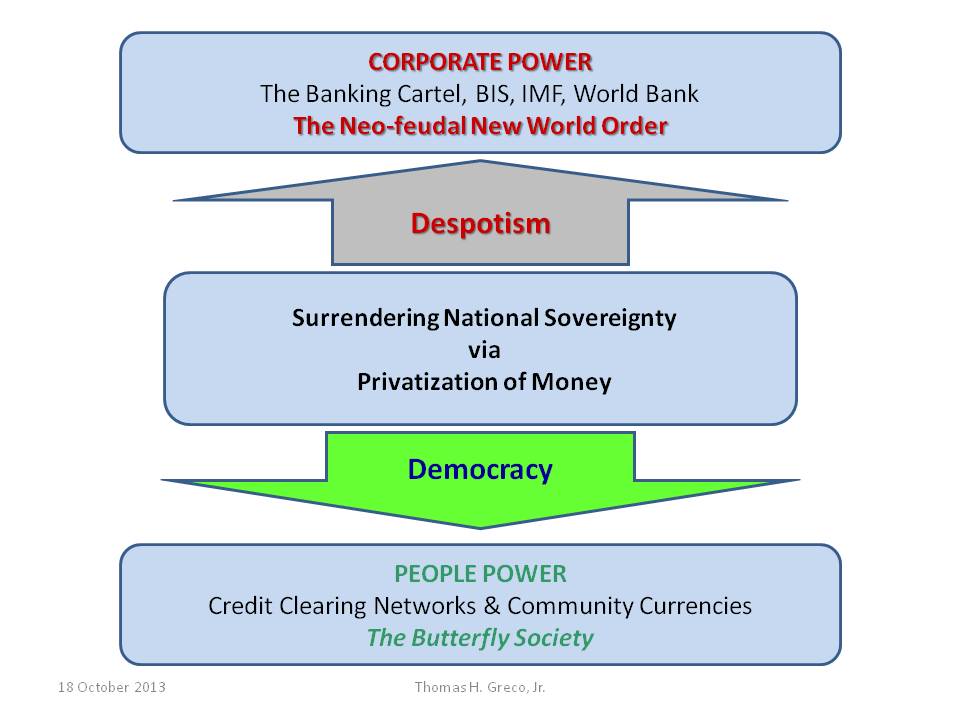 We cannot be complacent; we must reduce our dependence upon corporate controlled mega-systems, especially banks, and secure the availability of the necessities of life within our local regions.
# # #



 Beyond Money