AI has its dark side and will ultimately control and consume everything, but in the meantime it has features that an be used to do some good which may help turn the tide of civilization before that can happen. After feeding it the text of my revised and expanded Chapter 19—The Role of Governments in Solving the Money Problem, Gemini’s NotebookLM created this six minute video that does an excellent job of explaining what the chapter says and what it proposes. Take a look.
Today, out of curiosity, I asked Copilot this question:
“How would E. C. Riegel organize the exchange of value among producers and intermediaries in the distribution process?”
Here is Copilots’ surprisingly accurate response to that question. It is, in effect, a brief summary of his book Private Enterprise Money.
E. C. Riegel envisioned a radically decentralized and voluntary system of value exchange that bypassed both government-issued money and centralized banking. His proposed framework, known as the Valun Exchange System, was designed to empower producers and intermediaries to coordinate trade through a self-regulated, non-political monetary mechanism.
Here’s how it would work in practice:
1. Voluntary Association of Producers: Producers and intermediaries would form a cooperative network called a Valun Exchange. Membership would be voluntary and based on mutual trust and creditworthiness.
2. Private Credit as Currency: Instead of using state-issued money, members would issue credit to one another in the form of Valun units. These units would be backed by the members’ productive capacity and promises to deliver goods or services—not by gold, fiat, or government decree.
3. Accounts, Not Cash: Transactions would be recorded as debits and credits in members’ accounts, similar to a mutual credit system. No physical currency would be needed; the system would operate through bookkeeping entries.
4. Intermediaries as Facilitators: Distributors, wholesalers, and retailers would participate as both buyers and sellers, using their Valun accounts to settle transactions. Their role would be to facilitate the flow of goods, not to extract value through speculative finance.
5. Self-Limiting Credit: A member’s ability to issue credit would be limited by their past performance and the confidence of the network. This would prevent inflation and ensure that credit was grounded in real economic activity.
6. No Interest, No Taxes: Since the system was private and voluntary, it would not involve interest-bearing loans or taxation. Riegel believed this would eliminate many distortions in the traditional monetary system.
In essence, Riegel’s model treated money not as a commodity or a government tool, but as a social contract among producers—a means of measuring and facilitating exchange based on trust and productivity. It was a bold attempt to return the power of money creation to the people actually producing value.
If you’d like, I can sketch out a visual flow of how this system would operate among producers, intermediaries, and consumers.
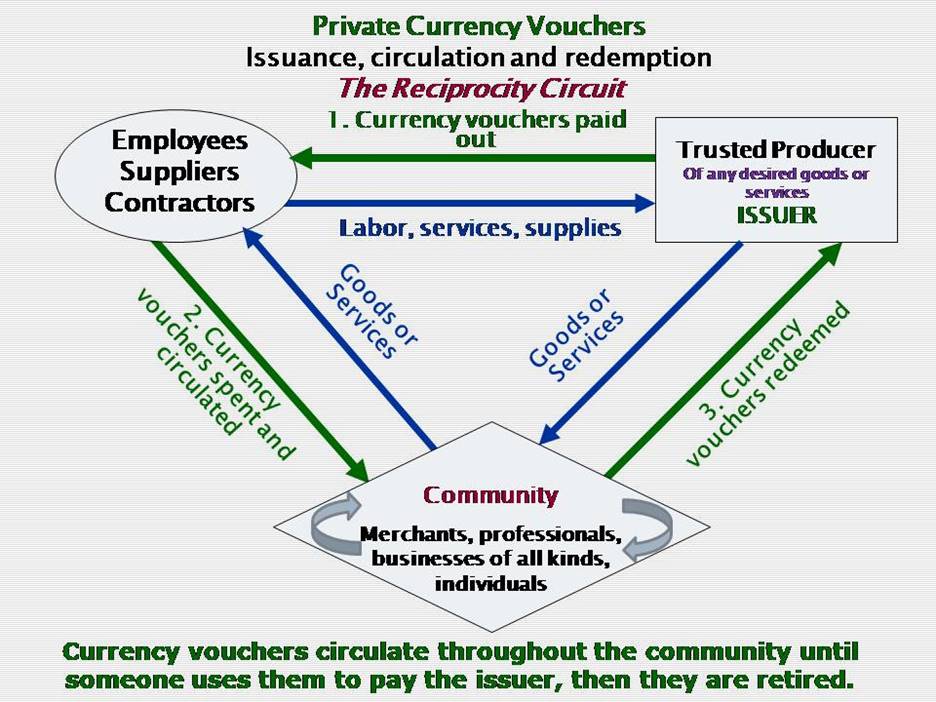
To that offer, I answered, “yes,” but in successive attempts Copilot failed to produce an accurate flow diagram. I have for many years been using my own diagram of credit flows in mutual credit clearing systems. Here it is below. If you substitute the word “valun” for “Currency vouchers,” this diagram shows exactly what Riegel was describing:
The “Trusted Producer” depicted in the upper right begins the process by using their line of credit to purchase something for an employee, supplier or contractor. Those credit vouchers then flow in the numbered sequence, the final step being when the Trusted Issuer accepts them back in payment for the goods or services they sell, thus completing the circuit of reciprocity. Note that at each step of the way, goods and services are circulating in the opposite direction to the voucher credits (or valuns).
I then pointed out to Copilot that it had failed to specify the units in which valun credits were to be denominated. This was its response:
Great point, Thomas. Riegel proposed that all debits and credits in his system would be denominated in a unit called the Valun—short for “value unit”. This was not just a name, but a deliberate attempt to establish a new standard of value independent of national currencies and political influence.
At the system’s launch, the Valun was intended to be roughly equivalent in purchasing power to the U.S. dollar, simply to ease adoption and pricing familiarity. However, over time, its value would be maintained internally by the productivity and trustworthiness of the network’s members, not by fiat or commodity backing.
So, in essence, every transaction—whether between producers, intermediaries, or consumers—would be recorded in Valuns, making it a closed-loop accounting system grounded in mutual credit and real economic activity.
Would you like a breakdown of how Valun pricing might work in practice, or how it could be stabilized over time?
I already knew how Riegel proposed to stabilize the Valun pricing unit, and I am not satisfied with it being adequate. I make my case in a document which Copilot cited as a source; it is contained in a previous post to my website, E. C. Riegel’s Valun Mutual Money Plan, but the reference was to a site other than my own. It would be better to read the original post on my site. That post contains the full text of the Valun Mutual Money Plan, together with my comments and critique. I believe that serious students would do well to read it.
The first edition of my book, The End of Money and the Future of Civilization, was published by Chelsea Green Publishing in 2009. While it remains as relevant today as it was when first published the printed book has been out of print for several years. But, having had the rights reverted to me by my publisher, I am making the entire book available for free in PDF format. You can read it or download it HERE. If you would like a hard copy of the first edition used copies can still be found on Amazon.com, Abe books, Thrift books and elsewhere.
Better still, you can avail yourself of the new revised and expanded 2024 edition which I have been working on for almost two years and is almost complete. Eighteen chapters have already been posted and can be freely read or download HERE.
My previous books, as published, may be freely accessed in digital format by clicking the title below.
Dear Dennis, I applaud your longstanding efforts on behalf of reason, peace, and monetary reform. But you must realize by now that reform is utterly impossible given the extreme centralization of monetary, financial, economic, and political power in the hands … Continue reading →
This video report from Alex Krainer harmonizes with what I’ve been arguing for mamy years. The fragility and faults of the centralized global debt-money regime, combined with the imperial overreach of the US and western allies are bringing the matter … Continue reading →
I recently viewed the video. Yanis Varoufakis: Iran War Collapses U.S. Neoliberal Economy, an interview by Glenn Diesen. Varoufakis does a very good job of exposing the fragility of the neoliberal economic model and its inability to withstand a major … Continue reading →
By Thomas H. Greco Jr. Professor Carroll Quigley was a historian and theorist who was renowned as a professor at the School of Foreign Service at Georgetown University, where he taught many famous and influential people including Nancy Pelosi and … Continue reading →
Virtually everyone senses that there is something drastically wrong with the state of our world. Many rail against the governments, institutions, and people that they hold responsible for the various aspects they recognize as unfair, unsustainable, destructive, and utterly inhuman. … Continue reading →
In 2013 I wrote an article that was published in the online academic journal, Internet Journal of Community Currency Research (IJCCR). That article, Taking Moneyless Exchange to Scale: Measuring and Maintaining the Health of a Credit Clearing System, was intended … Continue reading →
Upon the recent completion and publication of my new Chapter 20—Exchange, Finance, and the Store of Value, for the revised edition of my book, The End of Money and the Future of Civilization, I loaded it into NotebookLM and asked … Continue reading →
I subscribe to Alex Krainer’s Trend Compass channel on Substack, as well as his YouTube channel. Krainer provides historical lessons which highlight persistent patterns that impact our lives today. He recently published a two part essay on the West under … Continue reading →
I recently had a conversation with Copilot about designing an honest and effective exchange system that would circumvent the flawed and exploitative fiat money system. I began by saying, “The political money system is structurally flawed, and its eventual collapse … Continue reading →