Erecting the ‘wall of separation between church and state’… is absolutely essential in a free society. — Thomas Jefferson
The established beliefs about money in today’s world have become a sort of religion in which a fundamental tenet holds that government must, either directly or indirectly, have power over the system of money creation and circulation. This erroneous belief has taken the world to the brink of disaster which will surely ensue unless we take steps to depoliticize money by achieving the separation of money and state. It should be obvious by now that there will never be peace in the world so long as those who control our national governments are able to conjure up out of thin air the seemingly endless amounts of pseudo-money they need to pay for wars and whatever else might bolster their political and economic interests.
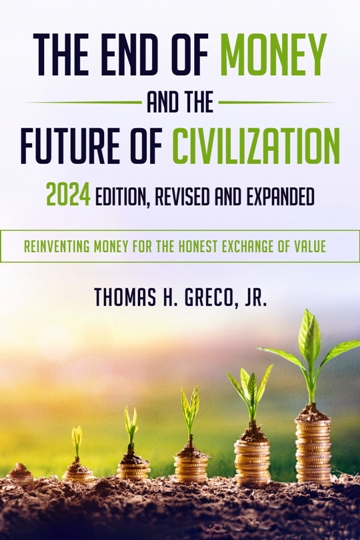
Read all about it in Chapter8—The Separation of Money and State, the latest chapter to be published in my new 2024 edition of The End of Money and the Future of Civilization.
Further chapters will continue to be posted as they are completed. Watch for Chapter Nine to be posted soon. As always, your comments and suggestions are welcomed, Thomas
You many not want the inconvenience of living without a SIM card in your phone, but you will learn a lot about internet privacy by watching this video. Pay special attention to the part about the Calyx Institute, a non-profit organization dedicated specifically to privacy, which offers free VPNs and hotspots.
Inflation is always and everywhere a monetary phenomenon. — Milton Friedman
Bankers, politicians, and pundits talk about inflation as if it were something mysterious and difficult to understand, but the truth about inflation is really quite simple. If you want to cut through the fog of obfuscation, read the latest chapter, Chapter 7— The Nature, Cause, and Consequences of Inflation, in my new 2024 edition of The End of Money and the Future of Civilization. You can find it here, and here, and on my Substack channel.
Further chapters will continue to be posted as they are completed on my website and Substack channel, as well as on Future Brightly. Watch for Chapter Eight to be posted in about two weeks.
As always, your comments and suggestions will be welcomed, Thomas ___________________
Anyone who believes exponential growth can go on forever in a finite world is either a madman or an economist. —Kenneth Boulding, Economist
Chapter Six — Usury, the Engine of Destruction, of The End of Money and the Future of Civilization, new 2024 edition, is now available at Ken Richings; Substack channel, Future Brightly. in advance of its publication here on my website and elsewhere. Access to my work remains free, but please reward Ken for his good work by opting to take a paid subscription to his Substack channel. Further chapters will continue to be posted as they are completed on Future Brightly, and two weeks later on this and the other sites. Watch for Chapter Seven to be posted in about two weeks.
As always, your comments and suggestions will be welcomed, Thomas ___________________
Covering the history of centralized banking, the danger of today’s concentration of wealth in the hands of a few who are working to completely control humanity; and the need to reinvent money, devolve power to local communities, and create honest “home-grown” means of payment (liquidity). His highly acclaimed book, The End of Money and the Future of Civilization, is being revised, updated, and expanded to reveal how the dysfunctional money system operates, and how to reinvent money to enable the honest exchange of value. New chapters are being posted serially on Future Brightly, on his website, as well as on his Substack and Medium channels. Almost all his writings and accumulated resources for researchers and monetary innovators can be downloaded free at BeyondMoney.net.
You can view or download the video here or on Podbean
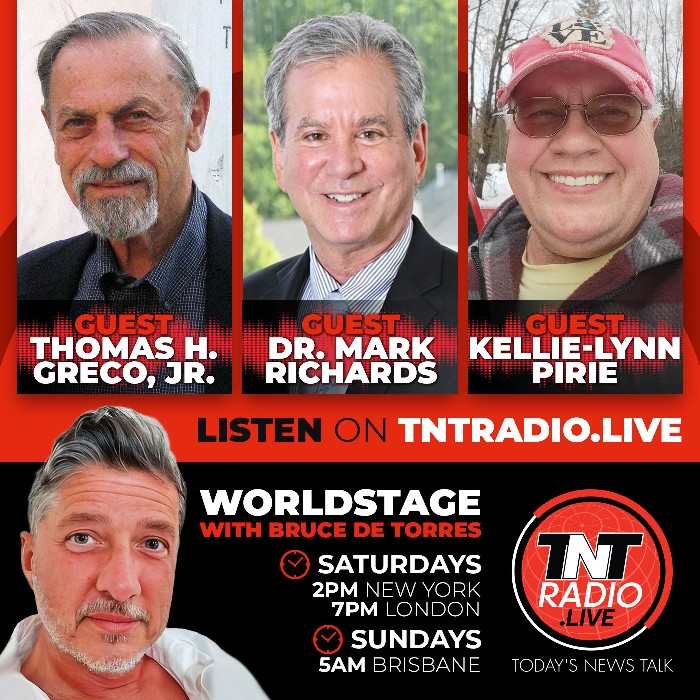
I am scheduled to be interviewed by Bruce de Torres on his World Stage program on Saturday, February 24, 2024 during the first segment of the program from 2 PM to 3 PM Eastern time (11 AM to Noon Pacific time, Noon to 1 PM Arizona time). You can tune in to listen live at https://tntradio.live/.
The world is governed by very different personages from what is imagined by those who are not behind the scenes. —Benjamin Disraeli, British Prime Minister under Queen Victoria
Chapter Five, the latest chapter in The End of Money and the Future of Civilization, new 2024 edition, is now available. It is being published first on Ken Richings; Substack channel, Future Brightly. Ken has greatly assisted my work in many ways, including editorial assistance and narration of each chapter. He has now posted all previous chapters, and starting now with Chapter 5, each new chapter will appear on his channel two weeks before being posted here on my website or elsewhere. I do not wish to place paywalls between me and my readers so all content will continue to remain freely available to read and download, either from Ken’s site or my own sites but I encourage you to reward Ken for his good work by opting to take a paid subscription to https://futurebrightly.substack.com/.
One of the books I was entrusted with by the School of Living is, The Cause of Business Depressions, by Hugo Bilgram and L. E. Levy, published in 1914 by J. B. Lippincott. This is another masterful work that we’ve inherited from the past that was either ignored or suppressed. I doubt that even a handful of academic economists alive today would recognize the authors’ names. But they were correct in saying: “If there were no money, any system of crediting sellers and debiting buyers would be fully competent to accomplish the work now performed by money,” and they provided in this book a detailed outline of how a mutual credit clearing network might be structured and managed.
In my book, Money: Understanding and Creating Alternatives to Legal Tender (Chelsea Green 2001), I quoted them as saying: “Were a number of businessmen to combine for the purpose of organizing a system of exchange effective among themselves, they could clearly demonstrate how simple the money system can really be made. The greater the number of businessmen that would thus cooperate, the more complete would be their own emancipation from the obstruction to commerce and industry which existing currency laws impose.”
Then I summarized the Bilgram and Levy plan as follows:
A group of business people would agree to settle their business accounts through a “clearing system,” using their own credit as a medium of exchange.
The method of clearing accounts would be, in the main, similar to that used by depository banks to clear accounts among its depositors. Each business association would open an account for each of its members.
Each member would then furnish “thoroughly acceptable and amply adequate” security for the amount of credit he or she wished to establish.
The security would be held by the association as a pledge to cover the “credit cheques” that the member might draw in excess of deposits, that is, to secure his or her debit balance.
Such “credit cheques” would be accepted by all members of the association in payment of business accounts. The amount of the check would be credited to the payee’s account (causing it to increase), and the same amount would be debited to the payer’s account (causing it to decrease).
Official currency and checks would be deposited to the account also, with the stipulation that only system credits, not official money, could be paid out or withdrawn from the account.
Members with net credits would be allowed to redeem a certain portion of them, say 20 percent each month, for official currency. This, of course, would require those with debits to provide the official currency for such redemptions.
Such associations in various localities could be federated to provide for inter-regional clearing of credits.
I’ve now taken the trouble to scan the pages of that entire section of the book and transcribed them into an editable Word document with my comments, and have added these files to the Library on my website so that serious students of finance and exchange system innovation will have the complete description to study and learn from.
Of course, their plan was conceived at a time when the gold standard was still operational, and paper currency was still redeemable for gold, but their basic ideas and structure provide a useful point of departure for present day innovators and reformers. However, I would not advise the implementation of the B and L proposal as it was originally presented because they encumber their credit clearing system with a lot of unnecessary and self-defeating “baggage.” I’ve described my own ideas in my various writings and presentations, including my paper, Credit Clearing – Pure and Simple. Here are the main differences I’ve proposed:
1. I have long maintained that “The creation of sound exchange media (money) requires that money be spent into circulation by trusted producers of real valuable goods and services that are in everyday demand and are in the market and available to be delivered in the near-term. Money then is a mere place holder for real economic value; it is a credible promise that will be accepted as a form of payment. (See my article Reconnecting the Monetary Economy to the Real Economy). A currency then is a mere place holder for real economic value; it is a credible promise that will be accepted as a form of payment. The same holds true for the credit that is allocated to participants within a credit clearing circle since such credit serves as an internal currency. I would therefor greatly relax the requirement for collateral since debit balances are already “backed” by the goods and services that they represent. 2. There is no reason for a credit clearing exchange to accept deposits of official fiat money except in the event of the withdrawal of a participant who leaves with a debit balance. It is, for instance, the usual practice of present-day commercial trade exchanges to have on file a credit card number for each member, and to charge that card only for service fees that are levied in cash, and for the amount of any debit balance remaining when a member leaves the system. Members wishing to leave who have a positive balance are not allowed to convert their trade credits to cash but must instead spend them within the system. 3. I would eliminate interest charges applied to negative balances. Since all participants benefit from the clearing process, the cost of operating the system should be borne equally by all, as B and L themselves seem to acknowledge in their somewhat confusing footnote 105. Rather than applying interest levies on accounts, I’ve proposed a revenue model based on the principle that one should pay fees in proportion to the amount of service they receive, which in this case is the amount of value cleared for an account. Remember, if no one ever had a negative balance there would be no credit and nothing to clear. Credit is what makes the business of exchange go round.
Such are the conditions that would enable real independence from the dysfunctional and exploitative political fiat money regime. — T.H.G. _____________________ RIP Sergio Lub
I was sad to learn a few days before Christmas that my very good friend and colleague Sergio Lub had gone into hospice care at home. He passed away on January 8, 2024. I first met Sergio and his wife Gaye in the late 1990s at a community currencies conference that was organized by Carol Brouillet. We immediately recognized that we had much in common and became good friends and colleagues. We traveled together to various parts of the world, including Europe, South America, India, and Southeast Asia, and worked together to educate various audiences about the “money problem,” and its solutions. I’ve long considered Sergio to be one of the world’s greatest networkers, and through him I’ve met a great many people whose work has been instrumental in addressing the critical challenges that presently confront our civilization. Sergio created an online social network long before there was a Facebook or a Twitter. His Friendly Favors platform, besides connecting people, includes a way of trading “favors.” While the platform is in need of an update and is no longer widely used, the structure and protocols that Sergio designed into it are there to guide the next generation of social innovators. Sergio was born of Russian parents in Argentina, and as a young man immigrated to the United States where he became a successful jewelry maker and entrepreneur and raised a family. His children, as they grew into adulthood eventually joined Sergio and his wife Gaye in the family business which continues to flourish.
I will sorely miss my friend Sergio and his steadfast support for my work which was consistent over the more than the quarter century of our friendship.
You can find more information about Sergio and the Lub family business at their website: https://www.sergiolub.com/pages/about-us _____________________ Publishing Update
The End of Money and the Future of Civilization, new 2024 edition Here’s an update on our publishing plans. I’ve given Ken Richings permission to be first in publishing my new book chapters on his Substack channel, Future Brightly. Ken has greatly assisted my work in many ways, including editorial assistance and narration of each chapter. He is now in the process of catching up by publishing on his channel the chapters that I’ve already published on my website, on medium, and on my own Substack channel. But starting with Chapter 5, each new chapter will appear on his channel two weeks before being posted on my website or elsewhere. You can still get free access even on Ken’s channel Future Brightly, but I’m urging you to please reward him for his good work by opting to take a paid subscription at https://futurebrightly.substack.com/. _____________________ Wishing you peace and joy in the New Year, Thomas
The original 2009 edition of my book, The End of Money and the Future of Civilization , is out of print but the Kindle edition and used copies can be ordered from Amazon.com. Chapters of the new 2024 edition will be posted as they are completed. You can find them here.
To order signed copies of my previous books, click on the title below:




 Beyond Money