Tag Archives: bailout

The Other Plot to Wreck America-An informative article from the New York Times

Even though it does not quite get to the root of the matter, this article is worth reading.

The Other Plot to Wreck America

By FRANK RICH

THERE may not be a person in America without a strong opinion about what coulda, shoulda been done to prevent the underwear bomber from boarding that Christmas flight to Detroit. In the years since 9/11, we’ve all become counterterrorists. But in the 16 months since that other calamity in downtown New York — the crash precipitated by the 9/15 failure of Lehman Brothers — most of us are still ignorant about what Warren Buffett called the “financial weapons of mass destruction” that wrecked our economy. Fluent as we are in Al Qaeda and body scanners, when it comes to synthetic C.D.O.’s and credit-default swaps, not so much.

What we don’t know will hurt us, and quite possibly on a more devastating scale than any Qaeda attack. Americans must be told the full story of how Wall Street gamed and inflated the housing bubble, made out like bandits, and then left millions of households in ruin. Without that reckoning, there will be no public clamor for serious reform of a financial system that was as cunningly breached as airline security at the Amsterdam airport. And without reform, another massive attack on our economic security is guaranteed. Now that it can count on government bailouts, Wall Street has more incentive than ever to pump up its risks — secure that it can keep the bonanzas while we get stuck with the losses.

The window for change is rapidly closing. Health care, Afghanistan and the terrorism panic may have exhausted Washington’s already limited capacity for heavy lifting, especially in an election year. The White House’s chief economic hand, Lawrence Summers, has repeatedly announced that “everybody agrees that the recession is over” — which is technically true from an economist’s perspective and certainly true on Wall Street, where bailed-out banks are reporting record profits and bonuses. The contrary voices of Americans who have lost pay, jobs, homes and savings are either patronized or drowned out entirely by a political system where the banking lobby rules in both parties and the revolving door between finance and government never stops spinning.

It’s against this backdrop that this week’s long-awaited initial public hearings of the Financial Crisis Inquiry Commission are so critical. This is the bipartisan panel that Congress mandated last spring to investigate the still murky story of what happened in the meltdown. Phil Angelides, the former California treasurer who is the inquiry’s chairman, told me in interviews late last year that he has been busy deploying a tough investigative staff and will not allow the proceedings to devolve into a typical blue-ribbon Beltway exercise in toothless bloviation.

He wants to examine the financial sector’s “greed, stupidity, hubris and outright corruption” — from traders on the ground to the board room. “It’s important that we deliver new information,” he said. “We can’t just rehash what we’ve known to date.” He understands that if he fails to make news or to tell the story in a way that is comprehensible and compelling enough to arouse Americans to demand action, Wall Street and Washington will both keep moving on, unchallenged and unchastened.

Angelides gets it. But he has a tough act to follow: Ferdinand Pecora, the legendary prosecutor who served as chief counsel to the Senate committee that investigated the 1929 crash as F.D.R. took office. Pecora was a master of detail and drama. He riveted America even without the aid of television. His investigation led to indictments, jail sentences and, ultimately, key New Deal reforms — the creation of the Securities and Exchange Commission and the Glass-Steagall Act, designed to prevent the formation of banks too big to fail.

As it happened, a major Pecora target was the chief executive of National City Bank, the institution that would grow up to be Citigroup. Among other transgressions, National City had repackaged bad Latin American debt as new securities that it then sold to easily suckered investors during the frenzied 1920s boom. Once disaster struck, the bank’s executives helped themselves to millions of dollars in interest-free loans. Yet their own employees had to keep ponying up salary deductions for decimated National City stock purchased at a heady precrash price.

Trade bad Latin American debt for bad mortgage debt, and you have a partial portrait of Citigroup at the height of the housing bubble. The reckless Citi executives of our day may not have given themselves interest-free loans, but they often walked away with the short-term, illusionary profits while their employees were left with shredded jobs and 401(k)’s. Among those Citi executives was Robert Rubin, who, as the Clinton Treasury secretary, helped repeal the last vestiges of Glass-Steagall after years of Wall Street assault. Somewhere Pecora is turning in his grave

Rubin has never apologized, let alone been held accountable. But he’s hardly alone. Even after all the country has gone through, the titans who fueled the bubble are heedless. In last Sunday’s Times, Sandy Weill, the former chief executive who built Citigroup (and recruited Rubin to its ranks), gave a remarkable interview to Katrina Brooker blaming his own hand-picked successor, Charles Prince, for his bank’s implosion. Weill said he preferred to be remembered for his philanthropy. Good luck with that.

Among his causes is Carnegie Hall, where he is chairman of the board. To see how far American capitalism has fallen, contrast Weill with the giant who built Carnegie Hall. Not only is Andrew Carnegie remembered for far more epic and generous philanthropy than Weill’s — some 1,600 public libraries, just for starters — but also for creating a steel empire that actually helped build America’s industrial infrastructure in the late 19th century. At Citi, Weill built little more than a bloated gambling casino. As Paul Volcker, the regrettably powerless chairman of Obama’s Economic Recovery Advisory Board, said recently, there is not “one shred of neutral evidence” that any financial innovation of the past 20 years has led to economic growth. Citi, that “innovative” banking supermarket, destroyed far more wealth than Weill can or will ever give away.

Even now — despite its near-death experience, despite the departures of Weill, Prince and Rubin — Citi remains as imperious as it was before 9/15. Its current chairman, Richard Parsons, was one of three executives (along with Lloyd Blankfein of Goldman Sachs and John Mack of Morgan Stanley) who failed to show up at the mid-December White House meeting where President Obama implored bankers to increase lending. (The trio blamed fog for forcing them to participate by speakerphone, but the weather hadn’t grounded their peers or Amtrak.) Last week, ABC World News was also stiffed by Citi, which refused to answer questions about its latest round of outrageous credit card rate increases and instead e-mailed a statement blaming its customers for “not paying back their loans.” This from a bank that still owes taxpayers $25 billion of its $45 billion handout!

If Citi, among the most egregious of Wall Street reprobates, feels it can get away with business as usual, it’s because it fears no retribution. And it got more good news last week. Now that Chris Dodd is vacating the Senate, his chairmanship of the Banking Committee may fall next year to Tim Johnson of South Dakota, home to Citi’s credit card operation. Johnson was the only Senate Democrat to vote against Congress’s recent bill policing credit card abuses.

Though bad history shows every sign of repeating itself on Wall Street, it will take a near-miracle for Angelides to repeat Pecora’s triumph. Our zoo of financial skullduggery is far more complex, with many more moving pieces, than that of the 1920s. The new inquiry does have subpoena power, but its entire budget, a mere $8 million, doesn’t even match the lobbying expenditures for just three banks (Citi, Morgan Stanley, Bank of America) in the first nine months of 2009. The firms under scrutiny can pay for as many lawyers as they need to stall between now and Dec. 15, deadline day for the commission’s report.

More daunting still is the inquiry’s duty to reach into high places in the public sector as well as the private. The mystery of exactly what happened as TARP fell into place in the fateful fall of 2008 thickens by the day — especially the behind-closed-door machinations surrounding the government rescue of A.I.G. and its counterparties. Last week, a Republican congressman, Darrell Issa of California, released e-mail showing that officials at the New York Fed, then led by Timothy Geithner, pressured A.I.G. to delay disclosing to the S.E.C. and the public the details on the billions of bailout dollars it was funneling to its trading partners. In this backdoor rescue, taxpayers unknowingly awarded banks like Goldman 100 cents on the dollar for their bets on mortgage-backed securities.

Why was our money used to make these high-flying gamblers whole while ordinary Americans received no such beneficence? Nothing less than complete transparency will connect the dots. Among the big-name witnesses that the Angelides commission has called for next week is Goldman’s Blankfein. Geithner, Henry Paulson and Ben Bernanke should be next.

If they all skate away yet again by deflecting blame or mouthing pro forma mea culpas, it will be a sign that this inquiry, like so many other promises of reform since 9/15, is likely to leave Wall Street’s status quo largely intact. That’s the ticking-bomb scenario that truly imperils us all.

Frank Rich is an Op-Ed columnist for The New York Times.
Thomas Greco’s Video Interview with Daniel Pinchbeck

Here are some segments of an interview I had with Daniel Pinchbeck during the Economics of Peace Conference in Sonoma, California in October of 2009. This interview was recorded by Haig Varjabedian

You can watch the entire interview in four parts on Vimeo.

Daniel Pinchbeck is an author and the  founder of  RealitySandwich.com, a website forum regarding experiences and initiatives surrounding the evolution of consciousness.

I also did an interview with Regina Meredith of Conscious Media Network.

Who Owns the U.S. Government?

The only surprising thing about this report is that it appeared on Fox News. Goldman Sachs has just reported record profits. Glenn Beck explains how your government made it possible.

The Crisis of Credit Visualized

Confused about the origins of the credit crisis? This animated video by Jonathan Jarvis helps to clear away the fog.

FED Inspector Clueless — Where Has All the Money Gone?

The recent testimony before Congress of the Inspector General of the Federal Reserve is laughably outrageous—a startling example of the persistent stonewalling and obfuscation by the private central bank that runs our government. Fortunately, we have a few courageous Representatives who are willing to ask the right questions. This video of questioning by Rep. Alan Grayson (D-Florida) is a “must see.”

Here is an excerpt from Rep. Grayson’s newsletter dated June 11, 2009:

Since last September, the Federal Reserve Bank has handed out over $1 trillion.  That’s $1,000,000,000,000.  It won’t tell us who got the money.

The Federal Reserve Bank also has guaranteed loans for an even larger amount.  Bloomberg News says around $9 trillion.  That’s $30,000 for every American.  It won’t tell us who got those guarantees.

I’m a member of the House Financial Services Committee.  A few weeks ago, the Inspector General of the Federal Reserve Bank was called as a witness.  I asked her if she knew who got the money.  She said no.

The Inspector General also admitted that she didn’t know how much money the Federal Reserve Bank has lost, already, on those deals.

That video was posted on YouTube, here.  Over 650,000 people have downloaded it and seen it.  That makes it the 6th most popular news video in the world last month, as you can see here.

Add the number who have seen the high-fidelity version, here, and the number of viewers is over 900,000.  Counting those viewers, it was the 4th most popular news video in the world last  month.

900,000 concerned citizens.  That’s more than the total circulation of every newspaper in Central Florida, combined.  That’s more than the total number of viewers watching the local news at 6 pm and 11 pm, combined.

The media did not cover this hearing at all.  But people found this clip on YouTube and told their friends about it, over and over again.

What this clip shows is that the Federal Reserve Bank is out of control.  And I’m working to do something about it.

I was the first Democrat to come out in favor of Rep. Ron Paul’s bill to audit the Federal Reserve Bank, H.R. 1207.  And I’ve used this video to mobilize bipartisan support for the bill.  Since the hearing, dozens and dozens of members of Congress have signed up.  They can see for themselves how badly this mess needs to be cleaned up.  We’re getting close to 218 co-sponsors, a majority of the House.

Congressman Ron Paul (R-Texas) has introduced a bill to not only audit the Federal Reserve, but also to abolish it (The Federal Reserve Board Abolition Act, H.R. 833. February 4, 2009). It’s encouraging to see the money and banking problem once more in the political spotlight. This is a time of great opportunity for liberating the “credit commons,” but it is also a time of great danger. Most politicians know little about the principles of sound money and banking, they believe in the centralization of power that is enabled by laws like “legal tender,” and they can easily be manipulated or bought off by the financial powers who will use any crisis as an opportunity to promote “solutions” that further enhance their power and ability to dominate economies, nations, and peoples.

It’s not only the Federal Reserve that’s “out of control,” it’s also our government and virtually all of our institutions and life support systems. The situation calls for the application of our collective intelligence to solving our problems and the devolution of power to the community level.

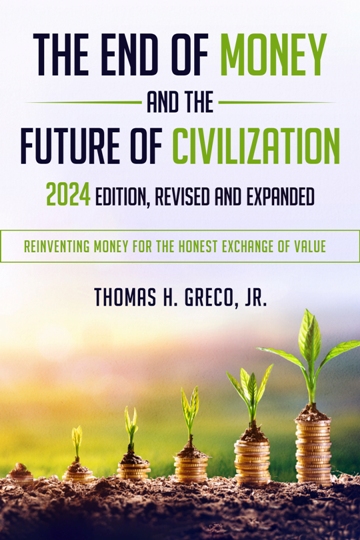
As I said in an earlier blog post, Eventually, it may be possible to act effectively at the governmental level, but only after the people have strongly asserted their own power to mediate the exchange process using their own credit apart from banks and the political money system. Only that assertion can bring about the “true free-market economy” that Mr. Paul desires. The nature of this power and how we can assert it are thoroughly addressed in my latest book, The End of Money and Future of Civilization. Please read it, and ask your representatives to read it. Better yet, send them a copy. –t.h.g.

The Great Inflation of 2010

Bill Bonner is absolutely correct in calling the monetization of debt The Grandest of Larcenies. He points out that, “Rather than honestly repaying what it has borrowed, a government merely prints up extra currency and uses it to pay its loans. The debt is “monetized”…transformed into an increase in the money supply, thereby lowering the purchasing power of everybody’s savings.”

As I argue in my new book, The End of Money and the Future of Civilization, enabling governments to spend more than they take in is half of the purpose of the central banking regime, the other half being to give the banking elite the privilege of charging interest on the people’s own credit.

As Bonner further points out,  “Of course, the Fed will not want to do such a dastardly deed; but it will do it anyway.” They are desperate to keep the game going and the only other alternative is to let interest rates rise as government seeks to sell more of its debt to increasingly reluctant lenders abroad.

Government, for its part, must either cut its profligate spending or raise taxes, or both. From the rhetoric coming out of Washington, it is clear that social programs, like Social Security and Medicare, are on the chopping block, but not sacred cows like military spending or bailouts for banks and corporate dinosaurs–the empire must be preserved.  Trial balloons for new taxes are now being floated. Is a VAT (value added tax) on the horizon?

As in the Weimar Republic between the World Wars, the politicians and bankers today may decide that hyper-inflation is the least onerous of their available options. The middle-class can say goodbye to their hard-earned savings.

Notes From the Field – Thailand

October 28-29, 2008

Relaxing on Koh Phangan

Much as I like Penang, I’m happy to be away from the bustle and noise of Georgetown for a while. I woke this morning to the sound of gentle rain hitting the roof of my seaside bungalow in Koh Phangan. With my Malaysian visa about to expire, I took it as an opportunity to visit Thailand again, choosing to return to the island (koh) that I visited last year. Koh Phangan in comparison to its better-known near neighbor, Koh Samui, is still relatively unspoiled. Although tourism is its economic base, it has not yet been overbuilt and overrun by upscale resorts and high rise condos. There is still a lot of open space and the typical accommodations consist of modest bungalows strung out along the various beaches.

A major attraction of Koh Phangan is the “full moon party” that attracts the twenty-something party crowd. I guess it was inevitable that ambitious entrepreneurs would augment that attraction by staging “half-moon” and “dark moon parties,” as well. Fortunately, that scene is easily avoided as it happens mainly at the south end of the island near Had Rin. The remainder of the island offers various levels of peace and quiet, nice beaches and clean water. Expenses are a bit higher here than in Penang but still affordable. I’m sure I could find ways to economize if I were to commit to a longer stay. It’s off season now so it’s a buyer’s market for lodgings. I dare say that ninety percent of the units are vacant right now.

The only sizeable village on the island is Thong Sala, located on the western side. That’s where the ferry docks are. It has all the usual conveniences – shops, restaurants, banks, cafes, and a nice night market where one can get a good cheap meal. I prefer to stay to the north and not too far away from Thong Sala at one of the many bungalow places that line the shore. The place I’m at is fairly new and clean and has screened windows, a rarity in these parts. It has no A/C, only a fan, but that’s quite adequate as it doesn’t get too hot here and there’s usually a breeze off the ocean.

The antipode to the party scene is the yoga/health spa scene. There is a sizeable cluster of people who come to the island for yoga workshops, personal growth, healing, and spiritual development. I first learned about Koh Phangan from my Italian friend, Michele, whom I met at Auroville last year. He had come here earlier that year to do yoga at the popular Agama Center which has a loose affiliation with the Ananda Yoga Resort where one can find various health oriented offerings like vegetarian food, yoga classes, sauna, massage, and a seven day colon cleanse program.

I came to the island last year prior to my visit to Bali. I liked it but was able to stay for only two weeks. Michele was not on the island at that time so I had to discover it on my own. This time, he is here so I have the advantage of being guided and introduced to people by someone who has spent a lot of time here.

The Bank Bailout Scam

What can you expect when a fox is appointed to manage the hen house? Our current Treasury secretary, Henry Paulson, was formerly the CEO of Goldman Sachs, one of the most powerful financial institutions in the world. His appointment to that post was clearly intended to enable a continuation of the long trend of greater concentration of power and wealth in elite hands.

Recent moves by the U.S. Treasury make that ever more obvious. In an article in Saturday’s (Oct. 25) New York Times, Times economic columnist, Joe Nocera, reveals what he calls “the dirty little secret of the banking industry”–namely, that “it has no intention of using the [government bailout] money to make new loans.”

Nocera explains that the Paulson plan to hand over $250 billion [in money borrowed into existence by the government] to the biggest banks, in exchange for non-voting stock, was never really intended to get them to resume lending to businesses and consumers, as was stated. That was just window dressing. The real purpose of the bailout is to engineer a rapid consolidation of the banking industry by enabling at public expense a wave of takeovers of smaller financial firms by the most powerful privileged banks. Examples, so far:

JPMorgan’s recent government-backed acquisition of two large competitors, Bear Stearns and Washington Mutual; the takeover of Merrill Lynch by Bank of America, Wachovia by Wells Fargo and, National City by PNC.

There’s more to come, and by deciding which banks get handouts and which don’t the entire consolidation process is being orchestrated from the top.

Expatriate Living

An “expatriate” is one who lives outside of his/her homeland. That term should not be confused with “ex-patriot,” who is someone who once was patriotic but is no longer. Not that the two are mutually exclusive, of course, but let’s not go off on that tangent just now. The “expat” lifestyle suits me very well. Besides enabling me to stretch the purchasing power of my small pension, there are social, educational, cultural, and even spiritual benefits to living abroad. That’s especially true when one gets away from the areas that are dependent upon tourism and immerses oneself for extended periods of time in the daily routines of ordinary people, which is something I feel I’ve barely started to do. It has been said that “travel broadens on,” but I would venture to say that living abroad tends to make one less nationalistic, more humanistic, and more appreciative of the things that all people have in common.

Communicating

When I left the U.S., I suspended my Verizon cell phone account. Their rates for international service are quite unreasonable in comparison to what’s available in Asia. Mobile phone dealers are everywhere here and the competition is fierce, so some phones and most services can be had pretty cheaply. The common practice here is to buy your own phone then buy a SIM card from one of the many service providers, then buy minutes of call time. As I understand it, you pay only for outgoing calls, not incoming, but there is an expiration date on your outgoing call time the duration of which depends on how big a block of time you buy. In Malaysia ten Ringgit was good for ten days, thirty Ringgit for thirty days.

Cheap as it is in Malaysia, service in Thailand seems even cheaper. To avoid high roaming charges on my Malaysian service, I did as I was advised by other travelers and bought another SIM card when I got to Hat Yai, my first stop in Thailand. The SIM card is a tiny electronic chip that slips into a slot just beneath the phone’s battery. Anyone can install it in about ten seconds. People at my guest house directed me to a shop right next door where I paid 50 baht (about $1.50) for a SIM card. I then “topped-up” my card at the guest house with 100 baht worth of call time. At .80 baht per minute that gave me 125 minutes of domestic call time, good until December 2. At a total cost of less than 5 dollars that’s not bad. No wonder every teenage kid in Asia has a mobile phone. Oh, and I can call internationally, too, (including the U.S.) at somewhat higher but still cheap rates. If the FCC was really doing its job, we’d have similarly good, cheap, mobile service in the U.S.

In Asia, people tend to use SMS (short message system) or text messaging more than voice communication. My own usage has changed accordingly. Text messages provide a much more accurate way of communicating, can be saved in phone memory, and are very inexpensive. I have my phone set to automatically save both incoming and outgoing messages, then I occasionally delete those that I no longer need. I hardly ever make a voice call anymore.

Sicko

DVD’s of popular movies, which are surely pirated, are sold openly at very low prices in Malaysia, Thailand, India, China, and I’m sure, other parts of Asia. A couple weeks ago I picked up a few for 5 Ringgit (US$1.60) each. Among them was Michael Moore’s latest film, Sicko. It is in my opinion his best yet, and I urge everyone to see it. The film provides a clear description of the appalling state of the American “health care” system and compares it with systems in Canada, the UK, France and Cuba. If those countries are able to provide good, free health care for their people, The US should be able to do it too.

State of Fear

Browsing the small collection of books available at my resort, I came across Michael Crichton’s, State of Fear. Reportedly a bestseller, it looked to be the most interesting amongst the available titles (aside from the two copies of Tolstoy’s War and Peace). It did not at first register with my conscious mind, but I was reminded a few days later, when I recommended it to him, that Peter Etherden, my good friend and colleague in the UK, had urged me a few years ago to read this book. Coincidence? Following my recommendation to him, Peter came back with: “I have been trying to persuade colleagues to read State of Fear since it first came out in 2004…when I found to my surprise that all the references in the extensive endnotes checked out. Prior to reading it I had believed the environmentalists’ case without looking into the data and the premises behind their claims.”

In this book, Crichton tells a whale of a tale. It’s quite engaging fiction, but it’s also designed to inform, just, as, Peter notes, was much of Charles Dickens’s work. In this case, the bad guys are money grubbing con men who have control over a major environmental organization. The plot revolves around the good guys and gals who attempt to foil the heinous criminal plans of the con men to create major disasters that can be blamed on human-induced climate change. These are crimes that are intended to pump up the “state of fear,” which is the underlying theme of the book. One of Crichton’s main characters argues, rather convincingly, that the global warming theory is not well supported by the actual scientific evidence, which Crichton provides for the reader in abundance.

When Peter first began expressing his doubts a few years ago about the global warming theory I thought he had gone over to the dark side because by then everybody “knew” that global warming was an irrefutable fact. Now, with the widespread viewing of Al Gore’s polemical film, An Inconvenient Truth, that “fact” is even more firmly entrenched in the public mind. I personally was an early believer in the global warming effect of the buildup of greenhouse gases (mainly carbon dioxide) and the prospect of abrupt climate change. That belief was based on my 1982 reading of John Hamaker’s book, The Survival of Civilization. Hamaker argued that this was a natural cycle with a period of about one hundred thousand years. He said it might be exacerbated by human activities, but was essentially quite independent of them. Hamaker’s evidence was paleontological, based on the physical examination of glacial ice cores and fossils.

His prediction was that the greenhouse effect would lead to more turbulent weather patterns in the temperate zones and eventually bring on another ice age. That seemingly paradoxical prediction was explained as follows:

More solar energy trapped in the atmosphere causes greater amounts of water to be evaporated from the oceans and lakes; this vapor causes greater cloud cover which migrates toward the poles covering more of the polar and temperate zones, blocking the sun’s energy and causing cooling in those regions. The result is greater wind shear – storms, tornados and hurricanes at the interface between the tropics and the temperate zones, and ultimately, global cooling and glaciation. And what drives this process of CO2 buildup in the first place? The depletion of minerals in the surface soils which cause plant growth to be less intense. And how does glaciation correct that? By bringing new minerals to the surface, which stimulates new plant growth, which takes more CO2 out of the atmosphere, which reverses the greenhouse effect, which causes the glaciers to recede. Hamaker’s prescription for ameliorating the effects of those changes – remineralize the soil by grinding up rocks (glacial till) and spreading the dust over fields and forests.

Well, it sort of made sense to me, though I did not dig very deeply into the subject. Subsequent studies by mainstream scientists, we are being told, confirm the CO2 buildup and the global warming phenomenon. The CO2 figures cited by Crichton confirm the buildup showing an increase from 316 parts per million in 1958 to 376 ppm in 2002. That’s an increase of 60 ppm or about 19 percent in 45 years. Crichton’s character minimizes the importance of that amount of change, but I find the argument less than compelling. Hamaker argued that the rate of CO2 increase is exponential (changing at an accelerating rate) not linear (changing at a constant rate), something that doesn’t show up in the limited data provided by Crichton. As for the global warming effect, Crichton argues against it by showing that, while some places have gotten warmer, others have actually gotten cooler. But if Hamaker’s thesis is correct, that is to be expected. It begs the question, is there a locational pattern to the places that have gotten cooler, and what are the geographical and weather variables that might explain that pattern?

Well, I don’t know, maybe we have global warming, maybe global cooling, maybe climate change, maybe not, but one thing seems clear – we’ve been making a mess of our planet with deforestation, urban sprawl, and pollution of many kinds that makes living in many places quite unpleasant or even downright dangerous. We ought to do something about that. But let’s get back to the main theme – fear. Is there a conspiracy to make us ever more fearful? Conspiracies abound, but anyone who tries to reveal the evidence of them is ridiculed and lumped into the category of paranoid nut cases. But there will always be wolves in sheep’s clothing and foxes getting into hen houses, who all the time try to tell us “There ain’t nobody here but us chickens.”

Crichton’s own “nutty professor” argues in the book that starting in 1989 there was a “major shift” in the media’s use of terms like crisis, catastrophe, plague, disaster, dire, unprecedented, and dreaded, and that it was all deliberate hype because “politicians need fears to control the population.” With the collapse of the “Communist menace,” a whole string of other threats have been trotted out as replacements. Whether it is real or imagined, climate change is one of them.

Power politics is no more than a big protection racket. As H. L. Mencken observed more than 70 years ago, “The whole art of practical politics is to keep the populace alarmed, and hence clamorous to be led to safety, by menacing it with an endless series of hobgoblins – all of them imaginary.” The power elite will always pose as our saviors, offering new plans and programs that they say will protect us or save us. They tell us there is no alternative (TINA). It’s time we started cooperating to create alternatives that reflect our own values and ideals and promote the common good. Remember the words of President Franklin Roosevelt: “We have nothing to fear but fear itself.”

Wall Street Bailout – Rep. Kaptur Describes the Rules of the Game

The Worsening Debt Crisis – An Interview With Michael Hudson

Michael Hudson is a very astute observer of economics, finance, politics, and history.
When he speaks everyone should pay attention.

I strongly recommend that anyone who wishes to understand, not just economics and finance, but our general socio-political predicament should read his entire interview.

I agree with his statement that “The economy has reached its debt limit and is entering its insolvency phase. We are not in a cycle but the end of an era. The old world of debt pyramiding to a fraudulent degree cannot be restored.

He says “the only basis for borrowing more is to inflate the price of real estate that is being pledged as collateral for mortgage refinancing.” That was the reason for the banks creating the real estate bubble in the first place, to provide a basis for lending ever more credit (debt-money) into circulation.

The political debt-money system contains a debt and growth imperative because of the compound interest that is attached to loans. To keep the game going there are two choices, expand debt by lending to the government sector (by running budget deficits), or expand debt by lending to the private sector (liberal lending to enable people to buy whatever (real estate, stocks and other securities, commodities, education (student loans), cars and other stuff, what else?)). When incomes are not sufficient for the debt burden to be carried, defaults occur. Defaults can be denied and deferred by various tricks — e.g., refinancing to reduce payments by extending length of repayment. When a financial institution has such extreme cash flow problems as to be unable to continue denial, the government will come in with a bailout plan that leaves the taxpayer to foot the bill. Now, it becomes the public sector’s turn to carry the expanding debt burden.

I am in full agreement with Hudson’s claim that, “It is pure hypocrisy for Wall Street’s Hank Paulson to claim that all this is being done to “help home owners.” They are vehicles off whom to make money, not the beneficiaries. They are at the bottom of an increasingly carnivorous and extractive financial food chain.”
The parasitic nature of the system becomes ever more evident. Either the host becomes increasingly sick and eventually dies, taking the parasites with it to the grave, or the host will act on the increasingly strong signals of malaise and find a way to expel the parasites or keep them in check. Nature shows us that co-existence is a possibility but only if the parasites are held within certain bounds. The New Deal of FDR was a temporary expedient to do just that. One could argue that FDR saved Capitalism.

Hudson clearly states what I have been trying to get across to people: “What people still view as an economic democracy is turning into a financial oligarchy. Politicians are looking for campaign support mainly from this oligarchy because that is where the money is. So they talk about a happy-face economy to appeal to American optimism, while being quite pragmatic in knowing who to serve if they want to get ahead and not be blackballed.”

So don’t expect Obama to do much different.

Hudson correctly observes that “financial interests have replaced the government as society’s new central planners.”
They control politics and everything else. – t.h.g.