Everytime I add new sources to Gemini it generates evrn better brief video explanations. This latest one is excellent.
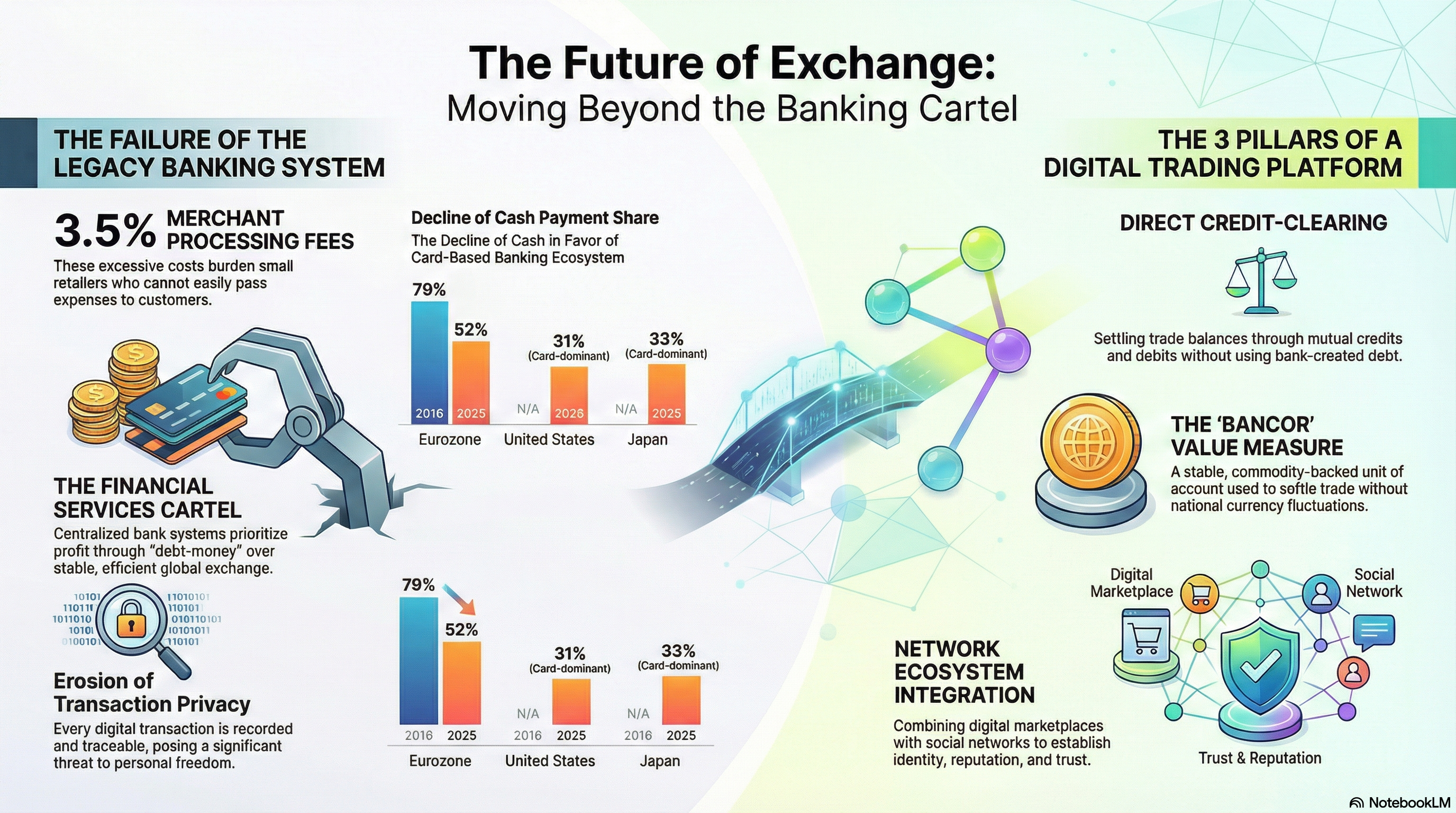

Everytime I add new sources to Gemini it generates evrn better brief video explanations. This latest one is excellent.
Posted in Debt, Finance and Economics, Geopolitics
Tagged credit clearing, Keynes, money problem
Clearing works at any level to settle claims – (1) among banks to settle claims arising from their clients’ check transactions, (2) among companies and individuals engaged in trade to offset their accounts payable against their accounts receivable, and (3) among nations to settle international trade balances. The first of these is well established and generally understood. The second is what occurs within grassroots mutual credit clearing systems (like LETS) and the commercial “barter” or trade exchanges that have proliferated around the world and are now enabling billions of dollars of cashless trading to take place every year. These private initiatives provide the inspiration and the prototypes that are now being scaled up and interconnected to make for more a efficient, secure, and equitable transaction infrastructure.
The third, which requires action at the highest levels of government, has been done on a bilateral basis (like barter) but the potential for multi-lateral clearing of trade balances has yet to be seriously considered. Is there sufficient vision, will, and independence of action at that level for anything useful to be done? That remains to be seen.
The present global financial order, which was largely established at Bretton Woods toward the end of World War II, is based on dollar dominance and exploitative initiatives that are managed through the intuitions that were forced upon the world at that time (the IMF and World Bank). I’ve not made a detailed study of the proposals that were made then, but according to a recent article by George Monbiot in the Guardian (UK), the Bancor proposal of John Maynard Keynes might deserve a second look. The article is titled, Keynes is innocent: the toxic spawn of Bretton Woods was no plan of his, and I encourage anyone who has an interest in this subject to read it. According to Monbiot, “The economist’s dream was blocked for an IMF serving the rich. Reforms proposed by G20 leaders are too little, too late.”
The details of the plan as described in the Guardian article may not be entirely to my liking, but it may be a good starting point for negotiations among a few enlightened governments to create an independent system for managing trade among themselves. – t.h.g.
UPDATE: I have since found an IMF document that purports to present the details of the Keynes Plan. I’ve not yet studied it in any depth, but it can be downloaded here.
Posted in Geo-politics, Global Economy, The Political Money System
Tagged bancor, barter, clearing, Guardian, international trade, Keynes, Monbiot
The first edition of my book, The End of Money and the Future of Civilization, was published by Chelsea Green Publishing in 2009. While it remains as relevant today as it was when first published the printed book has been out of print for several years. But, having had the rights reverted to me by my publisher, I am making the entire book available for free in PDF format. You can read it or download it HERE. If you would like a hard copy of the first edition used copies can still be found on Amazon.com, Abe books, Thrift books and elsewhere.
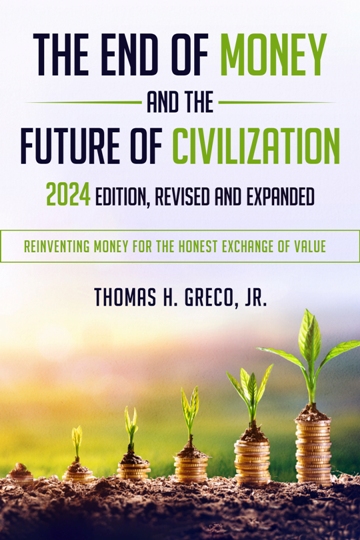 Better still, you can avail yourself of the new revised and expanded 2024 edition which I have been working on for almost two years and is almost complete. Eighteen chapters have already been posted and can be freely read or download HERE.
My previous books, as published, may be freely accessed in digital format by clicking the title below.
Money: Understanding and Creating Alternatives to Legal Tender (2001)
New Money For Healthy Communities (1994)
Money and Debt: a Solution to the Global Crisis (1980)
Collectors may find used and some new print copies of my books as published, on amazon.com and elsewhere online. Start by clicking on the title below:
Money: Understanding and Creating Alternatives to Legal Tender (2001)
| M | T | W | T | F | S | S |
|---|---|---|---|---|---|---|
| 1 | ||||||
| 2 | 3 | 4 | 5 | 6 | 7 | 8 |
| 9 | 10 | 11 | 12 | 13 | 14 | 15 |
| 16 | 17 | 18 | 19 | 20 | 21 | 22 |
| 23 | 24 | 25 | 26 | 27 | 28 | 29 |
| 30 | 31 | |||||
 Beyond Money
 Beyond Money