The first edition of my book, The End of Money and the Future of Civilization, was published by Chelsea Green Publishing in 2009. While it remains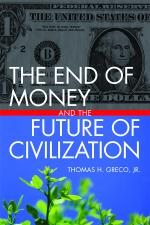 as relevant today as it was when first published the printed book has been out of print for several years. But, having had the rights reverted to me by my publisher, I am making the entire book available for free in PDF format. You can read it or download it HERE. If you would like a hard copy of the first edition used copies can still be found on Amazon.com, Abe books, Thrift books and elsewhere.
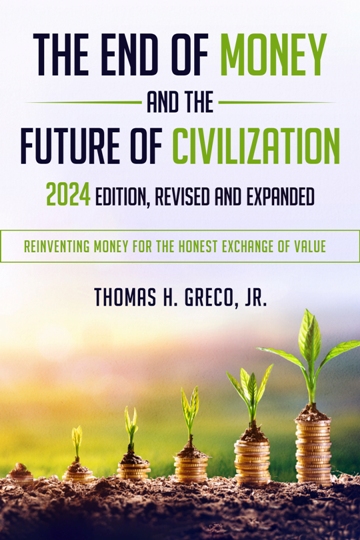
 Better still, you can avail yourself of the new revised and expanded 2024 edition which I have been working on for almost two years and is almost complete. Eighteen chapters have already been posted and can be freely read or download HERE.
My previous books, as published, may be freely accessed in digital format by clicking the title below.
Money: Understanding and Creating Alternatives to Legal Tender (2001)
New Money For Healthy Communities (1994)
Money and Debt: a Solution to the Global Crisis (1980)
Collectors may find used and some new print copies of my books as published, on amazon.com and elsewhere online. Start by clicking on the title below:
Money: Understanding and Creating Alternatives to Legal Tender (2001)
New Money For Healthy Communities (1994)
Money and Debt: a Solution to the Global Crisis (1980)



 Beyond Money
A quick technical note. Having read your book, the term “The End of Money” seems to me like a misnomer. A more precise definition of the concept laid out in the book would be something like “The End of EXOGENOUSLY Introduced Monies” – as opposed to, and in favor of, money arising ENDOGENOUSLY out of the exchange of goods and services in the real economy. As much as I hate the big words, in this case they are quite apt.
Jeanny
LikeLike
Hi Jeanny, thanks for your comment.It all depends on how one defines “money.” I often argue that there are two kinds of money–honest money and dishonest money, or legitimate money and illegitimate. I will better explain that in my new edition of “The End of Money…”, stay tuned.
But here’s a preview:
The Exchange function requires only two elements, credit, and an accounting unit that quantifies the amount of credit. That unit must be defined in terms of something real, like gold or silver as it was in former times. But an assortment or “market basket” of several commodities will provide a more stable measure of value than any single commodity.
Producers of real value can organize themselves to give each other credit, as they commonly do already. As they trade among themselves, their debits or obligations can be offset against their credits or claims. With these two elements, credit and an accounting unit based on real value, the need for money is eliminated. Further, between the time when the credits are issued and when they are redeemed, others outside the credit circle can use those credits as an alternative voucher currency to pay what they owe to others.
Saving, the other function that money is supposed to provide, can be accomplished by those who have surplus exchange credits that they wish to save, by using them to buy longer term obligations such as equity shares, or debt instruments like bonds notes or bills. In that way, the savings of some provide investment capital for others to use to become productive. Again, the need for money and borrowing from banks is eliminated. All of this can be achieved on a cooperative basis without charging interest but only fees sufficient to cover operating costs of the cooperative. Nor is there any need for government involvement beyond the adjudication and enforcement of legal contracts.
These changes alone can decentralize the control of finance, politics, and the economy, rein in reckless adventures of national governments, eliminate the endless growth of debt, and usher in a new civilization of peace and a dignified life for all.
LikeLike