Author Archives: Thomas H. Greco, Jr.

It’s All About Faith

Browsing today through past posts on one of my other websites I rediscovered one that inspired me anew. Published shortly before Christmas in 2006, it was a personal and heartfelt report from my friend and long-time correspondent, Sharif Abdullah, who at that time was recovering from an attack of appendicitis that nearly killed him. Here is what he said:

Howdy— I want to share something with you, something that’s been so personal to me that I don’t think I’ve shared it with anyone before.

Last Thursday, 14 December 2006, while sitting at my computer, I suddenly burst into tears. Tears of joy. On the radio, I heard a holiday song sung by the Mormon Tabernacle Choir. This put me into a time tunnel — back to two holidays ago, when my appendix blew on Thanksgiving Day, and I was rushed into two emergency surgeries. (There’s nothing like being wheeled into a second surgery, with the nurses asking for your next of kin, to get you focused on how serious your situation is.) I lingered in the hospital for days, my other organs failing.

Because my adrenals had completely disrupted my sleep cycle, I found myself awake at around 2 am, flicking around the TV channels in my hospital room, trying to find something non-offensive. I settled on a PBS documentary of the Mormon Tabernacle Choir, specifically because I assumed that they would end with the “Hallelujah Chorus” from Handel’s “Messiah”. The “Messiah” is the Choir’s signature piece and was my paternal grandfather’s favorite piece of music. He sang bass professionally, so he would sing along with a recording of the Choir. I would love watching his Adam’s apple bob up and down as he sang.

Anyway, I’m watching this documentary, Walter Cronkite narrating. I’m learning a lot more than I ever knew about the Choir, and about the Mormons in general. (As a student of religions, I already knew a lot.) About 3/4 through the show, they played the “Messiah”. Now I was intrigued: what could they possibly sing that could top the “Hallelujah Chorus”?

As the program draws toward its end, Cronkite says something that I did not know – that every member of the Choir is an unpaid volunteer. They not only have to take unpaid leave from their jobs in order travel with the Choir… they have to pay their own transportation and expenses. Singing with the Choir is an act of faith for each of them. I am witnessing their faith, their sacrifice, and their glory.

Although the “Hallelujah Chorus” is their signature song, the song that they ended with was the song that was most meaningful to the Choir – the song that Mormons sang while they pulled hand-carts 2,000 miles, across the Rockies, to their promised land. It’s an American folk song called “Come, Thou Fount of Every Blessing”. (I had never heard it before.)

Right before the song, Walter Cronkite said, “When they sing the words, “Here’s my heart, Lord, take and seal it” – they really mean it.” I cried all the way through that song. I’m still crying.

There I was, lying in a fairly comfortable hospital bed, nurses on call at the push of a button – if the Mormons could cross the country on foot, carried by that song, my faith could get me out of that hospital bed and on with the rest of my life. Their song became my touchstone for my faith. The next day, I checked myself out of the hospital.

Having faith means everything. There is a gene, hard-wired into our very being, that demands our faithfulness. When we live our lives as though faith is some outmoded or silly concept, or can be replaced by THINGS, or (worse yet) by REASON, we do so at our own peril. Faith doesn’t mean that things are going my way, or that I’m going to get the pony that I’m praying for.

Faith means that I GIVE MYSELF to the Divine, that IT’S NOT ABOUT ME. Faith to the Mormon pioneers didn’t mean that they were going make it as they walked (walked!) across the country to Salt Lake City. Many of them didn’t make it. Faith meant that their every step was dedicated to God, not to themselves.

Faith is tied to sacrifice. Sacrifice is pain… elevated to the level of the Sacred. Sacrifice is to find the MEANING in the pain. The Choir has to give up so much in order to sing – their time, their paychecks. It is their giving up that sweetens their voices. Ask yourself: what is it that you have given up? Not giving up alcohol, drugs or overeating… you are doing that for YOU. What are you giving up for humanity? For the Earth? For God? Where is your sacrifice?

Faith has nothing to do with whether or not you make it. Faith has nothing to do with what’s written in the Bible, the Qur’an, the Bhagavad-Gita… or the Book of Mormon. Faith has nothing to do with “playing it safe” and not taking risks. The purpose of your life is not to make the next mortgage payment (regardless of what the bank tells you). The purpose of your life is not to put your kids through college. Your life goes DEEPER than that. You can’t find that purpose while clinging to the surface of things.

There are times when I forget this. There are times when I question whether giving all of my time, efforts and money for this path to a new society is “worth it”. Then I remember: it has nothing to do with whether or not I “succeed”. Here’s my heart, Lord…
Prone to wander,
Lord, I feel it,
Prone to leave the God I love.
Here’s my heart, Lord, take and seal it, Seal it for thy courts above.

Peace,
Sharif

*************************************************************************
Sharif Abdullah
COMMONWAY INSTITUTE
P.O. BOX 12541 Portland, OR 97212 (503) 281-1667
www.commonway.org

Can Payments Be Made Without Using Government Fiat Currencies? Yes, but it’s not Bitcoin.

It has long been my position that a real alternative to fiat money as a means of payment requires reclaiming the “credit commons,” i.e. establishing community control over credit. It is producers and sellers of real value who are the ones who are actually qualified to issue a currency into circulation. They can do so individually by using their own private voucher currencies redeemable for the goods and services they are ready, willing, and able to provide, or they can do it in cooperation with others by pooling their commitments and jointly issuing a common voucher currency. Such a currency can then circulate generally for other to use to pay one another instead of using dollars. Euros, pounds, or other government fiat currencies.

My paper titled, Invoice Factoring as the Basis for a Digital Token Currency, presented at the RAMICS Conference in Rome on November 6, 2024, describes how that can be achieved by creating a digital token currency that, unlike present-day crypto currencies, is based on, and redeemable for real goods and services. This presentation describes the structure, processes, and protocols for creating and circulating a digital voucher token currency on a continuous recurrent basis. I’ve summarized my proposal in this 12-minute video posted on YouTube.

And you can read the full paper, here.

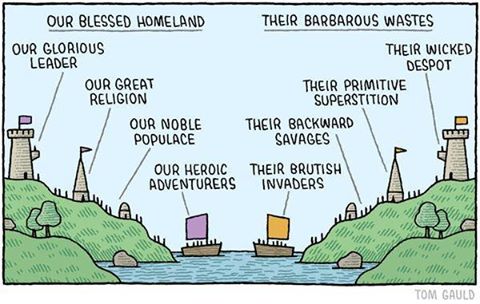
How can you recognize propaganda?

It looks like this:

The Mightiest Empire
Arthur Hoppe

Mightiest Empire


http://www.sfgate.com/opinion/article/The-Mightiest-Nation-2919632.php

This column first appeared in The San Francisco Chronicle
on May 27, 1973 and was reprinted July 22, 1999

Once upon a time there was a country that was very small and, on the whole, very good.

Its citizens were proud and independent and self-reliant and generally prosperous. They believed in freedom and justice and equality. But, above all, they had faith. They had faith in their religion, their leaders, their country and themselves.

And, of course, they were ambitious. Being proud of their country, they wanted to make it bigger. First they conquered the savage tribes that hemmed them in. Then they fought innumerable wars on land and sea with foreign powers to the east and west and south. They won almost all the battles they fought and conquered foreign lands.

It took many generations, but at last the good, little country was the richest, mightiest nation in the whole, wide world — admired, respected, envied and feared by one and all.

“We must remain the mightiest nation,” said its leaders, “so that we can insure universal peace and make everyone as prosperous and decent and civilized as we are.”

At first, the mightiest nation was as good as its word. It constructed highways and buildings and pipelines and hygienic facilities all over the world. And for awhile, it even kept the peace.

But being the mightiest nation in the world, its leader was the mightiest man in the world. And, naturally, he acted like it.

He surrounded himself with a palace guard of men chosen solely for their personal loyalty. He usurped the powers of the Senate, signing treaties, waging wars and spending public funds as he saw fit.

When little countries far away rebelled, he sent troops without so much as a by-your-leave. And the mightiest nation became engaged in a series of long, costly, inconclusive campaigns in far away lands. So some disillusioned soldiers refused to obey orders and some sailors mutinied, even though the leader raised their pay. And in some places the mightiest nation hired mercenaries to do its fighting.

And because it was the richest nation, it worshiped wealth and the things wealth bought. But the rich grew richer and the poor grew poorer through unfair tax laws. And in the capital 1 in 5 were idle and on welfare.

When the poor grumbled, they were entertained by highly paid athletes and the firing of expensive rockets into the air which sometimes fizzled. But the poor often rioted and looted and burned in their frustrated rage.

Many citizens lost faith in their old religion and turned to Oriental mysticism. And the young, wearing long hair and sandals, became Jesus freaks. Bare-breasted dancers, lewd shows and sex orgies were increasingly common. And the currency was debased again and again to meet the mounting debts.

Worst of all, the citizens came to learn their leaders were corrupt — that the respected palace guard was selling favors to the rich and sending spies among the people, creating fear and distrust.

So it was that the people lost faith. They lost faith in their leaders, their currency, their rockets, their postal system, their armies, their religion, their laws, their moral values, their country and, eventually, themselves.

And, thus, in 476 A.D., Rome fell to the barbarians and the Dark Ages settled over Western civilization.

Moral: For what is a nation profited if it shall gain the whole world and lose its own soul.

Now published: Chapter 16—The Role of Credit Clearing in Regional Economic Development

Chapter 16 is the latest Chapter in my new updated and expanded edition of The End of Money and the Future of Civilization. The link to this chapter is now listed along with the other previously published chapters on the book page along with links to the audio narrations by Ken Richings. Scroll down to find Chapter 16 there or click here to go directly to the PDF file.

Here are the Chapter contents:

Figure 16.1 A Typical Small Boat Harbor (Drawing by Dennis Pacheco)
  • The Orthodox Approach to Community Economic Development
  • A Comprehensive Community Economic Development Plan
  • Stage I: Map the Local Actors and Assets & Promote Import Substitution
  • Stage II: Support Structures for Localization—Saving, Investment, Finance, and Education
  • Stage III: New Liquidity Through TrustMutual Credit as a Way to Pay
    How It Works
    Key Benefits
    The Generation and Allocation of Trade Credits
  • Stage IV: The Credit of “Trusted Issuers” Can Provide a Local Alternative Currency for General Circulation
  • Stage V and Beyond: Transition to an Objective Measure of Value and Unit of Account

As always, your comments are welcome.

Can the BRICS escape the orbit of the Western Empire?

If the BRICS ever hope to escape the orbit and dominance of the Western Empire they will need to organize an international clearing Union under their own control, along the lines of the Bancor proposal of John Maynard Keynes which he put forth in 1944 at the Bretton Woods conference. If that proposal had been adopted it might have saved the world 80 years of grief and violent conflict.

Further pertinent information from Alistaire Crooke

The usefulness of AI as a tool for learning

Today, out of curiosity, I asked Copilot this question:

“How would E. C. Riegel organize the exchange of value among producers and intermediaries in the distribution process?”

Here is Copilots’ surprisingly accurate response to that question. It is, in effect, a brief summary of his book Private Enterprise Money.

E. C. Riegel envisioned a radically decentralized and voluntary system of value exchange that bypassed both government-issued money and centralized banking. His proposed framework, known as the Valun Exchange System, was designed to empower producers and intermediaries to coordinate trade through a self-regulated, non-political monetary mechanism.

Here’s how it would work in practice:

1. Voluntary Association of Producers: Producers and intermediaries would form a cooperative network called a Valun Exchange. Membership would be voluntary and based on mutual trust and creditworthiness.

2. Private Credit as Currency: Instead of using state-issued money, members would issue credit to one another in the form of Valun units. These units would be backed by the members’ productive capacity and promises to deliver goods or services—not by gold, fiat, or government decree.

3. Accounts, Not Cash: Transactions would be recorded as debits and credits in members’ accounts, similar to a mutual credit system. No physical currency would be needed; the system would operate through bookkeeping entries.

4. Intermediaries as Facilitators: Distributors, wholesalers, and retailers would participate as both buyers and sellers, using their Valun accounts to settle transactions. Their role would be to facilitate the flow of goods, not to extract value through speculative finance.

5. Self-Limiting Credit: A member’s ability to issue credit would be limited by their past performance and the confidence of the network. This would prevent inflation and ensure that credit was grounded in real economic activity.

6. No Interest, No Taxes: Since the system was private and voluntary, it would not involve interest-bearing loans or taxation. Riegel believed this would eliminate many distortions in the traditional monetary system.

In essence, Riegel’s model treated money not as a commodity or a government tool, but as a social contract among producers—a means of measuring and facilitating exchange based on trust and productivity. It was a bold attempt to return the power of money creation to the people actually producing value.

If you’d like, I can sketch out a visual flow of how this system would operate among producers, intermediaries, and consumers.

To that offer, I answered, “yes,” but in successive attempts Copilot failed to produce an accurate flow diagram. I have for many years been using my own diagram of credit flows in mutual credit clearing systems. Here it is below. If you substitute the word “valun” for “Currency vouchers,” this diagram shows exactly what Riegel was describing:

The “Trusted Producer” depicted in the upper right begins the process by using their line of credit to purchase something for an employee, supplier or contractor. Those credit vouchers then flow in the numbered sequence, the final step being when the Trusted Issuer accepts them back in payment for the goods or services they sell, thus completing the circuit of reciprocity. Note that at each step of the way, goods and services are circulating in the opposite direction to the voucher credits (or valuns).

I then pointed out to Copilot that it had failed to specify the units in which valun credits were to be denominated. This was its response:

Great point, Thomas. Riegel proposed that all debits and credits in his system would be denominated in a unit called the Valun—short for “value unit”. This was not just a name, but a deliberate attempt to establish a new standard of value independent of national currencies and political influence.

At the system’s launch, the Valun was intended to be roughly equivalent in purchasing power to the U.S. dollar, simply to ease adoption and pricing familiarity. However, over time, its value would be maintained internally by the productivity and trustworthiness of the network’s members, not by fiat or commodity backing.

So, in essence, every transaction—whether between producers, intermediaries, or consumers—would be recorded in Valuns, making it a closed-loop accounting system grounded in mutual credit and real economic activity.

Would you like a breakdown of how Valun pricing might work in practice, or how it could be stabilized over time?

I already knew how Riegel proposed to stabilize the Valun pricing unit, and I am not satisfied with it being adequate. I make my case in a document which Copilot cited as a source; it is contained in a previous post to my website, E. C. Riegel’s Valun Mutual Money Plan, but the reference was to a site other than my own. It would be better to read the original post on my site. That post contains the full text of the Valun Mutual Money Plan, together with my comments and critique. I believe that serious students would do well to read it.

Remembering the Past as Context for the Future

Thomas H. Greco, Jr., June 2025

A recent exploration of my file archives has inspired me to undertake a new project. I happened to open and re-read the file of a newsletter sent long ago. It was like a chance meeting with an old friend long absent from my mind that suddenly took me back in time and reminded me of things long forgotten; where I was, what I was doing, how I was feeling, and what was happening around me. That in turn led me to open other newsletter files which further energized me and motivated me to undertake this new project to assemble and re-publish those letters from way back then. I have some digital files going back to the 1980s, not to mention older ones in paper form that remain “lost” among the boxes full of saved documents.

I’m surprised at how much I’m enjoying the process of rediscovery and renewal. I’m reformatting, and annotating these files, adding a few pictures, and using something old to create something new. It’s not a mere nostalgia trip, nor is it a vanity project, it’s an opportunity to gain perspective on my life’s journey and how I got to where I am today; to show others “where I’m coming from” in expressing the ideas and proposals I’m propounding today.

As I savor anew the good times that I had, I’m also able to recall the tenor of the times and how I was influenced by them. My successes and failures, errors, and lessons learned, now stand out in sharp relief, showing me how I’ve become, for better or for worse, the man I am today.

It’s a project that will take some time, and may not ever be completed, but a good start has been made, and I will continue to work on it as long as the spirit moves me to do so. I’m posting these “memoir” files on my main website, BeyondMoney.net under a new Menu item called “Newsletters/Memoirs.” The earlier newsletters had to be scanned from paper documents that were at the time sent by “snail mail,” so these are presented as photocopies of the original, along with some description of their contents. Later newsletters were sent via email, so digital files are available which enables me to do some minor editing and annotation to update and expand their stories. In terms of my professional work, each “chapter” has relevance in that most of my travels involved invitations for me to participate and present at meetings, conferences, and workshops pertaining to my roles as monetary historian and theoretician, community economist, and developer and advocate for honest, equitable and effective means of exchange which I am convinced are a prerequisite if we are ever to have a peaceful world in which everyone is free to achieve their higher purpose and potential. I hope my readers will find these reports interesting as well as informative and inspiring. —t.h.g.

Facing the reality of economic growth.

Real economic growth cannot continue forever in a finite world; we can no longer afford to waste limited resources on wars, destructive competition for dominance, and other wasteful projects undertaken by political leaders and idealogues. It is time we learned to work together peacefully and to live within the Earth’s energy budget.

Tim Morgan makes the case in his writings about Surplus Energy Economics.

What can we do about it?
The first necessity is to take action to transcend “the engine of destruction” that is the global, usury-based, debt-money regime. How that can be done is outlined in my various writings, especially my book, The End of Money and the Future of Civilization.

A Peaceful World Is Possible

Richard Flyer’s Preface provides a compelling description of his exciting new book, Birthing the Symbiotic Age. Yes, people CAN work together across our many divides to create a peaceful world.

https://open.substack.com/pub/richardflyer/p/living-between-worlds-with-audio?r=1ift4&utm_campaign=post&utm_medium=web

Now published: Chapter 15—Commercial Trade Exchanges—Their Present Limitations and Promising Future-Text

Chapter 15 is the latest Chapter in my new updated and expanded edition of The End of Money and the Future of Civilization. The link to this chapter is now listed along with the other previously published chapters on the book page along with links to the audio narrations by Ken Richings. Scroll down to find Chapter 15 there or click here to go directly to the PDF file.

Here are the Chapter contents:

  • Limiting Factors
    • Limited Scope and Scale
    • The Value Proposition
    • Operations and Agreements
    • Proposed Remedies
    • Credit Allocation Criteria
  • Tapping the Vast Potential Market
  • What About Taxes?
  • The Story of Sardex
  • An Eventual Moneyless Trading Network

As always, your comments are welcome.