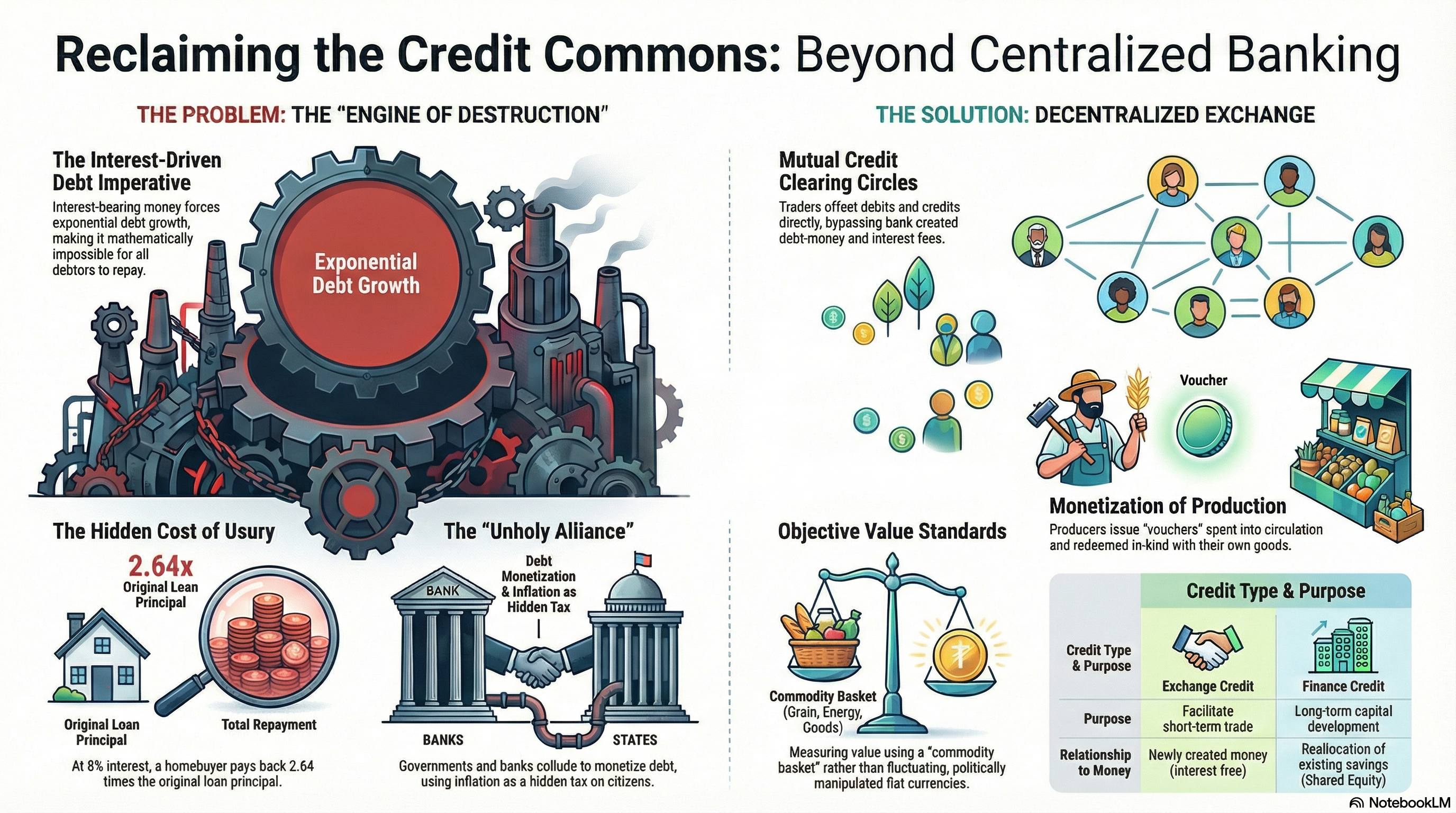
Yesterday I posted a remarkable six minute video that does an excellent job of explaining what I propose in Chapter 19—The Role of Governments in Solving the Money Problem, of my revised edition of my book, The End of Money and the Future of Civilization. The video below, which was also generated by NotebookLM, is based on additional material from my book and focuses on the nature of the money problem and how it has developed over more than 300 years. I am now working on the next video which will concentrate on explaining the solutions and alternative exchange devices and systems that I have long been prescribing. Watch for it.
IMDb, the popular online database of information related to films, television series, etc. has compiled A List of interesting Finance and Economics Documentaries/Short Films. While the last update to the list was made 11 years ago, these films are still extremely pertinent and worth watching. Some of them include interviews of yours truly. Readers are invited to add links to newer items as comments to this post.
This is the latest chapter to be published of my new 2024 edition of The End of Money and the Future of Civilization. It continues the story begun in the previous chapter of how money has evolved and changed its character over time.
Here is a brief excerpt:
Money has become merely an accounting system, a way of “keeping score” in the economic “game” of give and take. —Thomas H. Greco, Jr.
Let us begin by summarizing the evolution of the various kinds of money that have been used to mediate reciprocal exchange:
The circulation of gold and silver coins gave way to paper banknotes that were redeemable for gold or silver coins, which made the notes essentially warehouse receipts for gold on deposit.
Then, banks began to lend bank notes into circulation based on the pledge of collateral assets (some valuable and others not) other than gold, some of which included government obligations (bonds, notes, etc.).
But ALL notes were redeemable in gold. This became known as the “fractional reserve banking” system.
Bank account balances (checkable bank “deposits”) increasingly took the place of paper bank notes, and bank customers began to write checks against their deposits instead of using bank notes to make payments.
As banks created ever greater amounts of non-bona-fide money based on national government debts and other illegitimate collateral assets, the fiction of gold-backing and redeemability could no longer be supported, and governments reneged on their promise to redeem their currency for gold. This broke the final link between political fiat money and the real economy of valuable goods and services.
But, despite that, the emergence of credit clearing to offset credit obligation against credit claims was a major leap forward in facilitating the reciprocal exchange of value.
For now, you can read or listen to the entire chapter at Future Brightly:
It will also be published soon here, and on my own Substack channel. Further chapters will continue to be posted as they are completed. Watch for Chapter 11 to be posted soon.
As always, your comments and suggestions are welcomed, Thomas
The vast majority of people remain unaware of it, but the fact is, we have in our own hands, right now, the power to create or completely transcend money. As I’ve been preaching for many years, money is nothing more than credit, i.e., the willingness to trust that the value we provide as sellers of goods and services will be reciprocated when we become buyers. But, as we are now becoming so painfully aware, our trust in conventional political currencies and banks has been misplaced; we have been betrayed. It’s not only a matter of fraud and malfeasance, bad as that is, rather, the entire system was designed from the very start to enable the few to exploit the many.
There are two parasitic elements that are built into the central banking, debt-money system—interest and inflation. Every national currency is supported by the collective credit of the people. It is our own credit that we entrust to the bankers, then beg them to lend it back to us, and pay interest for the privilege. Besides that, the national government gets first priority in the allocation of credit. Banks like to lend to governments instead of to producers, because government securities are relatively risk-free and provide a guaranteed profit. When our collective savings prove insufficient to satisfy government’s spending demands, the banks will create enough new money to enable deficit spending, which is the essence of inflation. It is a hidden tax that eventually shows up as higher prices in the markets.
All of that will continue until the people are able to take back the reins of government, but that cannot happen until the people take back control of their economy, and that requires that we adopt new ways of mediating the exchange of goods and services that puts control in the hands of the people. E. C. Riegel eloquently expressed that prospect:
“To trade goods and services is a natural right of all people. To issue the money necessary to make these exchanges is also the natural right of all people who are intelligent enough to do so. We need not beg for money. We do not need to be money slaves: we can be money masters. When we have become money masters we shall master all our economic and political problems.
Dig up this treasure, your money power, that has been lying dormant in your consciousness and express it for wealth, health, peace and happiness by associating with others who are similarly awakened.”
The way to express our “money power,” and to achieve true democracy is to organize businesses and individuals into credit clearing associations and networks for the direct allocation of credit and payment without the use of political money. My writings, and those of E. C. Riegel, provide directions on how to do that.
I am currently in the process of publishing a major rewrite of my book, The End of Money and the Future of Civilization (Chelsea Green Publishing, 2009). The first nine chapters are already available for free download on this website here, and the works of E. C. Riegel are available on this website in the Library.
2012 was a very busy year for me, which included a five-week tour of Europe and the UK during which I gave a total of 15 presentations and workshops to various groups, in addition to consultations, discussions, and meet-ups with many kindred spirits and colleagues working in the realm of societal transformation. If you’re interested, you can read my report about it in my November 2012 Newsletter.
The latest chapter in my new 2024 edition ofThe End of Money and the Future of Civilization, has now been widely published. Here is an excerpt:
Erecting the ‘wall of separation between church and state’… is absolutely essential in a free society. — Thomas Jefferson
The established beliefs about money in today’s world have become a sort of religion in which a fundamental tenet holds that government must, either directly or indirectly, have power over the system of money creation and circulation. This erroneous belief has taken the world to the brink of disaster which will surely ensue unless we take steps to depoliticize money by achieving the separation of money and state.
It should be obvious by now that there will never be peace in the world so long as those who control our national governments are able to conjure up out of thin air the seemingly endless amounts of pseudo-money they need to pay for wars and whatever else might bolster their political and economic interests.
Erecting the ‘wall of separation between church and state’… is absolutely essential in a free society. — Thomas Jefferson
The established beliefs about money in today’s world have become a sort of religion in which a fundamental tenet holds that government must, either directly or indirectly, have power over the system of money creation and circulation. This erroneous belief has taken the world to the brink of disaster which will surely ensue unless we take steps to depoliticize money by achieving the separation of money and state. It should be obvious by now that there will never be peace in the world so long as those who control our national governments are able to conjure up out of thin air the seemingly endless amounts of pseudo-money they need to pay for wars and whatever else might bolster their political and economic interests.
Read all about it in Chapter8—The Separation of Money and State, the latest chapter to be published in my new 2024 edition of The End of Money and the Future of Civilization.
Further chapters will continue to be posted as they are completed. Watch for Chapter Nine to be posted soon. As always, your comments and suggestions are welcomed, Thomas
Covering the history of centralized banking, the danger of today’s concentration of wealth in the hands of a few who are working to completely control humanity; and the need to reinvent money, devolve power to local communities, and create honest “home-grown” means of payment (liquidity). His highly acclaimed book, The End of Money and the Future of Civilization, is being revised, updated, and expanded to reveal how the dysfunctional money system operates, and how to reinvent money to enable the honest exchange of value. New chapters are being posted serially on Future Brightly, on his website, as well as on his Substack and Medium channels. Almost all his writings and accumulated resources for researchers and monetary innovators can be downloaded free at BeyondMoney.net.
You can view or download the video here or on Podbean
The US dollar is rapidly losing its status as the global “reserve currency.” One after another, nations outside of the western coalition are waking up to the fact that dollars are needed only to pay for imports that come from the United States. In trades with other countries they are choosing to begin paying one another by using their own currencies, as reported in videos like this. They are recognizing that the real resources that they own are much more valuable than the empty promises that are embodied in inflated US dollars or other political currencies. The exploitation of weaker nations by the western powers that has been ongoing for centuries is coming to an end and the emergence of a multi-polar world order is now unstoppable.
The Bretton Woods agreement that established the post-war world financial order in 1944 was based on the promise that US dollars would be redeemed for gold at $35 an ounce. But the continuous debasement of the dollar over the years made that completely unrealistic, and ultimately its impossibility was formally recognized when President Nixon in 1971 “closed the gold window” and announced that the US government was reneging on that commitment. It would no longer give gold for dollars except at the prevailing market price. From that point on the fate of the dollar was sealed; it was just a matter of time. Despite the imposition of a series of extreme financial, economic, political, and military measures by the US and its western allies, time has run out on dollar dominance and the unipolar world order.
The main questions now are, 1) to what further extremes will the western empire resort in its desperate effort to forestall the inevitable political reordering, and 2) what sorts of new monetary and financial arrangements will be established to supplant the old Bretton Woods arrangement?
Regarding the first of these, the past several decades have seen a succession of both covert and overt interferences designed to weaken or neutralize monetary dissidents and potential political and economic rivals. Notable among the former have been Saddam Hussein, who in 2000 began selling Iraqi oil for Euros instead of dollars, and Muammar Gaddafi the Libyan leader who had plans to launch a pan-African currency called the Gold Dinar to free Africa from American domination. As a consequence, both men were murdered and their countries destroyed. Following the NATO invasion of Libya, and the murder of Gaddafi, then Secretary of State, Hillary Clinton, disgustingly and arrogantly boasted, “We came, we saw, he died!”
But nuclear armed Russia and China are not so easy to push around and brought to heel. When their Russian puppet Boris Yeltsin chose Vladimir Putin to succeed him as prime minister, the globalist western oligarchs thought they could continue to rape Russia and exploit its vast resources for their own purposes. But Putin surprised them with his loyalty to “Mother Russia” and his unwillingness to betray the Russian people to the globalists. Whatever we in the west might think about the man, his stance has clearly endeared him to the Russian people.
When the Soviet Union collapsed, the western powers promised not to move NATO farther to the east, but they have reneged on that promise, and one by one have brought the former Soviet republics into the western fold. [Robert F. Kennedy Jr. has elaborated on this point in his recent speech and highlighted the importance of respect for Russia’s legitimate security concerns if ever there is to be peace]. Then, in 2014 the CIA engineered the overthrow of the elected government in Ukraine and replaced it with their own puppet government to further pressure the Russian government to play ball. The perceived existential threat of NATO weapons, even nuclear ones, on their very doorstep, was too much for Russia’s leadership to bear. It should have come as no surprise to anyone that the Russians reacted as they did to counter that threat by launching their “special military operation.” Putin had stated repeatedly that he hoped to negotiate a deal that would respect Russia’s national security interests but the US government has chosen to perpetuate the war in order to weaken Russia and force it to submit. Former nuclear weapons inspector, Scott Ritter, with his military experience and vast knowledge of the region provides a much more nuanced picture of that siltation than the biased sound bites one typically gets from the mainstream media.
Farther to the east, China a major economic, political and military power, has also balked at submitting to a New World Order in which the Western Empire calls all the shots. So now the globalist oligarchs who control the US government see China as a major obstacle to their plan for establishing a trans-human, technocratic utopia under the control of the elite Super Class. Hence, we see continual saber rattling, military and political provocations, and endless prating about the “Chinese threat.”
Regarding a new system of exchange and finance, I expect that we may soon see the emergence of a multilateral system for clearing credits among nations, one that will be more along the lines of the Bancor plan that John Maynard Keynes proposed at Bretton Woods in 1944. Not that Keynes should be the last word on the matter, but he at least proposed a way of preventing trade deficits from becoming perpetual as they are now, by imposing a levy (interest) on positive balances, as well as negative balances, that would seem to eliminate the debt trap. Professor Perry Mehrling provides a brief description of the Bancor plan in this video.
I expect eventually to see the complete depoliticisation of money and the broader application of credit clearing directly among buyers and sellers at the level of individual traders, as they have been doing for decades through the scores of commercial trade exchanges that have been operating around the world. Money is, after all, merely an information system about credits and debits that enables goods and services that are sold to pay for other goods and services that are bought. Further, the settlement of accounts will be done not only through reciprocal exchange, but also through cooperative support and forgiveness of debts, which will bring with it greater fairness and finally a peaceful world. Indeed, there may someday be a world government, but it will not be imposed by force, nor will it be the product of greed and materialistic human minds.
# # #
Addendum: In this excellent article, America Has Just Destroyed a Great Empire, Prof. Michael Hudson offers a history lesson that underlines the points I’ve made in my article.
Here is a small excerpt:
Having endowed the region’s cosmopolitan Temple of Delphi with substantial silver and gold, Croesus asked its Oracle whether he would be successful in the conquest that he had planned. The Pythia priestess answered: “If you go to war against Persia, you will destroy a great empire.”
Croesus therefore set out to attack Persia c. 547 BC. Marching eastward, he attacked Persia’s vassal-state Phrygia. Cyrus mounted a Special Military Operation to drive Croesus back, defeating Croesus’s army, capturing him and taking the opportunity to seize Lydia’s gold to introduce his own Persian gold coinage. So Croesus did indeed destroy a great empire, but it was his own.
Fast-forward to today’s drive by the Biden administration to extend American military power against Russia and, behind it, China. The president asked for advice from today’s analogue to antiquity’s Delphi oracle: the CIA and its allied think tanks. Instead of warning against hubris, they encouraged the neocon dream that attacking Russia and China would consolidate U.S. control of the world economy, achieving the End of History.
But that’s not the way it’s working out. Please read the full article.
The first edition of my book, The End of Money and the Future of Civilization, was published by Chelsea Green Publishing in 2009. While it remains as relevant today as it was when first published the printed book has been out of print for several years. But, having had the rights reverted to me by my publisher, I am making the entire book available for free in PDF format. You can read it or download it HERE. If you would like a hard copy of the first edition used copies can still be found on Amazon.com, Abe books, Thrift books and elsewhere.
Better still, you can avail yourself of the new revised and expanded 2024 edition which I have been working on for almost two years and is almost complete. Eighteen chapters have already been posted and can be freely read or download HERE.
My previous books, as published, may be freely accessed in digital format by clicking the title below.



 Beyond Money