Category Archives: Banking

A different kind of bank

The Common Good Bank is a project with a great mission and a unique form of governance. You might consider making a commitment to participate. You and sign up at http://www.commongoodbank.com/signup.

Secret Banking Cabal Emerges From AIG Shadows: David Reilly

The most amazing thing about this story is that it appeared in Bloomberg, a mainstream financial news service. The second most amazing thing is that it acknowledges what critics  of central banks (including the Federal Reserve) have been complaining about for decades.

Here are a couple tidbits from the article, with my comments in italics. — t.h.g.

Jan. 29 (Bloomberg) — The idea of secret banking cabals that control the country and global economy are a given among conspiracy theorists who stockpile ammo, bottled water and peanut butter. After this week’s congressional hearing into the bailout of American International Group Inc., you have to wonder if those folks are crazy after all.
Well, duh…

As Representative Marcy Kaptur told Geithner at the hearing: “A lot of people think that the president of the New York Fed works for the US government. But in fact you work for the private banks that elected you.”
It is the bankers who have long dictated who would serve as Treasury Secretary, and most who have held that post had been top level bankers.

Yet when unelected and unaccountable agencies pick banking winners while trying to end-run Congress, even as taxpayers are forced to lend, spend and guarantee about $8 trillion to prop up the financial system, our collective blood should boil.
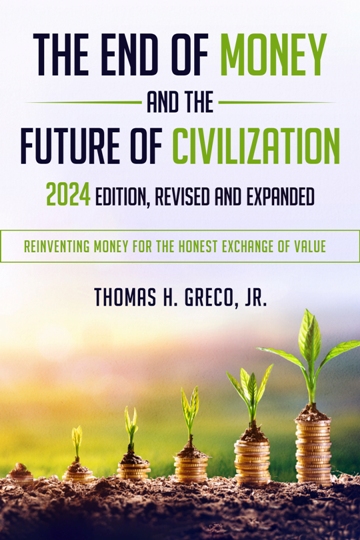
Indeed, but then what? The corrupt global system of money, banking and finance cannot be reformed. It needs to be transcended. My book, The End of Money and the Future of Civilization, describes effective action that can be taken by individuals, businesses, governments, and NGOs to achieve that outcome.

Read the full article here…

Capitalism-A Love Story

That’s the title of Michael Moore’s latest film.

If I were intent on finding fault with it, I might say that the film understates the case, or that there are huge gaps in the story it tells. But I prefer to focus on what the film is rather than what it isn’t. This film is, quite simply, a masterpiece; Moore’s best film ever. Every American, indeed, everyone in the world, should see it. It should be translated into every language in the world. It should be the focus of study groups, and stimulate community action across the country. —t.h.g.

The Real Reasons Behind Fed Secrecy

In one of his recent updates, Congressman Ron Paul says, “An audit would expose the Fed as a massive fraud perpetrated on this country, enriching a privileged few bankers at the top of our economic food chain, and leaving the rest of us with massively devalued dollars which we are forced to use by law.” You can listen to it here.

Ron Paul and the Federal Reserve

Ron Paul IS a national treasure. He is virtually the only member of Congress who has consistently and forcefully argued that the central banking system (the FED) needs to be eliminated. At the very least, the Fed must be accountable to the people. It is a private company that operates in secret.

Central banking from its very beginning (notably the founding of Bank of England) was designed to enrich the bankers and enable the political powers to circumvent popular control. The bankers are enriched by their monopoly control of our credit on which they require us to pay them interest when we “borrow” it back from them. The politicians get to spend virtually as much as they want to enrich themselves and their minions, to oppress the people, and to fight wars and undermine popular government and community self-determination.

The Fed enables all of this then tries to manage the effects of these crimes, giving us both depressions and inflation of the currency. That amounts simply to deciding who will be made to pay the price. On the one hand, small businesses are made to fail and workers become unemployed when banks restrict credit to the private productive sector, while at the same time lavishing credit on the government, bailing out financial behemoths, and financing mega-corporation that are deemed “too big to let fail.” On the other hand, the Fed will monetize government debt as needed to enable profligate government spending to continue. That monetary inflation naturally causes prices to increase, diminishing the purchasing power of everyone who lives on fixed incomes or has dollar denominated savings. In the extreme (hyper-inflation), the middle-class gets wiped out financially.

The one thing that NO ONE wants to talk about is LEGAL TENDER. It is legal tender laws that compel acceptance of debased political currencies. Without legal tender, those inferior currencies would quickly be displaced in the market by private and community exchange media that are properly issued on the basis of real value. This is happening anyway, as parallel exchange systems are being developed and used, but legal tender and general ignorance about money, banking, and credit put them at a disadvantage.

While the “Austrian School” of economics has managed to gain some attention, it’s too bad the “German School” has remained obscure. Names like Rittershausen, Beckerath, Zander, Meulen, and Milhaud, should become household words, along with E. C. Riegel. Their writings on free money and banking (i.e., free of monopoly control) are available at http://reinventingmoney.com.

These issues are largely covered in my various presentations that can be seen as movies or slide shows on my blog, http://beyondmoney.net.

— t.h.g.

Who Owns the U.S. Government?

The only surprising thing about this report is that it appeared on Fox News. Goldman Sachs has just reported record profits. Glenn Beck explains how your government made it possible.

The Crisis of Credit Visualized

Confused about the origins of the credit crisis? This animated video by Jonathan Jarvis helps to clear away the fog.

FED Inspector Clueless — Where Has All the Money Gone?

The recent testimony before Congress of the Inspector General of the Federal Reserve is laughably outrageous—a startling example of the persistent stonewalling and obfuscation by the private central bank that runs our government. Fortunately, we have a few courageous Representatives who are willing to ask the right questions. This video of questioning by Rep. Alan Grayson (D-Florida) is a “must see.”

Here is an excerpt from Rep. Grayson’s newsletter dated June 11, 2009:

Since last September, the Federal Reserve Bank has handed out over $1 trillion.  That’s $1,000,000,000,000.  It won’t tell us who got the money.

The Federal Reserve Bank also has guaranteed loans for an even larger amount.  Bloomberg News says around $9 trillion.  That’s $30,000 for every American.  It won’t tell us who got those guarantees.

I’m a member of the House Financial Services Committee.  A few weeks ago, the Inspector General of the Federal Reserve Bank was called as a witness.  I asked her if she knew who got the money.  She said no.

The Inspector General also admitted that she didn’t know how much money the Federal Reserve Bank has lost, already, on those deals.

That video was posted on YouTube, here.  Over 650,000 people have downloaded it and seen it.  That makes it the 6th most popular news video in the world last month, as you can see here.

Add the number who have seen the high-fidelity version, here, and the number of viewers is over 900,000.  Counting those viewers, it was the 4th most popular news video in the world last  month.

900,000 concerned citizens.  That’s more than the total circulation of every newspaper in Central Florida, combined.  That’s more than the total number of viewers watching the local news at 6 pm and 11 pm, combined.

The media did not cover this hearing at all.  But people found this clip on YouTube and told their friends about it, over and over again.

What this clip shows is that the Federal Reserve Bank is out of control.  And I’m working to do something about it.

I was the first Democrat to come out in favor of Rep. Ron Paul’s bill to audit the Federal Reserve Bank, H.R. 1207.  And I’ve used this video to mobilize bipartisan support for the bill.  Since the hearing, dozens and dozens of members of Congress have signed up.  They can see for themselves how badly this mess needs to be cleaned up.  We’re getting close to 218 co-sponsors, a majority of the House.

Congressman Ron Paul (R-Texas) has introduced a bill to not only audit the Federal Reserve, but also to abolish it (The Federal Reserve Board Abolition Act, H.R. 833. February 4, 2009). It’s encouraging to see the money and banking problem once more in the political spotlight. This is a time of great opportunity for liberating the “credit commons,” but it is also a time of great danger. Most politicians know little about the principles of sound money and banking, they believe in the centralization of power that is enabled by laws like “legal tender,” and they can easily be manipulated or bought off by the financial powers who will use any crisis as an opportunity to promote “solutions” that further enhance their power and ability to dominate economies, nations, and peoples.

It’s not only the Federal Reserve that’s “out of control,” it’s also our government and virtually all of our institutions and life support systems. The situation calls for the application of our collective intelligence to solving our problems and the devolution of power to the community level.

As I said in an earlier blog post, Eventually, it may be possible to act effectively at the governmental level, but only after the people have strongly asserted their own power to mediate the exchange process using their own credit apart from banks and the political money system. Only that assertion can bring about the “true free-market economy” that Mr. Paul desires. The nature of this power and how we can assert it are thoroughly addressed in my latest book, The End of Money and Future of Civilization. Please read it, and ask your representatives to read it. Better yet, send them a copy. –t.h.g.

What’s Wrong About the Political Money and Banking System?

To cut through all of the peripheral points, the main problems with the political money and banking system are:
1. The issuance of money on improper bases, mainly government debt, real estate, and assets of questionable value.
Principle: Money should be issued on the basis of goods and services already in the market or shortly to arrive there. All other needs (capital formation and consumer spending) should be financed out of savings.
2. Legal tender laws that force acceptance at par of debased political currencies.
Principle: Legal tender laws should be abolished. Only the issuer of a currency should be required to accept it at par. In the absence of legal tender, debased currencies will either be refused or pass at a discount in the market.
3. The charging of interest on credit money that is created as “loans.”
Principle: Money should be created interest free as a generalization of trade credit that facilitates the exchange of goods and services.

— t.h.g.

More Drum Beats for a Single Global Currency and a Global Central Bank

The global financial and economic crisis continues to deepen. Bankruptcies, unemployment, and home foreclosures are up, while incomes from wages, interest on savings, and investments are being squeezed. At the same time the money supply is being inflated by deficit spending to finance massive bank bailouts. A major increase in the cost of living will eventually follow.

The bankers and politicians who caused the problem in the first place are asking the people to trust them and accept more of the same medicine. Their plea is essentially this: “Give us more power, give us more money, and let us further centralize an already over-centralized system.” A global central bank and an eventual single global currency are what they have in mind.

A recent article by Paul Joseph Watson pretty clearly lays it out.