Category Archives: Developing Alternatives

The usefulness of AI as a tool for learning

Today, out of curiosity, I asked Copilot this question:

“How would E. C. Riegel organize the exchange of value among producers and intermediaries in the distribution process?”

Here is Copilots’ surprisingly accurate response to that question. It is, in effect, a brief summary of his book Private Enterprise Money.

E. C. Riegel envisioned a radically decentralized and voluntary system of value exchange that bypassed both government-issued money and centralized banking. His proposed framework, known as the Valun Exchange System, was designed to empower producers and intermediaries to coordinate trade through a self-regulated, non-political monetary mechanism.

Here’s how it would work in practice:

1. Voluntary Association of Producers: Producers and intermediaries would form a cooperative network called a Valun Exchange. Membership would be voluntary and based on mutual trust and creditworthiness.

2. Private Credit as Currency: Instead of using state-issued money, members would issue credit to one another in the form of Valun units. These units would be backed by the members’ productive capacity and promises to deliver goods or services—not by gold, fiat, or government decree.

3. Accounts, Not Cash: Transactions would be recorded as debits and credits in members’ accounts, similar to a mutual credit system. No physical currency would be needed; the system would operate through bookkeeping entries.

4. Intermediaries as Facilitators: Distributors, wholesalers, and retailers would participate as both buyers and sellers, using their Valun accounts to settle transactions. Their role would be to facilitate the flow of goods, not to extract value through speculative finance.

5. Self-Limiting Credit: A member’s ability to issue credit would be limited by their past performance and the confidence of the network. This would prevent inflation and ensure that credit was grounded in real economic activity.

6. No Interest, No Taxes: Since the system was private and voluntary, it would not involve interest-bearing loans or taxation. Riegel believed this would eliminate many distortions in the traditional monetary system.

In essence, Riegel’s model treated money not as a commodity or a government tool, but as a social contract among producers—a means of measuring and facilitating exchange based on trust and productivity. It was a bold attempt to return the power of money creation to the people actually producing value.

If you’d like, I can sketch out a visual flow of how this system would operate among producers, intermediaries, and consumers.

To that offer, I answered, “yes,” but in successive attempts Copilot failed to produce an accurate flow diagram. I have for many years been using my own diagram of credit flows in mutual credit clearing systems. Here it is below. If you substitute the word “valun” for “Currency vouchers,” this diagram shows exactly what Riegel was describing:

The “Trusted Producer” depicted in the upper right begins the process by using their line of credit to purchase something for an employee, supplier or contractor. Those credit vouchers then flow in the numbered sequence, the final step being when the Trusted Issuer accepts them back in payment for the goods or services they sell, thus completing the circuit of reciprocity. Note that at each step of the way, goods and services are circulating in the opposite direction to the voucher credits (or valuns).

I then pointed out to Copilot that it had failed to specify the units in which valun credits were to be denominated. This was its response:

Great point, Thomas. Riegel proposed that all debits and credits in his system would be denominated in a unit called the Valun—short for “value unit”. This was not just a name, but a deliberate attempt to establish a new standard of value independent of national currencies and political influence.

At the system’s launch, the Valun was intended to be roughly equivalent in purchasing power to the U.S. dollar, simply to ease adoption and pricing familiarity. However, over time, its value would be maintained internally by the productivity and trustworthiness of the network’s members, not by fiat or commodity backing.

So, in essence, every transaction—whether between producers, intermediaries, or consumers—would be recorded in Valuns, making it a closed-loop accounting system grounded in mutual credit and real economic activity.

Would you like a breakdown of how Valun pricing might work in practice, or how it could be stabilized over time?

I already knew how Riegel proposed to stabilize the Valun pricing unit, and I am not satisfied with it being adequate. I make my case in a document which Copilot cited as a source; it is contained in a previous post to my website, E. C. Riegel’s Valun Mutual Money Plan, but the reference was to a site other than my own. It would be better to read the original post on my site. That post contains the full text of the Valun Mutual Money Plan, together with my comments and critique. I believe that serious students would do well to read it.

The Power of Love!

This Symbiotic Culture post by Richard Flyer is, in my opinion, his most compelling thus far. His story about the Parallel Polis movement which arose within Czechoslovakia in the late 1970s in the midst of an oppressive Communist government, superbly illustrates the power inherent in the spirit of love which impels people to come together, cooperate, and share, despite our many differences and the tyrannical nature of the systems in which we might be embedded.

A Real Alternative to the Dollar; It’s not Bitcoin

Brett Scott has recently written an article titled The Art of Crypto Kayfabe, with the added tagline “You know the cage-fight between Bitcoin and the Dollar was staged all along, right?”

That article is masterful in debunking claims that Bitcoin and similar artificial digital commodities provide an alternative means of payment to the Dollar and other political currencies. He argues that “The actual monetary system is a coercive and extractive credit vortex underpinned by powerful legal structures, military, and the commercial banking sector around the world,” and that “Capitalism isn’t some merry ye olde market. It’s a gigantic global organism built upon state foundations that uphold private property laws, allows corporations to exist, and hold the reins of a transnational money system that both expands and contracts.”

It has long been my position that a real Dollar alternative requires reclaiming the “credit commons,” i.e. community control of credit that producers and sellers of real value allocate to one another, and that credit needs to be quantified in units that are defied on the basis of a real commodity or group of commodities that are in regular demand.

My paper titled, Invoice Factoring as the Basis for a Digital Token Currency, presented at the RAMICS Conference in Rome on November 6, 2024, described how that can be done by creating a digital token currency that, unlike present-day crypto currencies, is based on, and redeemable for real goods and services. This presentation describes the structure, processes, and protocols for creating and circulating a digital voucher token currency on a continuous recurrent basis. I’ve summarized my proposal in this 12-minute video posted on YouTube.

Read the full paper here.

A pathway toward building a decentralized, peaceful, convivial society

This short video about Sarvodaya describes with great clarity the pathway toward creating a decentralized, peaceful, convivial society that Gandhi and others have envisioned, and the Symbiotic Culture that Richard Flyer has for a long time been working on and writing about.

Now published, Chapter 11—Credit Clearing, the “UnMoney”

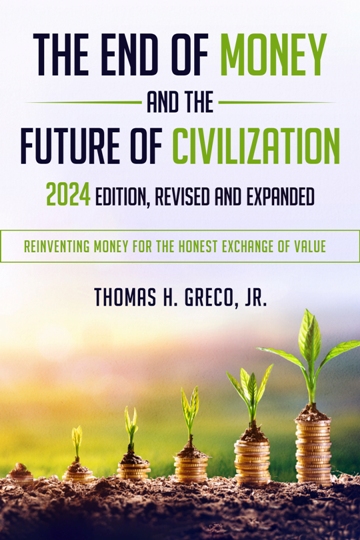
This is the latest chapter to be published of my new 2024 edition of The End of Money and the Future of Civilization. It continues the story about “credit clearing” that was begun in the previous chapter and shows how it will revolutionize trade and payments and make money, as we have known it, obsolete.  

Here is a brief excerpt:

If there were no money, any system of crediting sellers and debiting buyers would be fully competent to accomplish the work now performed by money. – Hugo Bilgram, 1914

In Chapter 10 we explained that the highest stage in the evolution of reciprocal exchange is “credit clearing,” and that banks have been using it for the past few hundred years to settle obligations amongst themselves.  In this chapter we will further describe the history and applications of credit clearing, and we will show how clearing can be used to offset claims among not only groups of banks, but also among any persons or entities that have financial claims against one another. Most significantly, it is a process that may be applied among buyers and sellers of goods and services to directly offset their respective claims without involving banks as middle-men and without the need for conventional bank- or government-created currencies.

Direct Clearing Among Buyers and Sellers

Credit clearing is actually an ancient process. During the Middle Ages, credit played a major role in the various European “market towns” which hosted, at regular intervals, trading fairs in which merchants from widely scattered areas would gather to trade their goods. It is reasonable to conclude that the process of credit clearing would have been fundamental in their trading activities. This is evidenced by the fact that these market towns typically provided market courts for settling disputes under “merchant law” that was separate from common law and could be adjudicated in a matter of hours or days. James Davis points out that, “At the pettiest level of sales credit, many traders appear to have acted both as creditors and debtors, and there is evidence for running accounts, reciprocal dealings and a ‘complex of claims and counterclaims,’” and that, “Credit oiled the wheels of trade, and market courts dealt in small-scale sales debts that were integral to local retail and wholesale commerce. A market court ostensibly lowered transaction costs and thus attracted more traders by aiding a perception of the market as ‘fair, affordable, efficient’”. 

The possibilities of direct credit clearing among buyers and sellers have long been recognized. In modern times, as early as 1914, Hugo Bilgram and L. E. Levy noted that, “If there were no money, any system of crediting sellers and debiting buyers would be fully competent to accomplish the work now performed by money.”  They further suggested that:

“Were a number of businessmen to combine for the purpose of organizing a system of exchange, effective among themselves, they could clearly demonstrate how simple the money system can really be made. The greater the number of businessmen that would thus cooperate, the more complete would be their own emancipation from the obstruction to commerce and industry which existing currency laws impose.”

They then went on to propose such a system and describe how it might operate, which I summarized in one of my previous books and in a website post.  I’ll not repeat that here because the context today is much different from what it was in 1914, but we will present a similar proposal based on what has since been learned and tailored to our current realities. I believe that it is no exaggeration to say that the creation and operation of such credit clearing systems is crucial to reversing the present trend toward economic ruin and global tyranny and changing the course toward realizing our human potential and the emergence of a peaceful, convivial civilization in which all can thrive.

You can read or listen to the entire chapter here.

Newsletter, August 2024 – Weathering the storm and emerging together

In this issue:

  • Breaking Together
  • Symbiotic Culture
  • Chapter 10, The Third Evolutionary Stage—The Emergence of Credit Clearing

Breaking Together

Jem Bendell, former professor and founder of the Initiative for Leadership and Sustainability (IFLAS) at the University of Cumbria (UK) has a highly credentialed background that is impressive by any measure. After a life changing experience, he embarked upon a different life path, delving deeply into diverse disciplines, including the latest climate science, that led to his writing, in 2023, his book, Breaking Together: A freedom-loving response to collapse, in which he summarized his startling conclusions:

“The collapse of modern societies has begun. That is the conclusion of two years of research by the interdisciplinary team behind Breaking Together. How did it come to this? Because monetary systems caused us to harm each other & nature to such an extent it broke the foundations of our societies. So what should we do? This book describes people allowing the full pain of our predicament to liberate them into living more courageously & creatively. They demonstrate we can be breaking together, not apart, in this era of collapse. Jem Bendell argues that reclaiming our freedoms is essential to soften the fall & regenerate the natural world. Escaping the efforts of panicking elites, we can advance an ecolibertarian agenda for both politics & practical action in a broken world.

Jem has since abandoned academia and his “illustrious career of delusion” in favor of a different path that embraces reality and includes practical decentralized actions of adaptation. Breaking Together is available as a free download, but if you would like to get a taste of it before plunging into his 500 page volume, I highly recommend that you listen to this two-part interview in which he quite articulately explains his main ideas, and how we can, by working together, adapt to the inevitable and ongoing collapse of our present version of civilization, and in the process build a better one. Interview Part 1; Part 2.

____________

Symbiotic Culture

The work of Richard Flyer puts my own work, and that of Jem Bendell and others within a more comprehensive and foundational context.

In a recent message, Richard Flyer alerts readers to a short video that he posted a couple years ago on his YouTube channel to explain his work of empowerment and societal change. By his own description, “It not only provides solid content about building Symbiotic Cultures and Networks, but it really captures the Spirit, enthusiasm, and hope we need now more than ever—the possibility and reality of Fractal Community Empowerment. It was released more than a year before the book Birthing the Symbiotic Age: An Ancient Blueprint for a New Creation came out on Substack as a weekly series. It shares many of the stories of on-the-ground grassroots movements I have been affiliated with, including San Diego, CA, and Reno, NV, as well as the Sarvodaya Shramadana movement of Sri Lanka – and their relevance today.”

I highly recommend that you take a few minutes to watch his inspiring message, and read the 2-minute synopsis of his book

____________

Chapter 10, The Third Evolutionary Stage—The Emergence of Credit Clearing

This is the latest chapter to be published of my new 2024 edition of The End of Money and the Future of Civilization. It continues the story begun in the previous chapter of how money has evolved and changed its character over time.

Here is a brief excerpt:

Money has become merely an accounting system, a way of “keeping score” in the economic “game” of give and take. Thomas H. Greco, Jr.

Let us begin by summarizing the evolution of the various kinds of money that have been used to mediate reciprocal exchange:

  1. The circulation of gold and silver coins gave way to paper banknotes that were redeemable for gold or silver coins, which made the notes essentially warehouse receipts for gold on deposit.
  2. Then, banks began to lend bank notes into circulation based on the pledge of collateral assets (some valuable and others not) other than gold, some of which included government obligations (bonds, notes, etc.).
  3. But ALL notes were redeemable in gold. This became known as the “fractional reserve banking” system.
  4. Bank account balances (checkable bank “deposits”) increasingly took the place of paper bank notes, and bank customers began to write checks against their deposits instead of using bank notes to make payments.
  5. As banks created ever greater amounts of non-bona-fide money based on national government debts and other illegitimate collateral assets, the fiction of gold-backing and redeemability could no longer be supported, and governments reneged on their promise to redeem their currency for gold. This broke the final link between political fiat money and the real economy of valuable goods and services.
  6. But, despite that, the emergence of credit clearing to offset credit obligation against credit claims was a major leap forward in facilitating the reciprocal exchange of value.

You can now read or listen to the entire chapter at Future Brightly:

Chapter 10—The Third Evolutionary Stage—The Emergence of Credit Clearing-Text

Chapter 10—The Third Evolutionary Stage—The Emergence of Credit Clearing-Audio narration

____________

The pieces are now all coming together. In what way will you participate in the great adventure?

Thomas

Your Money Power

Worth repeating, from my August 2012 Newsletter

Your Money Power

The vast majority of people remain unaware of it, but the fact is, we have in our own hands, right now, the power to create or completely transcend money. As I’ve been preaching for many years, money is nothing more than credit, i.e., the willingness to trust that the value we provide as sellers of goods and services will be reciprocated when we become buyers. But, as we are now becoming so painfully aware, our trust in conventional political currencies and banks has been misplaced; we have been betrayed. It’s not only a matter of fraud and malfeasance, bad as that is, rather, the entire system was designed from the very start to enable the few to exploit the many.

There are two parasitic elements that are built into the central banking, debt-money system—interest and inflation. Every national currency is supported by the collective credit of the people. It is our own credit that we entrust to the bankers, then beg them to lend it back to us, and pay interest for the privilege. Besides that, the national government gets first priority in the allocation of credit. Banks like to lend to governments instead of to producers, because government securities are relatively risk-free and provide a guaranteed profit. When our collective savings prove insufficient to satisfy government’s spending demands, the banks will create enough new money to enable deficit spending, which is the essence of inflation. It is a hidden tax that eventually shows up as higher prices in the markets.

All of that will continue until the people are able to take back the reins of government, but that cannot happen until the people take back control of their economy, and that requires that we adopt new ways of mediating the exchange of goods and services that puts control in the hands of the people. E. C. Riegel eloquently expressed that prospect:

“To trade goods and services is a natural right of all people. To issue the money necessary to make these exchanges is also the natural right of all people who are intelligent enough to do so. We need not beg for money. We do not need to be money slaves: we can be money masters. When we have become money masters we shall master all our economic and political problems.

Dig up this treasure, your money power, that has been lying dormant in your consciousness and express it for wealth, health, peace and happiness by associating with others who are similarly awakened.”

The way to express our “money power,” and to achieve true democracy is to organize businesses and individuals into credit clearing associations and networks for the direct allocation of credit and payment without the use of political money. My writings, and those of E. C. Riegel, provide directions on how to do that.

I am currently in the process of publishing a major rewrite of my book, The End of Money and the Future of Civilization (Chelsea Green Publishing, 2009). The first nine chapters are already available for free download on this website here, and the works of E. C. Riegel are available on this website in the Library.

2012 was a very busy year for me, which included a five-week tour of Europe and the UK during which I gave a total of 15 presentations and workshops to various groups, in addition to consultations, discussions, and meet-ups with many kindred spirits and colleagues working in the realm of societal transformation. If you’re interested, you can read my report about it in my November 2012 Newsletter.

#   #   #

Now published, Chapter 9—The Evolution of Money

The latest chapter in my new 2024 edition ofThe End of Money and the Future of Civilization, has now been published. Here is an excerpt:

The entirety of money, banking, and finance is comprised of claims and obligations. — Thomas H. Greco, Jr.

It was in a dusty old bookshop close to the British Museum in London that I discovered a slim volume that was to complete for me the picture of how money has evolved over time. I had been traveling in Europe and the United Kingdom in the summer of 2001 with my then partner, Donna, attending conferences, meeting with friends and cohorts, and enjoying the sights, sounds, and cultures of the Old World. It was actually Donna who discovered the book in the basement stacks and brought it to me, saying, “What about this one?” The book was The Meaning of Money by Hartley Withers. Although I had already been engaged in intensive research into the subjects of money and banking for more than twenty years and had written three books of my own on the subject, I had not previously heard of Withers, but it was evident that he must have been, in his day, a recognized authority on the subject, and that his book must have served for a long time as a leading text; I surmised that from the fact that the volume I held in my hands was the seventh edition, published in 1947, of a work first published in 1909, and that Withers had been the editor of The Economist magazine from 1916 to 1921. Reading Withers crystallized my understanding of the double transformation that money had undergone during the previous three hundred years, an understanding that afforded a clearer comprehension of the nature and significance of the changes that have taken place, an understanding that prepares the ground from which to launch the next great improvement in the exchange process.

For now, you can read or listen to the entire chapter at Future Brightly:

Chapter 9—The Evolution of Money—From Commodity Money to Credit Money and Beyond-Text
Chapter 9—The Evolution of Money—From Commodity Money to Credit Money and Beyond-Audio narration

It will also be published soon here, and on my own Substack channel. Further chapters will continue to be posted as they are completed. Watch for Chapter 10 to be posted soon.

As always, your comments and suggestions are welcomed,
Thomas

Recorded Interview with Pelle Neroth Taylor on TNT Radio

My interview on the Pelle Neroth Taylor show on Thursday, May 30, 2024 was recorded and is now available. My portion of the show can be heard here, and a transcript can be seen here.

This is a wide-ranging conversation about the problems with the present political system of money and exchange, and the decentralized exchange mechanisms that have been developing in parallel with it, including both commercial and grassroots currencies and credit clearing exchanges.

May 2024 Newsletter–Monetary meta-structures and Symbiotic Culture

In this issue:
* Chapter 8—The Separation of Money and State
* Upcoming interview on TNT Radio
* Six Lessons Learned About Community Currencies
* Mutual Credit Panel Discussion
* Symbiotic Culture
____________________
Readers have already seen the first two items in the posts below.
Here are the remaining three items:
____________________
6 Lessons Learned from 40 years of experimentation with local and community currencies.

Over the past several decades, many local and community currencies have come, and most of them have gone. By observing all that, and by my own research and experience with Tucson Traders and LETS Sonora, I’ve discovered several fundamental principles that have led me to the prescriptions I have been offering. Here is a partial list:

1. A community currency, to be truly effective, must be more than a local version of the existing political fiat currency.
2. A community currency must be created independently of the banking system.
3. A community currency can be created by local producers of real value in the form of vouchers that they can spend into circulation.
4. The amount of vouchers spent into circulation must not exceed the amount that an issuer is able to redeem by delivering goods and services within a few months’ time.
5. Such voucher currencies may wander away from the local community, but they must eventually return to the community to be redeemed by the issuer.
6. Voucher currencies must have an expiration date or demurrage fee to stimulate a healthy velocity of circulation, and to guarantee their timely redemption.

For more details about all that see my article, Local Currencies— What Works: What Doesn’t.
___________________
Legends in Alternative Currency talk Mutual Credit

Zachary Marlow, founder of the Moneyless Society initiative, has recently posted the video of a panel discussion on mutual credit which he hosted several weeks ago. I was one of the panelists, along with Matthew Slater, Dil Green, and Matthew Schutte. You can view it on YouTube.
___________________
Birthing the Symbiotic Age

Here is something that is truly different from the way most of us are accustomed to thinking about positive social, economic, and political change.

Richard Flyer has been working for decades to facilitate the emergence of what he calls a “Symbiotic Culture.” Inspired in large part by his involvement with the Sarvodaya movement in Sri Lanka, Richard has been  describing in his new book an “Ancient Blueprint for a New Creation.” The book, which is being published in sections, goes beyond theoretical reasoning or wishful thinking, it is a story or Richard’s journey of discovery and his real-world experience in acting as a catalyst to help that “new creation” to come about. In a recently published section titled, Chapter 7, Part 2, The Conscious Community Network and Local Food Ecosystem,Richard describes how the Northern Nevada Local Food System Network was able to emerge out of his one-on-one conversations with six “super connectors,” showing them how their common interests could be served by connecting their individual “silos” and cooperating for the benefit of all. He reports that, “Through these six people’s networks alone, we expanded the playing field for our food network to almost one hundred organizations and the fifty thousand people they were connected to!”
In explaining the success of the network, Richard described it this way:

“A Symbiotic Network is not a separate organization. Instead, it is a community-wide, multi-hub, network-centric ecosystem — really an “organism” — where power is shared by the stakeholders.”

  • It’s a virtuous, purpose-based network for mutual benefit, where participants ask, “What can I give?” It’s not a fixed coalition where each organization only wants to “get” something.
  • It’s a unique “umbrella” or “meta-network” designed to enhance the work and provide tangible benefit to each member organization and the whole community – not just another competing silo.
  • It’s a completely independent network, not controlled by an existing non-profit, business, or local government.
  • It’s an informal consortium that connects and proliferates the good in a region in one or more multiple domains (e.g., around food, education, health care, neighborhoods, arts and culture)—not a formal organization with a formal board of directors, executive director, CEO, employees, and budget.”

I am confident that if you read or listen to all three sections of his Chapter 7, you will want to go back to the beginning of the book to hear the rest of Richard’s remarkable story.
____________
Wishing you a pleasant summer,
Thomas

The entire newsletter can be viewed at https://beyondmoney.net/newsletter-2024-05-monetary-meta-structures-and-symbiotic-culture/.