Chapter 16 is the latest Chapter in my new updated and expanded edition of The End of Money and the Future of Civilization. The link to this chapter is now listed along with the other previously published chapters on the book page along with links to the audio narrations by Ken Richings. Scroll down to find Chapter 16 there or click here to go directly to the PDF file.
Here are the Chapter contents:
Figure 16.1 A Typical Small Boat Harbor (Drawing by Dennis Pacheco)
The Orthodox Approach to Community Economic Development
A Comprehensive Community Economic Development Plan
Stage I: Map the Local Actors and Assets & Promote Import Substitution
Stage II: Support Structures for Localization—Saving, Investment, Finance, and Education
Stage III: New Liquidity Through Trust—Mutual Credit as a Way to Pay How It Works Key Benefits The Generation and Allocation of Trade Credits
Stage IV: The Credit of “Trusted Issuers” Can Provide a Local Alternative Currency for General Circulation
Stage V and Beyond: Transition to an Objective Measure of Value and Unit of Account
Real economic growth cannot continue forever in a finite world; we can no longer afford to waste limited resources on wars, destructive competition for dominance, and other wasteful projects undertaken by political leaders and idealogues. It is time we learned to work together peacefully and to live within the Earth’s energy budget.
Tim Morgan makes the case in his writings about Surplus Energy Economics.
What can we do about it? The first necessity is to take action to transcend “the engine of destruction” that is the global, usury-based, debt-money regime. How that can be done is outlined in my various writings, especially my book, The End of Money and the Future of Civilization.
Richard Flyer’s Preface provides a compelling description of his exciting new book, Birthing the Symbiotic Age. Yes, people CAN work together across our many divides to create a peaceful world.
This Symbiotic Culture post by Richard Flyer is, in my opinion, his most compelling thus far. His story about the Parallel Polis movement which arose within Czechoslovakia in the late 1970s in the midst of an oppressive Communist government, superbly illustrates the power inherent in the spirit of love which impels people to come together, cooperate, and share, despite our many differences and the tyrannical nature of the systems in which we might be embedded.
This is the latest chapter to be published of my new 2024 edition of The End of Money and the Future of Civilization. It continues the exposition begun in Chapter 13, elaborating upon sound principles of credit allocation and management, highlighting what did not work and why, and describing in detail what it takes to make an exchange alternative succeed. It answers crucial questions like:
Who Is Qualified to Issue Currency?
On What Basis Should Currency Be Issued?
How Much Currency May Be Issued?
How to Determine the Period of validity?
And considers strategies for successful launch and implementaion, with due regard for the broad situational context into which an alternative currency or credit clearing exchange may be introduced.
This is the latest chapter to be published of my new 2024 edition of The End of Money and the Future of Civilization. It provides a comprehensive overview of the alternative exchange movement over the past several decades and its present state, along with important case studies, lessons learned, and prescriptions for significant performance improvements.
Here is a list of section headings with a few brief excerpts:
A currency, to be effective, must be SPENT into circulation. — Thomas H. Greco, Jr
Two Currents of Alternative Exchange
The Tucson Experience
More Recent Experiments in Mutual Credit Clearing In order for a mutual credit clearing exchange to be scalable and successful over the long run,
The allocation of credit lines cannot be arbitrary but must be based primarily on the value of the goods and services that each participant is prepared to sell within the exchange circle, and,
The project must be anchored in the local business community, especially the small- and medium-sized enterprises that form the backbone of every local economy and are the providers of people’s everyday needs.
Local Currencies
A Better Currency Model A sound, credible, effective, and scalable currency does not need to be redeemable for conventional money, the issuer needs only to provide credible assurance that its currency can be readily redeemed for some goods or services that are in general demand. Private or community currencies that are SPENT into circulation by trusted issuers, like utility companies, goods producers, or municipal governments, have much greater potential for promoting local community prosperity, resilience, and self-determination because they allow a community to monetize the value that is created and sold by local businesses and professionals. The internal “trade credits” provided to members of mutual credit clearing associations, like those being created by the scores of commercial “barter” exchanges that operate around the world, do the same. Such home-grown sources of liquidity enable a community to greatly reduce its dependence upon official money and bank borrowing, and to automatically favor local production and local sourcing of goods and services, thus reducing dependence upon imports and global corporate providers.
Love or die; that’s a James Bond movie I’d really like to see. I wonder what Big Entertainment would do with that theme. The human condition is looking to be ever more tenuous amid increasing numbers and intensity of natural disasters, warnings about new microbes and diseases, economic crises, social and political unrest, and “wars and rumors of wars”—all of it hyped to the max by the mainstream legacy media with one evident intent, to persuade you to be fearful, trust “the system” to tell you the truth, and accept the solutions, cures, and dictates that come to you from the top of the entrenched human hierarchy.
Meanwhile, those same elite few are preparing for the worst, which they see as inevitable. That story is intelligently told in this recent post by Jamie Wheal on Substack, Doomsday Prep for the Rest of Us. This quote is a spoiler but I just can’t resist sharing it: “…a fractional minority of humanity has seized the wheel of our collective future. And your “redemption” means everyone else’s likely annihilation.” If that sounds to you like conspiracy theory, you really need to read the article.
And if you’re seeking a more promising means of surviving and a better future for everyone, pay attention to those who down through the ages have tried to show us what Richard Flyer is now calling “the Ancient Blueprint” which can lead us toward a “Symbiotic Culture.”
For a brief 10 minute introduction, see Richard’s video, Heart of the Matter is the Matter of the Heart.
This short video about Sarvodaya describes with great clarity the pathway toward creating a decentralized, peaceful, convivial society that Gandhi and others have envisioned, and the Symbiotic Culture that Richard Flyer has for a long time been working on and writing about.
This is the latest chapter to be published of my new 2024 edition of The End of Money and the Future of Civilization. It summarizes the dimensions of the money problem and the pathways toward solving it as we described them in the previous chapters, and elaborates upon the various functions of money and finance and how they can be handled in ways that are honest, fair, and empowering.
Here is a brief excerpt:
The political money system is the keystone in the arch of power. —Thomas H. Greco, Jr.
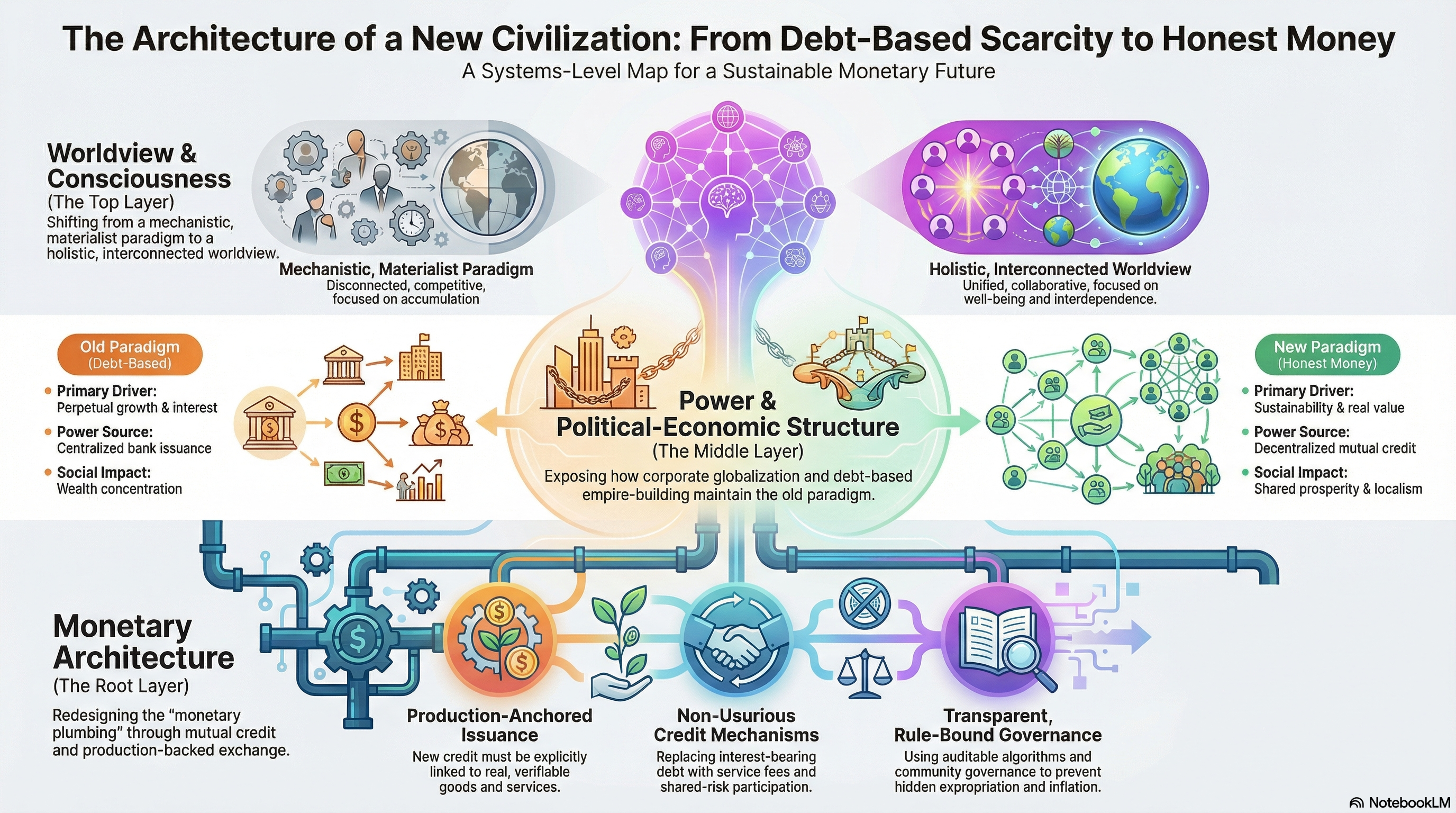
Having laid the necessary foundation in the first eleven chapters, we can now proceed to summarize the requirements for solving the money problem. We have shown how money has been politicized and how the control over its creation and allocation has become, what I call, “the keystone in the arch of power,” a power which is at once financial, economic, political, and social. Those who control money are able to control everything else. The inherent dysfunctions of the present monetary regime derive mainly from the following structural elements:
The monopolization of credit by the banking cartel in collusion with national governments
The creation of money by banks as interest-bearing “loans”
Legal tender status for official debt-money
The elimination of any operational concrete measure of value and unit of account
We have seen how that system:
Enables national governments to finance endless wars and other projects that are wasteful, destructive, and contrary both to the wishes of the citizenry and to the common welfare
Enables banks to reap inordinate profits while deciding to whom and for what purpose the money shall be distributed among “borrowers”
Gives a small, elite “super-class” the non-bona-fide money to acquire an ever-increasing proportion of the world’s real wealth and the ability to control political and economic affairs worldwide
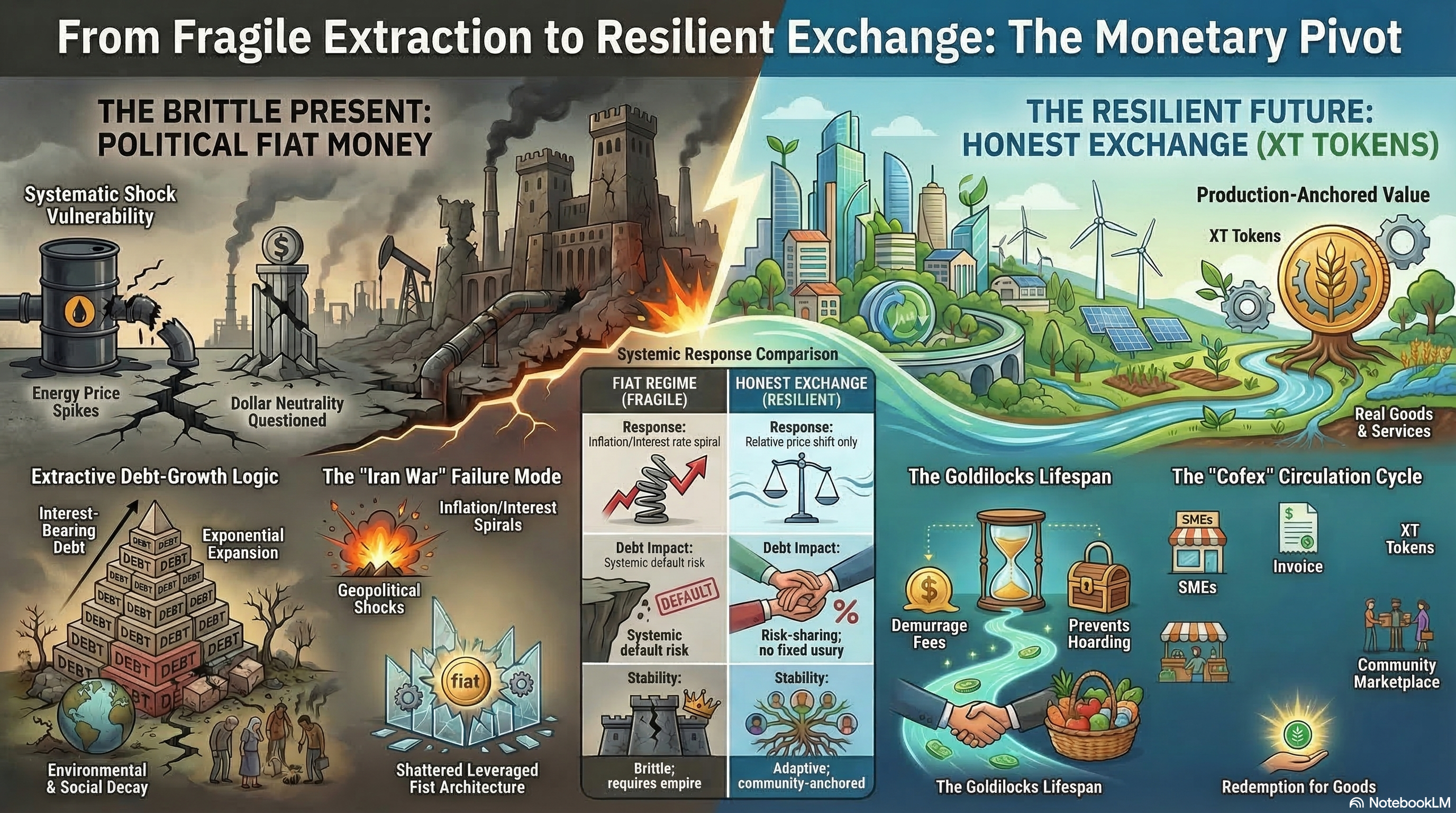
Forces the exponential growth of debt, and destructive competition for an always-insufficient supply of money for all debts to be repaid
Emerging Exchange Alternatives
The most graceful and promising approach to empowering ourselves and our communities is through voluntary, entrepreneurial activities that can liberate the exchange process and reclaim “the credit commons.” So long as people have the freedom of association and the right to contract it will be difficult if not impossible for governments to prevent the creation of exchange media and mechanisms by private initiative. We can thereby, step-by-step, reduce our dependence upon bank borrowing and political currencies, taking control of our own credit and organizing independent means for allocating it directly to those individuals and businesses that we trust and wish to support. Riegel reminds us that, “there is no constitutional or statutory barrier to the inauguration of a private enterprise, non-debt, non-interest, mutual money system.” Only popular control of credit and competition in currencies can transcend the money problem. As Ulrich von Beckerath has observed, “Extension of exchange transactions without State money is in reality the beginning of a new system of settling accounts, indeed the beginning of a new economic order.” A new economic order is precisely what is needed at this point in history.
Jem Bendell, former professor and founder of the Initiative for Leadership and Sustainability (IFLAS) at the University of Cumbria (UK) has a highly credentialed background that is impressive by any measure. After a life changing experience, he embarked upon a different life path, delving deeply into diverse disciplines, including the latest climate science, that led to his writing, in 2023, his book, Breaking Together: A freedom-loving response to collapse, in which he summarized his startling conclusions:
“The collapse of modern societies has begun. That is the conclusion of two years of research by the interdisciplinary team behind Breaking Together. How did it come to this? Because monetary systems caused us to harm each other & nature to such an extent it broke the foundations of our societies. So what should we do? This book describes people allowing the full pain of our predicament to liberate them into living more courageously & creatively. They demonstrate we can be breaking together, not apart, in this era of collapse. Jem Bendell argues that reclaiming our freedoms is essential to soften the fall & regenerate the natural world. Escaping the efforts of panicking elites, we can advance an ecolibertarian agenda for both politics & practical action in a broken world.
Jem has since abandoned academia and his “illustrious career of delusion” in favor of a different path that embraces reality and includes practical decentralized actions of adaptation. Breaking Together is available as a free download, but if you would like to get a taste of it before plunging into his 500 page volume, I highly recommend that you listen to this two-part interview in which he quite articulately explains his main ideas, and how we can, by working together, adapt to the inevitable and ongoing collapse of our present version of civilization, and in the process build a better one. Interview Part 1; Part 2.
The work of Richard Flyer puts my own work, and that of Jem Bendell and others within a more comprehensive and foundational context.
In a recent message, Richard Flyer alerts readers to a short video that he posted a couple years ago on his YouTube channel to explain his work of empowerment and societal change. By his own description, “It not only provides solid content about building Symbiotic Cultures and Networks, but it really captures the Spirit, enthusiasm, and hope we need now more than ever—the possibility and reality of Fractal Community Empowerment. It was released more than a year before the book Birthing the Symbiotic Age: An Ancient Blueprint for a New Creation came out on Substack as a weekly series. It shares many of the stories of on-the-ground grassroots movements I have been affiliated with, including San Diego, CA, and Reno, NV, as well as the Sarvodaya Shramadana movement of Sri Lanka – and their relevance today.”
This is the latest chapter to be published of my new 2024 edition of The End of Money and the Future of Civilization. It continues the story begun in the previous chapter of how money has evolved and changed its character over time.
Here is a brief excerpt:
Money has become merely an accounting system, a way of “keeping score” in the economic “game” of give and take. —Thomas H. Greco, Jr.
Let us begin by summarizing the evolution of the various kinds of money that have been used to mediate reciprocal exchange:
The circulation of gold and silver coins gave way to paper banknotes that were redeemable for gold or silver coins, which made the notes essentially warehouse receipts for gold on deposit.
Then, banks began to lend bank notes into circulation based on the pledge of collateral assets (some valuable and others not) other than gold, some of which included government obligations (bonds, notes, etc.).
But ALL notes were redeemable in gold. This became known as the “fractional reserve banking” system.
Bank account balances (checkable bank “deposits”) increasingly took the place of paper bank notes, and bank customers began to write checks against their deposits instead of using bank notes to make payments.
As banks created ever greater amounts of non-bona-fide money based on national government debts and other illegitimate collateral assets, the fiction of gold-backing and redeemability could no longer be supported, and governments reneged on their promise to redeem their currency for gold. This broke the final link between political fiat money and the real economy of valuable goods and services.
But, despite that, the emergence of credit clearing to offset credit obligation against credit claims was a major leap forward in facilitating the reciprocal exchange of value.
You can now read or listen to the entire chapter at Future Brightly:
The first edition of my book, The End of Money and the Future of Civilization, was published by Chelsea Green Publishing in 2009. While it remains as relevant today as it was when first published the printed book has been out of print for several years. But, having had the rights reverted to me by my publisher, I am making the entire book available for free in PDF format. You can read it or download it HERE. If you would like a hard copy of the first edition used copies can still be found on Amazon.com, Abe books, Thrift books and elsewhere.
Better still, you can avail yourself of the new revised and expanded 2024 edition which I have been working on for almost two years and is almost complete. Eighteen chapters have already been posted and can be freely read or download HERE.
To order signed copies of my previous books, click on the title below: