Category Archives: Geo-politics

How Might Credit Clearing Be Used to Make International Trade More Rational and Fair?

Clearing works at any level to settle claims – (1) among banks to settle claims arising from their clients’ check transactions, (2) among companies and individuals engaged in trade to offset their accounts payable against their accounts receivable, and (3) among nations to settle international trade balances. The first of these is well established and generally understood. The second is what occurs within grassroots mutual credit clearing systems (like LETS) and the commercial “barter” or trade exchanges that have proliferated around the world and are now enabling billions of dollars of cashless trading to take place every year. These private initiatives provide the inspiration and the prototypes that are now being scaled up and interconnected to make for more a efficient, secure, and equitable transaction infrastructure.

The third, which requires action at the highest levels of government, has been done on a bilateral basis (like barter) but the potential for multi-lateral clearing of trade balances has yet to be seriously considered. Is there sufficient vision, will, and independence of action at that level for anything useful to be done? That remains to be seen.

The present global financial order, which was largely established at Bretton Woods toward the end of World War II, is based on dollar dominance and exploitative initiatives that are managed through the intuitions that were forced upon the world at that time (the IMF and World Bank). I’ve not made a detailed study of the proposals that were made then, but according to a recent article by George Monbiot in the Guardian (UK), the Bancor proposal of John Maynard Keynes might deserve a second look. The article is titled, Keynes is innocent: the toxic spawn of Bretton Woods was no plan of his, and I encourage anyone who has an interest in this subject to read it. According to Monbiot, “The economist’s dream was blocked for an IMF serving the rich. Reforms proposed by G20 leaders are too little, too late.”

The details of the plan as described in the Guardian article may not be entirely to my liking, but it may be a good starting point for negotiations among a few enlightened governments to create an independent system for managing trade among themselves.  – t.h.g.

UPDATE: I have since found an IMF document that purports to present the details of the Keynes Plan. I’ve not yet studied it in any depth, but it can be downloaded here.

Weissman-12 Corrupt Deals Caused the Multi-Trillion Dollar Financial Meltdown

$5 Billion in Lobbying for 12 Corrupt Deals Caused the Multi-Trillion Dollar Financial Meltdown

By Robert Weissman, Multinational Monitor. Posted March 9, 2009.

$5 billion in lobbying to Congress got the finance industry lucrative legislative favors that paved the way for Wall Street’s devastating collapse.

What can $5 billion buy in Washington?

Quite a lot.

Over the 1998-2008 period, the financial sector spent more than $5 billion on U.S. federal campaign contributions and lobbying expenditures.

This extraordinary investment paid off fabulously. Congress and executive agencies rolled back long-standing regulatory restraints, refused to impose new regulations on rapidly evolving and mushrooming areas of finance, and shunned calls to enforce rules still in place.

“Sold Out: How Wall Street and Washington Betrayed America,” a report released by Essential Information and the Consumer Education Foundation (and which I co-authored), details a dozen crucial deregulatory moves over the last decade — each a direct response to heavy lobbying from Wall Street and the broader financial sector, as the report details. (The report is available at: www.wallstreetwatch.org/soldoutreport.htm.) Combined, these deregulatory moves helped pave the way for the current financial meltdown.

Here are 12 deregulatory steps to financial meltdown:

1. The repeal of Glass-Steagall

The Financial Services Modernization Act of 1999 formally repealed the Glass-Steagall Act of 1933 and related rules, which prohibited banks from offering investment, commercial banking, and insurance services. In 1998, Citibank and Travelers Group merged on the expectation that Glass-Steagall would be repealed. Then they set out, successfully, to make it so. The subsequent result was the infusion of the investment bank speculative culture into the world of commercial banking. The 1999 repeal of Glass-Steagall helped create the conditions in which banks invested monies from checking and savings accounts into creative financial instruments such as mortgage-backed securities and credit default swaps, investment gambles that led many of the banks to ruin and rocked the financial markets in 2008.

2. Off-the-books accounting for banks

Holding assets off the balance sheet generally allows companies to avoid disclosing “toxic” or money-losing assets to investors in order to make the company appear more valuable than it is. Accounting rules — lobbied for by big banks — permitted the accounting fictions that continue to obscure banks’ actual condition.

3. CFTC blocked from regulating derivatives

Financial derivatives are unregulated. By all accounts this has been a disaster, as Warren Buffett’s warning that they represent “weapons of mass financial destruction” has proven prescient — they have amplified the financial crisis far beyond the unavoidable troubles connected to the popping of the housing bubble. During the Clinton administration, the Commodity Futures Trading Commission (CFTC) sought to exert regulatory control over financial derivatives, but the agency was quashed by opposition from Robert Rubin and Fed Chair Alan Greenspan.

4. Formal financial derivative deregulation: the Commodities Futures Modernization Act

The deregulation — or non-regulation — of financial derivatives was sealed in 2000, with the Commodities Futures Modernization Act. Its passage orchestrated by the industry-friendly Senator Phil Gramm, the Act prohibits the CFTC from regulating financial derivatives.

5. SEC removes capital limits on investment banks and the voluntary regulation regime

In 1975, the Securities and Exchange Commission (SEC) promulgated a rule requiring investment banks to maintain a debt to-net capital ratio of less than 15 to 1. In simpler terms, this limited the amount of borrowed money the investment banks could use. In 2004, however, the SEC succumbed to a push from the big investment banks — led by Goldman Sachs, and its then-chair, Henry Paulson — and authorized investment banks to develop net capital requirements based on their own risk assessment models. With this new freedom, investment banks pushed ratios to as high as 40 to 1. This super-leverage not only made the investment banks more vulnerable when the housing bubble popped, it enabled the banks to create a more tangled mess of derivative investments — so that their individual failures, or the potential of failure, became systemic crises.

6. Basel II weakening of capital reserve requirements for banks

Rules adopted by global bank regulators — known as Basel II, and heavily influenced by the banks themselves — would let commercial banks rely on their own internal risk-assessment models (exactly the same approach as the SEC took for investment banks). Luckily, technical challenges and intra-industry disputes about Basel II have delayed implementation — hopefully permanently — of the regulatory scheme.

7. No predatory lending enforcement

Even in a deregulated environment, the banking regulators retained authority to crack down on predatory lending abuses. Such enforcement activity would have protected homeowners, and lessened though not prevented the current financial crisis. But the regulators sat on their hands. The Federal Reserve took three formal actions against subprime lenders from 2002 to 2007. The Office of Comptroller of the Currency, which has authority over almost 1,800 banks, took three consumer-protection enforcement actions from 2004 to 2006.

8. Federal preemption of state enforcement against predatory lending

When the states sought to fill the vacuum created by federal non-enforcement of consumer protection laws against predatory lenders, the Feds — responding to commercial bank petitions — jumped to attention to stop them. The Office of the Comptroller of the Currency and the Office of Thrift Supervision each prohibited states from enforcing consumer protection rules against nationally chartered banks.

9. Blocking the courthouse doors: Assignee Liability Escape

Under the doctrine of “assignee liability,” anyone profiting from predatory lending practices should be held financially accountable, including Wall Street investors who bought bundles of mortgages (even if the investors had no role in abuses committed by mortgage originators). With some limited exceptions, however, assignee liability does not apply to mortgage loans, however. Representative Bob Ney — a great friend of financial interests, and who subsequently went to prison in connection with the Abramoff scandal — worked hard, and successfully, to ensure this effective immunity was maintained.

10. Fannie and Freddie enter subprime

At the peak of the housing boom, Fannie Mae and Freddie Mac were dominant purchasers in the subprime secondary market. The Government-Sponsored Enterprises were followers, not leaders, but they did end up taking on substantial subprime assets — at least $57 billion. The purchase of subprime assets was a break from prior practice, justified by theories of expanded access to homeownership for low-income families and rationalized by mathematical models allegedly able to identify and assess risk to newer levels of precision. In fact, the motivation was the for-profit nature of the institutions and their particular executive incentive schemes. Massive lobbying — including especially but not only of Democratic friends of the institutions — enabled them to divert from their traditional exclusive focus on prime loans.

Fannie and Freddie are not responsible for the financial crisis. They are responsible for their own demise, and the resultant massive taxpayer liability.

11. Merger mania

The effective abandonment of antitrust and related regulatory principles over the last two decades has enabled a remarkable concentration in the banking sector, even in advance of recent moves to combine firms as a means to preserve the functioning of the financial system. The megabanks achieved too-big-to-fail status. While this should have meant they be treated as public utilities requiring heightened regulation and risk control, other deregulatory maneuvers (including repeal of Glass-Steagall) enabled them to combine size, explicit and implicit federal guarantees, and reckless high-risk investments.

12. Credit rating agency failure

With Wall Street packaging mortgage loans into pools of securitized assets and then slicing them into tranches, the resultant financial instruments were attractive to many buyers because they promised high returns. But pension funds and other investors could only enter the game if the securities were highly rated.

The credit rating agencies enabled these investors to enter the game, by attaching high ratings to securities that actually were high risk — as subsequent events have revealed. The credit rating agencies have a bias to offering favorable ratings to new instruments because of their complex relationships with issuers, and their desire to maintain and obtain other business dealings with issuers.

This institutional failure and conflict of interest might and should have been forestalled by the SEC, but the Credit Rating Agencies Reform Act of 2006 gave the SEC insufficient oversight authority. In fact, the SEC must give an approval rating to credit ratings agencies if they are adhering to their own standards — even if the SEC knows those standards to be flawed.

From a financial regulatory standpoint, what should be done going forward? The first step is certainly to undo what Wall Street has wrought. More in future columns on an affirmative agenda to restrain the financial sector.

None of this will be easy, however. Wall Street may be disgraced, but it is not prostrate. Financial sector lobbyists continue to roam the halls of Congress, former Wall Street executives have high positions in the Obama administration, and financial sector propagandists continue to warn of the dangers of interfering with “financial innovation.”

More Drum Beats for a Single Global Currency and a Global Central Bank

The global financial and economic crisis continues to deepen. Bankruptcies, unemployment, and home foreclosures are up, while incomes from wages, interest on savings, and investments are being squeezed. At the same time the money supply is being inflated by deficit spending to finance massive bank bailouts. A major increase in the cost of living will eventually follow.

The bankers and politicians who caused the problem in the first place are asking the people to trust them and accept more of the same medicine. Their plea is essentially this: “Give us more power, give us more money, and let us further centralize an already over-centralized system.” A global central bank and an eventual single global currency are what they have in mind.

A recent article by Paul Joseph Watson pretty clearly lays it out.

Yes, Abolish the Fed, But How?

Congressman Ron Paul has for many years been the lone voice crying in the “wilderness” of Congress for an end to the exploitative and disruptive central banking monetary system. Once again he has called for abolition of the Federal Reserve Banks and Board, and recently introduced a bill that would accomplish that. In his introductory remarks, he also called for government to issue only currency that is “backed by stable commodities such as silver and gold to be used as legal tender.”

While I agree with the need to abolish the Fed (and all similarly structured central banks that exist in most other countries around the world), and I agree that the power of the banks and the federal government to debase the currency needs to be curtailed, it is extremely unlikely that legislation adequate to that task can ever make it through Congress. Nonetheless, I applaud Congressman Paul’s efforts because they will at least accomplish the job of raising awareness in the public mind about the nature of the money problem.

Eventually, it may be possible to act effectively at the governmental level, but only after the people have strongly asserted their own power to mediate the exchange process using their own credit apart from banks and the political money system. Only that assertion can bring about the “true free-market economy” that Mr. Paul desires. The nature of this power and how we can assert it are thoroughly addressed in my upcoming book, The End of Money and Future of Civilization.(Due to be released in April, 2009 by Chelsea Green Publishing). – t.h.g.

The following was taken from http://www.lewrockwell.com/paul/paul504.html.

End the Fed

by Ron Paul

Before the US House of Representatives, February 4, 2009, introducing The Federal Reserve Board Abolition Act, H.R. 833.

Madame Speaker, I rise to introduce legislation to restore financial stability to America’s economy by abolishing the Federal Reserve. Since the creation of the Federal Reserve, middle and working-class Americans have been victimized by a boom-and-bust monetary policy. In addition, most Americans have suffered a steadily eroding purchasing power because of the Federal Reserve’s inflationary policies. This represents a real, if hidden, tax imposed on the American people.

From the Great Depression, to the stagflation of the seventies, to the current economic crisis caused by the housing bubble, every economic downturn suffered by this country over the past century can be traced to Federal Reserve policy. The Fed has followed a consistent policy of flooding the economy with easy money, leading to a misallocation of resources and an artificial “boom” followed by a recession or depression when the Fed-created bubble bursts.

With a stable currency, American exporters will no longer be held hostage to an erratic monetary policy. Stabilizing the currency will also give Americans new incentives to save as they will no longer have to fear inflation eroding their savings. Those members concerned about increasing America’s exports or the low rate of savings should be enthusiastic supporters of this legislation.

Though the Federal Reserve policy harms the average American, it benefits those in a position to take advantage of the cycles in monetary policy. The main beneficiaries are those who receive access to artificially inflated money and/or credit before the inflationary effects of the policy impact the entire economy. Federal Reserve policies also benefit big spending politicians who use the inflated currency created by the Fed to hide the true costs of the welfare-warfare state. It is time for Congress to put the interests of the American people ahead of special interests and their own appetite for big government.

Abolishing the Federal Reserve will allow Congress to reassert its constitutional authority over monetary policy. The United States Constitution grants to Congress the authority to coin money and regulate the value of the currency. The Constitution does not give Congress the authority to delegate control over monetary policy to a central bank. Furthermore, the Constitution certainly does not empower the federal government to erode the American standard of living via an inflationary monetary policy.

In fact, Congress’ constitutional mandate regarding monetary policy should only permit currency backed by stable commodities such as silver and gold to be used as legal tender. Therefore, abolishing the Federal Reserve and returning to a constitutional system will enable America to return to the type of monetary system envisioned by our nation’s founders: one where the value of money is consistent because it is tied to a commodity such as gold. Such a monetary system is the basis of a true free-market economy.

In conclusion, Mr. Speaker, I urge my colleagues to stand up for working Americans by putting an end to the manipulation of the money supply which erodes Americans’ standard of living, enlarges big government, and enriches well-connected elites, by cosponsoring my legislation to abolish the Federal Reserve.

Dr. Ron Paul is a Republican member of Congress from Texas.

*************************************************************

Here is the bill as introduced in the House.

Taken from http://thomas.loc.gov/cgi-bin/query/z?c111:h833:

Federal Reserve Board Abolition Act

HR 833 IH

111th CONGRESS

1st Session

H. R. 833

To abolish the Board of Governors of the Federal Reserve System and the Federal reserve banks, to repeal the Federal Reserve Act, and for other purposes.

IN THE HOUSE OF REPRESENTATIVES

February 3, 2009

Mr. PAUL introduced the following bill; which was referred to the Committee on Financial Services


A BILL

To abolish the Board of Governors of the Federal Reserve System and the Federal reserve banks, to repeal the Federal Reserve Act, and for other purposes.

Be it enacted by the Senate and House of Representatives of the United States of America in Congress assembled,

SECTION 1. SHORT TITLE.

This Act may be cited as the ‘Federal Reserve Board Abolition Act’.

SEC. 2. FEDERAL RESERVE BOARD ABOLISHED.

(a) In General- Effective at the end of the 1-year period beginning on the date of the enactment of this Act, the Board of Governors of the Federal Reserve System and each Federal reserve bank are hereby abolished.

(b) Repeal of Federal Reserve Act- Effective at the end of the 1-year period beginning on the date of the enactment of this Act, the Federal Reserve Act is hereby repealed.

(c) Disposition of Affairs-

(1) MANAGEMENT DURING DISSOLUTION PERIOD- During the 1-year period referred to in subsection (a), the Chairman of the Board of Governors of the Federal Reserve System–

(A) shall, for the sole purpose of winding up the affairs of the Board of Governors of the Federal Reserve System and the Federal reserve banks–

(i) manage the employees of the Board and each such bank and provide for the payment of compensation and benefits of any such employee which accrue before the position of such employee is abolished; and

(ii) manage the assets and liabilities of the Board and each such bank until such assets and liabilities are liquidated or assumed by the Secretary of the Treasury in accordance with this subsection; and

(B) may take such other action as may be necessary, subject to the approval of the Secretary of the Treasury, to wind up the affairs of the Board and the Federal reserve banks.

(2) LIQUIDATION OF ASSETS-

(A) IN GENERAL- The Director of the Office of Management and Budget shall liquidate all assets of the Board and the Federal reserve banks in an orderly manner so as to achieve as expeditious a liquidation as may be practical while maximizing the return to the Treasury.

(B) TRANSFER TO TREASURY- After satisfying all claims against the Board and any Federal reserve bank which are accepted by the Director of the Office of Management and Budget and redeeming the stock of such banks, the net proceeds of the liquidation under subparagraph (A) shall be transferred to the Secretary of the Treasury and deposited in the General Fund of the Treasury.

(3) ASSUMPTION OF LIABILITIES- All outstanding liabilities of the Board of Governors of the Federal Reserve System and the Federal reserve banks at the time such entities are abolished, including any liability for retirement and other benefits for former officers and employees of the Board or any such bank in accordance with employee retirement and benefit programs of the Board and any such bank, shall become the liability of the Secretary of the Treasury and shall be paid from amounts deposited in the general fund pursuant to paragraph (2) which are hereby appropriated for such purpose until all such liabilities are satisfied.

(d) Report- At the end of the 18-month period beginning on the date of the enactment of this Act, the Secretary of the Treasury and the Director of the Office of Management and Budget shall submit a joint report to the Congress containing a detailed description of the actions taken to implement this Act and any actions or issues relating to such implementation that remain uncompleted or unresolved as of the date of the report.

#     #     #

Bank of England Wants to Debase the Pound in Secret

As the global financial meltdown continues government and banking authorities become ever more desperate to preserve their flawed system of money and banking, using means of control that are increasingly despotic. Now they want to draw a more opaque curtain around their money manipulations to prevent people from taking effective action to protect themselves. For the past 165 years the Bank of England has been obliged to publish a weekly account of its balance sheet. This has at least made its inflationary actions visible and may have deterred it from more extreme abuses of the currency. Now they want to be relieved of this minimal obligation of transparency. This was reported in an article by Edmund Conway that appeared in the Telegraph of London on Saturday, January 10, 2009. In the subhead Conway says, “The Bank of England will be able to print extra money without having legally to declare it under new plans which will heighten fears that the Government will secretly pump extra cash into the economy.”

In addition to further bailouts of banks by governments around the world, we can expect ever more legislation aimed at sustaining the flawed money and banking system. That will include greater secrecy and more odious legal limitations on private initiatives that are seen as competing with conventional money and banks. We’ve seen it all before. That’s why a study of the history of money and banking is so important. – t.h.g.

Populist Latin American Governments Cooperating to Gain Independence From the Dollar

I’ve recently gotten several news reports of important developments that signal both greater independence for Latin America and a further weakening of the dollar as the dominant world currency. Here are some excerpts and links. -t.h.g.

7 countries talk single currency, Venezuela calls for IDB exodus

Seven countries, including two Caribbean islands, signed a document today paving the way for the establishment of a single currency among them, Cuban state media reported today.

The political leaders of Venezuela, Bolivia, Honduras, Nicaragua, Ecuador, Cuba and Dominica issued a final Declaration on Wednesday that gives a green light to the creation of a single currency, called the Sucre, that will initially circulate virtually, Granma said.

Another report on the meeting had this to say:

“We will leave the Inter-American Development Bank and we will make our own bank, a bank that we ourselves manage,” said Chávez.

Rafael Correa, the president of Ecuador, asked for support from ALBA member countries as he seeks international tribunals to relieve Ecuador of debt incurred by past governments which operated according to the values of U.S.-dominated international financial institutions.

And a related story reported agreement talks between Russian and Venezuelan leaders:

Talks in Caracas between Russian President Dmitry Medvedev and his Venezuelan counterpart Hugo Chavez have yielded a host of bilateral agreements.

“We have discussed with President Chavez the use of the national currencies, the ruble and the bolivar, in bilateral payments,” Medvedev said at a news conference in Caracas.

The two countries also agreed to sign another intergovernmental agreement to set up a joint bank within the next two weeks, Medvedev said.

The joint bank could become an instrument to finance projects in Russia and Venezuela, and will handle payments for oil supplies and will involve Gazprombank, Russia’s third-largest bank.

The Russian president said Moscow and Caracas could switch to national currencies in bilateral payments.

Notes From the Field – Thailand

October 28-29, 2008

Relaxing on Koh Phangan

Much as I like Penang, I’m happy to be away from the bustle and noise of Georgetown for a while. I woke this morning to the sound of gentle rain hitting the roof of my seaside bungalow in Koh Phangan. With my Malaysian visa about to expire, I took it as an opportunity to visit Thailand again, choosing to return to the island (koh) that I visited last year. Koh Phangan in comparison to its better-known near neighbor, Koh Samui, is still relatively unspoiled. Although tourism is its economic base, it has not yet been overbuilt and overrun by upscale resorts and high rise condos. There is still a lot of open space and the typical accommodations consist of modest bungalows strung out along the various beaches.

A major attraction of Koh Phangan is the “full moon party” that attracts the twenty-something party crowd. I guess it was inevitable that ambitious entrepreneurs would augment that attraction by staging “half-moon” and “dark moon parties,” as well. Fortunately, that scene is easily avoided as it happens mainly at the south end of the island near Had Rin. The remainder of the island offers various levels of peace and quiet, nice beaches and clean water. Expenses are a bit higher here than in Penang but still affordable. I’m sure I could find ways to economize if I were to commit to a longer stay. It’s off season now so it’s a buyer’s market for lodgings. I dare say that ninety percent of the units are vacant right now.

The only sizeable village on the island is Thong Sala, located on the western side. That’s where the ferry docks are. It has all the usual conveniences – shops, restaurants, banks, cafes, and a nice night market where one can get a good cheap meal. I prefer to stay to the north and not too far away from Thong Sala at one of the many bungalow places that line the shore. The place I’m at is fairly new and clean and has screened windows, a rarity in these parts. It has no A/C, only a fan, but that’s quite adequate as it doesn’t get too hot here and there’s usually a breeze off the ocean.

The antipode to the party scene is the yoga/health spa scene. There is a sizeable cluster of people who come to the island for yoga workshops, personal growth, healing, and spiritual development. I first learned about Koh Phangan from my Italian friend, Michele, whom I met at Auroville last year. He had come here earlier that year to do yoga at the popular Agama Center which has a loose affiliation with the Ananda Yoga Resort where one can find various health oriented offerings like vegetarian food, yoga classes, sauna, massage, and a seven day colon cleanse program.

I came to the island last year prior to my visit to Bali. I liked it but was able to stay for only two weeks. Michele was not on the island at that time so I had to discover it on my own. This time, he is here so I have the advantage of being guided and introduced to people by someone who has spent a lot of time here.

The Bank Bailout Scam

What can you expect when a fox is appointed to manage the hen house? Our current Treasury secretary, Henry Paulson, was formerly the CEO of Goldman Sachs, one of the most powerful financial institutions in the world. His appointment to that post was clearly intended to enable a continuation of the long trend of greater concentration of power and wealth in elite hands.

Recent moves by the U.S. Treasury make that ever more obvious. In an article in Saturday’s (Oct. 25) New York Times, Times economic columnist, Joe Nocera, reveals what he calls “the dirty little secret of the banking industry”–namely, that “it has no intention of using the [government bailout] money to make new loans.”

Nocera explains that the Paulson plan to hand over $250 billion [in money borrowed into existence by the government] to the biggest banks, in exchange for non-voting stock, was never really intended to get them to resume lending to businesses and consumers, as was stated. That was just window dressing. The real purpose of the bailout is to engineer a rapid consolidation of the banking industry by enabling at public expense a wave of takeovers of smaller financial firms by the most powerful privileged banks. Examples, so far:

JPMorgan’s recent government-backed acquisition of two large competitors, Bear Stearns and Washington Mutual; the takeover of Merrill Lynch by Bank of America, Wachovia by Wells Fargo and, National City by PNC.

There’s more to come, and by deciding which banks get handouts and which don’t the entire consolidation process is being orchestrated from the top.

Expatriate Living

An “expatriate” is one who lives outside of his/her homeland. That term should not be confused with “ex-patriot,” who is someone who once was patriotic but is no longer. Not that the two are mutually exclusive, of course, but let’s not go off on that tangent just now. The “expat” lifestyle suits me very well. Besides enabling me to stretch the purchasing power of my small pension, there are social, educational, cultural, and even spiritual benefits to living abroad. That’s especially true when one gets away from the areas that are dependent upon tourism and immerses oneself for extended periods of time in the daily routines of ordinary people, which is something I feel I’ve barely started to do. It has been said that “travel broadens on,” but I would venture to say that living abroad tends to make one less nationalistic, more humanistic, and more appreciative of the things that all people have in common.

Communicating

When I left the U.S., I suspended my Verizon cell phone account. Their rates for international service are quite unreasonable in comparison to what’s available in Asia. Mobile phone dealers are everywhere here and the competition is fierce, so some phones and most services can be had pretty cheaply. The common practice here is to buy your own phone then buy a SIM card from one of the many service providers, then buy minutes of call time. As I understand it, you pay only for outgoing calls, not incoming, but there is an expiration date on your outgoing call time the duration of which depends on how big a block of time you buy. In Malaysia ten Ringgit was good for ten days, thirty Ringgit for thirty days.

Cheap as it is in Malaysia, service in Thailand seems even cheaper. To avoid high roaming charges on my Malaysian service, I did as I was advised by other travelers and bought another SIM card when I got to Hat Yai, my first stop in Thailand. The SIM card is a tiny electronic chip that slips into a slot just beneath the phone’s battery. Anyone can install it in about ten seconds. People at my guest house directed me to a shop right next door where I paid 50 baht (about $1.50) for a SIM card. I then “topped-up” my card at the guest house with 100 baht worth of call time. At .80 baht per minute that gave me 125 minutes of domestic call time, good until December 2. At a total cost of less than 5 dollars that’s not bad. No wonder every teenage kid in Asia has a mobile phone. Oh, and I can call internationally, too, (including the U.S.) at somewhat higher but still cheap rates. If the FCC was really doing its job, we’d have similarly good, cheap, mobile service in the U.S.

In Asia, people tend to use SMS (short message system) or text messaging more than voice communication. My own usage has changed accordingly. Text messages provide a much more accurate way of communicating, can be saved in phone memory, and are very inexpensive. I have my phone set to automatically save both incoming and outgoing messages, then I occasionally delete those that I no longer need. I hardly ever make a voice call anymore.

Sicko

DVD’s of popular movies, which are surely pirated, are sold openly at very low prices in Malaysia, Thailand, India, China, and I’m sure, other parts of Asia. A couple weeks ago I picked up a few for 5 Ringgit (US$1.60) each. Among them was Michael Moore’s latest film, Sicko. It is in my opinion his best yet, and I urge everyone to see it. The film provides a clear description of the appalling state of the American “health care” system and compares it with systems in Canada, the UK, France and Cuba. If those countries are able to provide good, free health care for their people, The US should be able to do it too.

State of Fear

Browsing the small collection of books available at my resort, I came across Michael Crichton’s, State of Fear. Reportedly a bestseller, it looked to be the most interesting amongst the available titles (aside from the two copies of Tolstoy’s War and Peace). It did not at first register with my conscious mind, but I was reminded a few days later, when I recommended it to him, that Peter Etherden, my good friend and colleague in the UK, had urged me a few years ago to read this book. Coincidence? Following my recommendation to him, Peter came back with: “I have been trying to persuade colleagues to read State of Fear since it first came out in 2004…when I found to my surprise that all the references in the extensive endnotes checked out. Prior to reading it I had believed the environmentalists’ case without looking into the data and the premises behind their claims.”

In this book, Crichton tells a whale of a tale. It’s quite engaging fiction, but it’s also designed to inform, just, as, Peter notes, was much of Charles Dickens’s work. In this case, the bad guys are money grubbing con men who have control over a major environmental organization. The plot revolves around the good guys and gals who attempt to foil the heinous criminal plans of the con men to create major disasters that can be blamed on human-induced climate change. These are crimes that are intended to pump up the “state of fear,” which is the underlying theme of the book. One of Crichton’s main characters argues, rather convincingly, that the global warming theory is not well supported by the actual scientific evidence, which Crichton provides for the reader in abundance.

When Peter first began expressing his doubts a few years ago about the global warming theory I thought he had gone over to the dark side because by then everybody “knew” that global warming was an irrefutable fact. Now, with the widespread viewing of Al Gore’s polemical film, An Inconvenient Truth, that “fact” is even more firmly entrenched in the public mind. I personally was an early believer in the global warming effect of the buildup of greenhouse gases (mainly carbon dioxide) and the prospect of abrupt climate change. That belief was based on my 1982 reading of John Hamaker’s book, The Survival of Civilization. Hamaker argued that this was a natural cycle with a period of about one hundred thousand years. He said it might be exacerbated by human activities, but was essentially quite independent of them. Hamaker’s evidence was paleontological, based on the physical examination of glacial ice cores and fossils.

His prediction was that the greenhouse effect would lead to more turbulent weather patterns in the temperate zones and eventually bring on another ice age. That seemingly paradoxical prediction was explained as follows:

More solar energy trapped in the atmosphere causes greater amounts of water to be evaporated from the oceans and lakes; this vapor causes greater cloud cover which migrates toward the poles covering more of the polar and temperate zones, blocking the sun’s energy and causing cooling in those regions. The result is greater wind shear – storms, tornados and hurricanes at the interface between the tropics and the temperate zones, and ultimately, global cooling and glaciation. And what drives this process of CO2 buildup in the first place? The depletion of minerals in the surface soils which cause plant growth to be less intense. And how does glaciation correct that? By bringing new minerals to the surface, which stimulates new plant growth, which takes more CO2 out of the atmosphere, which reverses the greenhouse effect, which causes the glaciers to recede. Hamaker’s prescription for ameliorating the effects of those changes – remineralize the soil by grinding up rocks (glacial till) and spreading the dust over fields and forests.

Well, it sort of made sense to me, though I did not dig very deeply into the subject. Subsequent studies by mainstream scientists, we are being told, confirm the CO2 buildup and the global warming phenomenon. The CO2 figures cited by Crichton confirm the buildup showing an increase from 316 parts per million in 1958 to 376 ppm in 2002. That’s an increase of 60 ppm or about 19 percent in 45 years. Crichton’s character minimizes the importance of that amount of change, but I find the argument less than compelling. Hamaker argued that the rate of CO2 increase is exponential (changing at an accelerating rate) not linear (changing at a constant rate), something that doesn’t show up in the limited data provided by Crichton. As for the global warming effect, Crichton argues against it by showing that, while some places have gotten warmer, others have actually gotten cooler. But if Hamaker’s thesis is correct, that is to be expected. It begs the question, is there a locational pattern to the places that have gotten cooler, and what are the geographical and weather variables that might explain that pattern?

Well, I don’t know, maybe we have global warming, maybe global cooling, maybe climate change, maybe not, but one thing seems clear – we’ve been making a mess of our planet with deforestation, urban sprawl, and pollution of many kinds that makes living in many places quite unpleasant or even downright dangerous. We ought to do something about that. But let’s get back to the main theme – fear. Is there a conspiracy to make us ever more fearful? Conspiracies abound, but anyone who tries to reveal the evidence of them is ridiculed and lumped into the category of paranoid nut cases. But there will always be wolves in sheep’s clothing and foxes getting into hen houses, who all the time try to tell us “There ain’t nobody here but us chickens.”

Crichton’s own “nutty professor” argues in the book that starting in 1989 there was a “major shift” in the media’s use of terms like crisis, catastrophe, plague, disaster, dire, unprecedented, and dreaded, and that it was all deliberate hype because “politicians need fears to control the population.” With the collapse of the “Communist menace,” a whole string of other threats have been trotted out as replacements. Whether it is real or imagined, climate change is one of them.

Power politics is no more than a big protection racket. As H. L. Mencken observed more than 70 years ago, “The whole art of practical politics is to keep the populace alarmed, and hence clamorous to be led to safety, by menacing it with an endless series of hobgoblins – all of them imaginary.” The power elite will always pose as our saviors, offering new plans and programs that they say will protect us or save us. They tell us there is no alternative (TINA). It’s time we started cooperating to create alternatives that reflect our own values and ideals and promote the common good. Remember the words of President Franklin Roosevelt: “We have nothing to fear but fear itself.”

The Great Wake-up Call

Sometimes it’s a severe pain in the chest, sometimes shortness of breath, other times dizziness, numbness, disorientation or loss of muscle control. These are symptoms of something seriously wrong, a warning of impending health crisis, a signal that something needs to change.

In our collective experience known as political economy, we are experiencing symptoms of distress. The real estate bubble and subsequent bust, the financial meltdown, deepening recession and inflation are all telling us that something is wrong, that something needs to change.

The mainstream media don’t tell us what or how. They are part of the system that is trying to maintain the status quo. They will give space to minor policy adjustments and legislative proposals, but not to the kinds of deep structural changes or emergent systems that can make a real difference.

Fortunately, there are independent media and information sources that are devoted to providing the kinds of information people need.

Back in June of this year I viewed an amazingly good documentary film titled, Zeitgeist. I recommend it highly. Get it here.

Most of the information in it was already known to me, and includes much of what I’ve been trying for years to tell people in my own humble way. This film is well put together and pretty accurate as far as I can tell. One aspect that was somewhat new to me was the material that shows the congruence among the various “redeemer” myths going way back B.C. That part, and some of the political material, won’t go down easily with true believers of any stripe — the devout and patriotic, but if one can keep an open mind, there is much to be learned – much that could save our lives.

Now there is an addendum to the Zeitgeist movie that focuses more attention on the “money problem,” economic imperialism, and emerging sustainable technologies. The Zeitgeist: Addendum can be downloaded from the same site or from Google.

The first twenty minutes do a creditable job of describing how our conventional political money is created. It’s a good supplement to the films Money as Debt and The Money Masters that I previously recommended.

The next part of the film features John Perkins, author of Confessions of an Economic Hit Man. He does a superb job of clearly explaining how the empire achieves dominance over other countries, giving examples from his own experience. As he describes in his book, there are three levels of action. The imperial forces first try to corrupt the country’s leaders and get them to play along, saddling their people with huge debt loads and selling off government owned assets. If that fails, they will stir up internal opposition and either overthrow or assassinate a recalcitrant leader. If that fails, the military will be sent in as a last resort.

In recent years, the reluctance to use the last option seems to have diminished, as war affords opportunities for great profits to be amassed by political cronies and well-connected companies, and the power of Congress to mount opposition to military adventures has all but evaporated.

The original Zeitgeist movie contains important information about the central banking system and the Federal Reserve. If you don’t have time to watch the entire film, a relevant seven minute excerpt can be seen here.

If you want to view particular parts of each film, you can find them on YouTube. Start with Part I.

And now there is a Zeitgeist Movement you can participate in if you feel so inclined. http://www.thezeitgeistmovement.com/

My new book will give a different perspective on the global problematique, and is unique in offering practical approaches that will enable us to “escape from the matrix.” I still expect it to be out by early next year.

Hal Turner Shows the new Amero Coin and Describes the Impending Collapse of the Dollar.

For the past several months the internet has been abuzz about the elitist plans for the North American Union and the new Amero currency. Now Hal Turner shows a coin which he purports to be an Amero coin issued by the US government. Is it? You decide.

In any case, a new currency, like the old, will manifest not as coins or bills but as ledger credits (bank deposits).

Whether or not that coin is authentic, one thing seems certain: the US dollar is headed for oblivion and a new monetary regime is being prepared by the powers that be. Wars and bank bailouts are being paid for with increasing amounts of “empty dollars.” The money supply is being inflated with legalized counterfeit at an unprecedented rate. Besides ballooning budget deficits, there is the chronic trade deficit. The US continues to import more than it exports, relying on foreign governments to buy US government bonds to finance the deficits. The value of the US dollar must therefore shrink ever more rapidly. The savings of the middle class will be wiped out. Dollar denominated assets, like bank accounts, CD’s, bonds will become increasingly worthless while your debts will remain. Price increases may be temporarily held in check by the credit crunch as more businesses fail and more people lose their jobs. But the handwriting is on the wall. It’s a credit crunch for main street but a lavish abundance of credit for Wall Street and the Military-Industrial-Banking complex. Much higher prices and lower dollar values must follow.

What to do?

Mike Adams provides some pretty good advice on his website, NatutalNews.com. Take a look at his comprehensive special report, How to Build Your Financial Safety Net.

The thing that’s missing in Adams’ report is how to protect a nest egg. How do you protect the value of the assets you have? Here are my thoughts on that.

As prices bottom out, use your money to buy selected real estate and useful things of real value.

Get out of dollar denominated securities – bank deposits, CD’s, bonds, etc. Keep only enough liquid to are satisfy demands for payment of taxes, utilities, etc.

What are the alternatives?

Buy anything that can support you and your family directly – a home, productive land, gardens, orchards, woodlots, durable clothing, equipment, knowledge, skills, books, computers, etc. Buy selected foreign currencies. You might also help to build a sustainable economy by buying an equity stake (shares) in (small and medium sized) companies that are geared toward producing necessities of life in an earth-friendly way.Some promising industries are organic farming, renewable energy, pollution remediation, and complementary medicine. Above all, make friends, nurture your communities and form new ones. As my good friend Sergio Lub says, our best security is not in money or gold or material things, but in our relationships and our willingness to help each other. The effectiveness of actions by isolated individuals is severely limited. It will take organized cooperative action to really protect ourselves and get through this transition stage. Organize mutual support networks, including local credit clearing unions and currencies. My upcoming book will provide detailed advice on how to do that, but many of the ideas are already available on this blog (Beyond Money) and my Reinventing Money website.

WIR – Current Operational Realities

Susan Witt of the E. F. Schumacher Society has recently filed a report on her trip to Basel, Switzerland, during which she queried fellow Rotarians about their experience with the WIR Bank and WIR credits. It makes for some interesting reading. I’ve posted it with her permission as a page on this blog. WIR is an important case to study. Bes sure to read the other documents about it that are on this blog and my website.

And here’s a bit of levity:

Uncertainty has now hit Japan. In the last seven days, Origami bank has folded, Sumo Bank has gone belly up and Bonsai Bank has announced plans to cut some of its branches. Yesterday, it was also announced that Karaoke Bank will go up for sale and will likely go for a song, while shares in Kamikaze Bank were suspended today after they nose-dived. While Samurai Bank is soldiering on after sharp cutbacks, 500 staff at Karate Bank got the chop and analysts report that there is something fishy going on at Sushi Bank, where it is feared that staff may get a raw deal.

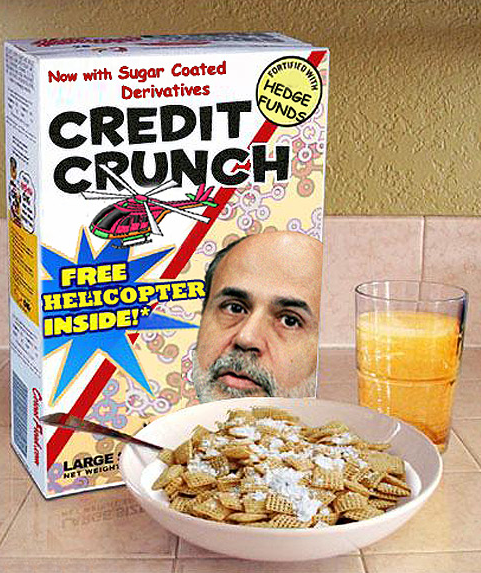
Q: George Bush was asked today “what did he think of the Credit Crunch?”
A: He replied: “It was his favorite Candy Bar.”

National Debt Clock Needs More Digits

According to the Associated Press, the national debt clock maintained by the Durst Organization on a billboard near Times Square in New York City has run out of digits now that the national debt has for the first time exceeded $10 trillion. That’s more than $86,000 for each American family. Whom do we owe it to? Not to ourselves as the “powers that be” would like us to believe, but to all those who own dollars and U.S. Government bonds, notes, and bills. Yes, some are held by pension funds, but vast amounts are held by foreign central banks, especially China, Japan, and the OPEC countries.

An item that appeared in Yahoo News, dated Wed Oct 8, reports that “The late Manhattan real estate developer Seymour Durst put the sign up in 1989 to call attention to what was then a $2.7 trillion debt.” Two more digits will shortly be added to enable the debt to be tracked up to one quarter quadrillion dollars. One must wonder what the dollar will be worth by then.

Wall Street Bailout – Rep. Kaptur Describes the Rules of the Game