Category Archives: Global Economy

Pertinent to global economic issues and events.

How Bad Will the Economy Get?

How Bad Will the Economy Get? This is the title of my article that was recently published on Alternet. It begins with the claim that:

Historically, every financial and economic crisis has been used to further centralize power and concentrate wealth. This one is no different, and in fact the moves being promoted by the Obama administration and the central banks of the Western powers will take the whole world to the pinnacle of financial despotism — unless enough people wake up and claim their own “money power.”

It continues with an outline of recent and historical developments that make the case, but concludes on a hopeful note with my brief description of existing cashless exchange mechanisms that are not dependent upon political money or banks. You can read the complete article here. – t.h.g.

The Great Inflation of 2010

Bill Bonner is absolutely correct in calling the monetization of debt The Grandest of Larcenies. He points out that, “Rather than honestly repaying what it has borrowed, a government merely prints up extra currency and uses it to pay its loans. The debt is “monetized”…transformed into an increase in the money supply, thereby lowering the purchasing power of everybody’s savings.”

As I argue in my new book, The End of Money and the Future of Civilization, enabling governments to spend more than they take in is half of the purpose of the central banking regime, the other half being to give the banking elite the privilege of charging interest on the people’s own credit.

As Bonner further points out,  “Of course, the Fed will not want to do such a dastardly deed; but it will do it anyway.” They are desperate to keep the game going and the only other alternative is to let interest rates rise as government seeks to sell more of its debt to increasingly reluctant lenders abroad.

Government, for its part, must either cut its profligate spending or raise taxes, or both. From the rhetoric coming out of Washington, it is clear that social programs, like Social Security and Medicare, are on the chopping block, but not sacred cows like military spending or bailouts for banks and corporate dinosaurs–the empire must be preserved.  Trial balloons for new taxes are now being floated. Is a VAT (value added tax) on the horizon?

As in the Weimar Republic between the World Wars, the politicians and bankers today may decide that hyper-inflation is the least onerous of their available options. The middle-class can say goodbye to their hard-earned savings.

The days of dollar dominance are coming to an end

An article in The Financial Times reports that Brazil and China are working toward an agreement that will enable the use of their own currencies in trade transactions rather than the US dollar. This will be a major step that will encourage other countries to do likewise, thus reducing the longstanding dependence upon the US dollar as the international payment medium. As foreign dollar holdings stop increasing or are reduced, the US government will have a harder time selling its bonds. The buyer of last resort, of course is the Federal Reserve.  As the Fed and the banking system monetize ever greater amounts of US government debt, the purchasing power of the dollar will drop precipitously.

The only thing that has supported the value of the dollar thus far has been the “great recession” in which the business sector is starved for credit and ordinary people are starved for cash; that and the abiding myth that the dollar will always be “as good as gold.” — t.h.g.

How Might Credit Clearing Be Used to Make International Trade More Rational and Fair?

Clearing works at any level to settle claims – (1) among banks to settle claims arising from their clients’ check transactions, (2) among companies and individuals engaged in trade to offset their accounts payable against their accounts receivable, and (3) among nations to settle international trade balances. The first of these is well established and generally understood. The second is what occurs within grassroots mutual credit clearing systems (like LETS) and the commercial “barter” or trade exchanges that have proliferated around the world and are now enabling billions of dollars of cashless trading to take place every year. These private initiatives provide the inspiration and the prototypes that are now being scaled up and interconnected to make for more a efficient, secure, and equitable transaction infrastructure.

The third, which requires action at the highest levels of government, has been done on a bilateral basis (like barter) but the potential for multi-lateral clearing of trade balances has yet to be seriously considered. Is there sufficient vision, will, and independence of action at that level for anything useful to be done? That remains to be seen.

The present global financial order, which was largely established at Bretton Woods toward the end of World War II, is based on dollar dominance and exploitative initiatives that are managed through the intuitions that were forced upon the world at that time (the IMF and World Bank). I’ve not made a detailed study of the proposals that were made then, but according to a recent article by George Monbiot in the Guardian (UK), the Bancor proposal of John Maynard Keynes might deserve a second look. The article is titled, Keynes is innocent: the toxic spawn of Bretton Woods was no plan of his, and I encourage anyone who has an interest in this subject to read it. According to Monbiot, “The economist’s dream was blocked for an IMF serving the rich. Reforms proposed by G20 leaders are too little, too late.”

The details of the plan as described in the Guardian article may not be entirely to my liking, but it may be a good starting point for negotiations among a few enlightened governments to create an independent system for managing trade among themselves.  – t.h.g.

UPDATE: I have since found an IMF document that purports to present the details of the Keynes Plan. I’ve not yet studied it in any depth, but it can be downloaded here.

Weissman-12 Corrupt Deals Caused the Multi-Trillion Dollar Financial Meltdown

$5 Billion in Lobbying for 12 Corrupt Deals Caused the Multi-Trillion Dollar Financial Meltdown

By Robert Weissman, Multinational Monitor. Posted March 9, 2009.

$5 billion in lobbying to Congress got the finance industry lucrative legislative favors that paved the way for Wall Street’s devastating collapse.

What can $5 billion buy in Washington?

Quite a lot.

Over the 1998-2008 period, the financial sector spent more than $5 billion on U.S. federal campaign contributions and lobbying expenditures.

This extraordinary investment paid off fabulously. Congress and executive agencies rolled back long-standing regulatory restraints, refused to impose new regulations on rapidly evolving and mushrooming areas of finance, and shunned calls to enforce rules still in place.

“Sold Out: How Wall Street and Washington Betrayed America,” a report released by Essential Information and the Consumer Education Foundation (and which I co-authored), details a dozen crucial deregulatory moves over the last decade — each a direct response to heavy lobbying from Wall Street and the broader financial sector, as the report details. (The report is available at: www.wallstreetwatch.org/soldoutreport.htm.) Combined, these deregulatory moves helped pave the way for the current financial meltdown.

Here are 12 deregulatory steps to financial meltdown:

1. The repeal of Glass-Steagall

The Financial Services Modernization Act of 1999 formally repealed the Glass-Steagall Act of 1933 and related rules, which prohibited banks from offering investment, commercial banking, and insurance services. In 1998, Citibank and Travelers Group merged on the expectation that Glass-Steagall would be repealed. Then they set out, successfully, to make it so. The subsequent result was the infusion of the investment bank speculative culture into the world of commercial banking. The 1999 repeal of Glass-Steagall helped create the conditions in which banks invested monies from checking and savings accounts into creative financial instruments such as mortgage-backed securities and credit default swaps, investment gambles that led many of the banks to ruin and rocked the financial markets in 2008.

2. Off-the-books accounting for banks

Holding assets off the balance sheet generally allows companies to avoid disclosing “toxic” or money-losing assets to investors in order to make the company appear more valuable than it is. Accounting rules — lobbied for by big banks — permitted the accounting fictions that continue to obscure banks’ actual condition.

3. CFTC blocked from regulating derivatives

Financial derivatives are unregulated. By all accounts this has been a disaster, as Warren Buffett’s warning that they represent “weapons of mass financial destruction” has proven prescient — they have amplified the financial crisis far beyond the unavoidable troubles connected to the popping of the housing bubble. During the Clinton administration, the Commodity Futures Trading Commission (CFTC) sought to exert regulatory control over financial derivatives, but the agency was quashed by opposition from Robert Rubin and Fed Chair Alan Greenspan.

4. Formal financial derivative deregulation: the Commodities Futures Modernization Act

The deregulation — or non-regulation — of financial derivatives was sealed in 2000, with the Commodities Futures Modernization Act. Its passage orchestrated by the industry-friendly Senator Phil Gramm, the Act prohibits the CFTC from regulating financial derivatives.

5. SEC removes capital limits on investment banks and the voluntary regulation regime

In 1975, the Securities and Exchange Commission (SEC) promulgated a rule requiring investment banks to maintain a debt to-net capital ratio of less than 15 to 1. In simpler terms, this limited the amount of borrowed money the investment banks could use. In 2004, however, the SEC succumbed to a push from the big investment banks — led by Goldman Sachs, and its then-chair, Henry Paulson — and authorized investment banks to develop net capital requirements based on their own risk assessment models. With this new freedom, investment banks pushed ratios to as high as 40 to 1. This super-leverage not only made the investment banks more vulnerable when the housing bubble popped, it enabled the banks to create a more tangled mess of derivative investments — so that their individual failures, or the potential of failure, became systemic crises.

6. Basel II weakening of capital reserve requirements for banks

Rules adopted by global bank regulators — known as Basel II, and heavily influenced by the banks themselves — would let commercial banks rely on their own internal risk-assessment models (exactly the same approach as the SEC took for investment banks). Luckily, technical challenges and intra-industry disputes about Basel II have delayed implementation — hopefully permanently — of the regulatory scheme.

7. No predatory lending enforcement

Even in a deregulated environment, the banking regulators retained authority to crack down on predatory lending abuses. Such enforcement activity would have protected homeowners, and lessened though not prevented the current financial crisis. But the regulators sat on their hands. The Federal Reserve took three formal actions against subprime lenders from 2002 to 2007. The Office of Comptroller of the Currency, which has authority over almost 1,800 banks, took three consumer-protection enforcement actions from 2004 to 2006.

8. Federal preemption of state enforcement against predatory lending

When the states sought to fill the vacuum created by federal non-enforcement of consumer protection laws against predatory lenders, the Feds — responding to commercial bank petitions — jumped to attention to stop them. The Office of the Comptroller of the Currency and the Office of Thrift Supervision each prohibited states from enforcing consumer protection rules against nationally chartered banks.

9. Blocking the courthouse doors: Assignee Liability Escape

Under the doctrine of “assignee liability,” anyone profiting from predatory lending practices should be held financially accountable, including Wall Street investors who bought bundles of mortgages (even if the investors had no role in abuses committed by mortgage originators). With some limited exceptions, however, assignee liability does not apply to mortgage loans, however. Representative Bob Ney — a great friend of financial interests, and who subsequently went to prison in connection with the Abramoff scandal — worked hard, and successfully, to ensure this effective immunity was maintained.

10. Fannie and Freddie enter subprime

At the peak of the housing boom, Fannie Mae and Freddie Mac were dominant purchasers in the subprime secondary market. The Government-Sponsored Enterprises were followers, not leaders, but they did end up taking on substantial subprime assets — at least $57 billion. The purchase of subprime assets was a break from prior practice, justified by theories of expanded access to homeownership for low-income families and rationalized by mathematical models allegedly able to identify and assess risk to newer levels of precision. In fact, the motivation was the for-profit nature of the institutions and their particular executive incentive schemes. Massive lobbying — including especially but not only of Democratic friends of the institutions — enabled them to divert from their traditional exclusive focus on prime loans.

Fannie and Freddie are not responsible for the financial crisis. They are responsible for their own demise, and the resultant massive taxpayer liability.

11. Merger mania

The effective abandonment of antitrust and related regulatory principles over the last two decades has enabled a remarkable concentration in the banking sector, even in advance of recent moves to combine firms as a means to preserve the functioning of the financial system. The megabanks achieved too-big-to-fail status. While this should have meant they be treated as public utilities requiring heightened regulation and risk control, other deregulatory maneuvers (including repeal of Glass-Steagall) enabled them to combine size, explicit and implicit federal guarantees, and reckless high-risk investments.

12. Credit rating agency failure

With Wall Street packaging mortgage loans into pools of securitized assets and then slicing them into tranches, the resultant financial instruments were attractive to many buyers because they promised high returns. But pension funds and other investors could only enter the game if the securities were highly rated.

The credit rating agencies enabled these investors to enter the game, by attaching high ratings to securities that actually were high risk — as subsequent events have revealed. The credit rating agencies have a bias to offering favorable ratings to new instruments because of their complex relationships with issuers, and their desire to maintain and obtain other business dealings with issuers.

This institutional failure and conflict of interest might and should have been forestalled by the SEC, but the Credit Rating Agencies Reform Act of 2006 gave the SEC insufficient oversight authority. In fact, the SEC must give an approval rating to credit ratings agencies if they are adhering to their own standards — even if the SEC knows those standards to be flawed.

From a financial regulatory standpoint, what should be done going forward? The first step is certainly to undo what Wall Street has wrought. More in future columns on an affirmative agenda to restrain the financial sector.

None of this will be easy, however. Wall Street may be disgraced, but it is not prostrate. Financial sector lobbyists continue to roam the halls of Congress, former Wall Street executives have high positions in the Obama administration, and financial sector propagandists continue to warn of the dangers of interfering with “financial innovation.”

More Drum Beats for a Single Global Currency and a Global Central Bank

The global financial and economic crisis continues to deepen. Bankruptcies, unemployment, and home foreclosures are up, while incomes from wages, interest on savings, and investments are being squeezed. At the same time the money supply is being inflated by deficit spending to finance massive bank bailouts. A major increase in the cost of living will eventually follow.

The bankers and politicians who caused the problem in the first place are asking the people to trust them and accept more of the same medicine. Their plea is essentially this: “Give us more power, give us more money, and let us further centralize an already over-centralized system.” A global central bank and an eventual single global currency are what they have in mind.

A recent article by Paul Joseph Watson pretty clearly lays it out.

Populist Latin American Governments Cooperating to Gain Independence From the Dollar

I’ve recently gotten several news reports of important developments that signal both greater independence for Latin America and a further weakening of the dollar as the dominant world currency. Here are some excerpts and links. -t.h.g.

7 countries talk single currency, Venezuela calls for IDB exodus

Seven countries, including two Caribbean islands, signed a document today paving the way for the establishment of a single currency among them, Cuban state media reported today.

The political leaders of Venezuela, Bolivia, Honduras, Nicaragua, Ecuador, Cuba and Dominica issued a final Declaration on Wednesday that gives a green light to the creation of a single currency, called the Sucre, that will initially circulate virtually, Granma said.

Another report on the meeting had this to say:

“We will leave the Inter-American Development Bank and we will make our own bank, a bank that we ourselves manage,” said Chávez.

Rafael Correa, the president of Ecuador, asked for support from ALBA member countries as he seeks international tribunals to relieve Ecuador of debt incurred by past governments which operated according to the values of U.S.-dominated international financial institutions.

And a related story reported agreement talks between Russian and Venezuelan leaders:

Talks in Caracas between Russian President Dmitry Medvedev and his Venezuelan counterpart Hugo Chavez have yielded a host of bilateral agreements.

“We have discussed with President Chavez the use of the national currencies, the ruble and the bolivar, in bilateral payments,” Medvedev said at a news conference in Caracas.

The two countries also agreed to sign another intergovernmental agreement to set up a joint bank within the next two weeks, Medvedev said.

The joint bank could become an instrument to finance projects in Russia and Venezuela, and will handle payments for oil supplies and will involve Gazprombank, Russia’s third-largest bank.

The Russian president said Moscow and Caracas could switch to national currencies in bilateral payments.

The Great Wake-up Call

Sometimes it’s a severe pain in the chest, sometimes shortness of breath, other times dizziness, numbness, disorientation or loss of muscle control. These are symptoms of something seriously wrong, a warning of impending health crisis, a signal that something needs to change.

In our collective experience known as political economy, we are experiencing symptoms of distress. The real estate bubble and subsequent bust, the financial meltdown, deepening recession and inflation are all telling us that something is wrong, that something needs to change.

The mainstream media don’t tell us what or how. They are part of the system that is trying to maintain the status quo. They will give space to minor policy adjustments and legislative proposals, but not to the kinds of deep structural changes or emergent systems that can make a real difference.

Fortunately, there are independent media and information sources that are devoted to providing the kinds of information people need.

Back in June of this year I viewed an amazingly good documentary film titled, Zeitgeist. I recommend it highly. Get it here.

Most of the information in it was already known to me, and includes much of what I’ve been trying for years to tell people in my own humble way. This film is well put together and pretty accurate as far as I can tell. One aspect that was somewhat new to me was the material that shows the congruence among the various “redeemer” myths going way back B.C. That part, and some of the political material, won’t go down easily with true believers of any stripe — the devout and patriotic, but if one can keep an open mind, there is much to be learned – much that could save our lives.

Now there is an addendum to the Zeitgeist movie that focuses more attention on the “money problem,” economic imperialism, and emerging sustainable technologies. The Zeitgeist: Addendum can be downloaded from the same site or from Google.

The first twenty minutes do a creditable job of describing how our conventional political money is created. It’s a good supplement to the films Money as Debt and The Money Masters that I previously recommended.

The next part of the film features John Perkins, author of Confessions of an Economic Hit Man. He does a superb job of clearly explaining how the empire achieves dominance over other countries, giving examples from his own experience. As he describes in his book, there are three levels of action. The imperial forces first try to corrupt the country’s leaders and get them to play along, saddling their people with huge debt loads and selling off government owned assets. If that fails, they will stir up internal opposition and either overthrow or assassinate a recalcitrant leader. If that fails, the military will be sent in as a last resort.

In recent years, the reluctance to use the last option seems to have diminished, as war affords opportunities for great profits to be amassed by political cronies and well-connected companies, and the power of Congress to mount opposition to military adventures has all but evaporated.

The original Zeitgeist movie contains important information about the central banking system and the Federal Reserve. If you don’t have time to watch the entire film, a relevant seven minute excerpt can be seen here.

If you want to view particular parts of each film, you can find them on YouTube. Start with Part I.

And now there is a Zeitgeist Movement you can participate in if you feel so inclined. http://www.thezeitgeistmovement.com/

My new book will give a different perspective on the global problematique, and is unique in offering practical approaches that will enable us to “escape from the matrix.” I still expect it to be out by early next year.

Hal Turner Shows the new Amero Coin and Describes the Impending Collapse of the Dollar.

For the past several months the internet has been abuzz about the elitist plans for the North American Union and the new Amero currency. Now Hal Turner shows a coin which he purports to be an Amero coin issued by the US government. Is it? You decide.

In any case, a new currency, like the old, will manifest not as coins or bills but as ledger credits (bank deposits).

Whether or not that coin is authentic, one thing seems certain: the US dollar is headed for oblivion and a new monetary regime is being prepared by the powers that be. Wars and bank bailouts are being paid for with increasing amounts of “empty dollars.” The money supply is being inflated with legalized counterfeit at an unprecedented rate. Besides ballooning budget deficits, there is the chronic trade deficit. The US continues to import more than it exports, relying on foreign governments to buy US government bonds to finance the deficits. The value of the US dollar must therefore shrink ever more rapidly. The savings of the middle class will be wiped out. Dollar denominated assets, like bank accounts, CD’s, bonds will become increasingly worthless while your debts will remain. Price increases may be temporarily held in check by the credit crunch as more businesses fail and more people lose their jobs. But the handwriting is on the wall. It’s a credit crunch for main street but a lavish abundance of credit for Wall Street and the Military-Industrial-Banking complex. Much higher prices and lower dollar values must follow.

What to do?

Mike Adams provides some pretty good advice on his website, NatutalNews.com. Take a look at his comprehensive special report, How to Build Your Financial Safety Net.

The thing that’s missing in Adams’ report is how to protect a nest egg. How do you protect the value of the assets you have? Here are my thoughts on that.

As prices bottom out, use your money to buy selected real estate and useful things of real value.

Get out of dollar denominated securities – bank deposits, CD’s, bonds, etc. Keep only enough liquid to are satisfy demands for payment of taxes, utilities, etc.

What are the alternatives?

Buy anything that can support you and your family directly – a home, productive land, gardens, orchards, woodlots, durable clothing, equipment, knowledge, skills, books, computers, etc. Buy selected foreign currencies. You might also help to build a sustainable economy by buying an equity stake (shares) in (small and medium sized) companies that are geared toward producing necessities of life in an earth-friendly way.Some promising industries are organic farming, renewable energy, pollution remediation, and complementary medicine. Above all, make friends, nurture your communities and form new ones. As my good friend Sergio Lub says, our best security is not in money or gold or material things, but in our relationships and our willingness to help each other. The effectiveness of actions by isolated individuals is severely limited. It will take organized cooperative action to really protect ourselves and get through this transition stage. Organize mutual support networks, including local credit clearing unions and currencies. My upcoming book will provide detailed advice on how to do that, but many of the ideas are already available on this blog (Beyond Money) and my Reinventing Money website.

WIR – Current Operational Realities

Susan Witt of the E. F. Schumacher Society has recently filed a report on her trip to Basel, Switzerland, during which she queried fellow Rotarians about their experience with the WIR Bank and WIR credits. It makes for some interesting reading. I’ve posted it with her permission as a page on this blog. WIR is an important case to study. Bes sure to read the other documents about it that are on this blog and my website.

And here’s a bit of levity:

Uncertainty has now hit Japan. In the last seven days, Origami bank has folded, Sumo Bank has gone belly up and Bonsai Bank has announced plans to cut some of its branches. Yesterday, it was also announced that Karaoke Bank will go up for sale and will likely go for a song, while shares in Kamikaze Bank were suspended today after they nose-dived. While Samurai Bank is soldiering on after sharp cutbacks, 500 staff at Karate Bank got the chop and analysts report that there is something fishy going on at Sushi Bank, where it is feared that staff may get a raw deal.

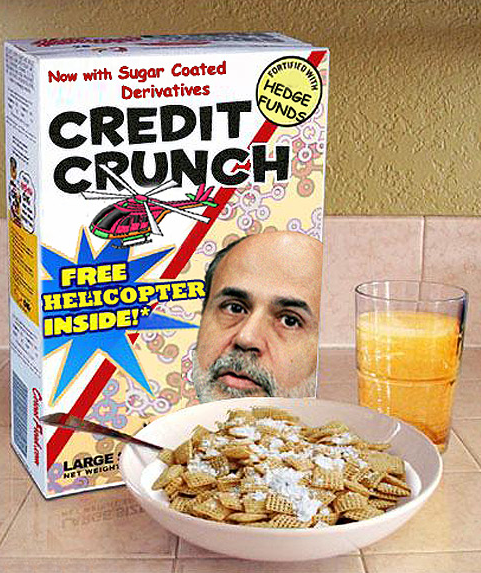
Q: George Bush was asked today “what did he think of the Credit Crunch?”
A: He replied: “It was his favorite Candy Bar.”

Brazil, Argentina abandon US dollar

Look for more bilateral agreements like this in the near future. This is a logical thing to do so long as neither country is abusing their currency too badly and the countries have a balance in their trade with one another. Their currencies will quickly find their way back home.
I expect these bilateral agreements to evolve into multilateral agreements that use the credit clearing process to net out accounts amongst the central banks.

The surprising thing here is that the central banks of Brazil and Argentina seem to be taking a course that is independent of the global banking fraternity. Read the article here. — t.h.g


Brazil, Argentina abandon US dollar

Brazil and Argentina have launched a new payment system in their bilateral trade, doing away with the US dollar as a medium of exchange.

The two Latin American nations started the Payment System on Local Currency (SML) on Monday following a last month agreement inked by their presidents to use local currencies in a bid to end transaction in dollars.

On Thursday, Argentine Central Bank President Martin Redrado and his Brazilian counterpart Henrique de Campos Meirelles signed the enforcement of the agreement for the SML, under which exports and imports between the two countries will take place with the Brazilian real (BRL) and the Argentine peso (ARS).

How the international banking fraternity created the present credit crisis

Here’s an article by Chris Quigley that describes how the international banking fraternity created the present credit crisis – t.h.g.

The “Originate to Distribute” Basle Banking Model Created the Banking Crisis

Christopher M. Quigley, B.Sc., M.M.I.I., M.A.

In an attempt to comprehend the current “credit crisis” I decided to try to investigate its underlying causes. To my dismay I discovered that the situation did not come about by accident but was actually conceived and planned by the International Banking Fraternity in Basel, Switzerland, in 1998.

The tsunami of credit that burst onto the scene after this “Basle Accord” helped save America from a recession, enabled it to fund a war, sleep walked Europeans, politically into the Euro Zone and attempted to copper fasten the artificial state called the European Union. This crisis is no accident it was premeditated and internationally agreed.

If you don’t believe the pre-meditation involved please read the quote below from the Wall Street Journal, Nov. 27th. 2007:

“In 1998 the Basle Accord created the opportunity for regulatory arbitrage whereby banks could shift loans off their balance sheets. A new capital discipline that was designed to “improve” risk management led to a PARALLEL BANKING SYSTEM whose lack of transparency explains how the market started to seize up.

The “originate-to-distribute” model REDUCED THE INCENTIVE for banks to monitor the CREDIT QUALITY of the loans they pumped into collateralized-

loan-obligations and other structured vehicles, the rules failed to highlight contingent credit risk……With Basle II, the question is just how the markets will evolve over the next 20 years…. as the new accord will require banks to hold LESS CAPITAL”.

American history has shown that many of its great leaders saw the danger in granting banking institutions too much power over the destiny of a nation. The Basle I Accord and now Basle II indicate just how fundamentally the International Banking Groups have lost their moral compass and altered old standard banking rules. Through sleight of hand i.e. “off balance sheet accounting” they allowed the financial structure of the world to become totally unstable and risk prone. If one was cynical one would actually come to believe that in 1998 future failure was built into the matrix; failure which only the strongest and the most astute could survive.

The end result will be systematic institutional deflation on a worldwide basis. Even though cash is being pumped into the major institutions the multiples of “off balance sheet” credit are now historic, thus the corporate inflation has already occurred. What we will now experience going forward is dept collapse and with it falling mortgage issuance and restrictive commercial funding. Here in Ireland business activity has almost come to a standstill and everybody is holding their breath wondering what the next crisis will be. The only saving grace is that things are not much better in Italy, Germany, France or Spain and is actually much worse in Scotland, (where the bank of Scotland failed) England and Greece. This crisis is truly global.

As institutional deflation (due to collapsing systematic credit) and social inflation (due to the panic demand and circulation of currency) spreads around the globe those who are left holding excess negotiable resources will be in a very powerful position to soak up value assets for pennies on the dollar. Regular folk will not be able to participate in this bonanza because for them the banking credit system will be closed with nothing to offer but foreclosure and frustration. The majority will in a defensive survival mode while the privileged few will be in full scale acquisitive attack. Such was the case in the last depression. How history is repeating itself. Those who instigated the “off balance sheet” travesty knew exactly what they were doing. My advice is if you cannot beat them join them. Friends go to cash and the physical money metals as soon as you can. Contract your business and life-style expenses. Network and co-operate within a real community for the exchange of goods and services that sustain life. Before things get really bad become educated and aware. Form city and town based money circles based on the teachings of E.C. Riegel and learn how to issue community based, bearer-negotiable, split-barter, exchangeinstruments of agreed value; otherwise known as money. (Most people do not fully understand that money, in essence, is a social contract based on human trust and mutual benefit). This “crisis event” is going to get much worse before it gets better folks. There will be short periods of reprieve but the reality of the problem is so serious and fundamental that it will take years, maybe decades (as in Japan), to work through, even with a R.T.C. (B) type solution. But perhaps it is true that “every cloud has a silver lining” and that “every problem bears within it the seeds of a greater opportunity”. Maybe finally after ninety five years the good people of the United States will awake from their media induced trance and realise that too much power was usurped by an elite on the 22nd. December 1913. Peaceful, proactive and constructive community must reassert its primacy over immoral, selfish and destructive institutionalism.