Here’s another report from RT television about the reasons for the NATO invasion of Libya and the overthrow of the Gadhafi government.

Here’s another report from RT television about the reasons for the NATO invasion of Libya and the overthrow of the Gadhafi government.
Posted in Developing Alternatives, Geo-politics, The Political Money System
Tagged Gadhafi, Gold Dinar, Libya
The following is a message sent by Guy “Josh” Josserand, one of my friends and associates, to the Occupiers in Tucson. It is an eloquent expression of hope and power that I think should be widely shared.–t.h.g.
Dear Occupiers and Occupationists,
Thank you so much from my heart for the power of your presence.
This is a rising tide of public awareness and personal participation for which I have had decades of anticipation.
A tsunami of love and respect for life is forming that can wash clean some centuries of fear-based domination of the many by the few.
Government of the People, for the People, and by the People now faces its last best chance to escape corporate feudalism.
Are we serfs or are we sovereigns?
Toward this end I wish to encourage the Occupation to speak, not about what it needs but WHAT IT GIVES.
As much as the Occupation needs the 99%, we all, the 100%, need what the Occupation offers even more.
It offers us all power and voice.
Let us INVITE each one to take control of the power they have.
Let us encourage them to accept the power they are.
Let us remind them of Marianne Williamson’s message which Nelson Mandela repeated in his Inaugural Address.
“Our deepest fear is not that we are inadequate. Our deepest fear is that we are powerful beyond measure. It is our light, not our darkness that most frightens us. We ask ourselves, Who am I to be brilliant, gorgeous, talented, fabulous? Actually, who are you not to be? You are a child of God. Your playing small does not serve the world. There is nothing enlightened about shrinking so that other people won’t feel insecure around you. We are all meant to shine, as children do. We were born to make manifest the glory of God that is within us. It’s not just in some of us; it’s in everyone. And as we let our own light shine, we unconsciously give other people permission to do the same. As we are liberated from our own fear, our presence automatically liberates others.”
Let us incorporate this perspective into every communication and act of Occupiers in every town and city of the world. Success of the Occupation will be measured by the degree to which we can eradicate fear from the hearts of both the 99% and the 1% as well, for the One Percent also suffers from bondage. Though they fortify themselves with wealth, it is only a wealth of power and dominance which is antithetical and incompatible with actual freedom, justice and happiness. Injustice for anyone breeds injustice for all, and as Rev. Martin Luther King, Jr. reminded us many years ago, “None of us is free until all of us are free.”
‘Josh’
Guy Josserand III
Posted in Emerging paradigm, Geo-politics
Tagged freedom, justice, peach, power, The Occupy movement, Tucson
One of my correspondents recently alerted me to a review of David Harvey’s book, The Enigma of Capital, and the crises of capitalism. I’ve not seen the book, but if the review is a faithful description, the book seems to be well worth reading.
I’m not inclined to frame my analyses and prescriptions in terms of competing ideologies because that leads to immediate resistance by the true believers on one side or another. Rather, we need to encourage people to think outside of their comfortable boxes by pointing out implicit assumptions and evident dysfunctions, and suggesting structural as well as policy changes that show promise of providing better outcomes.
Of course, what constitutes a better outcome will always be a point of disagreement based on the fundamental values, attitudes, and beliefs that different segments of society hold dear (e.g., the 1% vs the 99% that the Occupy movement has been highlighting). Besides that, our desires and expectations must ultimately adjust to the reality of our planetary limits to physical growth.
Based on the review, the points that I may agree or disagree with Harvey about are inserted in red in the review below.
The Enigma of Capital, and the crises of capitalism, By David Harvey
Review by Andrew Gamble
Friday, 30 April 2010
Andrew Mellon, the US Treasury Secretary during the Great Crash of 1929 and one of America’s richest men, observed that in a crisis assets return to their rightful owners. Nothing much has changed. As the present crisis has mutated from a banking crisis to a fiscal crisis and a sovereign debt crisis, bonuses continue to be paid, while the people of Greece and Iceland suffer huge cuts in jobs and services.
As the head of Citibank helpfully pointed out, “Countries cannot disappear. You always know where to find them.” Once the bubbles are burst, expectations about asset values are dashed, optimism gives way to despair, and wealth is ruthlessly redistributed. Capitalism survives by purging itself of debt and loading the costs of adjustment on the weak and the poor.
[I agree, but something needs to be said about HOW it purges itself of debt. We’ve seen very clearly in this latest cycle how the capitalists have come away whole by pushing the debt off onto the public sector by means of government bailouts. That has cause severe fiscal (budgetary) problems for governments, which now are pressured to cut spending. That is where the weak and the poor (including the “middle class”) get fleeced and sacrificed because the cuts are typically made in social spending and programs that promote the common good.]
For David Harvey, this is the latest of the great structural crises which have punctuated the development of capitalism and which signify that major limits have been reached to further growth. Crises on this view are inherent in capitalism itself, and the means by which it renews itself. Only a periodic clear-out of debt and unproductive activities creates the basis for a further leap forward.
Harvey is less interested in the detail of how the 2007-8 crisis unfolded than in understanding it as a manifestation of how capitalism works. Over the last two decades, he has become a leading exponent of classical Marxist political economy, his work known for its exceptional clarity and for integrating spatial categories into the theory of capital accumulation.
Capitalism in the last 200 years has proved itself by far the most dynamic and productive economic system known to history, but the wealth comes at a price, both for human beings and increasingly for the natural environment.
Periodically, capitalism over-expands and overshoots, encountering limits it cannot immediately transcend. This is a system which must keep expanding by at least 3 per cent a year. What drives it is the hope of profit, and this impulse comes to shape all social relations as well as nature. During booms, capital accumulates very fast, but the amount of surplus generated becomes harder and harder to absorb. The investments that have been made in the boom fix capital in all sorts of ways, in buildings, cities, regions and countries, as well as in labour forces and ways of organising production.
After a time many of these past investments no longer yield a high return and sometimes no return at all. This is what precipitates the crisis. It may take the form of a profits squeeze, caused by militant labour wresting gains from capital, or by factors depressing the rate of profit, or by too little demand. Harvey argues that the present crisis is particularly hard to resolve because it comes after a long period in which real incomes in the US have stagnated, while the wealth of the property-owning elite has soared.
The gap between what labour was earning and what it would spend was covered by credit. The average debt of per household, including mortgage repayments, was $40,000 in 1980. By 2007 it was $130,000. Getting this debt down and restarting the economy is a huge task.
[I too have been preaching that the limits to growth have been reached, and yes, however one might choose to characterize an economic system (capitalist, socialist, or otherwise), there must be a periodic “clear[ing]-out of debt and unproductive activities,” for the system to maintain its vitality, but not necessarily to make way for further growth.
I’m wondering if Harvey’s book adequately explains the phenomenon of “expansion and overshoot,” and whether or not that would also occur under his conception of a alternative non-Capitalist system. I’m also wondering about the basis for his statement that, “This is a system which must keep expanding by at least 3 per cent a year.” I’ve seen estimates that run closer to 6%. My own belief is that the proximate driver of continual economic growth is the compounding of interest that is a fundamental feature of our global monetary system, and that the surplus that is created by the economy goes largely into capital concentration and profit-seeking reinvestment, rather than to increased and more equitable consumption. Thus, we see starvation and want amidst plenty.]
Harvey is pessimistic that growth can be restarted without the infliction of quite unimaginable hardships on the many of the world’s poorest people. Capitalism survives by socialising losses and distributing gains to private hands. Harvey devotes a large part of his argument to show how this is done through the close ties of the state and finance. He calls it the state-finance nexus.
[Yes, this is an increasingly obvious point. I’m glad to see that Harvey is highlighting the “state-finance nexus.” I trace that back to the founding of the Bank of England in 1694, which established the pattern of central banking and government-banking collusion that has since spread around the world and culminated in a rather monolithic regime. But there are cracks beginning to form.]
This is not a conspiracy: both sides of the relationship need one another and support one another. There are frictions and conflicts, but in the end they work together because this is the only system anyone knows or thinks can be made to work. Michael Bloomberg, as Mayor of New York, commissioned a report which declared that excessive regulation in the US was threatening the future of the financial sector in New York.
The financial crash of 2008 destroyed the credibility of the financial growth model put in place after the last great capitalist crisis in the 1970s. It has also, as Harvey notes, put a question-mark over the continuance of US hegemony, because of the shift in the balance of the global economy towards the rising powers of India and China.
He thinks that the accumulated rigidities over the last cycle have become so great that only a very fundamental restructuring can restore the basis for renewed economic growth. But the pressure for an early return to business as usual are very great, threatening an early return of credit and debt as the only way to fuel the economy, and the eruption of another crisis in a few years.
Harvey argues that each major capitalist crisis has been worse than the last one, and more difficult to surmount. He accepts that capitalism, with all its resilience and inventiveness, is quite capable of overcoming this crisis too; but he is sceptical, and believes that this is the moment that a revived anti-capitalist movement can seize the opportunity to put forward a realistic alternative to capitalism as a way of organising the economy.
[Yes, it is evident that each successive cycle is more extreme than the last. The financial system based on interest-bearing debt is shaking itself apart.
It seems odd that he attributes “resilience and inventiveness” to capitalism. These are human qualities that might thrive in a variety of circumstances. The question is how, specifically, to support them. ]
This is perhaps where the argument is least convincing. The anti-capitalist left is fragmented and not particularly numerous. Radical political responses during previous capitalist crises have often favoured the right. The rise of China and India, both of which have continued to grow through the recession, suggests that the fundamental shift in the balance of the global economy is only just beginning, and if it continues is likely to provide huge potential for growth and absorption of surplus, provided certain political conditions are met.
This will not be easy but is certainly possible. Marx thought that no social order ever perishes before all the productive forces for which there is room in it have developed. On the evidence Harvey himself provides, capitalism still has a long way to go before that is the case, and no gravediggers are in sight.
[What are the physical limits to the application of those “productive forces?” It is evident that the masses of India and China cannot possibly achieve the levels of consumption and way of living that have prevailed in the West. The emphasis must shift from capital accumulation and increasing consumption to more equitable distribution and better quality of life for all.]
But this book is a welcome addition to the literature on the crisis. It provides a lucid and penetrating account of how the power of capital shapes our world, and sets out the case for a new radicalism and a vision of alternatives. What we need, he argues, is not just a new world but a new communism, following the failure of the old – although he does accept ruefully that using “communist” as a political label may not bring instant success in the United States.
[I guess we will need to read the book to see what Harvey has to propose in making the “case for a new radicalism and a vision of alternatives.”]
Andrew Gamble is Professor of Politics at the University of Cambridge and author of ‘The Spectre at the Feast’ (Palgrave Macmillan)
[Annotated comments by Thomas H. Greco, Jr.]
Posted in Finance and Economics, Geo-politics, The Political Money System
Tagged Caapital, capitalism, Harvey, The Independent
“Quakers in Britain share the concern for global economic justice and sustainability expressed by the Occupy movement. We agree with the statement of Occupy London Stock Exchange that our current economic system is unsustainable. It is undemocratic and unjust. We need alternatives.
We, too, “want structural change towards authentic global equality. The world’s resources must go towards caring for people and the planet, not the military, corporate profits or the rich,” (as stated in Occupy LSX initial statement). We are grateful to the various Occupy groups for raising these issues so passionately and respond to the deep spiritual significance that we recognise in the movement.
“Those of us who have visited have been welcomed, and found the Occupy sites an exceptional learning experience. We honour the values and positive ways of working within Occupy communities: without hierarchy, based on care for others, open to the contributions of all and searching for the truth. These are in harmony with our Quaker practice and business methods.
“The idea that another world is possible is crucial for us too. We cannot accept the injustice and destructiveness of our economic system as it is. At the annual meeting of Quakers in Britain in August 2011 we wrote: “We need to ask the question whether this system is so broken that we must urgently work with others of faith and good will to put in its place a different system in which our testimonies can flourish”. We support the process initiated by the Occupy movement to create a path towards a different future, and to develop it democratically.
“We hope that individual Quakers will continue to provide support, both moral and practical, to the movement. We greatly value its peaceful quality and we pray that this can be actively supported by all, including the civil and ecclesiastical authorities who have the difficult task of maintaining simultaneously both public order and the right of peaceful protest.”
Signed Paul Parker, Recording Clerk for Quakers in Britain
More and more people are wondering about how the Occupy movement will shift from protest and demonstration to strategies and actions that will result in personal and community empowerment, actions toward restructuring our institutions and shifting the balance of power from Washington and Wall Street to Main Streets, neighborhoods, and civic organizations.
One rather obvious strategy is to change the way we spend and invest our money.
Click here to see a list of financing alternatives that I started preparing as a resource list for my presentation to the Financial Planning Association in May, 2011. I have since added a few items to it, including a link to One PacificCoast Bank, a relatively new bank which has as its mission, “to build prosperity in our communities through beneficial banking services delivered in an economically and environmentally sustainable manner.” According to a description on the BALLE website, the “founders granted 100% of the bank’s dividends, when declared, to a foundation dedicated to the communities and environment upon which we all depend. This unique structure ensures that the bank’s interests are aligned with the needs of its customers and communities. We call this “beneficial banking.”
I like the sound of that and I’m hoping that this case may be the forerunner of a new pattern of corporate ownership in which service is the foremost purpose and profits are distributed to entities that serve the common good, not just the narrow interests of a few.
I have made my resource list a permanent page which is listed in the sidebar to the right under Resources. It remains a work in progress.–t.h.g.
From the beginning of the NATO offensive against the Gadhafi regime in Libya, there has been a lot of buzz about the real reasons behind the Western powers’ agenda for regime change. This article from the New American sketches a plausible explanation. It may have had more to do with Gadhafi’s new money plan than it did about Libya’s oil riches.—t.h.g.
Gadhafi’s Gold-money Plan Would Have Devastated Dollar
Written by Alex Newman
Friday, 11 November 2011 10:15
It remains unclear exactly why or how the Gadhafi regime went from “a model” and an “important ally” to the next target for regime change in a period of just a few years. But after claims of “genocide” as the justification for NATO intervention were disputed by experts, several other theories have been floated.
Oil, of course, has been mentioned frequently — Libya is Africa‘s largest oil producer. But one possible reason in particular for Gadhafi’s fall from grace has gained significant traction among analysts and segments of the non-Western media: central banking and the global monetary system.
According to more than a few observers, Gadhafi’s plan to quit selling Libyan oil in U.S. dollars — demanding payment instead in gold-backed “dinars” (a single African currency made from gold) — was the real cause. The regime, sitting on massive amounts of gold, estimated at close to 150 tons, was also pushing other African and Middle Eastern governments to follow suit.
And it literally had the potential to bring down the dollar and the world monetary system by extension, according to analysts. French President Nicolas Sarkozy reportedly went so far as to call Libya a “threat” to the financial security of the world. The “Insiders” were apparently panicking over Gadhafi’s plan.
“Any move such as that would certainly not be welcomed by the power elite today, who are responsible for controlling the world’s central banks,” noted financial analyst Anthony Wile, editor of the free market-oriented Daily Bell, in an interview with RT. “So yes, that would certainly be something that would cause his immediate dismissal and the need for other reasons to be brought forward [for] removing him from power.”
According to Wile, Gadhafi’s plan would have strengthened the whole continent of Africa in the eyes of economists backing sound money — not to mention investors. But it would have been especially devastating for the U.S. economy, the American dollar, and particularly the elite in charge of the system.
“The central banking Ponzi scheme requires an ever-increasing base of demand and the immediate silencing of those who would threaten its existence,” Wile noted in a piece entitled “Gaddafi Planned Gold Dinar, Now Under Attack” earlier this year. “Perhaps that is what the hurry [was] in removing Gaddafi in particular and those who might have been sympathetic to his monetary idea.”
Investor newsletters and commentaries have been buzzing for months with speculation about the link between Gadhafi’s gold dinar and the NATO-backed overthrow of the Libyan regime. Conservative analysts pounced on the potential relationship, too.
“In 2009 — in his capacity as head of the African Union — Libya’s Moammar Gadhafi had proposed that the economically crippled continent adopt the ‘Gold Dinar,’” noted Ilana Mercer in an August opinion piece for WorldNetDaily. “I do not know if Col. Gadhafi continued to agitate for ditching the dollar and adopting the Gold Dinar — or if the Agitator from Chicago got wind of Gadhafi’s (uncharacteristic) sanity about things monetary.”
But if Arab and African nations had begun adopting a gold-backed currency, it would have had major repercussions for debt-laden Western governments that would be far more significant than the purported “democratic” uprisings sweeping the region this year. And it would have spelled big trouble for the elite who benefit from “freshly counterfeited funny-money,” Mercer pointed out.
“Had Gadhafi sparked a gold-driven monetary revolution, he would have done well for his own people, and for the world at large,” she concluded. “A Gadhafi-driven gold revolution would have, however, imperiled the positions of central bankers and their political and media power-brokers.”
Adding credence to the theory about why Gadhafi had to be overthrown, as The New American reported in March, was the rebels’ odd decision to create a central bank to replace Gadhafi’s state-owned monetary authority. The decision was broadcast to the world in the early weeks of the conflict.
In a statement describing a March 19 meeting, the rebel council announced, among other things, the creation of a new oil company. And more importantly: “Designation of the Central Bank of Benghazi as a monetary authority competent in monetary policies in Libya and appointment of a Governor to the Central Bank of Libya, with a temporary headquarters in Benghazi.”
The creation of a new central bank, even more so than the new national oil regime, left analysts scratching their heads. “I have never before heard of a central bank being created in just a matter of weeks out of a popular uprising,” noted Robert Wenzel in an analysis for the Economic Policy Journal. “This suggests we have a bit more than a rag tag bunch of rebels running around and that there are some pretty sophisticated influences,” he added. Wenzel also noted that the uprising looked like a “major oil and money play, with the true disaffected rebels being used as puppets and cover” while the transfer of control over money and oil supplies takes place.
Other analysts, even in the mainstream press, were equally shocked. “Is this the first time a revolutionary group has created a central bank while it is still in the midst of fighting the entrenched political power?” wondered CNBC senior editor John Carney. “It certainly seems to indicate how extraordinarily powerful central bankers have become in our era.”
Similar scenarios involving the global monetary system — based on the U.S. dollar as a global reserve currency, backed by the fact that oil is traded in American money — have also been associated with other targets of the U.S. government. Some analysts even say a pattern is developing.
Iran, for example, is one of the few nations left in the world with a state-owned central bank. And Iraqi despot Saddam Hussein, once armed by the U.S. government to make war on Iran, was threatening to start selling oil in currencies other than the dollar just prior to the Bush administration’s “regime change” mission.
While most of the establishment press in America has been silent on the issue of Gadhafi’s gold dinar scheme, in Russia, China, and the global alternative media, the theory has exploded in popularity. Whether salvaging central banking and the corrupt global monetary system were truly among the reasons for Gadhafi’s overthrow, however, may never be known for certain — at least not publicly.
# # #
Posted in Finance and Economics, Geo-politics, The Political Money System
Tagged Gadhafi, Gold Dinar, Libya, NATO, regime change, The New American
Here is a remarkable statement by Paul B. Farrell that tells the unvarnished truth about the class war that is being waged against Americans. It is remarkable for two reasons, first, because Farrell has a background as a financial establishment insider–he was an investment banker with Morgan Stanley; executive vice president of the Financial News Network; executive vice president of Mercury Entertainment Corp; and associate editor of the Los Angeles Herald Examiner. Secondly, because this article appeared in MarketWatch, a mainstream news source controlled by Rupert Murdoch.
According to Wikipedia, MarketWatch “is now a wholly owned subsidiary of Dow Jones, which in turn is owned by News Corporation. MarketWatch is part of Dow Jones’ Consumer Media Group, along with The Wall Street Journal, Barron’s, the WSJ.com and affiliated Internet properties. Through the Rupert Murdoch-controlled News Corp. ownership, MarketWatch is also affiliated with, among many other global media properties, the New York Post, The Times of London, Fox News Channel and multiple other 20th Century Fox spinoffs, and HarperCollins publishers.”
I urge everyone to read the entire article paying close attention to Farrell’s conclusion.—t.h.g.
Rich Class fighting 99%, winning big-time
Commentary: Reagan began class war in 1981, Buffett declared in 2006
By Paul B. Farrell, MarketWatch. Nov. 1, 2011, 10:22 a.m. EDT
SAN LUIS OBISPO, Calif. (MarketWatch) — Yes, “there is class warfare, all right,” declared Warren Buffett. “But it’s my class, the rich class, that’s making war, and we’re winning.”
Yes, the Rich Class is at war with you, with the 99%, a war against America. This class war actually started a generation ago, in 1981 when Ronald Reagan became president. Since then, the Rich Class has been winners. Big-time. And the 99% are the losers. Real big-time.
I am going to keep reminding you over and over of this Rich Class declaration of war and how they’re defeating America.
Why more reminders? Because, except for Buffett, the vast majority of the Rich Class really are engaged in a massive cover-up, a widespread conspiracy that includes the Super Rich, Forbes 400 billionaires, Wall Street bank CEOs, all their high-paid Washington lobbyists, all the Congressional puppets they keep in office by spending hundreds of millions on campaign payola and all the conservative presidential candidates praying the same Rich Class dogma.
Yes, Rich Class has been fighting a 30-year war to rule America
They’re fighting you, winning big-time, and you’re the loser. It’s just one generation since conservatives put Reagan in office: In those three short decades the income and wealth of the top 1% has tripled while the income of the bottom 99% of all Americans has stagnated or dropped.
Yes, they are at war with you, fighting to gain absolute power over America … and they will never stop their brutal attacks.
Buffett didn’t admit to this Declaration of Class War on America till five years ago. It happened in Omaha, Neb., in Buffett’s “unpretentious offices” back in 2006 during a New York Times interview with Ben Stein, a former Nixon speech writer. Here’s Ben describing the declaration of war:
”Buffett compiled a data sheet of the men and women who work in his office. He had each of them make a fraction; the numerator was how much they paid in federal income tax and in payroll taxes for Social Security and Medicare, and the denominator was their taxable income. The people in his office were mostly secretaries and clerks, though not all.
”It turned out that Mr. Buffett, with immense income from dividends and capital gains, paid far, far less as a fraction of his income than the secretaries or the clerks or anyone else in his office. Further, in conversation it came up that Mr. Buffett doesn’t use any tax planning at all.
“He just pays as the Internal Revenue Code requires. ‘How can this be fair?’ he asked of how little he pays relative to his employees. ‘How can this be right?’ Even though I agreed with him, I warned that whenever someone tried to raise the issue, he or she was accused of fomenting class warfare.”
And to that comment by Stein, Buffett made his famous declaration of war: “There’s class warfare, all right,” Mr. Buffett said, “but it’s my class, the rich class, that’s making war, and we’re winning.”
In spite of that unequivocal declaration, Buffett’s Rich Class buddies still want you to believe that it’s the Occupiers, the lazy unemployed, the 99%, someone else, anyone other than their Rich Class that’s fomenting class warfare.
So you need occasional reminders, because the “Rich Class” has been spending mega-bucks for decades to shift responsibility. Fortunately today, folks like the Occupiers aren’t buying the con job.
Here’s a few:
Rich Class warriors: puppet-politicians in GOP-controlled Congress
We know the GOP is the Party of the Rich Class. But the Dems are co-conspirators fighting the class war as pawns of the wealthy. No wonder the Occupy Wall Street crowd focuses on the inequality gap between America’s top 1% and the 99% who’ve seen no income growth since the Reaganomics ideology took over American politics. Many are like House Budget Committee chairman Paul Ryan, clones of Ayn Rand’s narcissistic cult of selfish capitalism.
Listen, both parties are singing in harmony: “Yes, there’s class warfare. And yes, it’s our duty to fight for the richest class of capitalists who are making this war. We must help them win, get richer, squeeze more and more out of all Americans.”
Rich Class warriors: Federal Reserve-Wall Street bankers conspiracy
Yes, there are five banks in America that control about 90% of all the deposits … they control over 90% of America’s trading in the $650 trillion global derivatives casino … they control the Federal Reserve through directors and governors … their campaign payola and lobbyists virtually control the presidency, the Senate and Congress … they siphon huge bonuses from depositors, shareholders and pensioners alike:
“So yes, there is a class warfare running our banking system, every day. And yes, the CEOs in our rich class are leading that class war, and winning big. But more is never enough, so we want new ways to skim off profits, because we are invincible, too big and too greedy to fail.”
Rich Class warriors: Pentagon’s Perpetual War-Mongering Machine
The rich class loves war (war profiteering is a big business). Of course they often have to brainwash the 99% with fears like the mushroom-cloud lies Bush-Cheney used to get America into the $3 trillion Iraq War. Americans have a powerful love-hate relationship with war. Why else would we spend almost half our federal budget, several hundred billion dollars, on war every year?
“Yes, there’s class warfare, all right,” the former vice president might say as a one-time defense contractor CEO and oilman who continued profiting in office. He’d obviously admit: “Yes, we’re in a class war, and it’s my class, the rich class, that’s making war, and we proud that we kept winning that war while we was in office.”
Rich Class fighting to turn America back into Reagan’s ol’ Wild West
The list goes on: The Rich Class wants to time-travel America back to a lawless Old Wild West, back to a free-market Reaganomics anarchy where the top 1% trickle down leftovers to the 99% using this kind of self-destructive programs:
But, of course, there’s nothing new here. We just forget so easily, because it’s so bad. Which is why we’ll be reminding you often that the Rich Class has been fighting this war against you for 30 years, since Reagan.
And they’re so greedy they cannot stop fighting. So they will likely keep attacking the 99% for another decade, till the 2020 presidential elections, or more likely, till a catastrophic collapse of the economy coming soon.
Yes, folks, America really is under attack daily. We are fighting on the defense in an historic class warfare. Yes, the Rich Class really did start this war. And yes, they really are winning, big-time. And yes, they are addicted to winning at all costs, to get richer and richer just for the sake of getting richer and richer.
They have no conscience about the collateral damage done to the rest of Americans. They’ve lost their moral compass. In short, they will fight this war to the death, yours, theirs, even the death of America. Bet on it: Because more is never enough for America’s morally bankrupt Rich Class. [emphasis added-ed.]
Copyright © 2011 MarketWatch, Inc. All rights reserved.
Posted in Economics, Emerging paradigm, Politics
Tagged class war, conspiracy, Farrell, market watch, Occupy Wall Street, oligarchy
Where is the occupy movement headed? This is a question that needs to be a continuous part of our discussion. One observer that I regard as particularly astute is Richard K. Moore, visionary, activist, and author of Escaping the Matrix. Richard’s preoccupation is very similar to my own, i.e., to find answers to such fundamental questions as these: How does the world really work? What could a better world look like? How can we bring about the necessary transformation?
Here below is Richard’s very insightful expression (slightly abridged) of what is likely to happen UNLESS the Occupy movement can be informed of truly transformative options, motivated to share, cooperate and organize to implement them, and empowered enough to carry through to full realization of what I’m calling the Butterfly society.
In my view, that will mean a massive devolution of power, and herein lies the importance of the transition, relocalization, decentralization, and community self-reliance initiatives. But a necessary part of that is also a shift in values and ideals that motivate people to change their orientation from pursuing their narrow self-interest to acting for the common good.
Richard’s scenario is a pessimistic one, but it seems all too plausible. As he points out, there is always the risk with any movement, that it will be manipulated and co-opted to serve the interests of some particular group, most notably the existing power hierarchy. This may be the case with the recent regime changes in North Africa and the Middle-east, particularly Libya, where the change was achieved only by the massive intervention of NATO in a civil war that was waged against the government of Muammar Gaddafi by some pretty dubious characters. Now I make no apology for Gaddafi, but the avowed purpose of the NATO intervention just does not hold up to any reasonably close scrutiny. What will be the ultimate outcomes there and in Tunisia and Egypt remains to be seen.
Alvin Toffler, in his book, The Third Wave observed that the power of the nation state is on the wane, that it is being assailed both from ABOVE and from BELOW. The New World Order of the global elite is the “from above” part of that picture. Over the years, we’ve gotten a pretty good glimpse of what that looks like—ever greater centralization of power and concentration of wealth, and control of the many by the few who view themselves as “special” and destined to rule over the world. Carroll Quigley’s book, Tragedy and Hope is perhaps the most useful source on this because it includes a description of HOW their plans are being carried out. That is by their control over the entire machinery of MONEY—credit, currencies and exchange mechanisms; banking and finance; and markets. (The blocking of funds transfers, as in the case of Wiki Leaks, is only small weaponry in this “money war.”).
In Quigley’s words:
”The powers of financial capitalism had a far-reaching plan, nothing less than to create a world system of financial control in private hands able to dominate the political system of each country and the economy of the world as a whole… Their secret is that they have annexed from governments, monarchies, and republics the power to create the world’s money…”
Popular demands for change will, at best, end up changing nothing, and, at worst, put the masses of people in even deeper bondage than before UNLESS, the people carry through with the more difficult tasks that I mentioned above. Changes in leadership will not suffice. Our problems are structural, and nothing short of a thoroughgoing restructuring will suffice.
I’ve added some emphasis (bold type) to Richard’s essay below as a way of alerting the reader to some of the points I consider to be especially pertinent. The most important parts are toward the end, so please read it in its entirety.
I’m hoping that this and my other posts on the OWS can stimulate more such visioning and scenario planning that can lead to effective strategies for preventing manipulation and cooptation, and lead us to a truly free and compassionate New Civilization..–t.h.g.
On 10/25/2011 6:12 AM, Richard Moore wrote:
My concern, when I examine any movement or initiative, is to understand what its outcomes are likely to be, all things considered. Where is the OWS movement headed? If it’s headed somewhere I want to go, then I’d be likely to support it, even if I was uncomfortable with some aspects of the movement. And vice versa.
The OWS movement is based on two things, a critique and a process. The critique is a radical anti-establishment perspective. The process is about direct democracy in large groups, based on consensus. OWS is succeeding very well in communicating and promulgating its radical perspective. And the success of the OWS process, in maintaining movement harmony and avoiding divisiveness, has been impressive.
The success of the process offers hope that a better society is possible, based on direct democracy. Through participation in Occupations, that hope is reinforced by direct experience of ‘how things might be’. The enthusiasm of the Occupiers is communicated effectively to followers of the movement, and it’s a contagious enthusiasm. The hope becomes almost a confidence that a better world is coming, and the Occupations become almost proofs-of-concept of the new-world principles.
There is a direct relationship between the hope the movement generates, and the radicalness of the OWS perspective. People normally have a resistance to totally rejecting the current system. When I’ve offered those kind of radical critiques in my postings, many of you have objected to my over-negativity. The OWS perspective, and the hard-hitting viral OWS videos, make my negativity look like child’s play, but people can respond to the perspective, because there is also a branch of hope on offer. If one is in a lifeboat, one can stop pretending the ship isn’t sinking.
And the ship is sinking. The system, as we’ve known it, is totally corrupt and is in a process of collapse. The OWS radical perspective is right on the mark. As people suffer under debt burdens and austerity, they resonate on a personal level with these radical truths. And when they see the enthusiasm and hope generated by the movement, they are drawn to it. If they actually participate in an Occupation, or experience it vicariously on YouTube, they tend to become enthusiastic, promoting the movement in their own networks. It’s not surprising the movement has grown so quickly and on such a large global canvas.
There seems to be nothing standing in the way of the movement growing to its own natural maximum extent. The victory against eviction by Bloomberg stands as a kind precedent, that the on-the-ground Occupiers can expect to be reasonably tolerated by the powers that be. In some cases municipalities are officially endorsing their own local Occupations.
This is all leading up to a kind of Global Tahrir-Square Moment: everyone, so to speak, in the streets, everyone wanting radical regime change, and a sense of inevitable success in the air. In Egypt, the original Tahrir Square, the ‘success’ was the ouster of Mubarak, and the outcome was a military regime whose fundamental orientation is probably not much different from that of Mubarak.
The OWS movement is more sophisticated than that, and has avoided being limited by specific demands. Nonetheless, this later Tahrir Square scenario is highly vulnerable to co-option. The OWS process keeps people harmonized and motivated, while specifically avoiding anything that smacks of organization-building or goal setting. The focus is on demonizing the existing regime, and on encouraging the expectation that change is inevitable: just keep doing what you’re doing.
The hope of movement participants is that out of this scenario a viable direct-democracy process will emerge. The fact, however, is that the movement has grown exponentially in the horizontal direction – greater numbers and more locations – while remaining relatively static as regards its process. The process has been mainly about managing the Occupations and promulgating the movement. It has not been about developing a consciousness about how a direct-democracy / anarchist process can deal with the practical issues faced by a global society in crisis.
So when we reach our Global Tahrir-Square Moment we will be in a volatile situation. We’ll have all that global energy expecting the regime to fall, and no more real direction or vision than in the original Egyptian Tahrir Square. It’s basically a crowd waiting for something to happen.
Meanwhile there is the current regime itself. Is it asleep to all these happenings? Why is the mainstream media being so supportive? Why hasn’t the movement been suppressed in the way the anti-globalization movement was suppressed? Why aren’t there any black-block infiltrators, providing an excuse for suppression, as there was with the anti-globalization movement. Could it be because the regime is not upset with where the movement is heading?
Consider these quotations, which reflect something about how the current masters of the universe think about regime change:
“We shall have World Government whether or not we like it. The only question is whether World Government will be achieved by Conquest or Consent” – Paul Warburg, author of the Federal Reserve Act, speaking before the US Senate
“Today Americans would be outraged if U.N. troops entered Los Angeles to restore order; tomorrow they will be grateful. This is especially true if they were told there was an outside threat from beyond, whether real or promulgated, that threatened our very existence. It is then that all peoples of the world will plead with world leaders to deliver them from this evil. The one thing every man fears is the unknown. When presented with this scenario, individual rights will be willingly relinquished for the guarantee of their well being granted to them by their world government.” – Henry Kissinger speaking at Evian, France, May 21, 1992 Bilderburgers meeting.
“We are on the verge of a global transformation. All we need is the right major crisis and the nations will accept the New World Order.” – David Rockefeller
The people at the top of the current regime want regime change. They want to eliminate those messy nations that interfere with their direct control of global affairs. How convenient it is that the demonization material from OWS focuses on nations, their political corruption, their exploitive corporations, their deadly wars, and their greedy banks. The revelations of evil stop short of talking about the regime’s own plans for regime change. From the OWS perspective, the old regime is incapable of adapting and will simply crumble under the weight of the global movement.
In my article about elite plans, cited at the top of this posting, I suggested that a new regime – a new global government – will need to have its own mythology, and that part of that mythology will need to be a thorough demonization of the old regime. The primary concrete output of the OWS movement thus far is precisely such a demonization, very persuasive, and with high production values. When the old regime is swept away, it will be clear to everyone that the people themselves demanded it. The new regime, whatever it is, will have a strong claim to democratic legitimacy.
Everything about the OWS movement, whether by design or accident, is playing directly into the hands of those who have long been yearning to create a one-world government. Notice, in Rockefeller’s quote above, that his concern is about nations accepting a global government, rather than being concerned with the people themselves accepting it. Meanwhile Kissinger talks about UN troops being called in to restore order. And both talk about the importance of an appropriate crisis, to help usher in the new regime. One can’t anticipate a particular scenario from such statements, but they give us a sense of the ‘range of options’, that are ‘on the table’, as regards bringing about the regime’s own plans for regime change.
Taken altogether, I see the following as the ‘most likely outcome scenario’. The OWS movement will continue to grow, generating a general consensus that the existing system is illegitimate and failing. The ‘establishment’ – that is the police and the national governments – will continue to show themselves to be incapable of responding to the aspirations of the movement. In some cases, as we’ve seen in Greece, there will be violence. In other cases, things will stay peaceful. Meanwhile economic conditions will continue to rapidly deteriorate, nations will go bankrupt, and basic infrastructures will be threatened with breakdown. So we’ll have lots of people in the streets demanding regime change, conditions getting desperate, and governments unable to resolve the situation.
This scenario fits the definition of a ‘failed state’, a society that has become ‘ungovernable’. We’ve been conditioned over the past few years to accept the notion of a ‘failed state’, and to expect some kind of ‘humanitarian intervention’ as a ‘solution’. This is the formula that is likely to be employed to usher in a global takeover. Just as our corrupt leaders gave in to the banks when bailouts were demanded, so will our corrupt leaders ‘invite’ outside intervention, when they are told to do so by the same folks who told them to go along with the banks.
Outside intervention is not necessarily about UN troops on street corners, although that might be likely where violence has erupted, and the UN would then be seen as a ‘neutral buffer’ between the people and the hostile security forces of the state. Intervention is also about yielding sovereignty, of one kind or another, to global entities. Permitting external troops on your soil is one kind of yielding sovereignty. Submitting to some new financial regime, controlled globally, would be another form of yielding sovereignty. Agreeing to conform – on penalty of severe sanctions – to some global charter or constitution, would be another form of yielding sovereignty.
Behind the scenes, there will be an architecture for a global governance system, and you can be sure that despite what promises might be made, or whatever democratic-input mechanisms are established, this architecture will guarantee the continued dominance, openly or covertly, of the current masters of the universe. Lots of intermediate heads may roll; those are all expendable, and their demise will be counted as ‘victories’ for the movement, ‘proving’ that the movement is creating the changes that are occurring.
In the public arena, a ‘solution paradigm’ will emerge, and it will seem to be a product of the OWC process. We can expect breakthroughs in communication, where OWC leaders (non leaders?) are invited to participate in some kind of dialog with ‘important world leaders’, discussing the ‘great problems facing us all’.A vision of a participative global society will be developed, and it will be presented as an outcome of the OWC process, in collaboration with those enlightened ‘important world leaders’.
You may wonder how I come up with these scenarios, and whether there is any way to determine whether they have any validity. I come up with these scenarios by looking at things from the point of view of the masters of the universe, taking into account the means at their disposal, their typical modus operandi, their candidly stated goals, and the current actions they are taking or not taking.
By both their actions and their inactions – expressed as favorable media and a lack of suppression – they are encouraging the OWS phenomenon. By disempowering nations via austerity measures and privatization they are ensuring that nations will not be able to respond to the aspirations of OWS. A crisis is thereby created that is crying out for a solution. It’s the classic paradigm of manipulated change: failed system, crisis, handy solution being offered – by those who have the power to implement it.
And the masters of the universe do indeed have the power to offer a solution. As I suggested above, that solution is likely to be perceived as a vision of a participative global society, emerging out of the OWC process. But when push comes to shove, and it’s time to dot the i’s and cross the t’s, it will be the behind-the-scenes architecture that actually gets implemented. It’s like with the American Revolution, where the Declaration of Independence promised everything, but when the Constitution came along lots of the promises had gone missing. And somehow the old colonial elites continued to run things.
In the case of the Constitution, it was necessary to tack on the Bill of Rights, before the people would accept it. In the case of the charter of the new global government, given the OWC link, it will be necessary to include what we might call a Rights of Participation – some mechanism of direct popular input to governance, most likely modeled on the OWS process.
We end up with a situation where the masters of the universe establish their long-desired global governance system, where sellout national leaders relinquish sovereignty on cue as requested, and where we the people are left with a process that some of us participate in, and which the new regime has promised to ‘listen to’. We can expect some immediate and significant benefits to be doled out, involving the forgiveness of debts, the establishment of a new financial system, and some kind of revival of economic activity and employment.
In this way OWC will perceive that it ‘has achieved victory’, and people will leave the streets and enthusiastically seek to play their roles in the promising new system ‘they have created’ – and which is already showing concrete, positive results. OWC then no longer exists as a massive grassroots uprising, and anyone who takes to the streets after that will be seen as a counter-revolutionary, someone who ‘wants to destroy’ what ‘OWC has created’, namely, the ‘enlightened new global regime’. With an apparently credible claim to democratic mandate, the new regime will not tolerate opposition outside the framework of the designated participatory process.
The details in these scenarios have obviously been speculative. They are ‘one possible way things might unfold’, that I offer as a ‘plausible possibility’, given the power relationship between the masters of the universe and OWS movement, and given each of their methods and goals. I put in details so that we (both reader and writer) can think in concrete terms about what these power relationships might lead to in various situations, and at various stages as things unfold.
I think it is clear that the masters of the universe have a global architecture in the wings, and we can already see lots of it already operating in the various global institutions that have been set up, none of them so far interested in grassroots input. I also think it is clear that the rapid growth of the OWS movement, combined with the principled lack of attention to articulating a practical future vision, is speeding the movement to a situation where it will be highly vulnerable to co-option: a situation where the offering of significant carrots, in terms of material benefits and participatory opportunities, will be eagerly embraced by the masses in the streets, when we reach our Global Tahrir-Square Moment.
To the extent these basic perspectives are valid – what seem to me to be ‘clear observations’ – I have a hard time imagining a realistic scenario that has any final outcome other than the very one desired by the masters of the universe.
If anyone out there would like to articulate a more positive scenario, and say why it is plausible, I’d be very happy to see it. I’d be quite pleased if my current conclusions turn out to be wildly pessimistic. But so far, unfortunately, the evidence seems to suggest the contrary.
rkm
rkm website: http://cyberjournal.org
Previous posting:
dialog, ‘Occupy Wall Street’, misc
http://groups.yahoo.com/group/cyberjournal/message/499
Related article:
The Elite Plan for a New World Social Order
http://www.newdawnmagazine.com/articles/the-elite-plan-for-a-new-world-social-order
# # #
Posted in Emerging paradigm, Geo-politics
Tagged co-optation, global elite, manipulation, Occupy Wall Street, Richard Moore, scenarios
Nobody can speak for a movement that is as inclusive and diverse as the Occupy Wall Street movement. We each speak for ourselves, but out of that can come shared values and ideals and, eventually, coherent action that will result in significant improvement in the situation for everyone.
But catch this—Fox News was out doing man-in-the street interviews about the Occupy Wall Street movement when they happened upon Jesse LaGreca who turned out to be a knowledgeable and articulate unofficial working class spokesperson. Fox never aired the interview but it has found its way onto the internet and is causing quite a stir. Here it is:
And watch this follow-up interview with Jesse on KIRO-FM:
Posted in Emerging paradigm, Geo-politics, Global Economy
Tagged Fox News, Jesse LaGreca, Occupy Wall Street
The first edition of my book, The End of Money and the Future of Civilization, was published by Chelsea Green Publishing in 2009. While it remains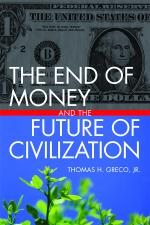 as relevant today as it was when first published the printed book has been out of print for several years. But, having had the rights reverted to me by my publisher, I am making the entire book available for free in PDF format. You can read it or download it HERE. If you would like a hard copy of the first edition used copies can still be found on Amazon.com, Abe books, Thrift books and elsewhere.
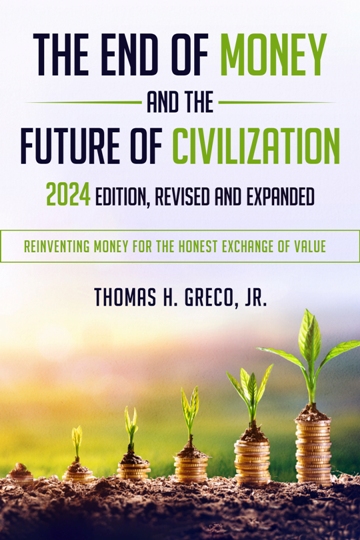 Better still, you can avail yourself of the new revised and expanded 2024 edition which I have been working on for almost two years and is almost complete. Eighteen chapters have already been posted and can be freely read or download HERE.
My previous books, as published, may be freely accessed in digital format by clicking the title below.
Money: Understanding and Creating Alternatives to Legal Tender (2001)
New Money For Healthy Communities (1994)
Money and Debt: a Solution to the Global Crisis (1980)
Collectors may find used and some new print copies of my books as published, on amazon.com and elsewhere online. Start by clicking on the title below:
Money: Understanding and Creating Alternatives to Legal Tender (2001)
 Beyond Money
 Beyond Money