The world is governed by very different personages from what is imagined by those who are not behind the scenes. —Benjamin Disraeli, British Prime Minister under Queen Victoria
Chapter Five, the latest chapter in The End of Money and the Future of Civilization, new 2024 edition, is now available. It is being published first on Ken Richings; Substack channel, Future Brightly. Ken has greatly assisted my work in many ways, including editorial assistance and narration of each chapter. He has now posted all previous chapters, and starting now with Chapter 5, each new chapter will appear on his channel two weeks before being posted here on my website or elsewhere. I do not wish to place paywalls between me and my readers so all content will continue to remain freely available to read and download, either from Ken’s site or my own sites but I encourage you to reward Ken for his good work by opting to take a paid subscription to https://futurebrightly.substack.com/.
One of the books I was entrusted with by the School of Living is, The Cause of Business Depressions, by Hugo Bilgram and L. E. Levy, published in 1914 by J. B. Lippincott. This is another masterful work that we’ve inherited from the past that was either ignored or suppressed. I doubt that even a handful of academic economists alive today would recognize the authors’ names. But they were correct in saying: “If there were no money, any system of crediting sellers and debiting buyers would be fully competent to accomplish the work now performed by money,” and they provided in this book a detailed outline of how a mutual credit clearing network might be structured and managed.
In my book, Money: Understanding and Creating Alternatives to Legal Tender (Chelsea Green 2001), I quoted them as saying: “Were a number of businessmen to combine for the purpose of organizing a system of exchange effective among themselves, they could clearly demonstrate how simple the money system can really be made. The greater the number of businessmen that would thus cooperate, the more complete would be their own emancipation from the obstruction to commerce and industry which existing currency laws impose.”
Then I summarized the Bilgram and Levy plan as follows:
A group of business people would agree to settle their business accounts through a “clearing system,” using their own credit as a medium of exchange.
The method of clearing accounts would be, in the main, similar to that used by depository banks to clear accounts among its depositors. Each business association would open an account for each of its members.
Each member would then furnish “thoroughly acceptable and amply adequate” security for the amount of credit he or she wished to establish.
The security would be held by the association as a pledge to cover the “credit cheques” that the member might draw in excess of deposits, that is, to secure his or her debit balance.
Such “credit cheques” would be accepted by all members of the association in payment of business accounts. The amount of the check would be credited to the payee’s account (causing it to increase), and the same amount would be debited to the payer’s account (causing it to decrease).
Official currency and checks would be deposited to the account also, with the stipulation that only system credits, not official money, could be paid out or withdrawn from the account.
Members with net credits would be allowed to redeem a certain portion of them, say 20 percent each month, for official currency. This, of course, would require those with debits to provide the official currency for such redemptions.
Such associations in various localities could be federated to provide for inter-regional clearing of credits.
I’ve now taken the trouble to scan the pages of that entire section of the book and transcribed them into an editable Word document with my comments, and have added these files to the Library on my website so that serious students of finance and exchange system innovation will have the complete description to study and learn from.
Of course, their plan was conceived at a time when the gold standard was still operational, and paper currency was still redeemable for gold, but their basic ideas and structure provide a useful point of departure for present day innovators and reformers. However, I would not advise the implementation of the B and L proposal as it was originally presented because they encumber their credit clearing system with a lot of unnecessary and self-defeating “baggage.” I’ve described my own ideas in my various writings and presentations, including my paper, Credit Clearing – Pure and Simple. Here are the main differences I’ve proposed:
1. I have long maintained that “The creation of sound exchange media (money) requires that money be spent into circulation by trusted producers of real valuable goods and services that are in everyday demand and are in the market and available to be delivered in the near-term. Money then is a mere place holder for real economic value; it is a credible promise that will be accepted as a form of payment. (See my article Reconnecting the Monetary Economy to the Real Economy). A currency then is a mere place holder for real economic value; it is a credible promise that will be accepted as a form of payment. The same holds true for the credit that is allocated to participants within a credit clearing circle since such credit serves as an internal currency. I would therefor greatly relax the requirement for collateral since debit balances are already “backed” by the goods and services that they represent. 2. There is no reason for a credit clearing exchange to accept deposits of official fiat money except in the event of the withdrawal of a participant who leaves with a debit balance. It is, for instance, the usual practice of present-day commercial trade exchanges to have on file a credit card number for each member, and to charge that card only for service fees that are levied in cash, and for the amount of any debit balance remaining when a member leaves the system. Members wishing to leave who have a positive balance are not allowed to convert their trade credits to cash but must instead spend them within the system. 3. I would eliminate interest charges applied to negative balances. Since all participants benefit from the clearing process, the cost of operating the system should be borne equally by all, as B and L themselves seem to acknowledge in their somewhat confusing footnote 105. Rather than applying interest levies on accounts, I’ve proposed a revenue model based on the principle that one should pay fees in proportion to the amount of service they receive, which in this case is the amount of value cleared for an account. Remember, if no one ever had a negative balance there would be no credit and nothing to clear. Credit is what makes the business of exchange go round.
Such are the conditions that would enable real independence from the dysfunctional and exploitative political fiat money regime. — T.H.G. _____________________ RIP Sergio Lub
I was sad to learn a few days before Christmas that my very good friend and colleague Sergio Lub had gone into hospice care at home. He passed away on January 8, 2024. I first met Sergio and his wife Gaye in the late 1990s at a community currencies conference that was organized by Carol Brouillet. We immediately recognized that we had much in common and became good friends and colleagues. We traveled together to various parts of the world, including Europe, South America, India, and Southeast Asia, and worked together to educate various audiences about the “money problem,” and its solutions. I’ve long considered Sergio to be one of the world’s greatest networkers, and through him I’ve met a great many people whose work has been instrumental in addressing the critical challenges that presently confront our civilization. Sergio created an online social network long before there was a Facebook or a Twitter. His Friendly Favors platform, besides connecting people, includes a way of trading “favors.” While the platform is in need of an update and is no longer widely used, the structure and protocols that Sergio designed into it are there to guide the next generation of social innovators. Sergio was born of Russian parents in Argentina, and as a young man immigrated to the United States where he became a successful jewelry maker and entrepreneur and raised a family. His children, as they grew into adulthood eventually joined Sergio and his wife Gaye in the family business which continues to flourish.
I will sorely miss my friend Sergio and his steadfast support for my work which was consistent over the more than the quarter century of our friendship.
You can find more information about Sergio and the Lub family business at their website: https://www.sergiolub.com/pages/about-us _____________________ Publishing Update
The End of Money and the Future of Civilization, new 2024 edition Here’s an update on our publishing plans. I’ve given Ken Richings permission to be first in publishing my new book chapters on his Substack channel, Future Brightly. Ken has greatly assisted my work in many ways, including editorial assistance and narration of each chapter. He is now in the process of catching up by publishing on his channel the chapters that I’ve already published on my website, on medium, and on my own Substack channel. But starting with Chapter 5, each new chapter will appear on his channel two weeks before being posted on my website or elsewhere. You can still get free access even on Ken’s channel Future Brightly, but I’m urging you to please reward him for his good work by opting to take a paid subscription at https://futurebrightly.substack.com/. _____________________ Wishing you peace and joy in the New Year, Thomas
Chapter 4, Central Banking and the Rise of the Money Power is now available here on this website, complete with end notes, along with previously published chapters 1, 2, and 3. Click on the links below to access the text and the audio narration directly. Additional chapters will be posted as they are completed here. Watch for Chapter 5 to be posted in about two weeks.
As always, your comments and suggestions will be welcomed. Thomas
Chapter 3, The Contest for Rulership—Two Opposing Philosophies. is now available. You can find it on my website, complete with end notes, along with previously published chapters 1 and 2. Click on the links below to access the text and the audio narration. Additional chapters will be posted as they are completed here. I expect to complete Chapter 4 and post it around the end of this year.
As always, your comments and suggestions will be welcomed, Thomas ___________________
Chapter 2, Mega-Crisis to Metamorphosis—Can Civilization Be Saved?, part of the new 2024 edition of The End of Money and the Future of Civilization is now available. Click on tje links below to access the text and the audio narration. Additional chapters will be posted as they are completed here. I hope you will take the time to read and/or listen to each new chapter as they are added. ___________________
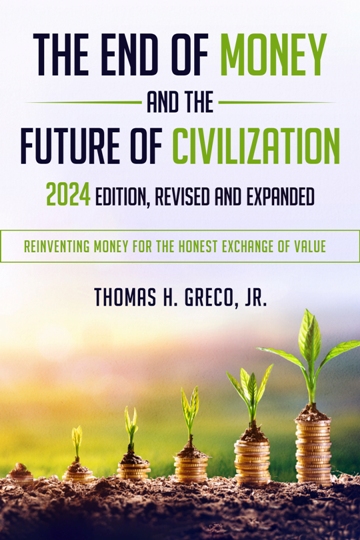
The first edition of my book, The End of Money and the Future of Civilization, was published by Chelsea Green Publishing in 2009. While it remains as relevant and timely today as it was when first published the printed book has been out of print for several years, although the digital Kindle edition is still available from Amazon.com, and there is an active market for used copies.
Having recently had the rights reverted to me by my publisher, I have decided to begin publishing a revised, updated, and expanded edition of the book. It will first be published in serial form, as freely downloadable chapters on my website, Medium, and elsewhere, as I complete them. The text of each section will be accompanied by an audio narration by Ken Richings.
Upon completion of the series, I plan to compile the various chapters and sections into both a print edition and an e-book edition. For the new edition, every chapter will be edited, some rewritten, others may be dropped, and new ones added to cover the changing financial, economic, and political circumstances, and to address more recent developments, including the emergence of cryptocurrencies like Bitcoin, blockchain technology, and smart contracts. That particular chapter will elaborate and expand upon what I’ve already written and published in my articles, Bitcoin, Blockchain, and the end of money as we’ve known it (2022), and Bitcoin, Blockchain Technology, and Crypto-Currency (2016).
The serial publication may not be on a regular schedule, but I’ve made it a priority to complete the series by the end of 2024. If you wish to be alerted as new sections of the book are posted you can follow me at my website, https://beyondmoney.net/, and subscribe to my occasional newsletter at MailChimp.
You can find the links to each subsequent chapter by clicking on the menu item The End of Money above. ___________________
I feel sorry for the Ukrainian people, not only have they been conscripted to fight a proxy war for the US against the Russians, a war in which despite massive financial and military support they are being slaughtered; they have now been selected to be a demonstration project for a US-created information system that gives the Kiev government all the information it needs to control every aspect of their people’s lives. Little by little, place by place, Big Brother is enslaving the masses.
I asked Bing Chat to give me a summary of the history, development and capabilities of the Diia phone app which is the heart of the system now being deployed. Here is what it gave me:
Generated by Bing Chat, Monday, October 2, 2023
The Diia app is a mobile application, web portal, and brand of e-governance in Ukraine that was launched in 2020 by the Ministry of Digital Transformation of Ukraine . The app allows Ukrainian citizens to use digital documents on their smartphones instead of physical ones for identification and sharing purposes. The Diia portal allows access to over 50 government services, and the government plans to make all kinds of state-person interactions available through Diia.
The name “Diia” is an acronym for “State and Me” in Ukrainian. The app was built in partnership with the USA and is poised to be shared with other countries. In fact, at the 2023 World Economic Forum in Davos, USAID Administrator Samantha Power said that the US hopes to replicate the success of Diia in other countries.
Diia was first presented on September 27, 2019, by the Ministry of Digital Transformation of Ukraine as a brand of the State in a Smartphone project. Vice Prime Minister and Minister of Digital Transformation Mykhailo Fedorov announced the creation of a mobile app and a web portal that would unite in a single place all the services provided by the state to citizens and businesses. On February 6, 2020, the mobile app Diia was officially launched.
In April 2020, the Ukrainian government approved a resolution for experimental usage of digital ID-cards and passports which would be issued to all Ukrainians via Diia. On October 5, 2020, during the Diia Summit, the government presented a first major update of the app and web portal branded “Diia 2.0”. By the end of 2020, the app had more than 6 million users, while the portal had 50 available services.
Please note that while I have tried my best to provide accurate information based on my sources, some details may be outdated or incomplete.
Ukraine has been at the forefront of government digitalization. The country became the first one in the world to allow a digital ID on a smartphone to be universally accepted as an alternative to a paper one. The Diia app can serve as a legally-recognized document for:
ID card
Foreign passport
Student card
Driving licence
Vehicle registration document
Vehicle insurance certificate
Tax identity
Birth certificate
IdP certificate (identity-management system)
The Diia app also provides access to over 70 government services, allowing citizens to do things like register as self-employed within the app in just 15 minutes.
Image from Behance.net
Further, according to one source, the government has already announced that the payment of benefits will be conditional on the presence of a Covid-19 vaccination certificate. While the use of the app is for the moment voluntary, do not for one moment think that it will remain so, or that similar systems won’t be imposed in other countries around the world as US officials have already stated their intention to do so. It’s a giant step forward in the agenda toward greater centralization of power and wealth and the elimination of democratic government. Any astute observer can see that right and left politics have been integrated into a global despotic “uniparty” under elite control. As Klaus Schwab, founder of the World Economic Forum has clearly stated, they have trained and placed in positions of power in countries around the world, people, like Justin Trudeau (PM of Canada) and Emmanuel Macron (President of France) who will promote their agenda. He has also told us, “You will own nothing…” Neither will you be allowed to do anything without the permission of Big Brother.
Give me the power to create the money and make it legal tender and I can become owner of the entire world. — T. H. Greco, Jr.
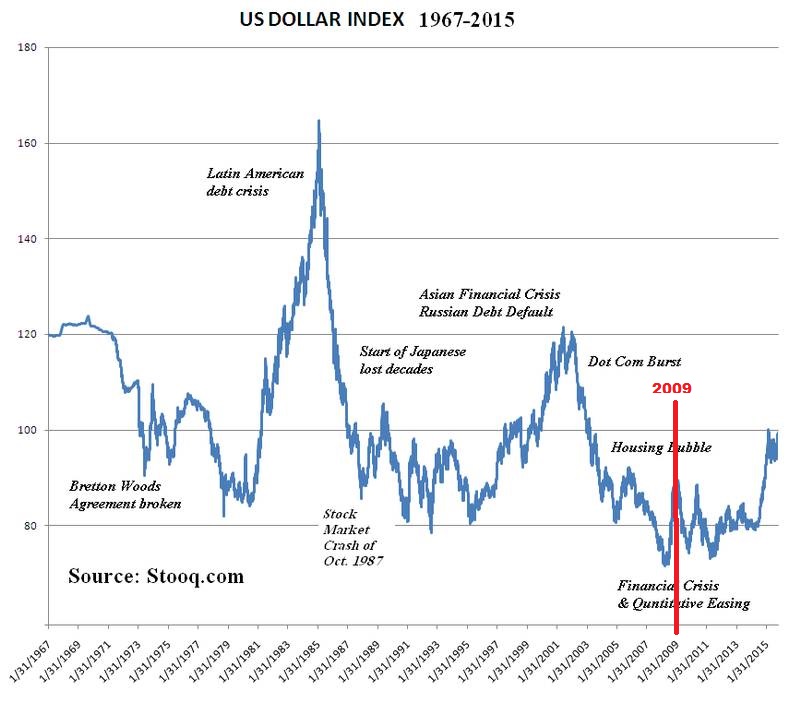
In 2009, while in the process of making the final edits to my book, The End of Money and the Future of Civilization, my editor took issue with my assertion that the declining value of the US dollar would continue indefinitely. He cited the increase in “value” of the dollar in the foreign exchange markets that was occurring at that time as evidence of my “error.”
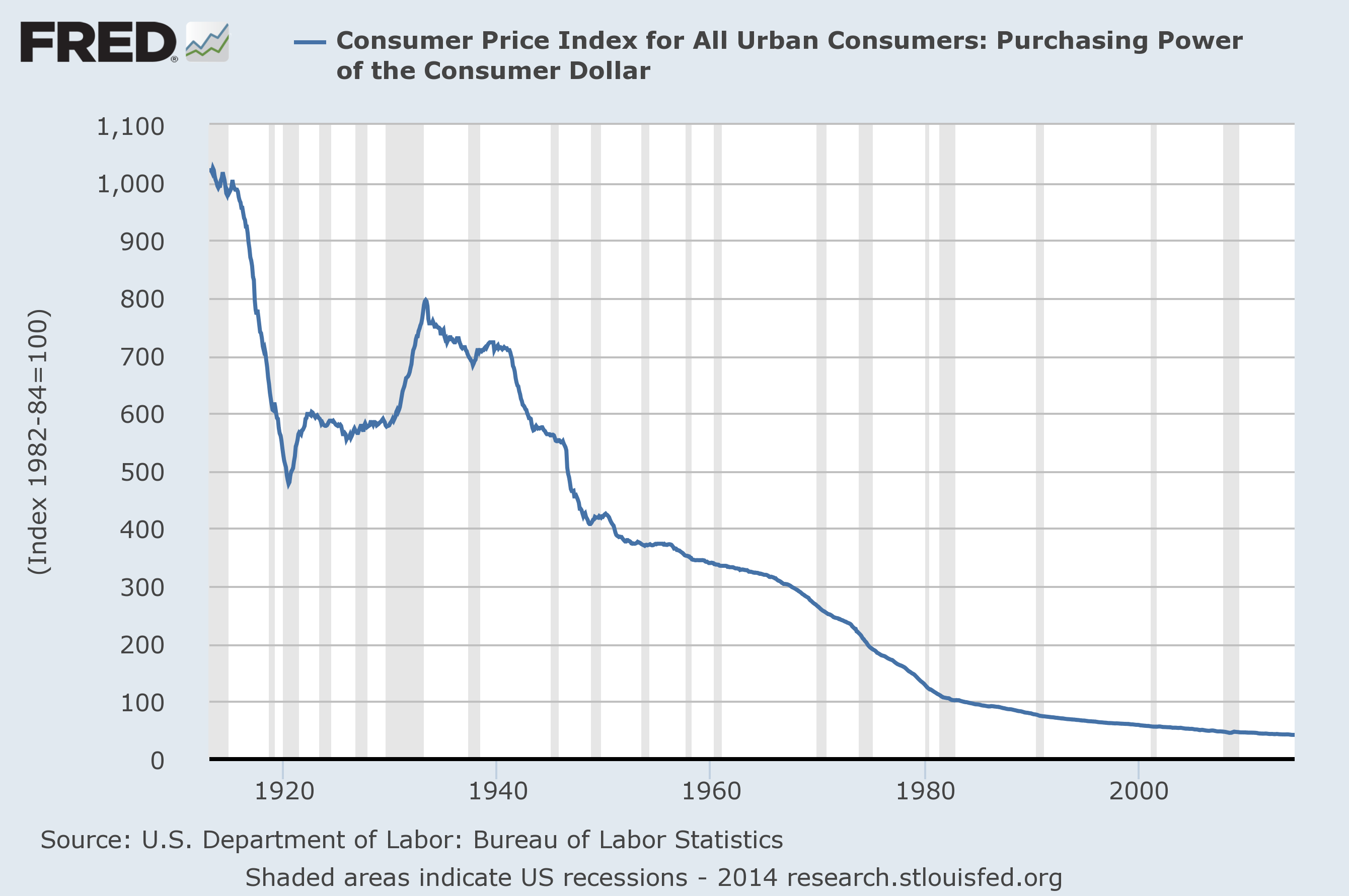
I responded that the “value” of the dollar compared to other political currencies did not reflect its true value in relation to the real economy, i.e., what a dollar could buy, because all national currencies suffer from the same defects (improper and excessive issuance and the “growth imperative”), and virtually all of them are losing “purchasing power” because of it. The fluctuations in their market values relative to one another result from political and monetary policy decisions taken in their respective countries, not from any increase in their real value.
I argued that what the world has been experiencing in recent years is unprecedented. Never before in recorded human history has there been such a unitary system of money, banking and finance upon which the economies and peoples of virtually every nation of the world have come to depend.
The long-term trends were, and remain, clearly evident and even worse than shown in the above graph. I referred my editor, among other things, to this Max Keiser video to drive home that point and to show that the Consumer Price Index (CPI) is being manipulated to make the decline in purchasing power look less bad than it actually is. Fortunately, that video is still available on YouTube. The mountain of evidence that has been accumulated during the years since the publication of my book has made it patently clear that my assertions were correct. The cost of living due to the debasement of the US dollar has not only continued to increase but has accelerated with the extreme measures that were taken during the pandemic years. Thus, the real value of the dollar, i.e., its purchasing power, has continued to decline even more rapidly than before, as indicated by the recent upturn in the CPI shown in the graph below.
If a strong dollar is in the interests of maintaining confidence and perpetuating the global system, the central banks of the western alliance will rally to support it. If currency inflation is causing prices to rise too rapidly in one place, the effects will be shifted to another place. In efforts to limit inflation overall, the productive sectors of the economy will be starved for credit, causing sound businesses to fail and more jobs to be sacrificed. People who have lost their livelihood are in no position to demand higher wages. Indeed, they will fight with one another to get whatever they can garner from a weakened economy. I argued at the time, and still maintain that the businesses that survive will be the huge corporations that enjoy favored treatment in receiving government bailouts and credit from banks and that those corporations will continue to grow ever larger through acquisitions, consolidations, and market dominance.
Cancer and the Debt Growth Imperative
One of humanity’s most dreaded diseases is cancer, which is tissue growth that has become uncontrolled and purposeless. It is growth of the wrong sort and in the wrong places which eventually kills itself as it kills the body of its host. Such has also been the nature of much of the economic growth that the world economy has experienced over the past many decades.
The debt-growth, economic-growth imperative that I have written so much about and summarized in The Usury Conjecture, can be visualized by thinking of the financial economy as a balloon that is attached to an air tank that is relentlessly filling the balloon with air. If you squeeze the balloon at one point to try to stop its expansion, it will simply bulge out somewhere else. In this analogy the air is debt, and the pressure in the air tank is generated by the interest that is applied to the “loans” that banks make to create fiat debt-money. The ever-growing debt must show up either in the private sector or in the public sector.
Those few who control the interest-based, debt-money regime have historically been given everything they’ve asked for to keep this flawed and destructive system alive. They have amassed enormous financial, economic and political power and are intent on owning and controlling everything. Nothing is sacrosanct; all will be sacrificed on the altar of Mammon because of this Faustian bargain between the money powers and the political powers that was struck centuries ago.
But despite the powerful tools at their disposal, they cannot forever avoid the inevitable. As the long-term negative trends continue and the symptoms become ever more severe, the people, communities, and independent producers who are adversely affected will get serious about rediscovering and inventing ways to escape. They will deploy their own honest and effective means of exchange and finance that will ultimately displace the old dysfunctional and destructive political system of money and finance.
Fortunately, the honest and effective systems of exchange and finance that I’ve long been describing in my books, The End of Money and the Future of Civilization, and Money: Understanding and Creating Alternatives to Legal Tender, are already available and are being employed at the margins of the economy. While their scale of operation is still relatively modest, it is inevitable that as improvements are made and their necessity becomes ever more evident, efforts to decouple from the dominant monetary and financial regime will continue to intensify, money banking and finance will be reinvented, and the chaos that now reigns will give way to a better world for all.
The Tyranny that is the Global Money System My new video has emerged out of the power point slide presentations I gave earlier this summer. It is a greatly improved description of the tyrannical nature of the global political money regime, how it has evolved, how it operates, and how we can free ourselves from its grip. Based on my more than 40 years of research, experience, and innovation in the realm of value exchange and finance, it succinctly reveals the truth about the money power, and more importantly, outlines tried-and-true exchange mechanisms by which people, businesses, and communities everywhere can transcend their dependence upon political money and bank borrowing by taking control of their own credit and using it in ways that can bring about a world of peace, justice, and freedom in which everyone can thrive.
Read the entire newsletter here or here, and you can Subscribe to receive my future occasional newsletters.
To satisfy my curiosity about AI, and ChatGPT in particular, I’ve been posing certain questions to it and been pleasantly surprised by the results. ChatGPT uses information that was publicly available online up to September 2021, so the responses that it generates will not include recent changes.
Here is one of my requests which, while much shorter, pretty well summarizes what I myself have written about the matter. I present it here for your information and your comments.
THG: Summarize the unique features of the work of Thomas H. Greco, Jr. on money and economics.
ChatGPT:
5/5 Thomas H. Greco, Jr. is known for his groundbreaking work on money and economics, focusing on alternative monetary systems and local economies. Some of the unique features of his work include:
Decentralized Monetary Systems: Greco advocates for the development of decentralized and community-based monetary systems that empower individuals and local communities to create their own means of exchange. He emphasizes the importance of currencies that are not controlled by centralized authorities like governments or banks.
Complementary Currencies: Greco promotes the idea of complementary currencies, which are designed to work alongside national currencies to facilitate local transactions and trade. These currencies are often tailored to specific communities or regions and can help stimulate local economies.
Democratization of Money Creation: He challenges the conventional model of money creation by banks and governments. Greco believes in the democratization of money issuance, allowing communities to create their own money based on real value and resources.
Mutual Credit Systems: Greco’s work includes the concept of mutual credit systems, where participants can extend credit to one another within a network. This can foster cooperation and exchange without the need for traditional banking intermediaries.
Localized Economies: He emphasizes the importance of localized economies that prioritize community resilience and sustainability. Greco’s work encourages communities to rely more on local production and resources to reduce dependency on distant supply chains.
Interest-Free Economics: Greco criticizes the conventional practice of charging interest on loans and believes that interest-free systems could lead to more equitable distribution of wealth and resources.
Advocacy for Change: Through his writings and lectures, Greco advocates for individuals, communities, and governments to explore and implement alternative economic and monetary systems. He believes that a shift away from the current monetary paradigm could lead to more just and sustainable economies.
In summary, Thomas H. Greco, Jr.’s work revolves around reimagining money and economics by proposing alternative monetary systems, promoting decentralized currencies, advocating for interest-free economies, and encouraging the development of localized, community-based economic structures. His ideas challenge conventional economic thinking and aim to create more resilient, equitable, and sustainable societies.
# # #
Update: Monday, August 28, 2023 This iteration is a bit more complete:
Thomas H. Greco, Jr. is known for his unique contributions to the fields of money and economics, particularly in the realm of alternative currencies and monetary systems. Some of the key features of his work include:
Local and Complementary Currencies: Greco emphasizes the importance of local and complementary currencies as tools for promoting economic resilience and community development. He advocates for the creation of currencies that are tailored to specific communities or regions, helping to stimulate local economic activity and reduce dependence on centralized national currencies.
Decentralization of Money Creation: A central theme in Greco’s work is the decentralization of money creation. He believes that allowing communities to create their own currencies empowers them to meet their specific needs, bypassing the traditional centralized banking system and enabling greater control over their economic destiny.
Credit Clearing Systems: Greco explores the concept of credit clearing systems, which facilitate transactions without the need for traditional currency. These systems work by enabling participants to exchange goods and services directly based on mutual credit agreements, reducing the reliance on scarce official currency.
Integral Theory and Economics: Greco integrates principles of integral theory into his economic thinking, considering not only economic factors but also social, ecological, and cultural dimensions. He emphasizes the need for a holistic approach to economics that takes into account the interconnectedness of various aspects of human life.
Monetary Reform Advocacy: Greco is an advocate for monetary reform, particularly in response to issues such as inflation, financial instability, and wealth inequality. He proposes alternative monetary systems that prioritize stability, fairness, and sustainability.
Educational Efforts: Beyond his academic work, Greco is involved in educational efforts to raise awareness about alternative currencies and monetary systems. He has authored books and conducted workshops to help individuals and communities better understand and implement these concepts.
Focus on Empowerment: One of the overarching themes of Greco’s work is empowering individuals and communities to have a greater say in their economic affairs. He believes that by rethinking the way money is created and circulated, people can gain more control over their economic lives and reduce their vulnerability to systemic financial crises.
Sustainability and Resilience: Greco’s work aligns with the principles of sustainability and resilience. By promoting local economies and alternative currencies, he aims to create systems that are more environmentally friendly and less susceptible to the boom-and-bust cycles of traditional monetary systems.
In summary, Thomas H. Greco, Jr.’s work on money and economics revolves around the development of local and complementary currencies, decentralization of money creation, credit clearing systems, integral theory integration, monetary reform advocacy, educational initiatives, empowerment, and a focus on sustainability and resilience. His ideas challenge conventional economic thinking and offer potential solutions for creating more equitable and community-driven economic systems.
The first edition of my book, The End of Money and the Future of Civilization, was published by Chelsea Green Publishing in 2009. While it remains as relevant today as it was when first published the printed book has been out of print for several years. But, having had the rights reverted to me by my publisher, I am making the entire book available for free in PDF format. You can read it or download it HERE. If you would like a hard copy of the first edition used copies can still be found on Amazon.com, Abe books, Thrift books and elsewhere.
Better still, you can avail yourself of the new revised and expanded 2024 edition which I have been working on for almost two years and is almost complete. Eighteen chapters have already been posted and can be freely read or download HERE.
My previous books, as published, may be freely accessed in digital format by clicking the title below.






 Beyond Money