Tag Archives: credit clearing

Credit Clearing Already a Proven Means of Exchanging Goods and Services

People often ask me how the credit clearing process that I advocate might be established and where existing successful models are to be found. I point them to the commercial “barter” sector, the 75 year old WIR Bank in Switzerland, and a few exchange alternatives that have been emerging spontaneously from the grassroots. Of course, what these trade exchanges offer is not “barter” at all, but credit clearing.

Significant as it is, the commercial trade exchange business is not well known because it does not yet involve consumers or employees to any great extent. It services businesses, mostly small and medium sized businesses (SMEs), and mostly at the retail level or in the service sector. Credit clearing and private currencies are important elements in the economy at any time, but they become even more necessary during times of financial disruption such as the current one.

On June 25 Sky News in the UK did a live interview with one of the leaders in the trade exchange industry, Wayne Sharpe, the charismatic founder and chief executive of Bartercard, International. Sharpe discussed the role that his company, and others like it, plays in revitalising the UK economy by helping businesses to “reserve cash, reduces costs and increase sales and profitability through a sophisticated system of barter.” Here is a transcript of that interview taken from the Bartercard website. (Thanks to Bob Meyer of Barter  News for alerting me to this report). – t.h.g

Why cash isn’t king – The flexible friend that can help businesses beat recession:

Bartercard works like a credit card, but transacting by clients’ own goods and services via its own unique Trade Pound ‘currency’. On joining, account holders receive a transaction card and an interest-free line of credit. When spare capacity is sold, members’ accounts are credited with trade pounds. When purchases are made, trade pounds are deducted. Bartercard allows members to trade without the need to spend valuable cash or engage in a direct swap.
Given recent global economic developments, Bartercard is proving totally relevant. It’s phenomenal growth in the UK market over recent months is testament to this. One reason for the rapid growth is that Bartercard charges success-based fees; charging a small commission on each trade so, if it doesn’t produce results, costs to its members are negligible.

Another reason for Bartercard’s success is the support it provides the beleaguered SME sector. SMEs are the lifeblood of the British economy; accounting for over 60% of domestic GDP yet, in the main, they have been overlooked by government.

Lavish financial support from government has been reserved for selected big businesses and in particular, the banking sector. Instead of using the money to stimulate the economy, the banks have devoted these huge resources to bolstering balance sheets and improving share price. The banks are failing to lend even to those SMEs with solid foundations and a great track record but which need financial support in extremely difficult trading conditions.
Bartercard is providing a real solution. More than 80% of its members are SME’s and Bartercard aims to generate 10% in additional sales for each and every member business, then use that trade to offset regular cash expense, thus improving cash profit by up to 20%.

With over 21 million transactions and more that $15 Billion in trade volume worldwide since inception Bartercard is a proven method to increase SME;s trade.
“I have lived in the UK for over 7 years now and I know and feel for the SME’s – they are the heart of this nation and we will help them beat the recession in any and every way we can” says the eternally upbeat Mr. Sharpe.

It seems the Sky is the limit.

New Money: A Creative Opportunity for Business

Every so often, I’ll browse though something I wrote previously. This article,  New Money: A Creative Opportunity for Business, was originally published in Perspectives on Business and Global Change (World Business Academy), Vol 11, No 3, September, 1997, and later included in the anthology The New Business of Business: Sharing Responsibility for a Positive Global Future, by Willis Harman and Maya Porter (Berrett-Koehler, 1997).

It is still pertinent and timely. You can find it in the sidebar under Resources, Monographs, or click here.

End of Money Excerpt on Reality Sandwich

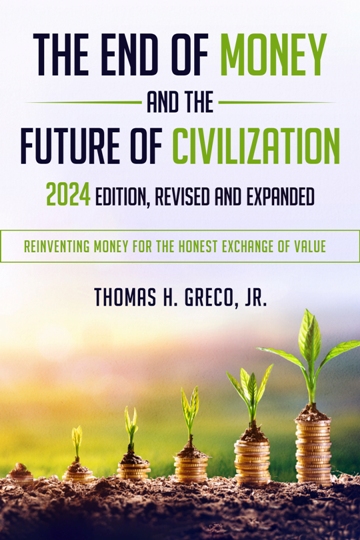
An excerpt from my book, The End of Money and the Future of Civilization, has been published on Reality Sandwich. Is is one of the more important chapters, which contains a prescription for community empowerment and enhanced self-determination. That chapter, A Regional Economic Development Plan Based on Credit Clearing,  is also here on this site under “Excerpts.”

My 2 Minute Elevator Speech

I’ve added to this site my “Two Minute Elevator Speech About Solving the Money Problem.” You can find it under My Audio-visual presentations in the list at the right, or just click here.

A Report on WIR by Susan Witt

A new page has been added to this blog, containing a recent report by Susan Witt on the WIR credit clearing association that has been operating in Switzerland for more than 70 years. Now called the WIR Bank and providing conventional banking services, WIR is an important case for monetary reformers and free exchange advocates to study. While there may yet be some deficiencies in its operating policies, WIR has proven over a long period of time the effectiveness of direct clearing of credits between buyers and sellers as an alternative to conventional bank-created debt-money.

An English translation by Prof. Philip Beard of Prof. Tobias Studer’s WIR and the Swiss National Economy can be downloaded from Lulu. com for $3.

An Annotated Précis, Review, and Critique of Prof. Tobias Studer’s WIR and the Swiss National Economy by Thomas H. Greco, Jr. and Theo Megalli can be found on another page on this blog.

Brazil, Argentina abandon US dollar

Look for more bilateral agreements like this in the near future. This is a logical thing to do so long as neither country is abusing their currency too badly and the countries have a balance in their trade with one another. Their currencies will quickly find their way back home.
I expect these bilateral agreements to evolve into multilateral agreements that use the credit clearing process to net out accounts amongst the central banks.

The surprising thing here is that the central banks of Brazil and Argentina seem to be taking a course that is independent of the global banking fraternity. Read the article here. — t.h.g


Brazil, Argentina abandon US dollar

Brazil and Argentina have launched a new payment system in their bilateral trade, doing away with the US dollar as a medium of exchange.

The two Latin American nations started the Payment System on Local Currency (SML) on Monday following a last month agreement inked by their presidents to use local currencies in a bid to end transaction in dollars.

On Thursday, Argentine Central Bank President Martin Redrado and his Brazilian counterpart Henrique de Campos Meirelles signed the enforcement of the agreement for the SML, under which exports and imports between the two countries will take place with the Brazilian real (BRL) and the Argentine peso (ARS).

Money and Power

What the world needs now is practical approaches to resolving the problem of power.

The key question is “who decides?” Right now, the process has been rigged so that a self-serving few decide for the many. How are they able to do that?
The key is MONEY.

Did George Bush and Tony Blair come begging to the people to donate money so they could attack Iraq?
Did they even ask us to pay higher taxes so they could fight this war?
Obviously, they did not. Bush even LOWERED taxes, especially for “his base,” the rich and well-connected.
How is it possible for expensive wars to be fought without raising taxes?

William Patterson and his cohorts figured that one out more than 300 years ago when the Bank of England was founded. They had no trouble selling the idea to King William III. The deal was this: The King got the money he needed to fight his war against France, while the financiers got the privilege of printing bank notes and lending them into circulation.
This perversion of the monetary system has since been “perfected” and spread almost universally to every country around the world. The power to control the creation and allocation of money (which is nothing more than credit) is the basis for all political power.
Until we do something about that, nothing much is going to change.

Fortunately, it is possible to restore “the credit commons” through voluntary, free market approaches. How? By establishing credit clearing associations that can be networked together worldwide.

LETS prototypes have given thousands of people some idea of how credit clearing works. Now we must take mutual credit clearing to the mainstream and build it to scale. E. C. Riegel had the vision but not the tools; we now have both the vision and the tools. Read my book, The End of Money and the Future of Civilization, view my presentations and interviews on this site, https://beyondmoney.net/, read the works of E. C. Riegel (free downloads at https://reinventingmoney.com/library/. Start by reading his Private Enterprise Money) and explore the other important resources listed in the Library.

[Updated, March 26, 2017]