Congressman Ron Paul has for many years been the lone voice crying in the “wilderness” of Congress for an end to the exploitative and disruptive central banking monetary system. Once again he has called for abolition of the Federal Reserve Banks and Board, and recently introduced a bill that would accomplish that. In his introductory remarks, he also called for government to issue only currency that is “backed by stable commodities such as silver and gold to be used as legal tender.”
While I agree with the need to abolish the Fed (and all similarly structured central banks that exist in most other countries around the world), and I agree that the power of the banks and the federal government to debase the currency needs to be curtailed, it is extremely unlikely that legislation adequate to that task can ever make it through Congress. Nonetheless, I applaud Congressman Paul’s efforts because they will at least accomplish the job of raising awareness in the public mind about the nature of the money problem.
Eventually, it may be possible to act effectively at the governmental level, but only after the people have strongly asserted their own power to mediate the exchange process using their own credit apart from banks and the political money system. Only that assertion can bring about the “true free-market economy” that Mr. Paul desires. The nature of this power and how we can assert it are thoroughly addressed in my upcoming book, The End of Money and Future of Civilization.(Due to be released in April, 2009 by Chelsea Green Publishing). – t.h.g.
The following was taken from http://www.lewrockwell.com/paul/paul504.html.
End the Fed
by Ron Paul
Before the US House of Representatives, February 4, 2009, introducing The Federal Reserve Board Abolition Act, H.R. 833.
Madame Speaker, I rise to introduce legislation to restore financial stability to America’s economy by abolishing the Federal Reserve. Since the creation of the Federal Reserve, middle and working-class Americans have been victimized by a boom-and-bust monetary policy. In addition, most Americans have suffered a steadily eroding purchasing power because of the Federal Reserve’s inflationary policies. This represents a real, if hidden, tax imposed on the American people.
From the Great Depression, to the stagflation of the seventies, to the current economic crisis caused by the housing bubble, every economic downturn suffered by this country over the past century can be traced to Federal Reserve policy. The Fed has followed a consistent policy of flooding the economy with easy money, leading to a misallocation of resources and an artificial “boom” followed by a recession or depression when the Fed-created bubble bursts.
With a stable currency, American exporters will no longer be held hostage to an erratic monetary policy. Stabilizing the currency will also give Americans new incentives to save as they will no longer have to fear inflation eroding their savings. Those members concerned about increasing America’s exports or the low rate of savings should be enthusiastic supporters of this legislation.
Though the Federal Reserve policy harms the average American, it benefits those in a position to take advantage of the cycles in monetary policy. The main beneficiaries are those who receive access to artificially inflated money and/or credit before the inflationary effects of the policy impact the entire economy. Federal Reserve policies also benefit big spending politicians who use the inflated currency created by the Fed to hide the true costs of the welfare-warfare state. It is time for Congress to put the interests of the American people ahead of special interests and their own appetite for big government.
Abolishing the Federal Reserve will allow Congress to reassert its constitutional authority over monetary policy. The United States Constitution grants to Congress the authority to coin money and regulate the value of the currency. The Constitution does not give Congress the authority to delegate control over monetary policy to a central bank. Furthermore, the Constitution certainly does not empower the federal government to erode the American standard of living via an inflationary monetary policy.
In fact, Congress’ constitutional mandate regarding monetary policy should only permit currency backed by stable commodities such as silver and gold to be used as legal tender. Therefore, abolishing the Federal Reserve and returning to a constitutional system will enable America to return to the type of monetary system envisioned by our nation’s founders: one where the value of money is consistent because it is tied to a commodity such as gold. Such a monetary system is the basis of a true free-market economy.
In conclusion, Mr. Speaker, I urge my colleagues to stand up for working Americans by putting an end to the manipulation of the money supply which erodes Americans’ standard of living, enlarges big government, and enriches well-connected elites, by cosponsoring my legislation to abolish the Federal Reserve.
Dr. Ron Paul is a Republican member of Congress from Texas.
*************************************************************
Here is the bill as introduced in the House.
Taken from http://thomas.loc.gov/cgi-bin/query/z?c111:h833:
Federal Reserve Board Abolition Act
HR 833 IH
111th CONGRESS
1st Session
H. R. 833
To abolish the Board of Governors of the Federal Reserve System and the Federal reserve banks, to repeal the Federal Reserve Act, and for other purposes.
IN THE HOUSE OF REPRESENTATIVES
February 3, 2009
Mr. PAUL introduced the following bill; which was referred to the Committee on Financial Services
A BILL
To abolish the Board of Governors of the Federal Reserve System and the Federal reserve banks, to repeal the Federal Reserve Act, and for other purposes.
Be it enacted by the Senate and House of Representatives of the United States of America in Congress assembled,
SECTION 1. SHORT TITLE.
This Act may be cited as the ‘Federal Reserve Board Abolition Act’.
SEC. 2. FEDERAL RESERVE BOARD ABOLISHED.
(a) In General- Effective at the end of the 1-year period beginning on the date of the enactment of this Act, the Board of Governors of the Federal Reserve System and each Federal reserve bank are hereby abolished.
(b) Repeal of Federal Reserve Act- Effective at the end of the 1-year period beginning on the date of the enactment of this Act, the Federal Reserve Act is hereby repealed.
(c) Disposition of Affairs-
(1) MANAGEMENT DURING DISSOLUTION PERIOD- During the 1-year period referred to in subsection (a), the Chairman of the Board of Governors of the Federal Reserve System–
(A) shall, for the sole purpose of winding up the affairs of the Board of Governors of the Federal Reserve System and the Federal reserve banks–
(i) manage the employees of the Board and each such bank and provide for the payment of compensation and benefits of any such employee which accrue before the position of such employee is abolished; and
(ii) manage the assets and liabilities of the Board and each such bank until such assets and liabilities are liquidated or assumed by the Secretary of the Treasury in accordance with this subsection; and
(B) may take such other action as may be necessary, subject to the approval of the Secretary of the Treasury, to wind up the affairs of the Board and the Federal reserve banks.
(2) LIQUIDATION OF ASSETS-
(A) IN GENERAL- The Director of the Office of Management and Budget shall liquidate all assets of the Board and the Federal reserve banks in an orderly manner so as to achieve as expeditious a liquidation as may be practical while maximizing the return to the Treasury.
(B) TRANSFER TO TREASURY- After satisfying all claims against the Board and any Federal reserve bank which are accepted by the Director of the Office of Management and Budget and redeeming the stock of such banks, the net proceeds of the liquidation under subparagraph (A) shall be transferred to the Secretary of the Treasury and deposited in the General Fund of the Treasury.
(3) ASSUMPTION OF LIABILITIES- All outstanding liabilities of the Board of Governors of the Federal Reserve System and the Federal reserve banks at the time such entities are abolished, including any liability for retirement and other benefits for former officers and employees of the Board or any such bank in accordance with employee retirement and benefit programs of the Board and any such bank, shall become the liability of the Secretary of the Treasury and shall be paid from amounts deposited in the general fund pursuant to paragraph (2) which are hereby appropriated for such purpose until all such liabilities are satisfied.
(d) Report- At the end of the 18-month period beginning on the date of the enactment of this Act, the Secretary of the Treasury and the Director of the Office of Management and Budget shall submit a joint report to the Congress containing a detailed description of the actions taken to implement this Act and any actions or issues relating to such implementation that remain uncompleted or unresolved as of the date of the report.
# # #

 as relevant today as it was when first published the printed book has been out of print for several years. But, having had the rights reverted to me by my publisher, I am making the entire book available for free in PDF format. You can read it or download it HERE. If you would like a hard copy of the first edition used copies can still be found on Amazon.com, Abe books, Thrift books and elsewhere.
 Better still, you can avail yourself of the new revised and expanded 2024 edition which I have been working on for almost two years and is almost complete. Eighteen chapters have already been posted and can be freely read or download HERE.
 Beyond Money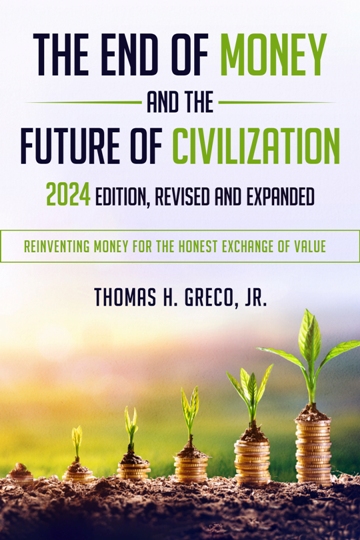
 Beyond Money