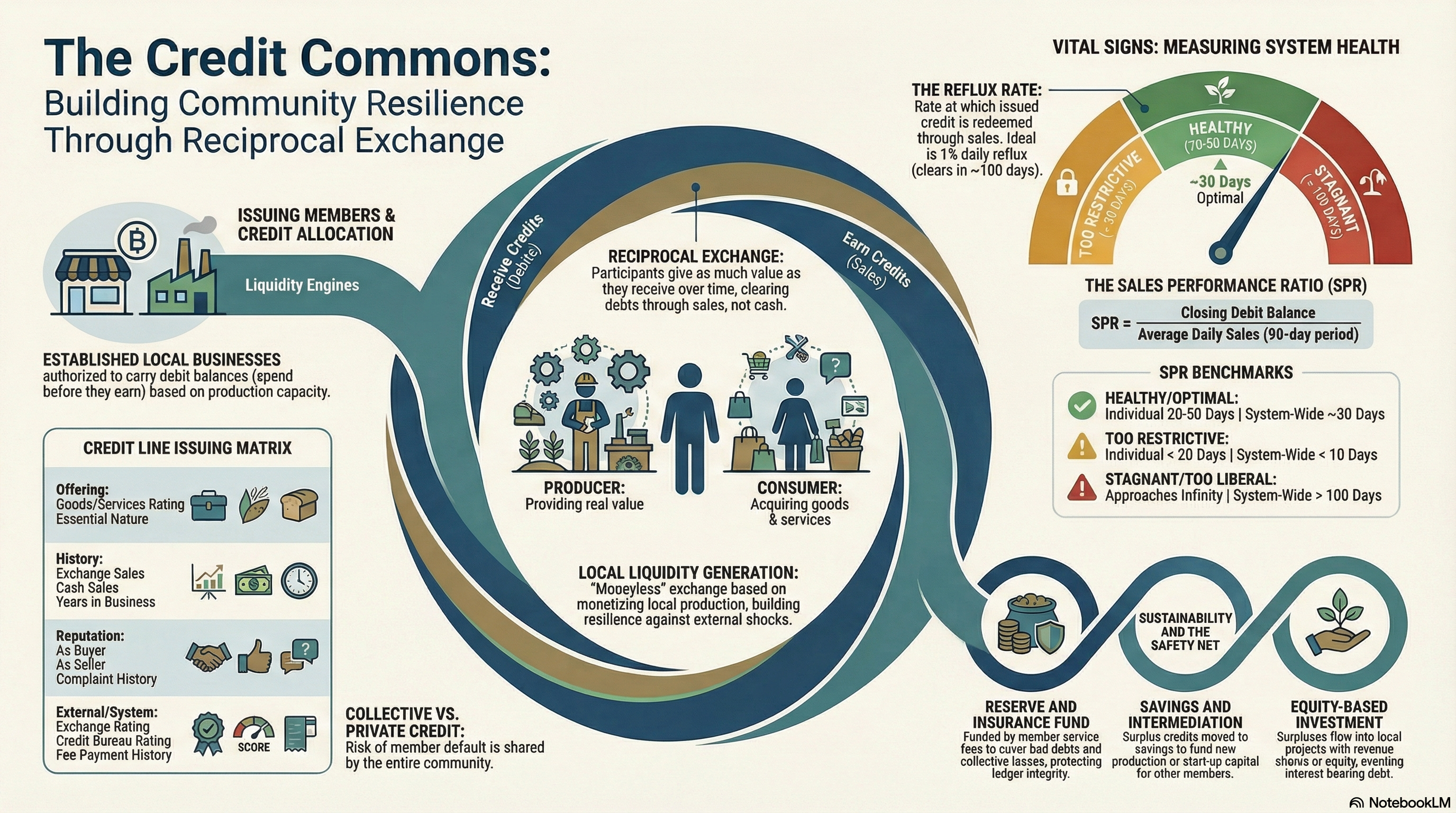
In 2013 I wrote an article that was published in the online academic journal, Internet Journal of Community Currency Research (IJCCR). That article, Taking Moneyless Exchange to Scale: Measuring and Maintaining the Health of a Credit Clearing System, was intended to bring order out of the chaos that prevailed within the movement to create decentralized moneyless systems of reciprocal exchange based on the credit clearing process.
Alas, that article attracted little notice and stimulated no significant action to correct common errors and improve system operations. But this matter is far too important to leave it at that. Fortunately, the past few years have seen the development and deployment of some powerful new communication tools that are able to create high quality, short audio and video overviews that make concepts and prescriptions accessible to anyone.
Over the past several weeks I have been making extensive use of these tools with amazing results and posting the output on my website, https://beyondmoney.net/, and elsewhere; I am doing the same in this case. is a 7 minute video overview of the article:
And here is a longer, more comprehensive 14 minute audio overview.
If you have any interest at all in reclaiming the “credit commons,” participating in decentralized, community-controlled exchange alternatives, and transcending the destructive political money regime, these are essential to understanding how to move forward.
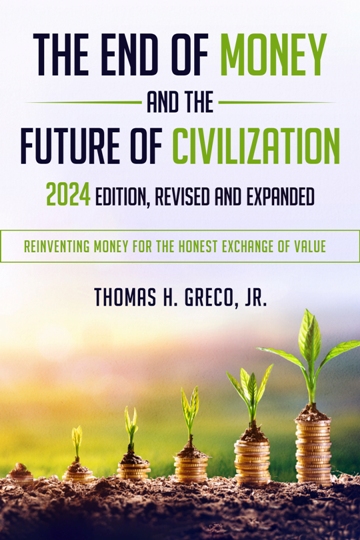
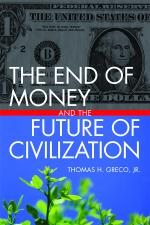
The latest chapter in my new 2024 edition ofThe End of Money and the Future of Civilization, has now been published. Here is an excerpt:
The entirety of money, banking, and finance is comprised of claims and obligations. — Thomas H. Greco, Jr.
It was in a dusty old bookshop close to the British Museum in London that I discovered a slim volume that was to complete for me the picture of how money has evolved over time. I had been traveling in Europe and the United Kingdom in the summer of 2001 with my then partner, Donna, attending conferences, meeting with friends and cohorts, and enjoying the sights, sounds, and cultures of the Old World. It was actually Donna who discovered the book in the basement stacks and brought it to me, saying, “What about this one?” The book was The Meaning of Money by Hartley Withers. Although I had already been engaged in intensive research into the subjects of money and banking for more than twenty years and had written three books of my own on the subject, I had not previously heard of Withers, but it was evident that he must have been, in his day, a recognized authority on the subject, and that his book must have served for a long time as a leading text; I surmised that from the fact that the volume I held in my hands was the seventh edition, published in 1947, of a work first published in 1909, and that Withers had been the editor of The Economist magazine from 1916 to 1921. Reading Withers crystallized my understanding of the double transformation that money had undergone during the previous three hundred years, an understanding that afforded a clearer comprehension of the nature and significance of the changes that have taken place, an understanding that prepares the ground from which to launch the next great improvement in the exchange process.
For now, you can read or listen to the entire chapter at Future Brightly:
It will also be published soon here, and on my own Substack channel. Further chapters will continue to be posted as they are completed. Watch for Chapter 10 to be posted soon.
As always, your comments and suggestions are welcomed, Thomas
What You Need to Know About Money. Currency, Credit, and Exchange
Abstract: There remains today, even among economists and “experts,” a general lack of understanding about the essential nature of money, currency and credit, and sound principles of their creation and management. This article provides a point-by-point summary of fundamental concepts and basic principles of exchange, it outlines the systemic defects and destructive nature of the dominant political, central banking, interest-based, debt-money system, and describes the ways in which honest and effective exchange media can be created on a decentralized basis outside of the banking system and in lieu of political money. A wider understanding of these points will lead to the widespread creation of honest exchange mechanisms and the devolution of financial, economic and political power that can change the course of civilization from self-destruction toward peace, justice, freedom and harmonious relationships.
The essential nature of money/currency A currency is a credit instrument, i.e., a promise to deliver valuable goods and/or services.
Basis of Issue A currency must therefore be issued into circulation on the basis of some value foundation, i.e., goods and/or services that the issuer is ready, willing, and able to sell immediately or in the near future.
Purpose of a currency The sole purpose of a currency is to facilitate the reciprocal exchange of value in the market. It is not a measure of value, nor is it a savings medium.
Reciprocal Exchange Reciprocal exchange is the voluntary exchange of one sort of value for another in the market.
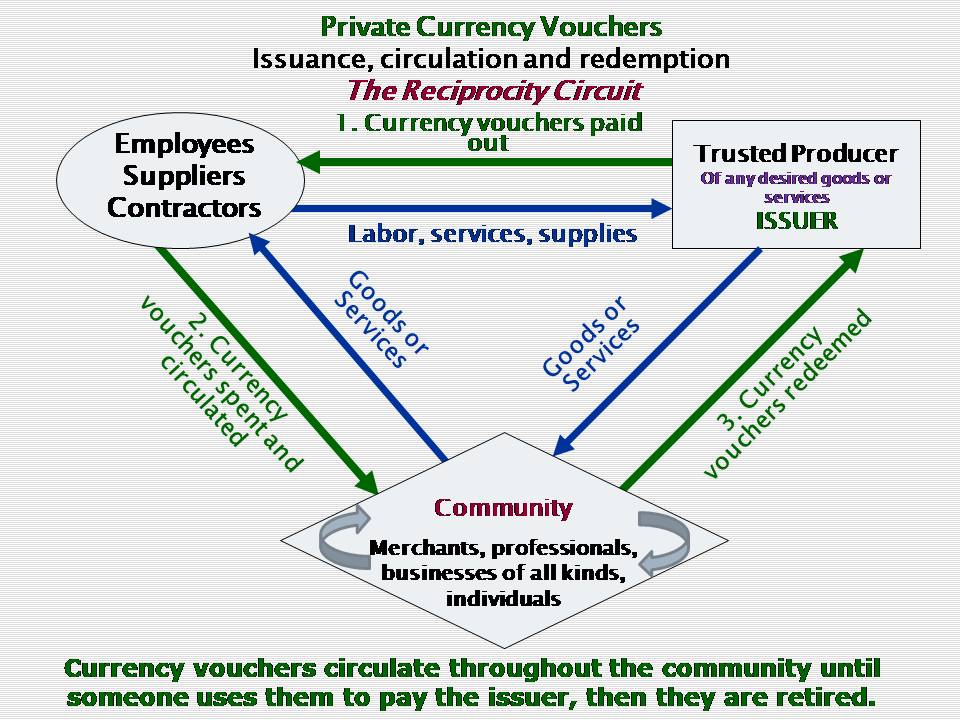
Issuance A currency enters into circulation when a provider of value offers it to another seller who accepts it as payment for their own goods or services, i.e., it is spent into circulation, not sold for fiat political money.
Circulation If it is to serve as a currency, a credit instrument must circulate freely and can change hands many times before eventually returning to the issuer for redemption, not for political money, but for the goods or services that are the issuer’s stock in trade.
Redemption and Extinction A currency is redeemed and extinguished when the reciprocity circuit has been closed, i.e., when the issuer accepts it back as payment for the goods and/or services that they are prepared to deliver immediately or in the near term.
Liquidity Liquidity is quite simply the ability to pay, i.e., having a payment medium that is widely accepted.
Monetization Monetization is the process of converting the value of an illiquid asset into a liquid form, i.e., a form that can be used as a payment medium (money/currency).
Who is qualified to issue a currency? Since a currency is a promise to deliver value, only producers and providers of real value are qualified to issue a currency.
Fallacious myths about money
The belief that money must be issued and controlled by governments and/or central banks.
The belief that banks collectively should have a monopoly on the allocation of credit.
The belief that interest is a necessary element in money creation and finance. How is conventional political money issued, and who issues it?
Virtually all political fiat monies are created by banks when they grant loans.
What are the flaws in political money system, and what are their impacts?
Most bank loans are made on an improper, or inadequate, basis or foundation.
Government and central bank currencies are no longer defined in terms of any real concrete value unit.
Thus, most political money is illegitimate and dishonest.
The interest that banks charge on loans far exceeds the cost of providing the service of monetizing the value of the collateral assets. This causes debts in the aggregate to grow exponentially over time making it impossible for all borrowers to repay what they owe, and making it certain that some must fail.
The concentration of money power in the hands of ever larger banks, in collusion with central governments, concentrates financial, economic and political power in the hands of an elite “super class” and undermines democratic government.
Assertions and Prescriptions
To preserve any semblance of social justice, economic equity, individual freedom, and democratic government, power must devolve to people in their various communities. The only feasible way of achieving that is through the creation of independent and honest mechanisms for exchanging value.
Such honest mechanisms include private currencies issued by providers of real value, and credit clearing associations that allocate credit on a sound basis to producers of real value, and enable them to exchange value without reliance on bank borrowing or the use of political money.
Such systems are not new; they have long existed and need only to be optimized, standardized, and networked together to provide means of exchange that are locally controlled yet globally useful.
The future will see the proliferation of entities that organize and enable the allocation of interest-free exchange credit to small- and medium-sized enterprises (SMEs) that are the backbone of resilient and sustainable community economies.
Standard procedures and protocols for credit allocation and management will emerge that will allow the effective networking of those entities into a global “internet of exchange” using credit that is locally controlled but globally useful.
Broadly speaking, technology is the organization of knowledge, people, and things to accomplish specific practical objectives. It includes processes, practices, techniques and systems as well as things. So what are the disruptive technologies in money and finance? Or is that even the right question to be asking? Is it Bitcoin, Ethereum, and other so-called crypto-currencies? Is it the blockchain, “smart contracts,” “big data,” algorithms?
To find out, watch this 15 minute video, which was extracted and adapted from a longer recording of the presentation, I made to the International Institute of Advanced Islamic Studies, in Kuala Lumpur, Malaysia, on October 10, 2016. It describes how communities and businesses can escape the debt trap and become more resilient and self-reliant? New independent approaches to payment and reciprocal exchange are being deployed which are making conventional money obsolete.
The first edition of my book, The End of Money and the Future of Civilization, was published by Chelsea Green Publishing in 2009. While it remains as relevant today as it was when first published the printed book has been out of print for several years. But, having had the rights reverted to me by my publisher, I am making the entire book available for free in PDF format. You can read it or download it HERE. If you would like a hard copy of the first edition used copies can still be found on Amazon.com, Abe books, Thrift books and elsewhere.
Better still, you can avail yourself of the new revised and expanded 2024 edition which I have been working on for almost two years and is almost complete. Eighteen chapters have already been posted and can be freely read or download HERE.
My previous books, as published, may be freely accessed in digital format by clicking the title below.


 Beyond Money