This is the latest chapter to be published of my new 2024 edition of The End of Money and the Future of Civilization. It continues the exposition begun in Chapter 13, elaborating upon sound principles of credit allocation and management, highlighting what did not work and why, and describing in detail what it takes to make an exchange alternative succeed. It answers crucial questions like:
Who Is Qualified to Issue Currency?
On What Basis Should Currency Be Issued?
How Much Currency May Be Issued?
How to Determine the Period of validity?
And considers strategies for successful launch and implementaion, with due regard for the broad situational context into which an alternative currency or credit clearing exchange may be introduced.
This is the latest chapter to be published of my new 2024 edition of The End of Money and the Future of Civilization. It provides a comprehensive overview of the alternative exchange movement over the past several decades and its present state, along with important case studies, lessons learned, and prescriptions for significant performance improvements.
Here is a list of section headings with a few brief excerpts:
A currency, to be effective, must be SPENT into circulation. — Thomas H. Greco, Jr
Two Currents of Alternative Exchange
The Tucson Experience
More Recent Experiments in Mutual Credit Clearing In order for a mutual credit clearing exchange to be scalable and successful over the long run,
The allocation of credit lines cannot be arbitrary but must be based primarily on the value of the goods and services that each participant is prepared to sell within the exchange circle, and,
The project must be anchored in the local business community, especially the small- and medium-sized enterprises that form the backbone of every local economy and are the providers of people’s everyday needs.
Local Currencies
A Better Currency Model A sound, credible, effective, and scalable currency does not need to be redeemable for conventional money, the issuer needs only to provide credible assurance that its currency can be readily redeemed for some goods or services that are in general demand. Private or community currencies that are SPENT into circulation by trusted issuers, like utility companies, goods producers, or municipal governments, have much greater potential for promoting local community prosperity, resilience, and self-determination because they allow a community to monetize the value that is created and sold by local businesses and professionals. The internal “trade credits” provided to members of mutual credit clearing associations, like those being created by the scores of commercial “barter” exchanges that operate around the world, do the same. Such home-grown sources of liquidity enable a community to greatly reduce its dependence upon official money and bank borrowing, and to automatically favor local production and local sourcing of goods and services, thus reducing dependence upon imports and global corporate providers.
Earlier this month Prof. Richard Werner posted a video on YouTube, which I thought was quite good in explaining the way banks create money, but I felt moved to post a response to it that provides some fundamental concepts and clarifies what is required to start regional alternatives to dominant centralized banking system and political fiat monies. I recommend that you watch Werner’s 10 minute video, and then contemplate my responses.
Prof. Werner makes many good and important points in this lecture, about how money is created and allocated by huge banking institutions which gives them enormous power over governments, people and the economy. Yes, control of money needs to be decentralized and democratized. Public and community banks are important elements in achieving that but they exist within the current dominant paradigm of creating money by making loans at interest, which is a fundamental flaw that forces a growth imperative. Debt grows exponentially as time passes so there is never enough money to enable all borrowers to pay what they owe. A distinction must be made between “exchange credit” and “investment credit.” The former should be allocated without interest to producers based on the value of goods and services each is able to sell immediately or in the near-term; the latter should be the reallocation of existing money from savers to entrepreneurs. The exchange function can best be organized as credit clearing circles, like the original WIR cooperative circle that Werner mentioned, then these various circles can be networked together into a global system of exchange. I have been articulating these points and more for the past several decades, most recently in a webinar I conducted for the University of Hertfordshire in November 2021: 2021-11 Transcending the present political money system–the urgent need and the way to do it. (https://beyondmoney.net/wp-content/uploads/2021/11/2021-11-hertfordshire-preso.mp4). The Q&A that followed is at https://beyondmoney.net/wp-content/uploads/2021/12/herts-qa.mp4. _________________
Thank you for the insightful comment, Thomas. What are your thoughts on the concept of interest in general? Is a interest-based financial system doomed to always end with enormous inflation culminating in financial collapse? _________________
That’s a very good question. One must distinguish between primary interest that banks impose on “borrowers” in the process of creating debt-money, and secondary interest that is demanded by those who hold existing money when they lend it to others for whatever purpose.
The primary interest causes debts to banks to grow exponentially because the interest payments do not, for the most part, go toward consumption expenditures but to ever expanding pools of capital held by “capitalists.” Thus, the money supply available for repayment to the banks is always deficient unless the banks create more money by making more “loans” to stay ahead of the extinction of money that occurs when principal payments are made. The empirical evidence of debt growth over time clearly supports this; I call it the ‘usury conjecture,” which I hope will eventually be proven mathematically and/or through some realistic model of the system.
The so-called “business cycle” that oscillates between inflation and depression is natural result of that inherent flaw in the centralized, interest-based debt-money regime. The interest must be paid, one way or the other. Quantitative easing by the various central banks amounts to life support for that failing system. It is essential that the new system be ready to take over before the plug is pulled on the old one or it dies in a chaotic collapses.
Capital can dominate only when exchange media are scarce, either naturally (commodity money like gold and silver) or artificially (centrally controlled debt money). When exchange media are abundant there is no basis for demanding interest. That abundance derives from reconnecting to the real economy of valuable goods and services. As E. C. Riegel clearly showed, only producers are qualified to issue (credit) money. That is money that producers SPEND into circulation and is accepted by others as payment based on the issuer’s credible promise to accept it back as payment for their own goods and services that they are ready, willing and able to deliver immediately or in the near term. That credit money can take the form of currency vouchers (physical or digital) issued interest-free by individual producers, or more effectively, issued jointly by the members of credit clearing circles. Those circles can then be combined into a global network of exchange in which trade credits are allocated and controlled locally but are globally useful as payment. I outline that system toward the end of my previously mentioned webinar (https://beyondmoney.net/wp-content/uploads/2021/11/2021-11-hertfordshire-preso.mp4). Once that system is in place, interest on secondary “loans” will give way to returns on equity shares as a way of funding capital formation.
It is clear that governments and banking corporations have long colluded in creating the present system of money, banking and finance that dominates economies around the world, and that they have no interest in making the kinds of changes that would reduce their power or share the wealth more fairly. As I have described it before, the banking cartel has been given the privilege of creating money out of thin air as debt and charging interest for its use, while the central governments get to spend as much as they want for whatever they want without regard to their limited tax revenues or the popular will.
In a recent interview, Prof. Richard Werner confirmed that fact and also explained that banks have been buying the wrong kinds of assets with the money they create, and that is why programs of “quantitative easing” (QE) have failed to achieve the outcomes he intended when he proposed them.
He argues, as I have, that we need more small banks that direct their money creation power toward small enterprises that will use the funds for productive purposes and strengthen their local economies. But the long term trend has been in the opposite direction, toward fewer and bigger banks that direct funds toward big corporations and capital funds that use the money for asset purchases, and toward central governments that use the money to acquire massive amounts of weaponry and conduct military adventures and destructive wars around the world.
But our most pressing need is to eliminate the growth imperative that arises from banks creating and lending money at compound interest. Since interest on money created as debt accrues with the passage of time and causes the debt to grow, the money supply is never sufficient for all loans to be repaid, so additional loans must be made in order to keep the money supply from shrinking and causing recessions or depressions. Since the money supply always lags behind the total amount owed, the economy is stimulated toward artificial and wasteful expansion of economic output. Not all increases in GDP are beneficial, and some are downright destructive. The production and use of weapons of war, for example, add to GDP but provide nothing to satisfy basic human needs or desires, and actually result in the destruction of existing infrastructure and death and misery for the people who happen to be on the receiving end.
If the necessary changes cannot be expected to come from the top of the economic and political pyramid, then they must emerge from the grassroots. Achievement of a steady state, equitable, peaceful and environmentally friendly economy requires deep restructuring of our systems of exchange and finance, and a shift away from debt finance and the increasing size and power of corporations and national governments.
As I’ve argued before in my articles and books, banks are supposed to perform two essential functions, the exchange function and the finance function. In the exchange function they should provide flexible short-term interest-free lines of credit to active buyers and sellers that are ready, willing, and able to provide goods and services to the market immediately or in the near term. This, in effect, monetizes the value of each business’s goods inventories or their capacity to provide valued services in the short run. As an adjunct to providing them with short-term exchange credit, banks should also provide them with credit clearing services in which their purchases are offset by their sales. This is precisely the sort of service that has been provided since 1934 by the Swiss WIR Bank (founded originally as the WIR Economic Circle Cooperative), and by the scores of commercial trade (or “barter”) exchanges that have been operating around the world.
In contrast to the exchange function, the finance function requires long-term credit instead of short-term credit. In performing the finance function banks should not create new money but should reallocate the temporary surplus funds of savers to entrepreneurs who will use it for productive purposes like capital improvements that increase their capacity to produce and distribute needed goods and services, and not for speculative and non-productive asset purchases. Further, they should provide these funds, not as interest-bearing loans, but as temporary equity that, unlike debt, causes the providers of funds to share both the risks as well as the rewards of business enterprise, and does not cause the growth imperative. If the equity stake of the bank is temporary instead of permanent, that will prevent the endless accumulation of vast pools of capital and will make capital a servant to productive enterprise rather than its master. Such equity shares that banks would administer on behalf of their depositors (savers) should expire after the original funds have been repaid to the savers along with a reasonable share of the profits that have been earned during the period of the agreement.
By making these simple changes in the kinds of banks we have, and way money and banks work, we can eliminate the endless expansion of debt, the inequitable distribution of power and wealth, the erosion of democratic government and the despoliation of the environment, and usher in a new more peaceful civilization.
If existing banks are unwilling to make these changes, or if existing banking regulations do not permit them, they can be implemented by other organizations that are entirely outside the banking system. The commercial trade exchanges mentioned earlier have, for more than 40 years, been facilitating the exchange function by providing credit clearing services to small and medium sized businesses, and are classified by the US government as “third party record keepers” that are not subject to banking regulations. By making some minor improvements in their operations and by networking them together, trade exchanges can evolve the exchange function in ways that can provide a worldwide web of exchange in which interest-free credit is locally controlled but globally useful.
Likewise, the finance function can be, and is, increasingly provided by small investors directly to entrepreneurs without involving banks by using innovative mechanisms like crowdfunding, community investment funds, and direct public offerings. By providing investment funds to SMEs and cooperatives in the form of equity shares, interest-free loans, or revenue shares, they can help rebuild local economies in ways that make communities more resilient and self-reliant, and most of this can be achieved by private enterprise without the need to enact any new laws or regulations.
A new page has been added to this blog, containing a recent report by Susan Witt on the WIR credit clearing association that has been operating in Switzerland for more than 70 years. Now called the WIR Bank and providing conventional banking services, WIR is an important case for monetary reformers and free exchange advocates to study. While there may yet be some deficiencies in its operating policies, WIR has proven over a long period of time the effectiveness of direct clearing of credits between buyers and sellers as an alternative to conventional bank-created debt-money.
The first edition of my book, The End of Money and the Future of Civilization, was published by Chelsea Green Publishing in 2009. While it remains as relevant today as it was when first published the printed book has been out of print for several years. But, having had the rights reverted to me by my publisher, I am making the entire book available for free in PDF format. You can read it or download it HERE. If you would like a hard copy of the first edition used copies can still be found on Amazon.com, Abe books, Thrift books and elsewhere.
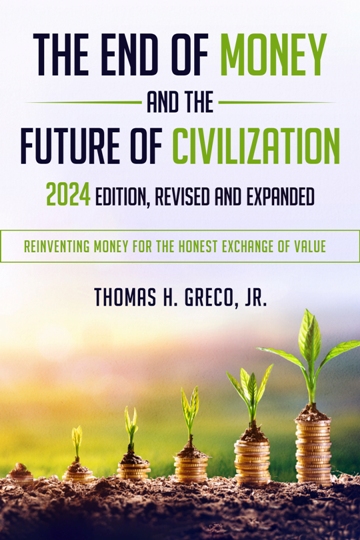
Better still, you can avail yourself of the new revised and expanded 2024 edition which I have been working on for almost two years and is almost complete. Eighteen chapters have already been posted and can be freely read or download HERE.
My previous books, as published, may be freely accessed in digital format by clicking the title below.




 Beyond Money