Category Archives: Banking

Should every state own a bank of its own?

A state owned bank can provide state economies with many advantages–if it is properly run. Here’s an article from Mother Jones about the Bank of North Dakota, the only state owned bank in the United States. It makes a pretty good case.–t.h.g.
How the Nation’s Only State-Owned Bank Became the Envy of Wall Street

60 Minutes exposes banks’ massive mortgage fraud

This is a truly astounding story about how major banks have routinely used falsified documents to foreclose on people who were lured into the housing bubble.

What IS the truth about Libya?

There are a lot of things about the turmoil in the Middle-east and the current assault on Libya that don’t quite add up. Here is one version of the truth that seems plausible. We’re all aware by now of the competition amongst the major power to secure oil supplies, and that oil is the primary reason behind the American war against Iraq.

Could it be that the burgeoning growth of Islamic finance has something to do with the policies of the Western powers in the Arab and Islamic world? Based as it is on funding without interest/usury (riba), true Islamic finance  is bound to eventually threaten the power of the banking establishment. –t.h.g.

The Truth About Libya

By Stephen Goodson 4-1-11

Colonel Muammar Gadaffi is frequently referred to in the media as a “mad dictator” and “bloody tyrant”, but do these allegations accord with the facts?

Libya consists of over 15O tribes, with the two main groups, the Meghabra living in Tripolitania in the west and the Wafallah living in Cyrenaica in the east. Previous attempts to unite these tribes by the Turkish (1855-1911) and ltalian {1911-43) colonial rulers failed and the country was split in two for administrative purposes.

Oil was discovered in Libya in 1959, but King ldris of the Senussi tribe allowed most of the oil profits to be siphoned into the coffers of the oil companies. The coup d’etat on 1 September 1969 led by Colonel Gadaffi had countrywide support. He subsequently married a woman from the royal Barqa tribe and adroitly unified the nation.

By retaining Libya’s oil wealth for the benefit of all its people, Gadaffi had created a socialist paradise. There is no unemployment, Libya has the highest GDP in .Africa, less than 5% of the population is classified as poor and it has fewer people living below the poverty datum line than for example in Holland. Life expectancy is 75 years and is the highest in Africa and I0% above the world average.

With the exception of the nomadic Bedouin and Tuareg tribes, most Libyan families possess a house and a car. There is free health care and education and not surprisingly Libya has a literacy rate of 82%. Last year Gadaffi distributed $500 to each man, woman and child (population 6.5 million).

Libya has a tolerable human rights record and stands at 61 on the International Incarceration Index, comparable with countries in central Europe (the lower the rating, the lower the standing – the USA occupies the no.1 spot!). There is hardly any crime and only rebels and traitors are dealt with harshly.

Anyone who has read Gadaffi’s little Green Book will realize that he is a thoughtful and enlightened leader. Libya has been accused of having committed numerous acts of terrorism in the past, but many of these have been perpetrated by foreign intelligence agencies as false flag operations – the Lockerbie bombing being a prime example.

The CIA and MI6 and their frontmen have been stoking up dissent in the east of the country for almost 30 years. Libya produces exceptionally high quality light crude oil and its production cost of $1 a barrel, compared to the current price of $115, is the lowest in the world.

Riba (usury) is not permitted. The Central bank of Libya is a wholly-owned by the Libyan Government and is run as a state bank, issuing all government loans free of interest. This is in contrast to the exploitative fractional reserve banking system of the West. The no-fly zone and the bombing of Libya have nothing to do with the protection of civilians. It is an act of war ­ a blatant and crude attempt by the oil corporations and international bankers to steal the wealth of Libya.

#     #     #

Usury, Interest, and Islamic Banking

One of the most popular posts on this site has been David Pidcock’s View on the State of Islamic Money, Banking, and Finance, which was posted in January of 2008. Over the past few years, these subjects have continued to draw increasing attention, and interest in interest-free financing has continued to grow in both the east and the west. It is not only on the basis of religious belief that the subject of usury is once again being debated (mainly in the Islamic world), but increasingly on account of the obvious and overwhelming expansion of debt throughout the world.

In November of last year (2010) the First World Conference on Riba was held in Kuala Lumpur, Malaysia. (Riba is the Islamic term for usury). In recent correspondence from David, he argued that there still are no truly Islamic banks. He also sent along one of his papers that he presented at the Riba conference. Whatever your preconceived opinions about the subject might be, I think you will find his paper to be interesting and informative. I have made it a permanent part of this website, which can be found in the sidebar under Other Resources, or just click on the title here, Riba? Part 1.

–t.h.g.

Currency speculation and arbitrage

For anyone who is confused about foreign exchange rates and speculation (which I think includes almost everyone), here is a clear explanation provided by Prof. Dr. Ahamed Kameel Mydin Meera of the International Islamic University of Malaysia. He explains it in relation to the 1997 East Asian Crisis that was brought on by speculative attacks (manipulation) on several Asian currencies.–t.h.g.

Let the sun shine in: Wikileaks to reveal banking secrets of the rich

There is a big difference between legitimate privacy concerns and secrets that enable fraud, malfeasance, and criminal activity. According to this article in The New Zealand Herald, Wikileaks will shortly publish information that promises to expose some of the latter.–t.h.g.

WikiLeaks: Banking secrets of rich leaked

5:30 AM Monday Jan 17, 2011

The overseas bank account details of 2000 “high-net worth” individuals and corporations – detailing widespread possible tax evasion – will be handed to WikiLeaks tomorrow.

The organisation is receiving the details from the most important and boldest whistleblower in Swiss banking history, Rudolf Elmer, two days before he goes on trial in his native Switzerland.

British and American individuals and companies are among those whose details are on CDs to be presented to WikiLeaks in London.

They include about 40 politicians, Elmer says.

Elmer, who after his press conference will return to Switzerland from exile in Mauritius to face trial, is a former chief operating officer in the Cayman Islands for the Julius Baer bank, which accuses him of stealing the information.

He is also – at a time when the activities of banks are a matter of public concern – one of a small band of employees and executives seeking to blow the whistle on what they see as unprofessional, immoral and even potentially criminal activity by powerful international financial institutions.

Switzerland is a fortress of banking and financial services, but is famously secretive and expert in concealing wealth from all over the world for tax evasion and other extra-legal purposes.

Elmer says he is revealing the information ” to educate society”.

He says his list includes “high-net worth individuals, multinational conglomerates and financial institutions – hedge funds”.

They are said to be “using secrecy as a screen to hide behind in order to avoid paying tax”.

They come from the US, Britain, Germany, Austria and Asia.

Clients include “business people, politicians, people who have made their living in the arts and multinational conglomerates – from both sides of the Atlantic”.

Elmer says: “Well-known pillars of society will hold investment portfolios and may include houses, trading companies, artwork, yachts, jewellery, horses, and so on.

“What I am objecting to is not one particular bank, but a system of structures,” he said.

“I have worked for major banks other than Julius Baer, and the one thing on which I am absolutely clear is that the banks know, and the big boys know, that money is being secreted away for tax-evasion purposes, and other things such as money-laundering.”

Elmer was held in custody for 30 days in 2005, and is charged with breaking Swiss bank secrecy laws, forging documents and sending threatening messages to two Baer officials.

Elmer says: “I agree with privacy in banking for the person in the street, and legitimate activity, but in these instances privacy is being abused so that big people can get big banking organisations to service them. The normal, hard-working taxpayer is being abused also.”

The names on the CDs will not be made public, just as a list of 15 clients that Elmer gave WikiLeaks in 2008 has remained undisclosed.

– OBSERVER


Judge Napolitano challenges elite bankers on Fox News

I’m no big fan of Fox News, but this is a surprisingly good segment. Judge Napolitano in the five minute speech does a pretty good job of telling “The Plain Truth of the Federal Reserve” (12/21/10), and our present economic and financial predicament. He pretty much follows what I said in the first part of my latest book, The End of Money and the Future of Civilization.

Now someone needs to ask him to read the second part to discover workable solutions. — t.h.g.

http://www.youtube.com/v/CUUZ4D7OcT4?fs=1&hl=en_US

At last, central banking and legal tender are once again subject to real political debate and public scrutiny.

In what seems to me to have been an unlikely turn of events, Congressman Ron Paul of Texas has been appointed to chair the House Subcommittee for Monetary Policy in the new Congress. In one sense this seems like very good news, on the other hand, it raises some serious questions about the oligarchy’s ultimate game plan.

Ron Paul is undoubtedly one of the few politicians who understands money and banking, but he has some serious blind spots, and call me cynical, but I think that politics at the federal level has been so thoroughly corrupted that I have little hope that anything that promotes the common good can ever come out of Congress.

Still, I strongly recommend that everyone watch the following C-span interview in which Congressman Paul outlines his agenda. It does not go as far as it needs to, but it is an agenda that I, for the most part, endorse.

According to Brendan Trainor, Rep. Paul in this interview makes the following points. I have highlighted what I consider to be the most urgent and important ones (in red).

  • Ron will start by requesting the information that is now due from the Fed from the watered down version of the “Audit the Fed” bill that was passed by Congress.
  • Ron will submit his more robust version of the Bill to Audit the Fed in Congress again.
  • Ron is aware of the twin dangers of his attack on the FED. Criticism of the FED could result in a reactionary attempt to create an even more centralized monetary system, or else “some of my allies who are critical of the FED” who Ron now public-ally calls “GREENBACKERS”, will push for Congressional issue of fiat money. Both of these outcomes have to be guarded against (by those few of us who understand the debate in the first place.)
  • Ron explicitly defends the proposition that the market should be regulating finance, not the regulators. The Market does a better job of regulation than the government. This counter-intuitive idea does require a limited government involvement (not to discount the anarcho-capitalist alternative) that will require
    an atmosphere of “law and order, NOT regulation“.
  • Market regulation through “law and order” means that banks and financial institutions are subject only to ordinary business law: That is, they are free to operate as they please, but they must fulfill their contracts and must not engage in fraud. If they cannot fulfill their contracts, they are to be shut down, not bailed out. Their assets are to be distributed to their creditors (bankruptcy).
  • The surest way to END THE FED is the peaceful, gradual method of eliminating, not the FED directly, but legal tender laws. Allow people once more to use GOLD CONTRACTS and other means of using alternative currencies and specie in domestic business contracts. Let the fiat paper dollar compete with the people’s choice: constitutional “honest money”.
  • Ron correctly deflects the usual straw man criticisms directed at him by those who favor central planning in monetary policy. ie
  • There were numerous financial panics before the FED was created. Yes, there were. But those panics were the result of “artificial conditions” and in any event were allowed to play themselves out by liquidation of the bad debts and bad contracts without government interventions up to the recession of 1920-21. That was the last recession that was handled without government intervention. It was a sharp recession, where unemployment reached nearly 20%. However, because President Warren G Harding did NOTHING, except cut government spending and taxes, the recession was OVER IN A YEAR.
  • If the FED does not intervene, the Recessions will be worse. The corollary of the first objection. Yes, the recessions may at times be worse, but they will be shorter. The so called “Panics” of the pre Fed era rarely lasted more than a year or two, and then the economy fully recovered. The interventionist policies starting with the Great Depression ( a ten year depression) and this one now only prolong the recessions, and in the end, the underlying causes are NOT addressed, leading to a new “BUSINESS CYCLE”.
  • Attacking the FED will harm the US DOLLAR hegemony. Ron: I want to protect the dollar, but within the context of markets. Markets are ultimately stronger than the central banks attempts to shore up the dollar, and nothing the central banks can do will overcome that fact. The Market, in the end, will out.
  • Fiscal policy (Congress) is more important than Monetary policy (the Fed) Ron: they work hand in glove. The Fed basically enables the Congress to spend exorbitantly by creating fiat money to cover them. We have to end the Wars and Global Empire, and we have to end the limitless welfare state as well. IOW, we do have to address fiscal policy, but at the same time, address its enabler, the FED.

Ron explicitly puts forward the idea that the BUSINESS CYCLE as we have known it can be ended. NOT with more regulation, certainly not with more “Central Planning” (that ultimately leads to Socialism, and we know THAT doesn’t work) , but ended  with the limited government ideal (classical liberalism.)

[A major blind spot is the failure to pinpoint interest/usury as the cause of financial imbalance that leads to the “business cycle.”—t.h.g.]

Definitely a radical agenda, led by a peace loving man. Let us all work to explain his ideas as this year’s economic policy drama unfolds. The attacks from the left and the RINO Republican establishment will be vicious and loud. Those of us who understand the monetary debate are few and our voices have few MSM outlets . Even monetarist libertarians will attack Ron. We must resist them to the best of our abilities, by explaining his policies whenever we can.

Brendan

[Another major blind spot is the size and market dominance of firms like Goldman Sachs, Citicorp, J.P. Morgan Chase, Bank of America, etc. Government needs to set the rules of the game to prevent such megalithic financial firms from emerging and manipulating markets. At the very least the Glass-Steagall law should be reinstituted. It also needs to pass legislation that encourages the development of mutual companies and cooperatives in the financial sector. That would be a complete reversal of the policies of recent decades.] — t.h.g.

Banks still not lending; number of problem banks rising

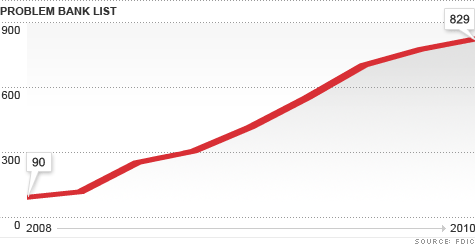
This CNN report says that banks are still not lending, and that the number of banks considered by the FDIC to be “problem banks” has risen to its highest level since 1993. Scroll down and watch the 2 minute video summary by Colin Barr.

No TARP funds for Shorebank

Shorebank in Chicago was closed by regulators last Friday. This bank, which has been prominent for its commitment to the needs of local business and low-income clients, was closed “after Wall Street backers failed to rescue the institution.” Over the past 2 years the federal government has lavished hundreds of billions of dollars on major Wall Street institutions while allowing small, local banks to fail. One must wonder why. According to a Reuters report:

“… the [Shorebank] bank, which was put on the ropes when the recession hit its lower-income borrowers especially hard, was unable to secure the funds it was seeking from the government’s Troubled Asset Relief Program, or TARP, it needed to match private-sector pledges.”

Read the full report here.