Category Archives: Community

Now published: Chapter 16—The Role of Credit Clearing in Regional Economic Development

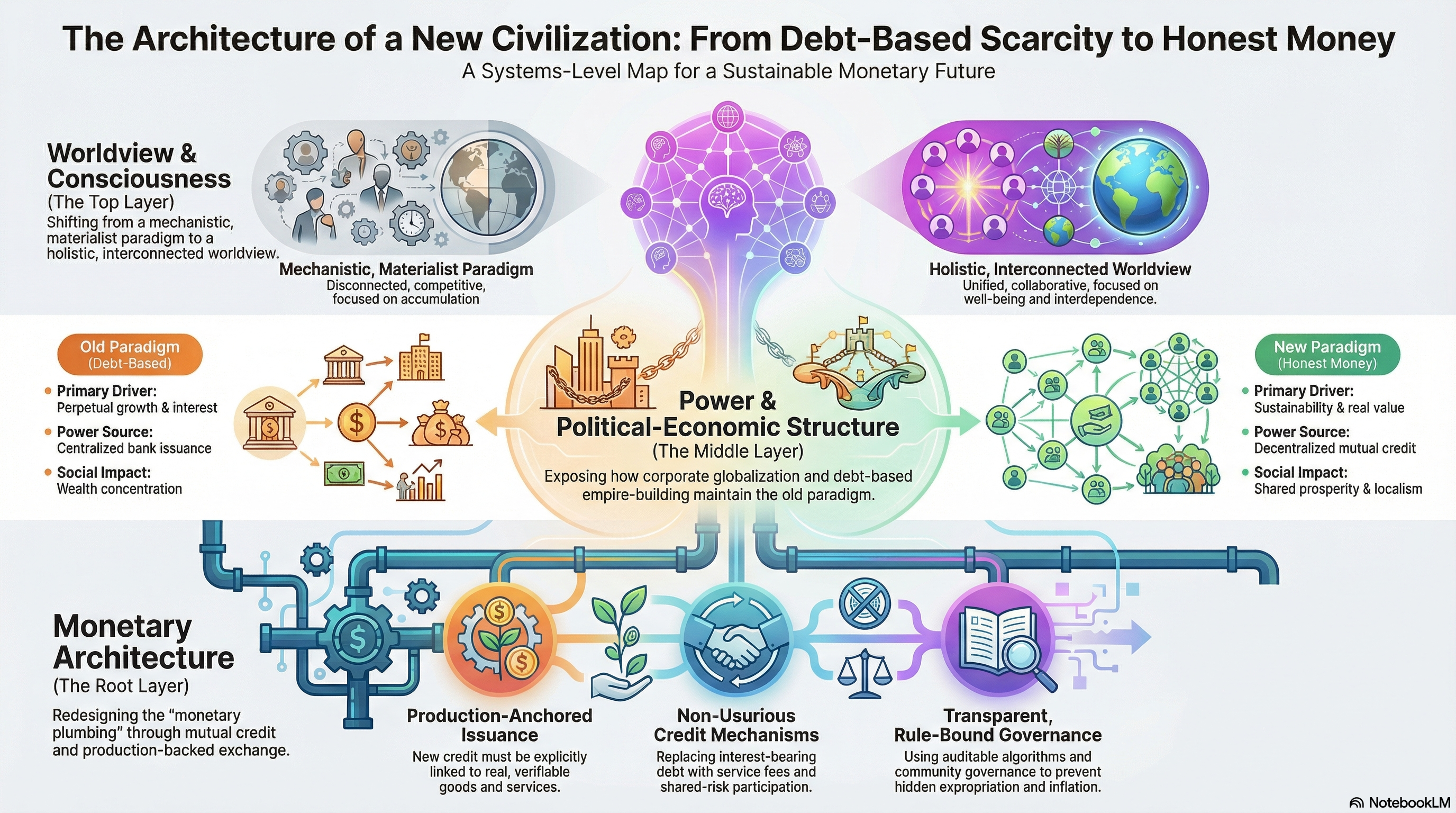
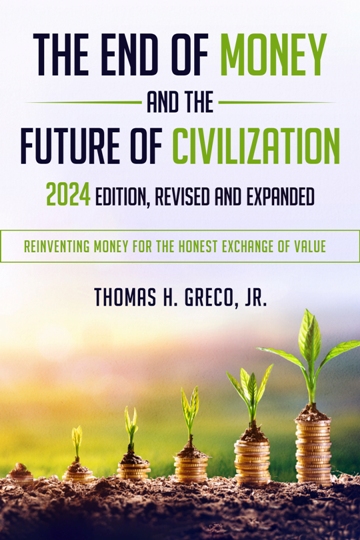
Chapter 16 is the latest Chapter in my new updated and expanded edition of The End of Money and the Future of Civilization. The link to this chapter is now listed along with the other previously published chapters on the book page along with links to the audio narrations by Ken Richings. Scroll down to find Chapter 16 there or click here to go directly to the PDF file.

Here are the Chapter contents:

Figure 16.1 A Typical Small Boat Harbor (Drawing by Dennis Pacheco)
  • The Orthodox Approach to Community Economic Development
  • A Comprehensive Community Economic Development Plan
  • Stage I: Map the Local Actors and Assets & Promote Import Substitution
  • Stage II: Support Structures for Localization—Saving, Investment, Finance, and Education
  • Stage III: New Liquidity Through TrustMutual Credit as a Way to Pay
    How It Works
    Key Benefits
    The Generation and Allocation of Trade Credits
  • Stage IV: The Credit of “Trusted Issuers” Can Provide a Local Alternative Currency for General Circulation
  • Stage V and Beyond: Transition to an Objective Measure of Value and Unit of Account

As always, your comments are welcome.

Newsletter, August 2024 – Weathering the storm and emerging together

In this issue:

  • Breaking Together
  • Symbiotic Culture
  • Chapter 10, The Third Evolutionary Stage—The Emergence of Credit Clearing

Breaking Together

Jem Bendell, former professor and founder of the Initiative for Leadership and Sustainability (IFLAS) at the University of Cumbria (UK) has a highly credentialed background that is impressive by any measure. After a life changing experience, he embarked upon a different life path, delving deeply into diverse disciplines, including the latest climate science, that led to his writing, in 2023, his book, Breaking Together: A freedom-loving response to collapse, in which he summarized his startling conclusions:

“The collapse of modern societies has begun. That is the conclusion of two years of research by the interdisciplinary team behind Breaking Together. How did it come to this? Because monetary systems caused us to harm each other & nature to such an extent it broke the foundations of our societies. So what should we do? This book describes people allowing the full pain of our predicament to liberate them into living more courageously & creatively. They demonstrate we can be breaking together, not apart, in this era of collapse. Jem Bendell argues that reclaiming our freedoms is essential to soften the fall & regenerate the natural world. Escaping the efforts of panicking elites, we can advance an ecolibertarian agenda for both politics & practical action in a broken world.

Jem has since abandoned academia and his “illustrious career of delusion” in favor of a different path that embraces reality and includes practical decentralized actions of adaptation. Breaking Together is available as a free download, but if you would like to get a taste of it before plunging into his 500 page volume, I highly recommend that you listen to this two-part interview in which he quite articulately explains his main ideas, and how we can, by working together, adapt to the inevitable and ongoing collapse of our present version of civilization, and in the process build a better one. Interview Part 1; Part 2.

____________

Symbiotic Culture

The work of Richard Flyer puts my own work, and that of Jem Bendell and others within a more comprehensive and foundational context.

In a recent message, Richard Flyer alerts readers to a short video that he posted a couple years ago on his YouTube channel to explain his work of empowerment and societal change. By his own description, “It not only provides solid content about building Symbiotic Cultures and Networks, but it really captures the Spirit, enthusiasm, and hope we need now more than ever—the possibility and reality of Fractal Community Empowerment. It was released more than a year before the book Birthing the Symbiotic Age: An Ancient Blueprint for a New Creation came out on Substack as a weekly series. It shares many of the stories of on-the-ground grassroots movements I have been affiliated with, including San Diego, CA, and Reno, NV, as well as the Sarvodaya Shramadana movement of Sri Lanka – and their relevance today.”

I highly recommend that you take a few minutes to watch his inspiring message, and read the 2-minute synopsis of his book

____________

Chapter 10, The Third Evolutionary Stage—The Emergence of Credit Clearing

This is the latest chapter to be published of my new 2024 edition of The End of Money and the Future of Civilization. It continues the story begun in the previous chapter of how money has evolved and changed its character over time.

Here is a brief excerpt:

Money has become merely an accounting system, a way of “keeping score” in the economic “game” of give and take. Thomas H. Greco, Jr.

Let us begin by summarizing the evolution of the various kinds of money that have been used to mediate reciprocal exchange:

  1. The circulation of gold and silver coins gave way to paper banknotes that were redeemable for gold or silver coins, which made the notes essentially warehouse receipts for gold on deposit.
  2. Then, banks began to lend bank notes into circulation based on the pledge of collateral assets (some valuable and others not) other than gold, some of which included government obligations (bonds, notes, etc.).
  3. But ALL notes were redeemable in gold. This became known as the “fractional reserve banking” system.
  4. Bank account balances (checkable bank “deposits”) increasingly took the place of paper bank notes, and bank customers began to write checks against their deposits instead of using bank notes to make payments.
  5. As banks created ever greater amounts of non-bona-fide money based on national government debts and other illegitimate collateral assets, the fiction of gold-backing and redeemability could no longer be supported, and governments reneged on their promise to redeem their currency for gold. This broke the final link between political fiat money and the real economy of valuable goods and services.
  6. But, despite that, the emergence of credit clearing to offset credit obligation against credit claims was a major leap forward in facilitating the reciprocal exchange of value.

You can now read or listen to the entire chapter at Future Brightly:

Chapter 10—The Third Evolutionary Stage—The Emergence of Credit Clearing-Text

Chapter 10—The Third Evolutionary Stage—The Emergence of Credit Clearing-Audio narration

____________

The pieces are now all coming together. In what way will you participate in the great adventure?

Thomas

Community Currencies Can Enable Universal Basic Mobility (UBM)

It may not be a basic necessity for life, but mobility surely is a basic necessity for living in a modern economy and for having a decent quality of life. This fact is increasingly recognized, and in response, many cities have been subsidizing public transit, and now many are considering making public transit completely free to all riders.  

Kansas City, Missouri implemented fare-free rides in response to the pandemic and then made free rides generally available in 2021. Tucson, Arizona, where a large portion of public transit costs have long been covered by the city budget, and where discounted fares have been available to certain low income groups, responded similarly to Kansas City and is now considering making zero fare rides on its Sun Tran system permanent for all.

A recent article titled, Is Universal Basic Mobility the Route to a Sustainable City?,  reports that the city of Oakland, California has recently begun a pilot project aimed at providing universal basic mobility (UBM), which according to the article, involves “a combination of policies, funding, and partnerships that aim to provide all members of society with a basic level of access to mobility.”

My own extensive efforts to help cities become more sustainable have been focused largely upon finding ways to provide them with locally created means of payment that are independent of the banking system and the federal government. Local currencies have a long record, hundreds of them have been created over the past few decades, and hundreds more appeared during the Great Depression of the 1930s. A properly issued local currency can help make a local economy, not only more sustainable, but more robust and prosperous, and enhance the quality of life for local community residents. It can do this by reducing the community’s dependence upon the centralized system of money creation and allocation and handouts from the federal government, and by using its own local production of goods and services as the basis for creating sound payment alternatives to fiat money.

Proper issuance requires a basic understanding of the essence of a currency and what is required to make it sound and acceptable as a payment medium. A sound local currency is a credit instrument that is spent into circulation by a trusted provider of goods and/or services that are in regular demand. The accepting party then has a claim against the goods and services of the issuer.  The issuer must be ready, willing, and able to redeem the currency, not in cash, but by accepting it back as payment for goods or services that they already have available, or soon will have available for sale.

Mobility is extremely important not only to the local economy by helping people get from their homes to the shops and their places of employment, but also to people’s physical and emotional health. Low income and disabled people are the most dependent upon public transit, so making transportation easy and inexpensive is especially important to them. On the other hand, providing those services constitutes a major expense and the question of how those expenses are to be covered remains a stumbling block.

It occurs to me that a community currency can play a role in providing universal basic mobility (UBM). The public transit agency qualifies as a trusted provider of transit services that it is ready, willing and able to provide at all times. That qualifies it to spend a currency (“Transit Tokens”) into circulation, using it to pay for goods and services that it needs for its operations, or even for services that benefit the entire community. Transit Tokens could be spent into circulation by the city government in return for work done voluntarily by citizens, work that is in the public interest, like graffiti abatement, trash pick-up, street beautification, aiding the homeless and disadvantaged, and many other things that contribute to our quality of life but for which funding is generally hard to find.

Why not keep transit fares at some modest level but accept payment not only in dollars but also in Transit Tokens? Those riders who are able to work can easily earn them and at the same time gain a sense of purpose and participation in the community. Others who are willing to volunteer  may not be able to donate dollars, but most are able to do some useful work to acquire Transit Tokens which they can then donate to homeless people or to nonprofit organizations that can then distribute them to others in need.

Further, if Transit Tokens are made generally transferable they can circulate amongst local merchants and throughout the local economy to provide an exchange medium that is supplemental to the supply of dollars, giving the community a source of homegrown liquidity that boosts the local economy and makes it more self-reliant. The issuance and circulation of Transit Tokens can be a good start toward reclaiming “people power” and rebuilding our local economies and a democratic society.

#     #     #

Ivan Illich and the Coming Cultural Revolution

Ivan Illich

Do educational institutions make people stupid? Do medical institutions make people sick?

Such questions may at first glance seem preposterous, but they were raised in all seriousness a few decades ago by Ivan Illich, and strongly argued in his books, Deschooling Society (1971) and Medical Nemesis (1975). In both cases his arguments stem from his overarching belief that as institutions become too large and too centralized they end up doing the exact opposite of what they are intended to do. Over the subsequent decades, we’ve seen mounting evidence that Illich was correct in his assessments. In our attempts to improve efficiency, eliminate uncertainty, and get more done in less time, we have allowed everything to become too big, too rigid, too fast, and too centrally controlled. In the process the individual has become ever more helpless and alienated and more dependent on impersonal institutions that are being corrupted by their power and inherent conflicts of interest. As Illich argues, we have become slaves to our institutions and our myths about who we are and how the world works. George Bernard Shaw spoke similarly in declaring that all professions are “conspiracies against the laity.”

Ivan Illich (1926–2002) was a Catholic priest, theologian, philosopher, and social critic, who became famous in the 1970s and 80s, and although his fame may have faded a bit in recent years, his ideas and works have been, and remain highly influential and are now more relevant than ever. Notable in this regard are such resources as The International Journal of Illich Studies, the upcoming, The Philosophy of Ivan Illich: An 8-Week Course, being offered by Nina Power, PhD, and a brand new book by noted journalist and broadcaster, David Cayley, titled, Ivan Illich:An Intellectual Journey (2021).

Cayley has followed the work of Illich since the 1960s, and in 1989 he visited Penn State University where Illich was then teaching, to record a series of interviews that were then used in a five part series in Cayley’s Ideas program that aired on CBC (the Canadian Broadcasting Company). That series titled, “Part Moon, Part Travelling Salesman: Conversations with Ivan Illich,” was comprised of one hour segments that included biographical information and comments about Illich and his ideas by others who knew him. The series is now available online and can be accessed here.

I became an instant admirer of Illich and his work in the early 1980s after reading both of the above mentioned books, as well as his prescriptive work, Tools for Conviviality (1973). In the latter he points out what Wikipedia calls “the institutionalization of specialized knowledge,” and “the dominant role of technocratic elites in industrial society.” Illich argues in favor of “appropriate technology” and the reacquisition of practical knowledge and simple tools that empower people and help to build community. In short, he calls for a general deinstitutionalization of society and a reconceptualization of what it means to be human.We have, by and large, internalized the belief that we are, in Illich’s words, “poor, sick and ignorant,” and in need of institutional services to remedy that situation.

In August of 1989 I had the honor of welcoming Illich to give a presentation at the 8th Assembly of the Fourth World and Decentralist Congress that was held in Toronto, Canada. As President at that time of the School of Living, the sponsoring organization, I served as moderator of the event which also included presentations by such insightful thinkers and activists as Leopold Kohr and John Papworth.  

Both Cayley and I have taken Illich’s insights to heart in our personal responses to the ongoing crisis of civilization and to its latest manifestation, the “pandemic” and official reactions to it. Cayley’s sentiments are expressed in his recent post, Concerning Life, in which he delves deeply into Iliich’s expressions of what the word “life” actually means and what Illich meant when he said that life has become “an idol” and “a fetish.” He and I seem to share the view that the concept of life has been distorted in the public mind as Christendom, and religious institutions in general, have tried to accommodate with a materialistic civilization that is now unraveling.

For me it comes down to this: Life is more than breath and pulse, flesh and blood, muscle and bone. The fear of death inhibits true life which is more than physical, it is spiritual– free, adventuresome, and spontaneous and open to unknown possibilities. Perhaps this is what Jesus meant when he said, “For whosoever will save his life shall lose it: and whosoever will lose his life for my sake shall find it” (Matthew 16:25). And this, from a more secular point of view states the same essential truth: Life is the destiny you are bound to refuse until you have consented to die. –W.H. Auden.

God grant that I might find the courage to push through my fear whenever it arises, to embrace my destiny, and choose to truly live.  

# # #

How, Then, Shall We Live? — What we might learn from the Amish

I grew up in the 1940s and 50s, a time that I consider to be the Golden Age of prosperity and promise, a time when the middle-class was growing larger and more prosperous and it seemed that things would only continue to get better. It was a time when a family could manage quite nicely, as mine did, on a single modest income. My dad was a “debit agent” for a big mutual insurance company, selling life insurance and collecting the premiums from policy holders within his territory, or “debit.” On his modest income he was able to provide us with a nice home, put both my sister and me through college, and allow my mother to remain at home to take care of us kids, keep house, and prepare our meals as middle-class wives typically did in those days.

The social revolution of the 1960s and 70s brought some massive cultural changes, including the rise of the environmental, civil rights, human potential, feminist, gay-rights, back-to-the-land, and peace movements, along with a relaxation of sexual mores, a shift to more casual modes of dress, the hippies, the flower children, experimentation with psycho-active substances, and experiments in communal and cooperative living.

The leveling of class distinctions and income distributions that characterized the post-World War II era continued up until about 1980. Around that time many of those earlier trends seemed to run out of energy, and reactionary forces threw many of them into reverse. Notable among the latter has been the massive reversal of economic fortunes of the middle and lower classes. Despite huge increases in productivity and increased material abundance, class and wealth differences again began to increase and have by now reached unprecedented proportions. For most families, the income from one job is no longer sufficient.

But my purpose here is not to recapitulate the history of that era, nor to critique it, but simply to introduce the reader to a drastically different way of living that has been thriving for decades, if not centuries right alongside the high-tech, consumerist, debt-ridden rat-race that most of us are caught up in, and to suggest that there may be something important to be learned from the Amish as we try to reinvent civilization amidst the present intensifying chaos. 

Photo by Randy Fath on Unsplash

Given my interest in social justice, economic equity, personal freedom, intentional communities, and the social phenomena of the 60s and 70s, it is not surprising that I would discover Donald  Kraybill’s book, The Riddle of Amish Culture, which for me was an eye-opener that showed me a much different way in which people were able to thrive. That was sometime in the 1980s, the same time as my involvement with the School of Living which caused me to make frequent trips into Pennsylvania where School of Living headquarters were then located. Those trips took me through parts of the state where Amish farms and businesses were numerous.

Recently, as I was sorting through some of the many boxes containing my archives and personal records, I came across a photocopy of an article titled, Amish Economics by Gene Logsdon that appeared in the September-October 1986 issue of Community Service Newsletter. Rereading that article after so many years and in the present day context of social, economic and political upheaval, it struck me as being even more pertinent now as we struggle to reimagine how we ought to be living on this finite planet. I’ve scanned that article, converted it to a PDF file, and am making it available here for your edification.

In spite of what many consider to be their backward ways and their inclination to eschew much of modern technology, the Amish have managed to thrive both as a religious and social community as well as economically while many in the conventional world have struggled to survive. According to Wikipedia, “The Amish are among the fastest-growing populations in the world.” Between 1920 and 2019, the Amish population in the United States increased from about 5,000 to 350,000, and they have spread beyond Pennsylvania into many other states, notably Ohio, Indiana, Wisconsin, New York, and Michigan.

Now I am not advocating that we all live as the Amish do, but I think we might do well cultivate some of their attitudes about community and mutual support, and adopt some of their agricultural, land stewardship, and small business practices. Amish communities also enjoy certain freedoms from government policies and dictates because of their religious beliefs and practices.    

If you’d like to dig deeper into what the Amish might teach the rest of us, you can learn a lot from the links in this article and from the Amish Times.

Your comments on this article would be welcomed.

#     #     #

My latest interview with Greg Magarshak

This discussion between Thomas H. Greco, Jr. and Intercoin founder Greg Magarshak covers a wide range of topics including the principles of sound currency issuance; mutual credit clearing; proper allocation of credit; the problems of centralized power, depression, and inflation; empowerment of small businesses and local communities; crypto-currencies; universal basic income (UBI), and more.  

Newsletter February 2021 — The Impending Failure of Wikipedia and other news

In this issue:

  • “Artificial Intelligence,” Bots, and Censorship: Why Wikipedia can no longer be trusted
  • Censored on Facebook
  • Consolidating and Preserving my Legacy
  • The Farm
  • Now, for your edification and amusement

Read it on my Mailchimp site.

Who’s Reset will it be?

The oligarchs, plutocrats, and technocrats have a plan for you. It’s been called the “New World Order,” and now, “The Great Reset” which is being promoted by the World Economic Forum. Despite their high sounding rhetoric, you and I will have no role in formulating this plan, rather it is self-elected “global leaders” who will “come together to design a common recovery path and shape the Great Reset.”

It is imperative the people around the world come together now to plan our own future, one that is based on our own common values, needs, and a shared vision of how humans can live in harmony with nature and with each other. One current initiative that intends to facilitate that effort is “The Greater Reset” which is upcoming starting Monday, January 25th and continuing through Friday, January 29th.

Our World. Our Way.

The Greater Reset Activation: January 25th – 29th, 2021

“The Greater Reset is the world’s collective response to the World Economic Forum’s Initiative: The Great Reset.

“We offer an alternative to the WEF’s top-down, centralized, authoritarian vision. Our desire is to help all people find community and liberty by providing practical steps and knowledge for co-creating a world that respects individual liberty, bodily autonomy, and choice. We invite you to join us for 5 days of discussion about the diverse opportunities available for those who seek to live in harmony with humanity and the planet, while respecting our innate freedom.”

You can get program details, and sign up for “The Greater Reset” at https://thegreaterreset.org/

Relocalization and Community Empowerment–How to get it done

You won’t want to miss this webinar with
GAYLE MCLAUGHLIN for a conversation on
How a Progressive Alliance Can Change Culture

Gayle McLaughlin was a two term Mayor of Richmond, CA and she is currently running for the Richmond City Council in 2020. Under her leadership as Mayor, Richmond increased the minimum wage to $15 an hour in 2008. Homicides were reduced by 70%, and the Richmond Chevron refinery was forced to pay $100 million dollars in additional taxes after a successful lawsuit that required payment for the environmental hazards and harm they caused to the community. She led the fight against foreclosures in Richmond. She co-founded the Richmond Progressive Alliance, which was the precursor to the California Progressive Alliance. As Mayor, she also oversaw the hiring of a new police chief who radically altered the police culture in their community by reorganizing the police force to one that worked with, instead against, the community. In 2016, she helped pass the first new rent control law to take effect in California in 30 years. Her book, Winning Richmond: How a Progressive Alliance Won City Hall, is available online. Gayle has never taken any corporate money in her campaigns and she has won every one thus far. Her enlightened leadership has altered Richmond but, as she says, there is much to be done to keep the progressive values and gains alive. Which is why she is running for the Richmond City Council again.

Gayle’s first book, Refinery Town: Big Oil, Big Money, and the Remaking of an American City, was published in 2017 with a foreword written by Bernie Sanders. In 2019, her political memoir, Winning Richmond: How a Progressive Alliance Won City Hall, is literally a how-to for radically changing city governments. In all of her campaigns for public office, she has never taken any money from corporations.

Friday, June 26 at 4:00 pm, Pacific Daylight Time.

Tickets: $20 General. * $15 for Praxis Members – Zoom link sent upon Registration. Click Here to Register. If you cannot afford a ticket or need a reduced fee, please Contact: info@praxispeace.org  

#     #     #

“Everything’s up to date in Kansas City,” including free public transit

On December 5, the Kansas City council voted unanimously to make city bus routes fare-free. While the city’s light rail has been free for some time, fare-free service will now be extended to include all bus routes.

Well, it makes good sense, doesn’t it? At a time when income disparities are becoming ever more extreme, lower income people still need to get to work, and greater mobility has many benefits in terms of productivity and quality of life. Besides that, a shift toward mass transit has positive benefits for the environment. I, for one, hope that other cities will follow this example.

Read all about it at, Kansas City becomes first major American city with universal fare-free public transit.