Category Archives: credit

Now published, Chapter 11—Credit Clearing, the “UnMoney”

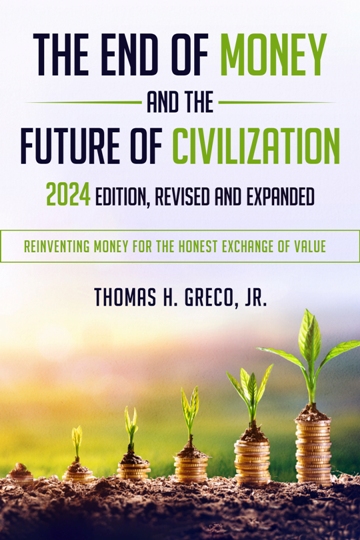
This is the latest chapter to be published of my new 2024 edition of The End of Money and the Future of Civilization. It continues the story about “credit clearing” that was begun in the previous chapter and shows how it will revolutionize trade and payments and make money, as we have known it, obsolete.  

Here is a brief excerpt:

If there were no money, any system of crediting sellers and debiting buyers would be fully competent to accomplish the work now performed by money. – Hugo Bilgram, 1914

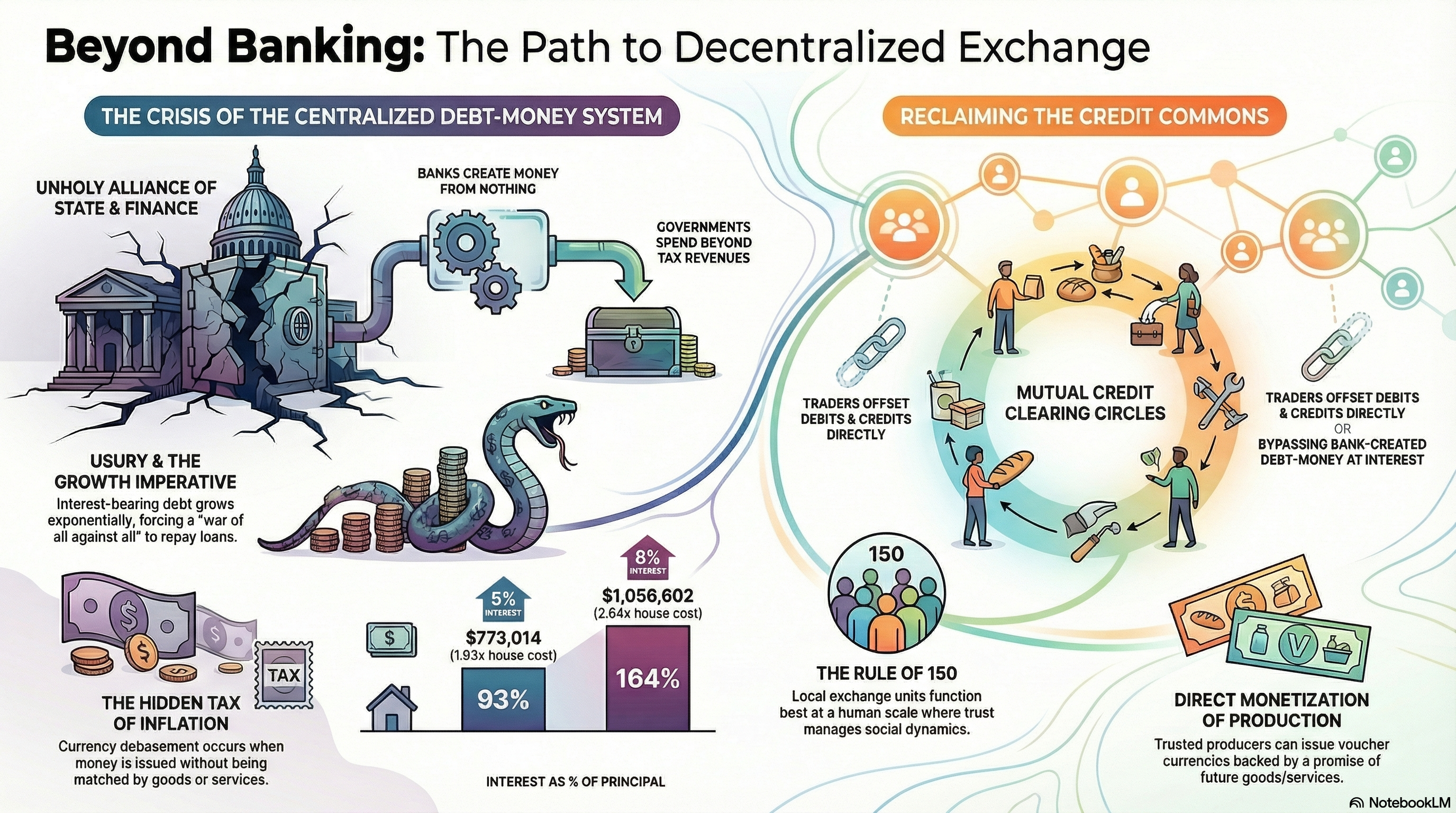
In Chapter 10 we explained that the highest stage in the evolution of reciprocal exchange is “credit clearing,” and that banks have been using it for the past few hundred years to settle obligations amongst themselves.  In this chapter we will further describe the history and applications of credit clearing, and we will show how clearing can be used to offset claims among not only groups of banks, but also among any persons or entities that have financial claims against one another. Most significantly, it is a process that may be applied among buyers and sellers of goods and services to directly offset their respective claims without involving banks as middle-men and without the need for conventional bank- or government-created currencies.

Direct Clearing Among Buyers and Sellers

Credit clearing is actually an ancient process. During the Middle Ages, credit played a major role in the various European “market towns” which hosted, at regular intervals, trading fairs in which merchants from widely scattered areas would gather to trade their goods. It is reasonable to conclude that the process of credit clearing would have been fundamental in their trading activities. This is evidenced by the fact that these market towns typically provided market courts for settling disputes under “merchant law” that was separate from common law and could be adjudicated in a matter of hours or days. James Davis points out that, “At the pettiest level of sales credit, many traders appear to have acted both as creditors and debtors, and there is evidence for running accounts, reciprocal dealings and a ‘complex of claims and counterclaims,’” and that, “Credit oiled the wheels of trade, and market courts dealt in small-scale sales debts that were integral to local retail and wholesale commerce. A market court ostensibly lowered transaction costs and thus attracted more traders by aiding a perception of the market as ‘fair, affordable, efficient’”. 

The possibilities of direct credit clearing among buyers and sellers have long been recognized. In modern times, as early as 1914, Hugo Bilgram and L. E. Levy noted that, “If there were no money, any system of crediting sellers and debiting buyers would be fully competent to accomplish the work now performed by money.”  They further suggested that:

“Were a number of businessmen to combine for the purpose of organizing a system of exchange, effective among themselves, they could clearly demonstrate how simple the money system can really be made. The greater the number of businessmen that would thus cooperate, the more complete would be their own emancipation from the obstruction to commerce and industry which existing currency laws impose.”

They then went on to propose such a system and describe how it might operate, which I summarized in one of my previous books and in a website post.  I’ll not repeat that here because the context today is much different from what it was in 1914, but we will present a similar proposal based on what has since been learned and tailored to our current realities. I believe that it is no exaggeration to say that the creation and operation of such credit clearing systems is crucial to reversing the present trend toward economic ruin and global tyranny and changing the course toward realizing our human potential and the emergence of a peaceful, convivial civilization in which all can thrive.

You can read or listen to the entire chapter here.

Now published, Chapter 10—The Third Evolutionary Stage—The Emergence of Credit Clearing

This is the latest chapter to be published of my new 2024 edition of The End of Money and the Future of Civilization. It continues the story begun in the previous chapter of how money has evolved and changed its character over time.

Here is a brief excerpt:

Money has become merely an accounting system, a way of “keeping score” in the economic “game” of give and take. Thomas H. Greco, Jr.

Let us begin by summarizing the evolution of the various kinds of money that have been used to mediate reciprocal exchange:

  1. The circulation of gold and silver coins gave way to paper banknotes that were redeemable for gold or silver coins, which made the notes essentially warehouse receipts for gold on deposit.
  2. Then, banks began to lend bank notes into circulation based on the pledge of collateral assets (some valuable and others not) other than gold, some of which included government obligations (bonds, notes, etc.).
  3. But ALL notes were redeemable in gold. This became known as the “fractional reserve banking” system.
  4. Bank account balances (checkable bank “deposits”) increasingly took the place of paper bank notes, and bank customers began to write checks against their deposits instead of using bank notes to make payments.
  5. As banks created ever greater amounts of non-bona-fide money based on national government debts and other illegitimate collateral assets, the fiction of gold-backing and redeemability could no longer be supported, and governments reneged on their promise to redeem their currency for gold. This broke the final link between political fiat money and the real economy of valuable goods and services.
  6. But, despite that, the emergence of credit clearing to offset credit obligation against credit claims was a major leap forward in facilitating the reciprocal exchange of value.

For now, you can read or listen to the entire chapter at Future Brightly:

Chapter 10—The Third Evolutionary Stage—The Emergence of Credit Clearing-Text
Chapter 10—The Third Evolutionary Stage—The Emergence of Credit Clearing-Audio narration

It will also be published soon here, and on my own Substack channel. Further chapters will continue to be posted as they are completed. Watch for Chapter 11 to be posted soon.

As always, your comments and suggestions are welcomed,
Thomas

Your Money Power

Worth repeating, from my August 2012 Newsletter

Your Money Power

The vast majority of people remain unaware of it, but the fact is, we have in our own hands, right now, the power to create or completely transcend money. As I’ve been preaching for many years, money is nothing more than credit, i.e., the willingness to trust that the value we provide as sellers of goods and services will be reciprocated when we become buyers. But, as we are now becoming so painfully aware, our trust in conventional political currencies and banks has been misplaced; we have been betrayed. It’s not only a matter of fraud and malfeasance, bad as that is, rather, the entire system was designed from the very start to enable the few to exploit the many.

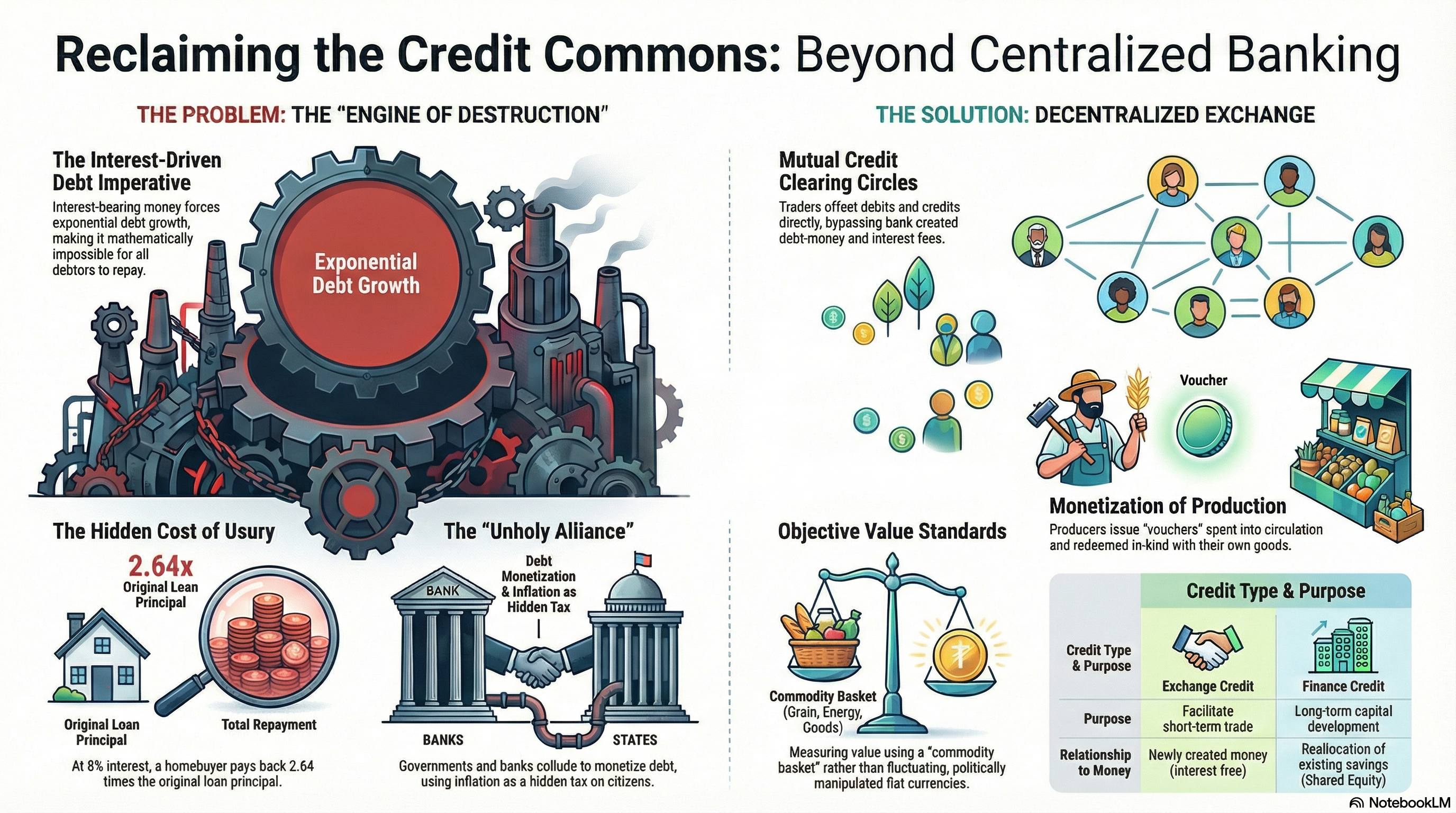
There are two parasitic elements that are built into the central banking, debt-money system—interest and inflation. Every national currency is supported by the collective credit of the people. It is our own credit that we entrust to the bankers, then beg them to lend it back to us, and pay interest for the privilege. Besides that, the national government gets first priority in the allocation of credit. Banks like to lend to governments instead of to producers, because government securities are relatively risk-free and provide a guaranteed profit. When our collective savings prove insufficient to satisfy government’s spending demands, the banks will create enough new money to enable deficit spending, which is the essence of inflation. It is a hidden tax that eventually shows up as higher prices in the markets.

All of that will continue until the people are able to take back the reins of government, but that cannot happen until the people take back control of their economy, and that requires that we adopt new ways of mediating the exchange of goods and services that puts control in the hands of the people. E. C. Riegel eloquently expressed that prospect:

“To trade goods and services is a natural right of all people. To issue the money necessary to make these exchanges is also the natural right of all people who are intelligent enough to do so. We need not beg for money. We do not need to be money slaves: we can be money masters. When we have become money masters we shall master all our economic and political problems.

Dig up this treasure, your money power, that has been lying dormant in your consciousness and express it for wealth, health, peace and happiness by associating with others who are similarly awakened.”

The way to express our “money power,” and to achieve true democracy is to organize businesses and individuals into credit clearing associations and networks for the direct allocation of credit and payment without the use of political money. My writings, and those of E. C. Riegel, provide directions on how to do that.

I am currently in the process of publishing a major rewrite of my book, The End of Money and the Future of Civilization (Chelsea Green Publishing, 2009). The first nine chapters are already available for free download on this website here, and the works of E. C. Riegel are available on this website in the Library.

2012 was a very busy year for me, which included a five-week tour of Europe and the UK during which I gave a total of 15 presentations and workshops to various groups, in addition to consultations, discussions, and meet-ups with many kindred spirits and colleagues working in the realm of societal transformation. If you’re interested, you can read my report about it in my November 2012 Newsletter.

#   #   #

Newsletter 2024-06 —The Evolution of Money, and more

In this issue

  • Chapter 9—The Evolution of Money
  • Recorded Interview on TNT Radio
  • Bank of Dave, the movie
  • Tim Berners-Lee’s Internet lament
  • 2024 A pivotal year

Chapter 9—The Evolution of Money

The latest chapter in my new 2024 edition of The End of Money and the Future of Civilization, has now been published. Here is an excerpt:
The entirety of money, banking, and finance is comprised of claims and obligations. — Thomas H. Greco, Jr.

It was in a dusty old bookshop close to the British Museum in London that I discovered a slim volume that was to complete for me the picture of how money has evolved over time. I had been traveling in Europe and the United Kingdom in the summer of 2001 with my then partner, Donna, attending conferences, meeting with friends and cohorts, and enjoying the sights, sounds, and cultures of the Old World. It was actually Donna who discovered the book in the basement stacks and brought it to me, saying, “What about this one?” The book was The Meaning of Money by Hartley Withers. Although I had already been engaged in intensive research into the subjects of money and banking for more than twenty years and had written three books of my own on the subject, I had not previously heard of Withers, but it was evident that he must have been, in his day, a recognized authority on the subject, and that his book must have served for a long time as a leading text; I surmised that from the fact that the volume I held in my hands was the seventh edition, published in 1947, of a work first published in 1909, and that Withers had been the editor of The Economist magazine from 1916 to 1921. Reading Withers crystallized my understanding of the double transformation that money had undergone during the previous three hundred years, an understanding that afforded a clearer comprehension of the nature and significance of the changes that have taken place, an understanding that prepares the ground from which to launch the next great improvement in the exchange process.

For now, you can read or listen to the entire chapter at Future Brightly: Chapter 9—The Evolution of Money—From Commodity Money to Credit Money and Beyond-Text
Chapter 9—The Evolution of Money—From Commodity Money to Credit Money and Beyond-Audio narration
___________________________
Recorded Interview on TNT Radio

My interview on the Pelle Neroth Taylor show on May 30, 2024 was recorded and is now available. My portion of the show can be heard here, and a transcript can be seen here. This was a wide-ranging conversation about the problems with the present political system of money and exchange, and the decentralized exchange mechanisms that have been developing in parallel with it, including both commercial and grassroots currencies and credit clearing exchanges.
__________________________
Bank of Dave

I recently viewed the movie Bank of Dave. It was both entertaining and thought provoking and based on a true story. Here is a description from Imdb: Based on the true-life experiences of Dave Fishwick; ‘Bank of Dave’ tells the story of how a working class Burnley man and self-made millionaire fought to set up a community bank. While the movie is highly fictionalized to add entertainment value, the important elements are factual. Seeking to satisfy my curiosity about that, I found this news report from the Manchester Evening News: How much of Netflix’s Bank of Dave is based on a true story?___________________________
Tim Berners-Lee’s Internet lament

Tim Berners-Lee is widely credited with being the inventor of the world wide web. In his article, Original Hope, he laments the fact that what he hoped would develop into an infrastructure that would “allow for collaboration, foster compassion, and generate creativity,” has come to be “dominated by the self-interest of several corporations that have eroded the web’s values and led to breakdown and harm.” He has issued a call for action that will “reform the current system and create a new one that genuinely serves the best interests of humanity… [and] encourage collaboration, to create market conditions in which a diversity of options thrive to fuel creativity and shift away from polarising content to an environment shaped by a diversity of voices and perspectives that nurture empathy and understanding.” He concludes by citing a few emerging innovations that are beginning to do just that. You can read about it on Medium.
___________________________
2024 A pivotal year.

This year, 2024, is shaping up to be both frightening and climactic. Several of the geopolitical developments of the past year have been causing serious upheavals in the economic and political relationships among nations, and simmering conflicts have boiled over and are threatening to erupt into another catastrophic world war. These issues and concerns were discussed in the podcast, 2023 Geopolitical Marathon, which featured the views and opinions of respected experts including, Pepe Escobar, Jeffrey Sachs, Jackson Hinkle, Alastair Crooke and Alexander Dugin. If you want to better understand the facts of these matters and what may happen next, please give it your attention.
___________________________
While I remain optimistic about our prospects, I’m also convinced that we cannot afford to be complacent. We need to inform ourselves and listen to all points of view while remembering that we are all one human family responsible for our own future and our common home we call Earth. We sink or swim together.

Thomas 

Now published, Chapter8—The Separation of Money and State

The latest chapter in my new 2024 edition ofThe End of Money and the Future of Civilization, has now been widely published. Here is an excerpt:

Erecting the ‘wall of separation between church and state’… is absolutely essential in a free society.
— Thomas Jefferson

The established beliefs about money in today’s world have become a sort of religion in which a fundamental tenet holds that government must, either directly or indirectly, have power over the system of money creation and circulation. This erroneous belief has taken the world to the brink of disaster which will surely ensue unless we take steps to depoliticize money by achieving the separation of money and state.

It should be obvious by now that there will never be peace in the world so long as those who control our national governments are able to conjure up out of thin air the seemingly endless amounts of pseudo-money they need to pay for wars and whatever else might bolster their political and economic interests.

You can find the text here and the audio narration here, or on my Substack channel, or on Future Brightly.

I’d be pleased to have your comments and suggestions,
Thomas

Chapter Eight—The Separation of Money and State

Erecting the ‘wall of separation between church and state’… is absolutely essential in a free society.
     — Thomas Jefferson

The established beliefs about money in today’s world have become a sort of religion in which a fundamental tenet holds that government must, either directly or indirectly, have power over the system of money creation and circulation. This erroneous belief has taken the world to the brink of disaster which will surely ensue unless we take steps to depoliticize money by achieving the separation of money and state.
It should be obvious by now that there will never be peace in the world so long as those who control our national governments are able to conjure up out of thin air the seemingly endless amounts of pseudo-money they need to pay for wars and whatever else might bolster their political and economic interests.

Read all about it in Chapter8—The Separation of Money and State, the latest chapter to be published in my new 2024 edition of The End of Money and the Future of Civilization.

You can find it right now on Future Brightly, and it will be published soon here and on my own Substack channel.

Further chapters will continue to be posted as they are completed. Watch for Chapter Nine to be posted soon.
As always, your comments and suggestions are welcomed,
Thomas

Interview with Bruce de Torres on TNT Radio

Thomas H. Greco, Jr. Interview with Bruce de Torres, on his Worldstage show on TNT Radio:

Covering the history of centralized banking, the danger of today’s concentration of wealth in the hands of a few who are working to completely control humanity; and the need to reinvent money, devolve power to local communities, and create honest “home-grown” means of payment (liquidity). His highly acclaimed book, The End of Money and the Future of Civilization, is being revised, updated, and expanded to reveal how the dysfunctional money system operates, and how to reinvent money to enable the honest exchange of value. New chapters are being posted serially on Future Brightly, on his website, as well as on his Substack and Medium channels. Almost all his writings and accumulated resources for researchers and monetary innovators can be downloaded free at BeyondMoney.net.

You can view or download the video here or on Podbean

Or listen to or download the audio at Podbean or on beyondmoney.net