This podcast featuring Michael Shuman, Jenny Kassan, and Elizabeth Ü, is a “must watch.” It clearly explains the options available to savers, investors, and entrepreneurs.

This podcast featuring Michael Shuman, Jenny Kassan, and Elizabeth Ü, is a “must watch.” It clearly explains the options available to savers, investors, and entrepreneurs.
Bitcoin is analogous to gold in that it is hard to produce and acquire, its supply is limited, it can be exchanged anonymously, and it’s path cannot easily be traced. That has some good socio-political implications and some bad ones. Here is an article that sketches a fairly clear picture of some of that. http://www.bloomberg.com/news/2013-04-05/bitcoin-really-is-an-existential-threat-to-the-modern-liberal-state.html
Compiled by Thomas H. Greco, Jr.
There are two fundamentally different but related aspects of the “money problem” that urgently need to be addressed. One is exchange problem, the other is the finance problem. Recent history has made it clear that in both realms, existing structures and institutions are serious flawed.
The exchange problem stems from the monopolization and misallocation of credit by the banking cartel and the perverse and improper issuance of political currencies (dollars, euros, pounds, yen, etc.). Solutions to the exchange problem are intended to provide liquidity, i.e., a means of payment, wherever it is needed so that markets can continue to function, so that producers can continue to sell and consumers can continue to buy despite the shortage or abusive issuance of conventional money.
The finance problem is the shortage of investment capital to small and medium sized and locally-owned business. That shortage stems from bank investment policies and preferences and government regulations that favor the channeling of everyone’s savings into corporate and government securities. Solutions to the finance problem seek to enable savers to directly allocate their savings to enterprises and projects that enhance the resilience and sustainability of their communities, provide real security, and contribute to the common good.
Decentralization, relocalization, and disintermediation are the emerging trends leading to a new economic paradigm. “Crowdfunding” is raising investment capital from large numbers of small investors. This may be in the form of donations, loans, or equity shares.
This is needed today because,
1. People (justifiably) do not trust banks and Wall Street,
2. People are looking for better returns than can be had from banks and the stock market,
3. People are looking for ways to protect their savings from inflation,
4. People are looking for ways to assure their access to basic necessities through direct ownership of enterprises that produce them.
5. People are seeking security by making their local community economies more resilient and sustainable.
Unfortunately, there are legal obstacles that currently limit those possibilities. The Jobs Act that was passed into law in April of 2012 is intended to remove some of those obstacles, but the Securities and Exchange Commission (SEC) has yet to act on its mandate to come up with new regulations that relax those restrictions.
____________________________________________________
Among the leading organizations in the field, and one of the best sources of information about funding options, is Cutting Edge Capital. Their mission is “to develop tools that will make it easier and more affordable for businesses and nonprofits to do legally-compliant community capital raising.” Their website is http://www.cuttingedgecapital.com. /
A very useful article from their website, authored by Nathan Hyun, is titled, The Direct Public Offering – The Original Securities-Based Crowdfunding Model. Here is the concluding paragraph.
Ultimately, the new crowdfunding exemption (when it becomes legal) will provide companies with another option for accessing securities-based capital from the crowd and it could prove even more exciting for those wishing to build platforms and tools to offer issuers. In the meantime, the original crowdfunding model, the DPO, continues to provide companies with an effective way to conduct a self-underwritten and self-administered public securities offering. If you are a small or medium sized business, startup or nonprofit and are looking to immediately raise capital from the crowd through a public securities offering, a DPO is presently your only option and may be the best option even when the new crowdfunding law goes into effect.
Several informational resources related to crowdfunding are listed below.
_____________________________________________________
What is Crowdfunding and JOB’s Act?
http://www.rysalisbury.com/announcements/what-is-crowdfunding-and-jobs-act
This site provides a thorough overview of the present regulatory situation. It specifically states that, “Crowdfunding, or to be more specific, ‘equity-based crowdfunding’ is not yet legal.”
_____________________________________________________
Crowdfunding Predictions for 2013
2012 was quite a year for the crowdfunding industry. In April, President Obama signed the JOBS Act into law, which will open up equity-based crowdfunding for unaccredited investors. In May, the Pebble E-Paper Watch set a crowdfunding record and gained national media headlines, raising over $10 million on donation-based crowdfunding site Kickstarter. Research firm Massolution estimates the crowdfunding industry (equity + donation + lending +reward crowdfunding) will grow from $1.5 billion in 2011 to $2.8 billion in 2012.
Complete article at:
http://www.forbes.com/sites/ryancaldbeck/2012/12/11/crowdfunding-predictions-for-2013/
_____________________________________________________
4 Signs A Company Is NOT A Good Candidate For Equity Crowdfunding
1. The company is a tech company.
2. The company will need multiple rounds of financing.
3. The company is built on Intellectual Property, not brand.
4. The company is difficult to understand.
Read the entire article here: http://www.forbes.com/sites/ryancaldbeck/2012/10/16/4-signs-a-company-is-not-a-good-candidate-for-equity-crowdfunding/
_____________________________________________________
Why 84% of Kickstarter’s top projects shipped late
http://money.cnn.com/2012/12/18/technology/innovation/kickstarter-ship-delay/
http://money.cnn.com/2012/12/18/technology/innovation/kickstarter-ship-delay/
____________________________________________________
More About Legal Issues
U.S. Securities and Exchange Commission (SEC)
The SEC updated its home page (http://www.sec.gov/), with info re: JOBS act (http://www.sec.gov/spotlight/jobs-act.shtml)
with a specific reminder
“On April 5, 2012, the Jumpstart Our Business Startups (JOBS) Act was signed into law. The Act requires the Commission to adopt rules to implement a new exemption that will allow crowdfunding. Until then, we are reminding issuers that any offers or sales of securities purporting to rely on the crowdfunding exemption would be unlawful under the federal securities laws.”
http://www.sec.gov/spotlight/jobsact/crowdfundingexemption.htm
_____________________________________________________
Selected sites
Indiegogo
Kickstarter
Propel Arizona
Propel Arizona is on the front page of the Arizona Republic business section on February 14, 2013. They did a good job of explaining what crowdfunding is, too.
Online version: http://www.azcentral.com/business/arizonaeconomy/articles/20130213arizona-crowdfunding-propel-arizona.html
Gofundme
http://www.gofundme.com/crowdfunding-websites/
____________________________________________________
Other related articles
SEC uses JOBS Act to set up new roadblocks to crowdfunding
Read more at http://venturebeat.com/2012/08/31/sec-uses-jobs-act-to-set-up-new-roadblocks-to-crowdfunding/#xOwOvdrWaKqW3Ysi.99
‘Rich Man’s Crowd Funding’
http://www.forbes.com/sites/groupthink/2013/01/15/rich-mans-crowd-funding/
There has been over the years, no shortage of common sense ideas that have the power to create a world that works for everyone. Many of these are included in this recent article. I leave it to the reader to use their good judgement in sorting the wheat from the chaff. –t.h.g.
By Gar Alperovitz and Steve Dubb
We’ve got to break out of the old ways of thinking about the economy.
Most activists tend to approach progressive change from one of two perspectives: First, there’s the “reform” tradition that assumes corporate control is a constant and that “politics” acts to modify practices within that constraint. Liberalism in the United States is representative of this tradition. Then there’s the “revolutionary” tradition, which assumes change can come about only if the major institutions are largely eliminated or transcended, often by violence.
But what if neither revolution nor reform is viable?
Paradoxically, we believe the current stalemating of progressive reform may open up some unique strategic possibilities to transform institutions of the political economy over time. We call this third option evolutionary reconstruction. Like reform, evolutionary reconstruction involves step-by-step nonviolent change. But like revolution, evolutionary reconstruction changes the basic institutions of ownership of the economy, so that the broad public, rather than a narrow band of individuals (i.e., the “one percent”) owns more and more of the nation’s productive assets.
Posted in Developing Alternatives, Economics, Emerging paradigm
If you doubt it, think about these famous words from experts of the past–t.h.g.
“The bomb will never go off. I speak as an expert in explosives.” – – Admiral William Leahy , US Atomic Bomb Project
“There is no likelihood man can ever tap the power of the atom.” — Robert Millikan, Nobel Prize in Physics, 1923
“Computers in the future may weigh no more than 1.5 tons.” — Popular Mechanics, forecasting the relentless march of science, 1949
“I think there is a world market for maybe five computers.” — Thomas Watson, chairman of IBM, 1943
“I have traveled the length and breadth of this country and talked with the best people, and I can assure you that data processing is a fad that won’t last out the year.” — The editor in charge of business books for Prentice Hall, 1957
“But what is it good for?” — Engineer at the Advanced Computing Systems Division of IBM, 1968, commenting on the microchip.
“640K ought to be enough for anybody.” — Bill Gates, 1981
This ‘telephone’ has too many shortcomings to be seriously considered as a means of communication. The device is inherently of no value to us” — Western Union internal memo, 1876.
“The wireless music box has no imaginable commercial value. Who would pay for a message sent to nobody in particular?” — David Sarnoff’s associates in response to his urgings for investment in the radio in the 1920s.
“The concept is interesting and well-formed, but in order to earn better than a ‘C,’ the idea must be feasible” — A Yale University management professor in response to Fred Smith’s paper proposing reliable overnight delivery service. (Smith went on to found Federal Express Corp.)
“I’m just glad it’ll be Clark Gable who’s falling on his face and not Gary Cooper” — Gary Cooper on his decision not to take the leading role in “Gone With The Wind.”
“We don’t like their sound, and guitar music is on the way out” — Decca Recording Co. rejecting the Beatles, 1962.
“Heavier-than-air flying machines are impossible” — Lord Kelvin, president, Royal Society, 1895.
“If I had thought about it, I wouldn’t have done the experiment. The literature was full of examples that said you can’t do this” – – Spencer Silver on the work that led to the unique adhesives for 3-M “Post-It” Notepads.
“Drill for oil? You mean drill into the ground to try and find oil? You’re crazy” — Drillers who Edwin L. Drake tried to enlist to his project to drill for oil in 1859.
“Stocks have reached what looks like a permanently high plateau.” – – Irving Fisher, Professor of Economics, Yale University , 1929.
“Airplanes are interesting toys but of no military value” — Marechal Ferdinand Foch, Professor of Strategy, Ecole Superieure de Guerre , France .
“Everything that can be invented has been invented” — Charles H. Duell, Commissioner, US Office of Patents, 1899.
“The super computer is technologically impossible. It would take all of the water that flows over Niagara Falls to cool the heat generated by the number of vacuum tubes required.” — Professor of Electrical Engineering, New York University
“I don’t know what use any one could find for a machine that would make copies of documents. It certainly couldn’t be a feasible business by itself.” — the head of IBM, refusing to back the idea, forcing the inventor to found Xerox.
“The abdomen, the chest, and the brain will forever be shut from the intrusion of the wise and humane surgeon,” — Sir John Eric Ericksen, British surgeon, appointed Surgeon-Extraordinary to Queen Victoria 1873.
And last but not least…
“There is no reason anyone would want a computer in their home.” — Ken Olson, president, chairman and founder of Digital Equipment Corp., 1977
“There is no reason anyone would want a computer in their home.” — Ken Olson, president, chairman and founder of Digital Equipment Corp., 1977
Here below is a recent article that appeared in the New York Times. It provides background and an update on one of the most bizarre trials to be held in the United States since the Scopes “monkey trial.”–t.h.g.
MALIBU, Calif. — High above the cliff tops and the beach bars, up a winding mountain road, in a borrowed house on someone else’s ranch, an unusual criminal is waiting for his fate.
His name is Bernard von NotHaus, and he is a professed “monetary architect” and a maker of custom coins found guilty last spring of counterfeiting charges for minting and distributing a form of private money called the Liberty Dollar.
Described by some as “the Rosa Parks of the constitutional currency movement,” Mr. von NotHaus managed over the last decade to get more than 60 million real dollars’ worth of his precious metal-backed currency into circulation across the country — so much, and with such deep penetration, that the prosecutor overseeing his case accused him of “domestic terrorism” for using them to undermine the government.
Of course, if you ask him what caused him to be living here in exile, waiting with the rabbits for his sentence to be rendered, he will give a different account of what occurred. …more…
Posted in Developing Alternatives, Politics, The Political Money System
Tagged Bernard von NotHaus, Liberty Dollar
by Chong Kee Tan
As more grassroots organizations launch new community currencies in different parts of the world and exploring alternatives to the traditional economy, more are starting to discover the commercial barter exchange industry. At the 2012 IRTA annual conference – IRTA is an association of the commercial trade and barter industry – Rob Van Hilten from Qoin, a community currency organization, called for dialogue between the two so that each could learn from the other.
Commercial barter exchanges focus on B2B (business to business) trade whereas community currencies tend to focus on C2C (consumer to consumer) exchanges. Both are now moving towards the B2C space and trying to figure out how best to do it.
Another key trend is the use of software to facilitate trade in complementary currencies. When transactions are captured electronically, it immediately raises the question of tax reporting.
Right now, IRS ruling for reporting is that all barter trades must be reported using 1099-B. Corporations can report the aggregate amount, while individuals and sole proprietors have to itemize every transaction. This makes individuals and sole proprietors balk at participating in barter transactions because receiving a 1099-B will force them to become businesses that must file at minimum a Schedule C.
Thomas Greco suggested four possible solutions:
1. Get the IRS to take a more reasonable attitude on this.
2. Get the regulations changed by pressuring legislators.
3. Drown the IRS in reports. It can be more easily automated these days.
4. Allow members to draw paper vouchers against their account balance or line of credit. Eliminates the paper trail of transactions and reduces admin burden. Vounchers should have an expiration date.
#1 is risky because it brings small community exchanges that were previously under the radar under the IRS microscope. The IRS could easily make a rigid ruling. It could then take a long time to undo the damage.
#2 is a long and drawn out process. #3 is unlikely to produce any change. But #4 is promising as an immediate solution.
Vouchers can be issued in a few fixed denominations, like $1, $5 and $10. To prevent counterfeiting, the vouchers should have security features. This makes them look very much like paper community currencies such as BerkShares, or Bristol pound, or the greenbacks.
They function just like paper money too. When a business accepts it as payment, they account for and report tax on it just like when they receive cash. But this paper complementary currency can circulate among consumers without any electronic trail.
It is even more tax compliant than cash because when a business deposits the voucher into their trading account, the software will recognize it as an income from sales and will report it in the 1099-B. Banks on the other hand do not report cash deposits to the IRS as income.
Thus, we see that B2B transactions in complementary currency can take place on software platforms through electronic credit and debit of accounts. C2C transactions can take place through the voucher mechanism, which is available in most commercial software packages. Finally B2C transactions can take place both through the voucher mechanism when accepting payment from consumers, and through the software when depositing vouchers received into their accounts.
What this means is that community currencies can be implemented in a tax compliant way using commercial barter exchange software. Furthermore, using a commercial barter exchange software also allows community currency initiative to offer B2B barter and B2C loyalty programs. In short, it enables a fully integrated solution.
IRTA is currently evaluating all available barter software platforms. Stay tune to find out which platforms are good for such an integrated implementation.
The above is a summary of a discussion between Thomas Greco, Annette Riggs, K. R. Hughes and Chong Kee Tan on 9/21/12. Reported by Chong Kee Tan.
Posted in Developing Alternatives
A currency project that was conceived and operated by Will Ruddick in Kenya last year has reportedly achieved significant social benefits at very little cost. A full report titled, Eco-Pesa: An Evaluation of a Complementary Currency Programme in Kenya’s Informal Settlements can be found at the International Journal of Community Currency Research.
Posted in Developing Alternatives, Emerging paradigm, Exchange Design
The first edition of my book, The End of Money and the Future of Civilization, was published by Chelsea Green Publishing in 2009. While it remains as relevant today as it was when first published the printed book has been out of print for several years. But, having had the rights reverted to me by my publisher, I am making the entire book available for free in PDF format. You can read it or download it HERE. If you would like a hard copy of the first edition used copies can still be found on Amazon.com, Abe books, Thrift books and elsewhere.
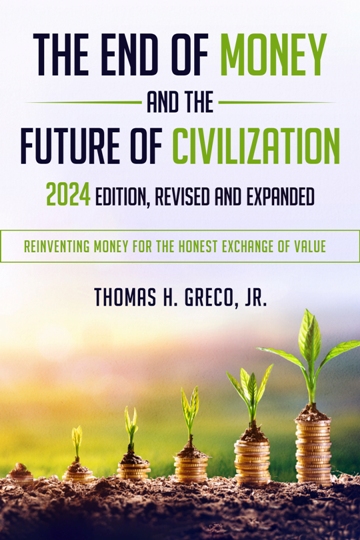 Better still, you can avail yourself of the new revised and expanded 2024 edition which I have been working on for almost two years and is almost complete. Eighteen chapters have already been posted and can be freely read or download HERE.
My previous books, as published, may be freely accessed in digital format by clicking the title below.
Money: Understanding and Creating Alternatives to Legal Tender (2001)
New Money For Healthy Communities (1994)
Money and Debt: a Solution to the Global Crisis (1980)
Collectors may find used and some new print copies of my books as published, on amazon.com and elsewhere online. Start by clicking on the title below:
Money: Understanding and Creating Alternatives to Legal Tender (2001)
 Beyond Money
 Beyond Money