Category Archives: Economics

A List of interesting Finance and Economics Documentaries/Short Films

IMDb, the popular online database of information related to films, television series, etc. has compiled A List of interesting Finance and Economics Documentaries/Short Films. While the last update to the list was made 11 years ago, these films are still extremely pertinent and worth watching. Some of them include interviews of yours truly. Readers are invited to add links to newer items as comments to this post.

Interview with Bruce de Torres on TNT Radio

Thomas H. Greco, Jr. Interview with Bruce de Torres, on his Worldstage show on TNT Radio:

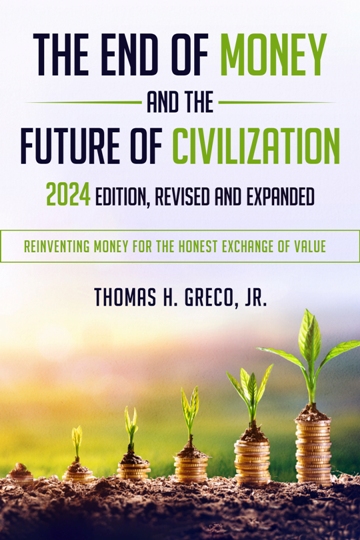
Covering the history of centralized banking, the danger of today’s concentration of wealth in the hands of a few who are working to completely control humanity; and the need to reinvent money, devolve power to local communities, and create honest “home-grown” means of payment (liquidity). His highly acclaimed book, The End of Money and the Future of Civilization, is being revised, updated, and expanded to reveal how the dysfunctional money system operates, and how to reinvent money to enable the honest exchange of value. New chapters are being posted serially on Future Brightly, on his website, as well as on his Substack and Medium channels. Almost all his writings and accumulated resources for researchers and monetary innovators can be downloaded free at BeyondMoney.net.

You can view or download the video here or on Podbean

Or listen to or download the audio at Podbean or on beyondmoney.net

How, Then, Shall We Live? — What we might learn from the Amish

I grew up in the 1940s and 50s, a time that I consider to be the Golden Age of prosperity and promise, a time when the middle-class was growing larger and more prosperous and it seemed that things would only continue to get better. It was a time when a family could manage quite nicely, as mine did, on a single modest income. My dad was a “debit agent” for a big mutual insurance company, selling life insurance and collecting the premiums from policy holders within his territory, or “debit.” On his modest income he was able to provide us with a nice home, put both my sister and me through college, and allow my mother to remain at home to take care of us kids, keep house, and prepare our meals as middle-class wives typically did in those days.

The social revolution of the 1960s and 70s brought some massive cultural changes, including the rise of the environmental, civil rights, human potential, feminist, gay-rights, back-to-the-land, and peace movements, along with a relaxation of sexual mores, a shift to more casual modes of dress, the hippies, the flower children, experimentation with psycho-active substances, and experiments in communal and cooperative living.

The leveling of class distinctions and income distributions that characterized the post-World War II era continued up until about 1980. Around that time many of those earlier trends seemed to run out of energy, and reactionary forces threw many of them into reverse. Notable among the latter has been the massive reversal of economic fortunes of the middle and lower classes. Despite huge increases in productivity and increased material abundance, class and wealth differences again began to increase and have by now reached unprecedented proportions. For most families, the income from one job is no longer sufficient.

But my purpose here is not to recapitulate the history of that era, nor to critique it, but simply to introduce the reader to a drastically different way of living that has been thriving for decades, if not centuries right alongside the high-tech, consumerist, debt-ridden rat-race that most of us are caught up in, and to suggest that there may be something important to be learned from the Amish as we try to reinvent civilization amidst the present intensifying chaos. 

Photo by Randy Fath on Unsplash

Given my interest in social justice, economic equity, personal freedom, intentional communities, and the social phenomena of the 60s and 70s, it is not surprising that I would discover Donald  Kraybill’s book, The Riddle of Amish Culture, which for me was an eye-opener that showed me a much different way in which people were able to thrive. That was sometime in the 1980s, the same time as my involvement with the School of Living which caused me to make frequent trips into Pennsylvania where School of Living headquarters were then located. Those trips took me through parts of the state where Amish farms and businesses were numerous.

Recently, as I was sorting through some of the many boxes containing my archives and personal records, I came across a photocopy of an article titled, Amish Economics by Gene Logsdon that appeared in the September-October 1986 issue of Community Service Newsletter. Rereading that article after so many years and in the present day context of social, economic and political upheaval, it struck me as being even more pertinent now as we struggle to reimagine how we ought to be living on this finite planet. I’ve scanned that article, converted it to a PDF file, and am making it available here for your edification.

In spite of what many consider to be their backward ways and their inclination to eschew much of modern technology, the Amish have managed to thrive both as a religious and social community as well as economically while many in the conventional world have struggled to survive. According to Wikipedia, “The Amish are among the fastest-growing populations in the world.” Between 1920 and 2019, the Amish population in the United States increased from about 5,000 to 350,000, and they have spread beyond Pennsylvania into many other states, notably Ohio, Indiana, Wisconsin, New York, and Michigan.

Now I am not advocating that we all live as the Amish do, but I think we might do well cultivate some of their attitudes about community and mutual support, and adopt some of their agricultural, land stewardship, and small business practices. Amish communities also enjoy certain freedoms from government policies and dictates because of their religious beliefs and practices.    

If you’d like to dig deeper into what the Amish might teach the rest of us, you can learn a lot from the links in this article and from the Amish Times.

Your comments on this article would be welcomed.

#     #     #

The time is now for a new civilization

In 1997 I produced a monograph titled, The Cooperative Community Commonwealth: A Prospective Outline for a New Socioeconomic Framework. Over the ensuing years I’ve revisited and edited it a few times. It was when written and until now ahead of the wave, but the peculiar turn of events of the past few years, and especially those of 2020, have intensified both the urgency and the opportunities for the kinds of actions described in this visionary plan. After making a few additional minor edits I’ve published it on this site and on Medium.

The Cooperative Community Commonwealth: A Prospective Outline for a New Socioeconomic Framework

The present state of civilization, even in so-called “democratic” or “free” countries, is one of dominance by massive hierarchical structures which are centrally controlled by a relatively small group of people. These individuals wield enormous power by virtue of their control of the established structures and mechanisms, especially those of money and finance, and through their ownership of the vast majority of the land and capital.

The further development of civilization and the fuller realization of the human potential depend upon the further liberation of people within a context of increasing global awareness and concern. This, in turn, requires broader, more democratic access to land and capital, the devolution of power to the community level, and progress beyond familiar modes of domination and coercion. Such a process will require reliance upon the gentlest of means, higher levels of awareness and personal responsibility, the creation of new, inclusive structures, and their implementation under popular control.

…. Read the full article here.

Alternative History — What If?

This Power Point slide show presentation was delivered virtually to the Alternative History Festival in Poland in September 2020. It highlights several historical turns as modern civilization has evolved that led to our present predicament and then asks how things might have been different and how they ought to be.

You can download it here.

After the Great Pause–toward a New Society

Recent events have made it clear that there is no going “back to normal.” It seems to me that in this time of flux there are many possibilities, but I think they boil down to two fundamental choices. The world can continue on the trajectory of increasing concentrations of power and wealth, and dominance of the many by the few, or society can begin to decentralize and move toward community empowerment and local control.

Many are calling for people to embrace “a new human story founded on the principles of connection and diversity” and argue that such a story is already emerging.

The upcoming online event called World Localization Day promises to move our collective consciousness in that direction. I’ve already registered to participate and suggest that others do likewise. It will be happening next Sunday, June 21. This global event will be streamed three times: starting at 4pm in Sydney, 4pm in New York and 4pm in London. Registration fees are on a sliding scale, or even free for those with scant means.

As the website says:
After COVID-19, we can return to stressful disconnected lives and climate catastrophe, or we can slow down, scale down and rebuild our connections to each other and to the Earth.

Check it out.

Riding the Populist Wave

This, my latest article, points out that capitalists now admit that the system is “rigged” in their favor; it argues that Trump and Sanders represent two edges of the populist wave that is now dominating U.S. politics, that a Sanders win over Trump is entirely plausible, that the New Deal of FDR has  been systematically dismantled and needs to be reestablished, and that in the long run people will need to work together in communities to build systems and structures that can circumvent the rigged system.

Here is an excerpt, but I hope you’ll read the entire article.

There, the capitalists are admitting it–the system is rigged.

In his latest newsletter, financial advisor, John Mauldin, Co-Founder of Mauldin Economics, acknowledges that the system is rigged in favor of the wealthy and powerful, and against everyone else, including the shrinking middle-class. Mauldin says:

The “financialization” of the American economy has led to increasing income and wealth disparity. As much as it pains me to say it, the “system” really is rigged. Whatever the good intentions of the Federal Reserve in particular and the US government in general have been, it has distorted the economic feedback loops that balance a true market-based economic system. The fact is we already have “socialism” today. It’s not the socialism we feared in 1974. We have socialized the risks of capitalism, to the benefit of a small portion of the country, while a larger portion struggles.

So, Mauldin admits what has been obvious for a long time, that the U.S. economy is characterized by socialism for the rich ruling class, and dog-eat-dog competition for everyone else. He cites this fact as the main reason why political outsider Donald Trump was elected President in 2016 and why “socialist” Bernie Sanders might conceivably be elected President in 2020. I agree.

So, what do Trump and Sanders have in common?

As I see it, both are viewed by the electorate as “populist,” which ostensibly means anti-elite, Trump representing right-wing populism and Sanders left-wing populism. But, except for paying lip service to a plan to shift U.S. foreign policy away from the imperial belligerence of the deep state, Trump’s actions as President belie any anti-elite sentiment. In fact, it’s been quite the opposite.

What people want is something other than the globalist, interventionist, imperialist policies of the past several decades that have wasted enormous amounts of resources, killed hundreds of thousands of people, destroyed communities and nations, and caused political upheaval around the world. People want relief from the economic policies that have favored capital over labor by increasing capital mobility while shifting jobs from the U.S. to low wage countries especially in Asia, and at the same time reduced constraints on banks and corporations, enabling them to more fully exploit people and the environment.
More…

A version of the article was also published on Medium and republished at OpEd News.