Category Archives: Exchange Design

New Ways to Pay and Be Paid

I had a Skype chat recently with Ken Banks who pointed me to an excellent article about m-Pesa, a system operating in Kenya that uses mobile phones to provide an easy way of making payments. The article is, The Invisible Bank: How Kenya Has Beaten the World in Mobile Money, by Olivia O’Sullivan.

In his introduction to the article, Ken Banks says this:

 Click a few keys, exchange a few numbers, and it’s done. With just a mobile phone and a registration with Safaricom, Kenya’s mobile service giant, you can pay for anything in seconds – no cash, no long journeys to towns to reach a bank, and no long lines when you get there. This is m-Pesa, the revolutionary approach to banking which is changing economies across Africa. The service allows customers and businesses to pay for anything without needing cash, a bank account, or even a permanent address.

Here is a brief description from the article itself

So how does it work? m-Pesa relies on a network of small shop-front retailers, who register to be m-Pesa agents. Customers come to these retailers and pay them cash in exchange for loading virtual credit onto their phone, known as e-float. E-float can be swapped and transferred between mobile users with a simple text message and a system of codes. The recipient of e-float takes her mobile phone into her nearest retailer when she wants to cash in, and swaps her text message code back for physical money. There are already more m-Pesa agents in Kenya than there are bank branches.

This case demonstrates how any credible entity (like a phone company or power company) can now become a depository “bank” that enables credits denominated in any chosen units (hopefully, objectively defined units like phone minutes or kilowatt hours) to be easily transferred from one account to another via cell phones.

Networks of existing storefronts (like 7-Eleven convenience stores) are being added on top of cell phone technology to enable deposits into and withdrawals from any account. That could potentially be done in any desired currency. As an example, 7-Eleven stores in Thailand have begun to accept payments for purchases made online. The advantage is that no credit card is required. I’ve used this service myself when I booked flights online with NOK Airlines, a Thai low cost carrier. Once booked, one has 24 hours within which to trot on over to any conveniently located 7-Eleven and pony up payment, usually in cash. In my case, I paid in Thai Baht notes that I drew from a nearby ATM using my debit card and drawn on my credit union account in Arizona. 7-Eleven also sells prepaid cell phone minutes. They could easily add acceptance of cash payments to add credits denominated in any desired units to an account (i.e., deposits).

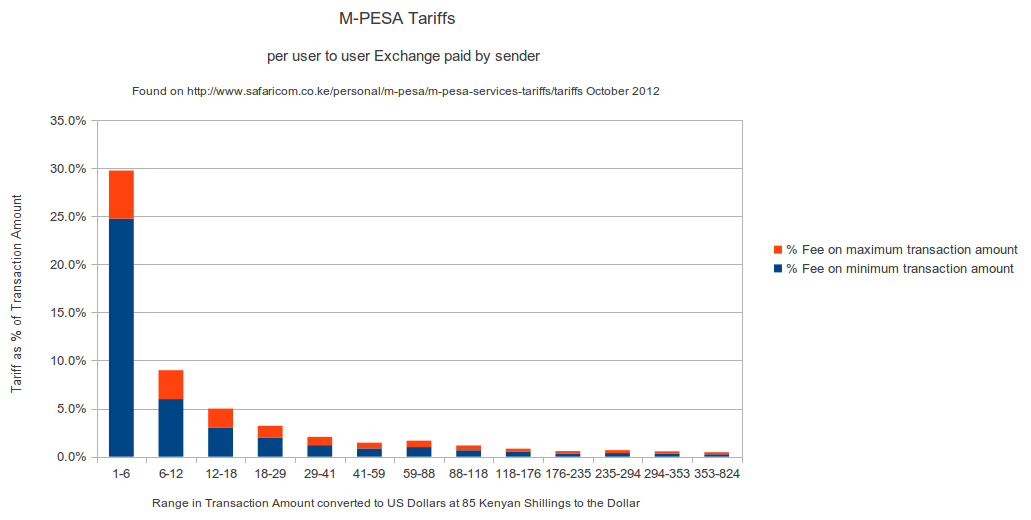
While m-Pesa fees are relatively high for small transactions, that is likely to improve as competing companies enter the field.

Here, is a chart of the m-Pesa fee schedule.

(Chart prepared by Will Ruddick)

The monetary and financial revolution is just a matter of putting existing components together. The hardest part will be in negotiating the minefield of laws, regulations, and taxation policies that protect existing monopolies and fiefdoms. But once begun, it will be increasingly difficult to stop this snowball from rolling downhill. –t.h.g.

Cyclos, worth another look??

I Just received a message from one of my advisee groups on the west coast. They are seriously considering Cyclos as the platform for their local exchange system.

Here is what they say:

Cyclos offers a complete Open-Source on-line banking system with additional modules such as e-commerce and communication tools. Check this out at http://project.cyclos.org/

The objective of the project is to develop open source complementary currency software that is easy to use and maintain, flexible, secure, and highly customizable. The Cyclos structure is entirely dynamic.

This means that it is possible to ‘build’ a monetary system from scratch. Organizations that want a standard system can use the default database that comes with basic configurations and can be easily enhanced. Cyclos is used for mutual credit systems like LETS, Barter systems, administration of Micro credits or remittances, Time banks and backed currency systems such as a C3 (consumer and commerce circuit). Cyclos just started to be used as a back-end for mobile banking services in Africa, and various Universities are studying the possibility to use Cyclos as a campus payment system.

It seems that the newest version of Cyclos may have the functionality, ease of use, and customizability that we have been looking for.

I’d be interested to see or hear expert reviews and people’s actual experience with using the Cyclos platform. Please send them as a comment to this post.

The Language of Money and Accountancy

One of E. C. Riegel’s most important published articles is, Money Is the Language of Accountancy, which was published in The Journal of Accountancy, the official publication of the American Institute of Accountants, in November 1945 (pp. 358-360).

In this article, Riegel outlines the benefits of a proposed “Private Enterprise Money” system (which I have highlighted), explains its elegant simplicity, and shows how it can be the key to solving myriad economic, social, and political problems.

The article achieves Riegel’s usual high standards of incisive reasoning and eloquent expression, but there are a few points on which I disagree. I therefore find it necessary to write and publish my critique along with it. While Riegel’s explanation of the nature of money is superb, I have some serious disagreements with him regarding the measure of value and the requirements for implementation of the mutual credit system. We now have the advantage of six decades of actual experience with clearing systems of the sort that Riegel envisioned. I also find it necessary to clarify a few of Riegel’s points. I urge the reader therefore to read both the article, which appears below, and my critique which follows it.

Anyone who truly wishes to understand money and to discover the way forward toward justice, freedom, and economic democracy should study Riegel’s works starting with his book, Fight From Inflation. These can be found at http://www.newapproachtofreedom.info/—t.h.g.

Money Is the Language of Accountancy

By E. C. Riegel

Proceeding from the assumption that the study and comprehension of money is an integral part of accountancy, this author explains his own conception of the function of money and credit, proposes the establishment of a “private-enterprise money” system, outlines it’s operation, and lists some of the advantages which he believes would result from the point of view of accountants, in particular, and the national welfare. Mr. Riegel, who is president of the Valun Institute in New York, describes himself as “a non-academic student of credit and money.” He is the author of several books, including a recent volume entitled “Private Enterprise Money,” which develops the proposal outlined in this article.

SINCE money is the language of accountancy, an unstable unit plagues the accountant with a confusion of tongues. This year’s statement is written in a tongue different from last year’s and perhaps even last month’s. Figures are not merely black and red; they are also gray and pink. Taxes are impossible of estimation because when the government runs a deficit there is a hidden tax that manifests itself in inflation. Depreciation cannot be gauged because property may show appreciation in terms of the changing dollar. Profit-and-loss figures are deceptive. Reserves may depreciate or appreciate in terms of the unit. All is confusion. Is accountancy futile?

The problem is serious enough to challenge the profession. If it is not solved accountancy must suffer. If accountants master the problem the profession will be raised to new levels of prestige in the business world. The study and comprehension of money is an integral part of accountancy and must not be left to the voodooism of monetary economics.

Money can best be understood by inquiring into the purpose of it. In simple or whole barter there is no need of money. When barter is to be split into halves, i.e., one trader is to receive full satisfaction in value, and the other is to receive only a promise of value, there arises the need of an accounting system and money is a system of split-barter accounting. It is essential to remember that in the process of trading by means of money, there is no departure from barter, but merely a facilitation of barter by splitting it into two parts, one half finished and the other half prospective. Values still continue to exchange for values with money acting as an interim device, but itself having no value.

Perhaps the easiest way to comprehend money is to imagine ourselves in a position where we had to initiate a system that would enable us to escape from the rigidity of whole barter to the flexibility of split barter. Let us approach the problem as one purely of accountancy, completely divorced from politics.

The problem would be one of providing the means whereby trader No. 1 could receive value from trader No. 2 by the former giving the latter an order for an equal value which order would be acceptable to any trader at any time. An IOU would not be sufficient; it must be converted into a WeOU. In other words there must be a conversion from private credit to composite credit underwritten by all the participants in the trading circle. Obviously, this calls for a pact of all the traders agreeing to honor the promises of each as if issued by all. Mutual or social or composite credit is, therefore, the foundation of a money system and the device that liberates traders from the limitations of whole barter.

Before such common agreement can be obtained two questions must be determined: (a) what is the promise of each that is to be credited by all? (b) what is the limit of such promises? In other words we must define the meaning of the credit and the limit of it. Since the purpose of money is to split barter in two parts with one trader receiving value and the other “holding the bag,” it is obvious that the money must issue from the former (the buyer) and must pledge not money but value and the buyer-issuer promises to deliver value when any money is tendered to him from whatever quarter. Thus we see that the essence of credit under a true money system is not to promise to pay money but a promise to receive money. To comprehend this is to liberate private enterprise from the control of finance.

As to the limit of the credit of each participant, this can be agreed upon on the basis of the needs of various trades, and industries, and professions rather than passing upon the applications of each member thereof. This being done, each participant would be authorized to draw checks against his assigned credit without giving any note or other instrument. The credit would have no term but would be in the nature of a call credit since the pledge is to deliver value on demand by tender of money.

Realizing that we have a mutual credit agreement whereunder the credit can be offset only by delivering value (selling goods or services), it is obvious that we cannot afford to admit to our money exchange as a money issuer any factor [entity, ed.] that is not engaged in the business of buying and selling. Ipso facto governments are excluded since they have no way of making good their promise which is implicit in the issue power. This explodes the delusion that governments back money. It is only private enterprisers that back money; governments merely depreciate it by freely issuing it but never backing it by over-the-counter transactions.

Establishing a Monetary Unit

Before we can give meaning to our agreements we must determine the size or power of the money unit. This may seem formidable but is quite simple. Few people realize that our dollar was given its meaning by merely making it par with the Spanish dollar already current in the colonies and the states. Thus we can agree that our unit (I suggest the name “valun” from VALue UNit) shall be equal to the current dollar or some multiple thereof and set our prices in valuns accordingly.

Having agreed upon the three essentials: (a) the definition of the credit, (b) the extent of the credit, (c) the size of the unit, we are ready to set up a clearing house through which our bookkeeping can operate and to provide the means of covering its expenses. This latter can be accomplished by the simple device of a check-clearing charge. No investment is needed, the
Exchange being able to equip itself on credit based upon its prospective income from check-clearance charges. The Exchange itself would have no money-issuing power but could draw only upon accrued income. To provide currency in bills and coins would be very simple. The Exchange would purchase the bills and coins and they would be subject to requisition by members by cashing a check. Such requisition would bring a debit to the account of the check writer and a credit to the account of “the currency controller.”

A deposit of currency would, of course, bring the reverse action. The cost of printing the currency and minting the coins could be charged to each drawer or thrown into overhead and covered by the check-clearing charge just like the cost of printing check books.

Private-Enterprise Money

These are the general outlines of the establishment and operation of a private-enterprise money system. For details I must refer the reader to my book, Private Enterprise Money. Since the substance of the whole plan is mutual credit there is no occasion for anybody to pay interest to anybody and, of course, there is no place for the promissory note. Check drafts and deposits are the only instruments of record and the “money-makes-money” principle is absent. Money is made the instrumentality of the private profit system but of itself is valueless and profitless. This revolution has tremendous significance in the issue between private enterprise and collectivism because the criticism of the former is due entirely to financism.

The reason a private-enterprise money system assures stability of the unit and gives definite meaning to accountancy is that no units will be issued except for value received since each trader in self-defense must restrict his issue to selfish purposes. There could be no issues for boondoggling, or relief, or subsidy, or war, because the government would have no issue power. There could be no inflation or its reflex, deflation. This does not imply that the government could not carry out any project that the taxpayer approved, but it does mean that such approval would be necessary since the taxpayer would be the sole source of money and the government would be powerless to tax by the deficit process of changing the power of the unit through inflation. In brief, we would have government of government—democracy at last. The private-enterprise money system would accomplish the following:

Provide a stable price level.

End the debt-money system. Credit would be extended solely on the promise to pay with goods and services.

Abolish interest within the system.

Take the money-creating power out of the hands of government and banks and place it in the hands of private enterprisers.

Make government operate on a cash basis; prevent deferred and delusive taxes through inflation.

Assure distribution of goods by distributing money power.

Prevent inflation and deflation.

Defeat bureaucracy, fascism, and communism by taking the money power from government

Defeat hidden money control from any quarter.

Assure full employment and a high standard of living.

Give the people the veto power over war and all government extravagances.

Supply the perfecting element in democracy and private enterprise.

If the accounting profession will interest itself in the establishment of a true money system it will render an incomparable service to business and the public. The study of the subject is not extra-curricular; it is part and parcel of accountancy. No profession can gain so much from its solution; none must suffer so much from its non-solution.

Money and Reconversion

The reconversion problem with which the nation is now engaged is basically a problem of dollar-power conversion from the prewar power to the current power. By rationing and restraints upon spending, the action of demand upon supply has been cushioned. This cushion must be removed and since there are now about eighteen available dollars for each dollar of consumer goods (at 1939 prices) we face a tremendous potential inflationary price rise. If through the self-restraint of the people, or by artificial restraints imposed by government, the accumulated dollars are not permitted to come into the market, industry will stagnate and relief and public-works payments will increase the unbalance between a dollars and goods. When the flood breaks prices will skyrocket into runaway inflation. The dollar must be converted, sooner or later, from its prewar power to its natural current power which will grow progressively smaller and I believe will not be arrested short of complete fade-out.

The creation of a private-enterprise money unit is, therefore, imperative if we are to escape chaos and bloodshed. The subject is one of greatest urgency and I hope that the accountants will actively participate in the project.

This article was published in The Journal of Accountancy, November 1945, pp. 358-360. (Official Publication of the American Institute of Accountants).

#   #   #

A Brief Critique of E. C. Riegel’s article, Money Is the Language of Accountancy

By Thomas H. Greco, Jr.

Riegel says,

“Having agreed upon the three essentials: (a) the definition of the credit, (b) the extent of the credit, (c) the size of the unit, we are ready to set up a clearing house through which our bookkeeping can operate and to provide the means of covering its expenses.”

I agree that “the essence of credit under a true money system is not to promise to pay money but a promise to receive money,” but I cannot fully agree with his proposals for b) and c).

Regarding b), he says:

“As to the limit of the credit of each participant, this can be agreed upon on the basis of the needs of various trades, and industries, and professions rather than passing upon the applications of each member thereof. This being done, each participant would be authorized to draw checks against his assigned credit without giving any note or other instrument.”

Surely, the nature of the member’s particular business must be considered, but it cannot be the sole criterion for determining credit limits. I would want each account limit to be based, at least, upon their historical volume of business, plus perhaps one or two additional factors, like their reputation and overall contribution to the welfare of the community. Also, he does not make clear that there must be some formal underlying agreement defining rights and responsibilities of membership in the clearing exchange.

Regarding c), the size of the unit, it is not enough to set its initial value equal to the dollar at the time of commencement, as Riegel suggests. That is only a logical starting point, considering that dollar valuation is what we are all accustomed to. Dollars is the value “language” we understand. But unless the system unit is defined in physical terms, it will simply depreciate along with the dollar as debasement of the dollar by the monetary authorities continues. I’ve written about that before in my books. In order to maintain its value over time, the credit unit (Riegel calls it a valun) must be defined in terms of something other than the dollar. My choice of definition has long been a “market basket” of basic commodities, because that will be the most stable measure over time and is impossible for any group of entities to manipulate.

Further, I think it is naive and inconsistent for Riegel to say that, “No investment is needed, the Exchange being able to equip itself on credit based upon its prospective income from check-clearance charges. The Exchange itself would have no money-issuing power but could draw only upon accrued income.”

I agree that the system should support itself through transaction fees, i.e., what he calls “check-clearance charges,” but if the Exchange itself has no money issuing power, how is it to cover its start-up costs? Either some up-front investment will be needed, or the exchange must be given a credit line. I favor the former as a safer alternative, but if the exchange is given a line of credit it must be strictly limited on the basis of its anticipated near-term revenues.

Regarding Private-Enterprise Money, Riegel is quite correct in saying, “Since the substance of the whole plan is mutual credit there is no occasion for anybody to pay interest to anybody and, of course, there is no place for the promissory note.”

By way of clarification, what he means is that mutual credit does not require that anyone borrow money into circulation. Thus, there is no need for the issuer of credit to sign a promissory note to a bank or anyone else, or to pay interest on negative account balances. There is however the need for each member of a mutual credit exchange to sign a general agreement that outlines the rights and responsibilities of their participation. I have provide a draft of such an agreement in my book, The End of Money and the Future of Civilization.

The key provision, as Riegel states, is that “no units will be issued except for value received.” That means no monetization of government debts or the inflation of credits on the basis of valueless or non-marketable assets. It is Riegel’s objective and mine to deprive government of the power to exceed its budget by debasing the currency, but Riegel’s insistence that “the government would have no issue power,” may be both impractical and overly restrictive, especially with regard to lower levels of government, like counties and municipalities. Nonetheless, government spending at all levels must be strictly limited to their legitimate tax revenues as approved by the people. Their participation in a mutual credit system must limit their credit issuing power to some small fraction of their annual anticipated tax revenues.

Finally, I wish to make a point about one of Riegel’s predictions. In the final section of the article titled, Money and Reconversion, Riegel says, “The dollar must be converted, sooner or later, from its prewar power to its natural current power which will grow progressively smaller and I believe will not be arrested short of complete fade-out.” Obviously, he was wrong about the “complete fade-out” of the dollar in the post World War II era. There was, indeed, a significant increase in prices at that time, but the tremendous increase in productive capacity that America achieved during the war enabled an unprecedented flood of consumer goods to reach the market rather quickly and absorb the very large savings that people had accumulated. While dollar debasement has continued up to the present day, and the purchasing power of the dollar has continued to decline, the monetary authorities have found many ways to forestall an acute crisis—until recently. Now, concerted action can no longer be deferred. The usury-debt-money system must be transcended, the credit commons must be reclaimed, and a decentralized and democratic network of mutual credit clearing circles is within our power to create. Riegel has provided us a torch to light our way.—t.h.g.

CES, a prototype global exchange system for the 21st century

In a new article titled, Reinventing Money – A Community Exchange System from South Africa Conquers the World, Tim Jenkin describes the development and operation of the Community Exchange System (CES) which he founded in 2002. Beginning as a single local credit clearing exchange, CES has evolved into a global network of more than 340 local exchanges distributed over 34 countries.

“The CES web site is just a tool for managing exchange groups, for keeping accounts and for advertising. Each group administers itself and has its own rules and conditions of use. This keeps the overall system democratic and provides the basis for a multitude of separate but interacting local economies. Some groups base their unit of value on the national currency while others use time (e.g hours or minutes)… The long-term vision of CES is to democratise the entire network.”

“The CES has been operating for nearly nine years now and, though it is still minuscule compared to the global financial system, has demonstrated that it is as versatile as the conventional money system, and indeed more efficient in many ways. It caters to fairly large volumes of trade, permits international trade, provides an extremely efficient means of tax collection through an optional transaction levy, handles multiple conversion rates seamlessly and clears accounts instantaneously.”

While the CES prototype needs some refinement, it provides an operational “proof of concept” for the creation of a locally controlled, yet globally useful system of exchange that transcends the dysfunctional interest-based, debt-money system that is driving the world to destruction. I fully agree with Tim’s conclusions that:

“In the new era of declining energy and other natural resources, the global economy is inevitably going to have to contract. The debt-based money system looks increasingly unstable in the current low-growth environment and definitely cannot operate in a steady state or degrowth environment. A new exchange system  that operates something like CES will be needed. Such an exchange system simply reflects the economic situation, it does not drive it. When  interest is removed as a factor in exchange, the growth imperative is removed along with the debt bondage that most of us live under.

Extraction mechanisms such as speculation, derivatives, securitisation, hedging and other casino-like activities that allow a parasitic class to skim off the wealth of a society are also excluded. The decentralisation of control and lack of opportunities to hijack the exchange system for private gain will return the money power to ordinary people. No longer will those who currently control the financial system be the ones who decide where society puts it efforts and how it allocates its resources.

The realisation that money is information and not real stuff is hugely liberating because it means that a local community can create its own exchange system and not be dependent on the dysfunctional global one that is driving humanity to the brink of disaster.

This has all been made possible by our ability to share information on the internet. Local communities should jump at the opportunity to be able to define and control their own destinies instead of allowing financial institutions and governments to do it.”

I encourage all to read the entirety of Tim’s article. You can read it online or download the pdf file here.–t.h.g.

What’s the “Occupy” movement all about?

Occupy Wall Street and the many related offshoot occupations are raising a lot of questions. These will not be quickly answered, but one thing is clear–increasing numbers of people are fed up with the political and economic status quo. They are not only expressing their dissatisfaction and disgust, but they are looking  for ways to make positive changes that will benefit everyone, not just the few who are presently in control.

Michael Hudson is one of the few university economists who understands the systemic nature of our global economic malaise, and is willing to speak frankly about it. The following is a recent interview that is worth watching.–t.h.g.

New Moneeey

I recently came across a series of video animations titled, New Moneeey, which, it turns out, are pretty good. New Moneeey appears to be a group effort but John Ince seems to be a key player. I met John a couple years ago when he came to one of my lectures in San Francisco. I lost track of him for a while but we’ve recently reconnected. I’ve not tried to verify all of the statements made in the videos, but even if off by a factor of 10, they are significant.

John’s credentials are quite impressive. They include a Harvard MBA and whole raft of accomplishments in writing, media, and entrepreneurship. He is the author of two recently published books, The Money Question, and Meaningful Money, and is in the process of preparing a new book, The Wizard of Iz.

Here is the first part of the New Moneeey series. You may want to watch the entire thought provoking series.

The Emergence of Self-Organizing Systems of Exchange

Joseph Jaworski is the author of Synchronicity: The Inner Path of Leadership. In a message today from the publisher announcing the second edition of the book, I noted the reference to Jaworski’s “Four Principles to Access the Source of Innovation.” Although I’ve not yet read the book, I did take a look at the blog entry that describes the principles.

This is an excerpt of what it says:

At the heart of what Joseph Jaworski discovered during this fifteen-year journey as a way to understand and access the Source of wisdom and creativity – the place from which profound innovation flows – are these four principles:

 1. There is an open and emergent quality to the universe; a group of simple components can suddenly re-emerge at a higher level of self-organization as a new entity with new properties.

2. The universe is a domain of undivided wholeness; both the material world and consciousness are parts of the same undivided whole.

3. There is a creative Source of infinite potential enfolded in the manifest universe; connection to this Source leads to the emergence of new realities.

4. Humans can learn to draw from the infinite potential of the Source by choosing to follow a disciplined path toward self-realization and love, the most powerful energy in the universe. The words of philosopher Pierre Telihard de Chardin speak well to this principle. “Someday, after mastering the winds, the waves, the tides, and gravity, we shall harness the energies of love and then, for a second time in the history of the world, man will have discovered fire.”

Perhaps you own experience, like mine, will attest to the truth inherent in those principles.

I was particularly struck by the first principle and the statement that, a group of simple components can suddenly re-emerge at a higher level of self-organization as a new entity with new properties. This is highly relevant to the transition process that is currently underway in the world, especially the reinvention of money. In Chapter 17 of my book, The End of Money.., I describe the four basic elements required for A Complete Web-Based Trading Platform. These elements are:

1. A marketplace

2. A social network

3. A means of payment

4. A measure of value or pricing unit

These components are indeed “re-emerging” (based on our changing collective consciousness) “at a higher level of self-organization.” We are seeing more widespread recognition that:

  • money is nothing but a systems of accounting for credits and debits,
  • that it is the people’s collective credit that supports every national currency and payment medium,
  • that the creation of money based on interest-bearing debt requires continual expansion of debt, which drives economic growth that has become dysfunctional and destructive,
  • that we no longer need to depend upon banking wizardry to provide the monetary and financial means for exchanging goods and services and actualizing our productive capacity.

We now have many web-based marketplaces and social networks, numerous private currencies and payment systems that use direct credit clearing, and increasing recognition that there is an urgent need for a measure of value that is independent of any fiat currency or central bank.

As I pointed out in my chapter, there are a number of “disruptive technologies” that are emerging to completely change the nature of money and banking. These are:

  • Direct credit-clearing among buyers and sellers
  • The use of the Internet to create Web-based marketplaces
  • Transparency in Web-based accounting, information, and exchange systems
  • Strong identity verification
  • Secure encryption of information over the Internet
  • Social networking
  • Reputation ratings of vendors and buyers that are continually updated and available on-demand
  • The reemergence of mutual companies, co-responsibility, and localized Web-based markets

“It is not any of these individually but all of them in combination that will, I believe, result in structures that will provide superior performance in mediating the exchange process. Worsening economic and financial conditions, such as those experienced in 2007 and 2008, will create enhanced market opportunities for this sort of nonpolitical trading platform, and will assure their eventual implementation and wide acceptance.”

#     #     #

Stop Chasing the Buck and Change Your Luck

Cashless trading based on credit clearing is moving into its next stage of development, the optimization and scale-up stage.

Established groups and associations are beginning to recognize the importance and urgency of disengaging from conventional structures of money and banking, reclaiming “the credit commons,” and reorganizing the exchange of value under local community control. One such association is Green America, formerly known as Coop America, which has recently established  The Green America Exchange  as a way of offering cashless trading opportunities to members of their Green Business Network.

GAEx uses the GETS trading platform which has been developed by Richard Logie, a long-time commercial trade exchange operator and leader in the industry. While the GETS software is proprietary, it seems to have the functionality needed for cashless trading within the exchange. According to Logie, the platform also has the capability needed for networking similar exchanges together into a larger more widespread trading community.

In response to a request from the Green America administration I’ve written the following article for posting (in four parts) on the Green America Exchange blog. For your convenience, I’ve also posted it below.–t.h.g.

Stop Chasing the Buck and Change Your Luck

Thomas H. Greco, Jr.

Most small and medium sized businesses (SMEs) these days are having a hard time financially–sales are down, costs are up, and bank credit is unavailable, all of which is symptomatic of the stagflation that besets the American economy.

Our present predicament is no accident of nature, nor is it a temporary condition; it is the expected result of a flawed system of money, banking and finance. We have allowed the banks to control our credit and charge us interest for the “privilege” of accessing some of it as bank “loans.” The fact is that the dollar regime, like every other political currency, collectivizes credit. It is the people’s collective credit that supports each national currency, but the allocation of that credit is determined by forces beyond popular control, and an inordinate proportion of it is used to fund the war machine and to enrich corporate fat cats, all to the detriment of peace, equity, and the common good.

But we need not be victims of a system that is so obviously failing us. We can learn to play a different game. It is possible to organize an entirely new structure of money, banking, and finance, one that is interest-free, decentralized, and controlled, not by banks or central governments, but by businesses and individuals that associate and organize themselves into cashless trading networks. This is a way to reclaim “the credit commons” from monopoly control and create healthy community economies that can enhance the quality of life for all.

In brief, any group of traders can organize to allocate their own collective credit amongst themselves, interest-free. This is merely an extension of the common business practice of selling on open account—“I’ll ship you the goods now and you can pay me later,” except it is organized, not on a bilateral basis, but within a community of many buyers and sellers. Done on a large enough scale that includes a sufficiently broad range of goods and services, such systems can avoid the dysfunctions inherent in conventional money and banking and open the way to more harmonious and mutually beneficial trading relationships that enable the emergence of sustainable economies and promote the common good—a true economic democracy.

This approach is no pie-in-the-sky pipedream, it is proven and well established. Known as mutual credit clearing, it is a process that is used by scores of commercial “barter” companies around the world to provide cashless trading for their business members. In this process, the things you sell pay for the things you buy without using money as an intermediate exchange medium. Instead of chasing dollars, you use what you have to pay for what you need. It’s as simple as that. Unlike traditional barter, which depends upon a coincidence of wants and needs between two traders who each have something the other wants, mutual credit clearing provides an accounting for trade credits, a sort of internal currency, that allows traders to sell to some members and buy from others. According to the International Reciprocal Trade Association (IRTA), a major trade association for the industry, “IRTA Member companies using the ‘Modern Trade and Barter’ process, made it possible for over 400,000 companies World Wide to utilize their excess business capacities and underperforming assets, to earn an estimated $12 billion dollars in previously lost and wasted revenues.”

Perhaps the best example of a credit clearing exchange that has been successful over a long period of time is the WIR Economic Circle Cooperative. Founded in Switzerland as a self-help organization in the midst of the Great Depression (1934), WIR provided a means for its members to continue to buy and sell to one another despite a shortage of Swiss francs in circulation. Over the past three quarters of a century, in good times and bad, WIR (now known as the WIR Bank) has continued to thrive. Its more than 60,000 members throughout Switzerland trade about $2 billion worth of goods and services annually.

Now the Green Business Network of Green America, is offering that kind of opportunity to its membership through Green America Exchange, GAEx. While still in the formative stages, Green America Exchange has the potential to become, not merely a lifeboat for SMEs in difficult times, but a model for a new paradigm in business.

The challenge for any network, of course, is to achieve sufficient scale to make it useful. The bigger the network, the more opportunities it provides for cashless trades to be made. In the early stages, it may require some help to find those opportunities, but as the members discover each other and become aware of what each has to offer, the value proposition becomes ever more evident and more businesses are attracted to it. Like Facebook, Twitter, My Space and other networks that are purely social, cashless trading networks will eventually grow exponentially –and that will mark a revolutionary shift in political as well as economic empowerment. It will be a quiet and peaceful revolution brought on, not by street demonstrations or by petitioning politicians who serve different masters, but by working together to use the power that is already ours—to apply the resources we have to support each other’s productivity and to give credit where credit is due.

Through participation in an exchange network that is open, transparent and democratic members enjoy the benefits of:

  • A reliable and friendly source of credit that is interest-free and community controlled.
  • Less need for scarce dollars.
  • Increased sales.
  • A loyal customer base.
  • Reliable suppliers.

What will it take to make mutual credit clearing networks go viral the way social networks have? That is the key question, the answer to which has heretofore remained elusive. While the WIR has been an obvious success, it seems to have been intentionally constrained and prevented from spreading beyond Swiss borders, and while commercial “barter” has been significant and growing steadily, it is still tiny in relation to the totality of economic activity.

As they are operated today, commercial trade exchanges are self-limiting and typically impose significant burdens upon their members. These include onerous fees for participation, exclusive memberships, limited scale and range of available goods and services within each exchange, the use of proprietary software, and insufficient standardization of operations which limits the ability of members of one trade exchange to trade with members of other exchanges.

Virtually all commercial trade exchanges are small, local, and operated as for-profit businesses. Small scale, local control, and independent enterprise are all desirable characteristics, but when it comes to exchanging valuable goods and services, something more is needed. What the world needs now is a means of payment that is locally controlled but globally useful.

Here are the things that I think are needed for cashless trading based on mutual credit clearing to go viral:

  1. Members need to offer to the network, not only their slow moving merchandise and luxury services, but their full range of goods and services at their usual prices. This will assure the value of the internal trade credits and make them truly useful.
  2. Like any “common carrier,” trade exchanges should make membership open to all with little qualification.
  3. Lines of credit (the overdraft privilege) must be determined according to each member’s ability and willingness to reciprocate, measured for example, by her record of sales into the network.
  4. Trade exchanges must be operated for and by the members in a way that is transparent and responsive.
  5. Members must exercise their duties to provide proper oversight and supervision of those assigned to manage the exchange.

As soon as there is a model exchange that has mastered these dimensions of design and operation, its success will inspire others to follow suit and the rapid growth phase will begin, leading eventually to an internet-like global trading network that will make money obsolete. Perhaps Green America Exchange will become that model.

#     #     #

Thomas H. Greco, Jr. is a writer, networker, and consultant, specializing in cashless exchange systems and community economic development. A former engineer, entrepreneur, and tenured college professor, he is widely regarded as a leading authority on free-market approaches to monetary and financial innovation, and is a sought-after advisor and speaker at conferences internationally. He is the author of many articles and books, including The End of Money and the Future of Civilization (Chelsea Green, 2009) and Money: Understanding and Creating Alternatives to Legal Tender (Chelsea Green, 2001). His blog, https://beyondmoney.net/, and website, http://reinventingmoney.com/, are valuable resources that provide detailed explanations and prescriptions for communities, businesses, and governments.

Monetary Reformer Convicted in Liberty Dollar Case

According to an FBI press release dated March 18, 2011, Bernard von NotHaus, 67, founder of NORFED and creator of the Liberty Dollar silver coin, has been convicted by a federal jury of “making, possessing, and selling his own coins.” The conviction of von Nothaus demonstrates just how far through the looking glass we have gone. According to the US government, anyone who advocates monetary reform (or any sort of government reform) may be a “terrorist.”

Here is a chilling quote from the FBI press release:

“Attempts to undermine the legitimate currency of this country are simply a unique form of domestic terrorism,” U.S. Attorney Tompkins said in announcing the verdict. “While these forms of anti-government activities do not involve violence, they are every bit as insidious and represent a clear and present danger to the economic stability of this country,” she added. “We are determined to meet these threats through infiltration, disruption, and dismantling of organizations which seek to challenge the legitimacy of our democratic form of government.”

It is evident that Ms. Tompkins has no idea what “legitimate currency” is, or that what she purports to be protecting is anything but “our democratic form of government.” The actual situation is well stated by J. Neil Schulman in his recent post at Rational Review:

“If there is such a thing as economic terrorism, it has been conducted without punishment by the financial elites who own and operate the Federal Reserve Bank. For the Department of Justice of the United States to overlook this mega-crime and prosecute a man whose goal was to enforce the law as written in the Constitution they have taken an oath to obey is an obscene reversal of fact and language. If there is such a thing as economic terrorism, the Federal Reserve is the economic equivalent of al-Qaeda, and its ravaging of the economy is the 9/11 of U.S. economic history.” (03/22/11)

This case is far from settled, and will hopefully serve to revive the political debate about money and finance, and ultimately advance the cause of free money and free banking.

By the way, Glenn beck will plug G. Edward Griffin’s book, The Creature from Jekyll Island, on Friday 2011 March 25. The entire Glenn Beck show that day will be devoted to an exposé of the Federal Reserve. The Glen Beck program is aired weekdays on Fox News at 5 PM Eastern time. –t.h.g.

“Real Money” features Malaysia confernce presentation

Real Money: Money and Payment Systems from an Islamic Perspective is a new anthology from the IIUM Press, Malaysia. Edited by Professor Ahamed Kameel Mydin Meera of the International Islamic University Malaysia (IIUM), this book contains contributions from several authors including yours truly. My chapter titled, The End of Money and the Liberation of Exchange, is essentially a transcript of the presentation I gave at the 2007 Gold Dinar Conference in Kuala Lumpur.

In it, I outlined the basic framework for a global credit clearing network that utilizes no national currencies as payment media and no political currency unit as a value measure. As I did in my first book, Money and Debt: A Solution to the Global Crisis, I argued that the various functions that money is supposed to serve—medium of exchange, measure of value, and store of value—can and must be segregated, and described a global payment system based on direct credit clearing, using an objective, concretely defined measure of value, like the gold Dinar, silver dirham, or some composite commodity standard.

I outlined how this Shari’ah compliant approach could provide inflation-free accounting, achieve full employment, reduce the need for foreign exchange reserves, eliminate exchange rate risks, and provide more equitable trading relations among all the peoples of the world.

My presentation can be viewed at http://video.google.com/googleplayer.swf?docId=-1399011433067824706&hl=en

The book is available from IIUM Press, Kuala Lumpur, Malaysia. Email: rescentre@iium.edu.my. Phone: +6603-6196-4862