Category Archives: Geo-politics

The scam that is the global money system

It is a story that I have told in my own writings and presentations, particularly in my book, The End of Money and the Future of Civilization, but the video below is well worth viewing. I’ve not been a big fan of Glen Beck, and I abhor the Fox network, which I consider to be a propaganda instrument of the global elite, but this particular program is ironically quite good at telling the story of the creation of the Federal Reserve, the banking cartel, and the collusive arrangement between the bankers and the politicians (that pattern was actually established with the founding of the Bank of England in 1694). Beck’s featured guest, G. Edward Griffin, the author of The Creature From Jekyll Island, is particularly astute in his observations. The conversation only goes astray toward the end when it turns to gold backing, a proposal that is based on a still naive conceptualization of what money is and how it works.

Interestingly, Beck was fired by the Fox network shortly after this program aired, presumably for exposing the scam of the elite cabal that Fox is there to serve.

The New Greek Agenda

The Greanville Post has just published what is purported to be the 40 point agenda of the new Greek coalition government headed by the Syriza party that recently won a stunning victory at the polls.

Here is the agenda as reported:

  1. Audit of the public debt and renegotiation of interest due and suspension of payments until the economy has revived and growth and employment return.
  2. Demand the European Union to change the role of the European Central Bank so that it finances States and programs of public investment.
  3. Raise income tax to 75% for all incomes over 500,000 euros.
  4. Change the election laws to a proportional system.
  5. Increase taxes on big companies to that of the European average.
  6. Adoption of a tax on financial transactions and a special tax on luxury goods.
  7. Prohibition of speculative financial derivatives.
  8. Abolition of financial privileges for the Church and shipbuilding industry.
  9. Combat the banks’ secret [measures] and the flight of capital abroad.
  10. Cut drastically military expenditures.
  11. Raise minimum salary to the pre-cut level, 750 euros per month.
  12. Use buildings of the government, banks and the Church for the homeless.
  13. Open dining rooms in public schools to offer free breakfast and lunch to children.
  14. Free health benefits to the unemployed, homeless and those with low salaries.
  15. Subvention up to 30% of mortgage payments for poor families who cannot meet payments.
  16. Increase of subsidies for the unemployed. Increase social protection for one-parent families, the aged, disabled, and families with no income.
  17. Fiscal reductions for goods of primary necessity.
  18. Nationalization of banks.
  19. Nationalization of ex-public (service & utilities) companies in strategic sectors for the growth of the country (railroads, airports, mail, water).
  20. Preference for renewable energy and defence of the environment.
  21. Equal salaries for men and women.
  22. Limitation of precarious hiring and support for contracts for indeterminate time.
  23. Extension of the protection of labor and salaries of part-time workers.
  24. Recovery of collective (labor) contracts.
  25. Increase inspections of labor and requirements for companies making bids for public contracts.
  26. Constitutional reforms to guarantee separation of Church and State and protection of the right to education, health care and the environment.
  27. Referendums on treaties and other accords with Europe.
  28. Abolition of privileges for parliamentary deputies. Removal of special juridical protection for ministers and permission for the courts to proceed against members of the government.
  29. Demilitarization of the Coast Guard and anti-insurrectional special troops. Prohibition for police to wear masks or use fire arms during demonstrations. Change training courses for police so as to underline social themes such as immigration, drugs and social factors.
  30. Guarantee human rights in immigrant detention centers.
  31. Facilitate the reunion of immigrant families.
  32. Depenalization of consumption of drugs in favor of battle against drug traffic. Increase funding for drug rehab centers.
  33. Regulate the right of conscientious objection in draft laws.
  34. Increase funding for public health up to the average European level.(The European average is 6% of GDP; in Greece 3%.)
  35. Elimination of payments by citizens for national health services.
  36. Nationalization of private hospitals. Elimination of private participation in the national health system.
  37. Withdrawal of Greek troops from Afghanistan and the Balkans. No Greek soldiers beyond our own borders.
  38. Abolition of military cooperation with Israel.  Support for creation of a Palestinian State within the 1967 borders.
  39. Negotiation of a stable accord with Turkey.
  40. Closure of all foreign bases in Greece and withdrawal from NATO.

If they are able to pull off even a few of their main agenda items, the new governors of Greece could set a precedent that will likely lead to major power shifts back toward national sovereignty and away form the New World Order along with the breakup or complete restructuring of the European Union.

This is shaping up to be a battle reminiscent of the Battle of Thermopylae in 480 BC, but fought this time, not with weapons of iron, but with innovative systems of money, credit, finance, and organization. -t.h.g.

#     #     #

Vladimir Putin and the New World Order

Despite the ongoing attempts of the Western media and politicians to vilify him, Russian President Vladimir Putin is showing himself to be a true statesman deserving of international attention and respect. Former Reagan administration official and Wall Street Journal editor Paul Craig Roberts, in a recent post, goes so far as to declare Vladimir Putin Is The Leader Of the Moral World.

Roberts begins his post by commenting as follows:

Dear Friends,

Vladimir Putin’s remarks at the 11th meeting of the Valdai International Discussion Club are worth more than a link in my latest column. These are the remarks of a humanitarian political leader, the like of which the world has not seen in my lifetime. Compare Putin to the corrupt war criminal in the White House or to his puppets in office in Germany, UK, France, Japan, Canada, Australia, and you will see the difference between a criminal clique and a leader striving for a humane and livable world in which the interests of all peoples are respected.

In a sane Western society, Putin’s statements would have been reproduced in full and discussions organized with remarks from experts such as Stephen F. Cohen. Choruses of approval would have been heard on television and read in the print media. But, of course, nothing like this is possible in a country whose rulers claim that it is the “exceptional” and “indispensable” country with an extra-legal right to hegemony over the world. As far as Washington and its prostitute media, named “presstitutes” by the trends specialist Gerald Celente, are concerned, no country counts except Washington. “You are with us or against us,” which means “you are our vassals or our enemies.” This means that Washington has declared Russia, China, India, Brazil and other parts of South America, Iran, and South Africa to be enemies.

This is a big chunk of the world for a bankrupt country, hated by its vassal populations and many of its own subjects, that has not won a war since it defeated tiny Japan in 1945 by using nuclear weapons, the only use of such terrible weapons in world history. ….

Read the rest of Roberts’ post and the full text of Putin’s speech at http://www.paulcraigroberts.org/2014/10/25/vladimir-putin-leader-moral-world-paul-craig-roberts/

This RT report gives some highlights of the speech:

And this video purports to provide a summary of the main points that Putin made in that speech:

 #     #     #

Bank of Japan announces plan for massive inflation of the Yen, as US Fed curtails dollar monetization (QE). What does it mean for you?

A recent article in the Guardian (UK) reports that the Japanese central bank has announced plans to “inject ¥80tn (£447bn) a year into the financial system, mainly through the purchase of government bonds, in a bid to ward off the threat of deflation.”

Thus, Japan takes over much of the burden of keeping a flawed global money system alive, as the US central bank (the Federal Reserve) ends its own program of dollar inflation.

Bloomberg provides a “quick take” on the FED policy saying, “It was the biggest emergency economic stimulus in history and now it’s over. The U.S. Federal Reserve’s once-in-a-lifetime program to buy immense piles of bonds, month after month, in an extraordinary effort to restart a recession-deadened economy came to an end in October after adding more than $3.5 trillion to the Fed’s balance sheet – an amount roughly equal to the size of the German economy. The bond-buying program, called quantitative easing or QE, had been controversial since its start in 2009, as had the Fed’s decision in 2013 to gradually reduce the monthly economic boost, a plan that became known as the taper. Whether the Fed tapered too soon, given global economic weakness, or too late, given signs of bubbles in some markets, was hotly debated. But even after the taper’s end the Fed continued to pump support into the economy the old-fashioned way, by holding its interest rates near zero.”

As I’ve pointed out before, “Quantitative easing” is simply a euphemism for inflation of the currency (mainly by central banks buying government bonds and other uncollectable debt). Other things being equal, currency inflation eventually leads to price inflation. But other things are not equal. The US has indeed seen significant inflation of prices in some sectors, especially food, but other prices are being kept down, primarily because of layoffs and underemployment, leaving consumers with lower incomes and reduced purchasing power. If income from wages and interest on savings are held down, people must either do without or borrow more money to maintain their levels of spending. The following table from the Federal Reserve shows the growth in consumer credit over the past few years.

Consumer Credit Outstanding ($ Billions)
2009 2010 2011 2012 2013 2014
As of 8/31
2,552.8 2,647.4 2,755.9 2,923.6 3,097.9 3,225.3

These figures cover most short- and intermediate-term credit extended to individuals, excluding loans secured by real estate.

Those figures show a more than a 26% increase in consumer credit just over the past four and one half years, much of it high-interest credit card debt. Although credit card debt has declined somewhat from its 2009 peak, according to nerdwallet.com, falling indebtedness is largely due to defaults rather than repayment.

The same site reports that, in total, American consumers owe:

  • $11.63 trillion in debt, an increase of 3.8% from last year
  • $880.5 billion in credit card debt
  • $8.07 trillion in mortgages
  • $1,120.3 billion in student loans, an increase of 11.5% from last year

Central banks find currency inflation necessary in order to offset the reductions in the money supply caused by charging interest on money that banks create when they make “loans.” There is never enough money in circulation to enable repayment of the aggregate of principal plus accrued interest of money created as bank “loans.” Thus the “natural” tendency of the usury-based debt-money system is toward deflation. Central governments then must become the borrowers of last resort and central banks become the lenders of last resort as bankers and politicians continue their absurd dance that is a death spiral of recurrent and ever more extreme financial crises.

The real solution to our monetary, financial, and economic problems is to end the usury-based debt-money system. But the bankers, the rulers of the world, will not stand for that. By control of the money creation process, they have extended their power to tightly control the political process, as well. Thus, the wealth and purchasing power of the vast majority of people will continue to decline as the system continues to pump up the wealth and power of the few who control the money system, and their minions.

According to the Fed, between 2010 and 2013, “mean (overall average) family income rose 4 percent in real terms, but median income fell 5 percent, consistent with increasing income concentration during this period.” And “Families at the bottom of the income distribution saw continued substantial declines in average real incomes between 2010 and 2013, continuing the trend observed between the 2007 and 2010 surveys.”

So, what can people and communities do to counter these trends and regain control of their economic fortunes and enhance their political power?

Considering the dynamics of power that prevail in the so-called democratic countries today, reliance on the political process to effect systemic reforms seems futile. So, while it is necessary to continue to protest the status quo and reframe the political dialog, it is even more important to take action to rebuild society from the bottom upward. We must reduce our dependence upon the very systems that are being used to disempower us, of which the political money system is foremost.

That is not so daunting as it might first appear, and conceptually it is not very complicated. It is what my work of the past quarter century as been all about. The biggest difficulties have had to do with dispelling erroneous myths about money and banking and helping people to see beyond the orthodox. This, and the lack of adequate tools have retarded the process of taking promising alternatives to scale, but that is quickly changing as new technologies that enable moneyless trading become available.

But don’t sit idly by waiting for things to happen “out there.” Start with your own personal development and empowerment, while working to strengthen your various communities and networks, your city, state, and region. Some tips to get you started can be found here. –t.h.g.

#     #     #

Bolivan President Evo Morales taking bold steps to end economic colonialism

A recent article, Evo Morales: A Bolivian idol, posted on the Aljazeera website, quotes the Bolivian president as saying,

“I have no regrets – in fact, I am pleased to have expelled the US ambassador, the Drug Enforcement Administration (DEA) and to have closed the US military base in Bolivia. Now, without a US ambassador, there is less conspiracy, and more political stability and social stability. Without the International Monetary Fund, we are better off economically.”

Bold action, indeed. Read the full article here.

9/11 — the Myth and the Reality

Dr. Paul Craig Roberts is a man with impeccable credentials. Besides having been affiliated with a half dozen universities and think tanks, he served as Assistant Secretary of the Treasury for Economic Policy in the Reagan administration.

In his latest web post, he recalls the events of 9/11, 2001, debunks the official story, and sums up the changes that have transformed the United States into a “warfare/police state.”–T.H.G.

9/11 After 13 years

Paul Craig Roberts

The tragedy of September 11, 2001, goes far beyond the deaths of those who died in the towers and the deaths of firefighters and first responders who succumbed to illnesses caused by inhalation of toxic dust. For thirteen years a new generation of Americans has been born into the 9/11 myth that has been used to create the American warfare/police state.

The corrupt Bush and Obama regimes used 9/11 to kill, maim, dispossess and displace millions of Muslims in seven countries, none of whom had anything whatsoever to do with 9/11. .. More..

Dollar decline accelerates as political alliances are being reshaped

Whether you’re a Democrat, Republican, Independent, Green, LaRouchite, or consider yourself apolitical, you need to pay attention to what is happening on the money and banking front, because that is the realm in which World War III is now being fought.

We can’t afford to tune out messengers that wear a different party label or with whom we might disagree on other issues. Listen carefully to what Ron Paul has to say in this Alex Jones interview and use your common sense to separate the “wheat from the chaff.”

How do central banks control interest rates?

Question: How do central banks control interest rates?

Answer: By creating counterfeit money.

Of course, they will never admit that. They see their “purchases” of debt instruments, mainly those of governments, as being legitimate. But such purchases violate sound monetary principles, and even their legality is questionable.

The obvious question that must be asked is “Where do central banks get the money with which to buy those debt instruments?” The answer is, they do not “get” the money, they create it–by fiat. This is  their celebrated “quantitative easing,” which is actually currency inflation. The new “high powered money” thus created puts new “reserves” into the banking system, which banks use to multiply their own purchases of government bonds and other assets.

Without this “monetization” of debts by the banking system, newly offered debt instruments, like government bonds, would have to offer higher rates of interest to attract buyers from the general public.

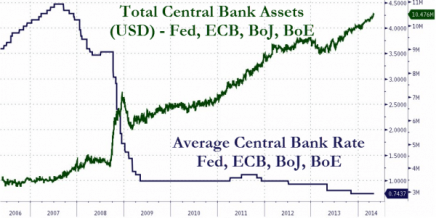
Interest rates on the ever-increasing amounts of sovereign debts can only be kept low by this sort of central bank intervention. As I put it, central banks are the “buyers of last resort” for bonds that cannot be sold at artificially low rates of interest. The chart below show just how desperate the situation has become since the financial crisis of 2008.

Interest Rate Elephant In The Room


Initially, however,  in the case of the Fed, the purchases were of “junk” that the banks had created during the real estate bubble. That was the bailout that saved the banks but put the squeeze on people through foreclosures, layoffs, and loss of income on their savings.

As shown in this chart and others I posted previously, all he major central banks are doing the same thing, so foreign exchange rates are not too adversely affected–yet. But keep your eye on Brazil, Russia, India, China, and other countries that show signs that they may not be willing to play along./ t.h.g.

An open letter to the Financial Times

Dear Martin Wolf,
Your article, Strip private banks of their power to create money, highlights some of the problems of the global money and banking system, but falls short in the proposed solution.

The problem is not private money creation, per se, but the monopolization of credit (money creation) in the hands of a private banking cartel and the collusive arrangement between bankers and politicians.

In today’s world, banks get to lend our collective credit back to us and charge interest for it while central governments get to spend more than they earn in overt tax revenues, relying on the banking system to monetize government debts. These two parasitic drains on the economy, interest and inflationary government debt monetization, create a growth imperative that is destroying the environment, shredding the social fabric, and creating ever greater disparities of income and wealth.

Turning over the money monopoly to politicians (what I call the “Greenback solution”) will not change things very much. It will be the same people wearing different hats. The political process has been so thoroughly corrupted and taken over by this small elite class that political approaches to solving the money problem have no chance of passage anyway. I articulated that argument a few years ago in my Alternet article, The End of Money: Take Power Back From the Money and Banking Monopoly.

True solutions must emerge, and are emerging, from society and from associations of small and medium-sized businesses. Money is first and foremost a medium for facilitating the exchange of goods and services and other forms of real value, but the exchange function can be effectively and efficiently provided outside the banking system and without the use of conventional political money. This is being done for associated businesses through credit clearing exchanges and through the issuance of private currencies or vouchers by businesses that produce real value. Both approaches have the capacity to provide exchange media that can be used by general public as well.

So, rather than ban private issuance of currencies, such private issuance needs to be proliferated and encouraged. There needs to be competition in currency so that there will be a sufficient amount of exchange media, and so that political currencies cannot be abused without losing patronage in the market. Rather than establishing the state as the money power, we need to have a separation of money and state. That argument is more fully developed in my latest book, The End of Money and the Future of Civilization.

Best wishes,

Thomas H. Greco, Jr.

Newsletter – April, 2014

Flight MH370
Shortly before midnight on March 6 I departed Kuala Lumpur on board a Boeing 777 bound for Tucson, via Tokyo and Los Angeles. That was just 26 hours ahead of the mysterious flight MH370 which departed from the same airport just after midnight on March 8 and has become the object of a massive search and equally massive speculation. I get an uneasy feeling when I consider how close I came in time and circumstance to being on that plane. Now, more than a month later, the mystery of the flight’s disappearance seems no closer to being solved.
Given the changing and contradictory news that has been provided by Malaysian authorities and others involved in the search, I can’t help but wonder if the news is being manipulated and crucial information is being withheld from the public. Why haven’t we heard more about the passengers? Who they are and what might they have been involved in? One tantalizing fact that is no longer mentioned is that 20 of the passengers were employees of Freescale Semiconductor, which according to the Express (UK) “makes powerful microchips for industries including defence.” The Express article, Malaysian plane: 20 passengers worked for ELECTRONIC WARFARE and MILITARY RADAR firm, reveals some facts about the company’s ownership that raise suspicions and ought to be fully investigated. A casual search of the internet will bring up plenty of other possible scenarios and explanations of what might have happened to flight MH370.
_____________________________________________________
Russia, Ukraine, and the New world Order
While still in Malaysia I picked up a copy of The Star (March 4 edition), one of Malaysia’s leading daily newspapers. One of the main articles had to do with the crisis in the Ukraine. The headline read: Ousting democratically-elected leaders, with the sub-head, The ousters of democratically-elected leaders have often been carried out directly or indirectly by champions of democracy themselves, thus suggesting how hypocritical and disingenuous western politicians have been in any number of cases where regime change has been the intended result. The article was written by Dr. Chandra Muzaffar, who is President of the International Movement for a Just World (JUST). You can read it here.As western leaders vilify the Russian leadership and the media beat the drums for “sanctions,” it is important to keep in mind that the Ukrainian government of PresidentViktorYanukovich was democratically elected in 2010, and he was forcibly removed by a coalition that includes neo-Nazis and fascists, backed by western countries intent on bringing Ukraine into the EU orbit and NATO.If the United States and EU are really interested in a negotiated settlement, they will need to seriously consider the Russian point of view and address the legitimate concerns of the Russian government. Floyd Rudmin’s recent article in Counterpunch, Viewing the Ukraine Crisis From Russia’s Perspective, provides some fundamental background facts that provide a more complete picture.
_____________________________________________________
It’s Time to Put Money Out of its Misery
Last month I wrote an article for publication in Transformation as part of their 9 article series on money. Now, editor, Michael Edwards has provided a wrap-up piece, It’s time to put money out of its misery. Read it here.
_____________________________________________________
Traveling with Children
One curious thing I noted during my recent visits in Southeast Asia is the number of  young adults that I saw traveling with small children. In one instance I happened to be on a motor coach going from Penang to Kuala Lumpur. Among the passengers were two Scandinavian couples in the company of two infants and one toddler. This experience put me in mind of a very acute observation made by some long forgotten sage (it might have been Ogden Nash, but I can’t swear to it): The definition of a baby–“An alimentary canal with a loud noise at one end and a foul odor at the other.”

Actually, I think it’s wonderful that so many young people are willing and able to balance child rearing with their search for adventure, but it’s too bad the children will have little of it to recall.
_____________________________________________________
Sharing the Commons
One thing that seems certain to me is that the new paradigm society will come about through radical sharing and a major shift of our collective energies toward projects that promote the common good. On the Commons has just announced the offer of their new e-book Sharing Revolution: The essential economics of the commons by Jessica Conrad. You can download the free e-book here. I’ve not yet read it, but I’m confident that it will prove to be a major resource in “helping people connect and collaborate to advance the common good and develop greater economic autonomy.”

#     #     #