In an act of tremendous courage and commitment to “government by the people,” Edward Snowden has revealed the abusive power that is being wielded by the United States government, in particular through the National Security Agency (NSA), at which he was employed.
Here below is a video interview of Snowden by Guardian (UK) columnist Glenn Greenwald, in which Snowden explains his actions.
http://youtu.be/3P_0iaCgKLk
You can read the related Guardian article here.
And here blow is a CNN interview of Greenwald in which he explains what the NSA and the tech companies have said about the PRISM program of collecting personal communications of ordinary American citizens.
http://youtu.be/k6NyiFMrDqY
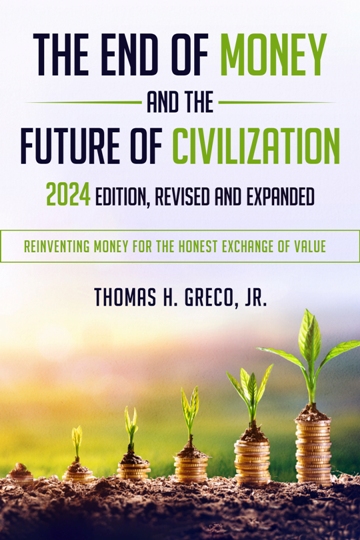
In my latest book, The End of Money and the Future of Civilization, I included a chapter titled, The Contest for Rulership—Two Opposing Philosophies, in which I attempted to outline the inevitable conflict that will decide what kind of world we will live in. Here is the first part of that chapter:
Chapter 3. The Contest for rulership—Two Opposing Philosophies
There appears to be a general tendency for those who get a little power to try to acquire more of it—and like an addictive drug, power’s ability to satisfy seems to depend upon its use in ever-larger doses. Lest the following be misunderstood, let me say at the start that I believe the same tendencies exist in every one of us, and that our efforts to improve our collective lot should not be cast as an “us versus them” contest. When I speak of ruling “elites” it is not to cast them as “evil” in opposition to the “virtuous masses,” but to explain the distortions in human affairs that have developed over time and to suggest what may be needed to give civilization a chance of evolving toward higher levels of achievement and a more harmonious condition.
Elitist or Egalitarian?
In 1944, F. A. Hayek warned that the western democracies were on the same “road to serfdom” that had been followed by fascist Germany and Italy (and communist Russia) during the early twentieth century.
He characterized the political contest as being between socialism on the one hand, and capitalism on the other—equating the former with “collectivism” and the latter with “individualism.” Hayek’s dichotomy is, I think, an overly simplistic characterization, and the fundamental struggle goes beyond particular political ideologies or economic systems however one might wish to define them. In my view there is a contest raging in the world that is more fundamental and less apparent than Hayek’s. It is one that impinges directly upon our freedom, our dignity, and our morality. It is a struggle between what might be called elitism on the one hand, and egalitarianism on the other. By elitism I mean the centralized rulership exercised by a small privileged class, while egalitarianism implies the dispersal of power and popular self-government. As Lord Acton keenly observed, “Power corrupts, and absolute power corrupts absolutely.” Whether that power be wielded through political office or economic dominance makes little difference; the outcome is the same. It is easy for those who live far above the masses to delude themselves into thinking that power and privilege are their “right,” and that whatever serves the narrow self-interest of their class, or race, or religious group also serves the general interest.
Hayek was sensitive to the defects of communism, but he seems to have been blind to the defects inherent in capitalism that make it equally susceptible to becoming totalitarian and tyrannical. The defining feature of totalitarian systems is the centralization of power and control, whether it be economic, political, or social, for these three are but facets of one whole. Considering the millennia of institutionalized hierarchy in our societies, Laurence Victor goes so far as to say,
I believe that [bureaucracies] are strong attractors for human psychopaths. In fighting their way to the top, individuals are selected who have the greatest tolerance for collateral damage of their actions. Today, the top [levels] of most power echelon hierarchies are populated by psychopaths. . . . The greater the power, the greater the collateral damage required and the greater the deception—both to others done damage [to] and those who are indoctrinated to damage others.[There are] two alternative modes for coordinating activity so as to accomplish what only many hands in coordinated activity could accomplish. The egalitarian mode involves voluntary cooperation to achieve requisite coordination. An exemplar might be a tribe’s collective effort in gathering materials and constructing a long house. The egalitarian mode can have leaders or managers, as roles to assist in coordination. Ideally, each person contributes as to their existing competencies and interests—and all essential roles are covered. The elitist mode involves forced labor in a top down command structure to achieve coordination (and even to get persons to act as demanded). The force could be facilitated by slavery or wages, both essential for survival in the prevailing situation. Once a people settle into an elitist mode, it must be defended by force and the indoctrination of labor to accept their status.
For that reason, any excuse for concentrating power and curtailing the personal rights and freedoms to which all are entitled, even national defense or a “war on terror,” must be viewed with suspicion—for as H. L. Mencken observed more than seventy years ago, “The whole aim of practical politics is to keep the populace alarmed (and hence clamorous to be led to safety) by menacing it with an endless series of hobgoblins, all of them imaginary.” The real hobgoblins, often created by government itself, can be effectively addressed only by a responsible citizenry acting together from its community base.
Law, by itself, is incapable of restraining the behavior of the addict, for addiction creates imperatives that are stronger than the inhibitions induced by law. But, beyond that, power addicts’ need for ever more power leads them to seek ways to control the very process by which laws are made, changed, and adjudicated. While the separation of governmental powers into executive, legislative, and judiciary functions was intended to offer some assurance of pluralism and impartiality, the ever-widening socioeconomic differences have the effect of drawing these functions together into the hands of power elites whose members possess shared interests that are typically antagonistic to those of the masses who comprise the rest of society. As legal constraints upon concentrated power are gradually nullified, government becomes a weapon against freedom, and the ruling class tightens its grip. The people must be ever watchful for the telltale signs of creeping totalitarianism—government secrecy, stonewalling, obfuscation, classified information, abuse of prisoners, surveillance of citizens, harassment of dissenters, appeals to national security and executive privilege, and covert interventions in the affairs of other countries. These signs have been plainly evident in America for some time, and the trend toward totalitarian government has been ramped up since the events of September 11. This is clearly shown in Naomi Wolf ’s book The End of America, which outlines ten steps common to all transitions from democratic to totalitarian rule, and shows how they are already manifest today in the United States. Chalmers Johnson, in his Blowback trilogy, has clearly described how America’s imperial overreach has all but destroyed our republican form of government.
It is said that “the price of freedom is eternal vigilance,” but it cannot end there—vigilance is but the beginning of freedom. The acquisition and preservation of freedom require, in addition, responsible civic action. An informed, organized, and politically active citizenry is the only kind that has any chance of remaining free. {end of excerpt}
So long as we put material things foremost, and so long as we remain dependent upon their system of money and their banks, they will continue to control and dominate us. But we have it within our power to declare our economic independence, share the resources we have at our disposal, and apply our skills and talents to serving the common good.
My expectation is that increasing numbers of “cracks” (like Snowden’s revelation) within the despotic systems of control will lead the top level rulers to prematurely attempt to spring the trap on democratic government. This departure from “gradualism” will provide enough contrast to enable people to see what is being done to them, and to recognize that their fundamental common interests are at stake. Hopefully, we the people will assert our collective will in coordinated peaceful action that will turn the tide toward popular control and a world that works for everyone.–t.h.g.



 Beyond Money