Category Archives: My activities

Interview on GreenPlanetFM

On May 4 I was interviewed by Tim Lynch of New Zealand’s GreenPlanetFM radio program. You can lsiten to it here.

New Zealand Follow-up

Deirdre Kent and conference organizer Laurence Boomert have provided a link to audio records of the New Zealand Community Currencies Conference 2009 that was held in Whanganui April 17-19th.

Here is their note:
Here is a link to the audio recording of our keynote speaker Thomas Greco at the conference.
http://miscellaneous-sonstiges.blogspot.com/2009/04/thomas-greco-talk-on-radio4all-notes.html
Click on the link in the yellow box then scroll to the bottom of the new page and click on the red download arrow – enjoy

Audio recordings of other speakers at the conference will also soon be available and a bit later we will have the videos that go with the talks.
The written resource document that records the different models of currency brought forward at the conference will soon
be available.

I’ve also now posted the photos to my photo gallery. — t.h.g.

Report From New Zealand – April 21, 2009

Overall, my New Zealand experience has been a whirlwind of presentations, interviews and meetings (with one weekend break for R&R at a seaside campout). It’s been a rewarding and satisfying opportunity to share my knowledge and insights, as well as to learn from the many able and dedicated people who have inspired me along the way.

The change in climate from Bangkok’s steamy heat to Auckland’s early autumn chill was rather a shock. I did not expect New Zealand weather to be quite so cool. Fortunately, my tropical wardrobe was quickly augmented with woolens borrowed from host and conference organizer Laurence Boomert or purchased from the local Salvation Army thrift shop. While time has not allowed a visit to the south island, my wide ranging visits around the north island give the impression of New Zealand as beautiful and pristine. With a land mass about the same size as Britain but less than one tenth its population and plenty of natural resources, the feeling is one of roominess and abundance.

A couple hours after my arrival at the Auckland airport, Laurence put on a ferry boat to Waiheke Island, a half-hour ride across the bay from the city, where I gave an evening presentation at the local theater to a group of about 70 island residents, then stayed the night at the home of the Peter Russell family, a beautiful place with awesome 180 degree views of the sea and nearby islands. My presentation there was called, Community Economic Development: A Comprehensive and Innovative Approach, in which I described the multi-stage regional development program I’ve been advocating for the past few years and which our south India project is trying to implement.


The next morning a small group gathered over breakfast at Peter’s house to discuss the possibilities for starting a community currency on the island. It took little more than an hour to reach a common vision and a plan for a currency that would initially be issued as vouchers by a popular local café, then shift over into a credit clearing association anchored by a few trusted issuing members. The expectation is that this first node might be the “seed crystal” that can precipitate the organization of similar small clearing associations that will eventually be linked up to form an Auckland area exchange network.

Returning to Auckland later that morning, Laurence hurried me over to the studios of New Zealand National Radio to record an interview with Kim Hill to be aired on her popular Saturday morning program. [That program was aired on April 11. During the following week I heard favorable comments from many people who had heard that broadcast].

That same evening, (Wednesday, April 8), a group of about 90 people gathered at Auckland University to hear my presentation on, Money, Power, Democracy, and War: Finding the path toward global peace, harmony, and prosperity. This was an updated version of a presentation I first gave in Tucson a couple years ago.


Waitakere is one of five cities (boroughs?) that comprise the Auckland metropolitan region. It seems that the new right-wing national government is determined to replace these five city administrations with a single “super city” administration, a move which will further disempower people and local communities. It is opposed by the majority of residents and likely to face serious citizen opposition. For now, the separate city governments are still functioning. Around noontime on the next day (Thursday), Laurence and I met with some staff people of the Waitakere city to discuss community economic development strategies.

The weekend provided an opportunity for some relaxation. The Prana retreat is located on the Coromandel peninsula on the east coast of the north island, about a four hour drive from Auckland. Although the weather was too cold for me to be interested in swimming in the sea, I enjoyed the occasional sunshine, the beach and spectacular views, the peaceful setting , the morning yoga classes, the music, the drumming and the people.

Taupo is known for its beautiful large fresh water lake and its hot springs. That was our next stop on the way to Wellington. On the way we stopped at a roadside stand to buy some avocados, which at $5 a dozen ($3 US), were an irresistible bargain. As a second thought I also picked up a bag of golden kiwis for $2. The golden variety, which I had never seen before, proved to be a delicious treat with flesh that is more delicately flavored and less acidic than the common green variety.

In Wellington, I gave a presentation called, The Political Money System: The Story of Central Banks, Inflation, and Legal Tender, which I began with a statement that I had posted on my blog in September, 2008:

The present disorder in the financial markets and the cascading failures of financial institutions come as no surprise. Those who recognize the impossibility of perpetual exponential growth and who understand how compound interest is built into the global system of money and banking expect the continuation of periodic “bubbles” and “busts,” each of increasing amplitude, until the systems shakes itself apart.


As I’ve said before, and as I argue forcefully in my new book (which I’m told has just come off the press), the separation of money and state is something that is urgently needed if any dignified form of civilization is to survive the deepening multi-dimensional global crisis.

Following the Wellington session Laurence drove home to Wanganui while I stayed and took up lodging for two nights in the Comfort Hotel which gave me an opportunity to explore a bit of the central waterfront area of this capital city. I had the chance on Thursday (April 16) to experience the fine New Zealand railway system, taking the train up to Carterton where I was the guest of Helen and Alf Dew. Helen is a living example of sustainable living on a largely self-sufficient urban homestead. I hope that she will some day write her own book detailing her approaches to gardening, water harvesting, food preserving, nutrition and the various other aspects of “the art of living.”

The national Community Currencies Conference (April 17-19) brought together well over 100 enthusiastic participants who convened at the Quaker Settlement in Wanganui to share information and discuss new possibilities. My Keynote presentation delivered on Saturday morning (April 18) was titled, Reclaiming The Credit Commons: The Key to Sustainability and Relocalization. Prefaced with a brief outline of my vision of societal metamorphosis, I argued that liberating the exchange process from monopoly control by means of localization and popularization of credit is a necessary prerequisite to achieving a steady-state economy and the devolution of power to local communities.


On Monday, the day before my departure for Australia, Laurence took a few of us on a tour of the Environmental Center and a couple community gardens around Wanganui. Towards the end of our tour he received a call from Merania, a reporter who writes for the local daily newspaper. She wanted to do an interview for a feature story, so we hurried back to the Environmental Center to meet her there. She spent quite a bit of time asking questions not only of me but also of Helen Dew and Margaret Jefferies, conference presenters who were in our party. Merania called back later in the evening to say that the editors had liked the story so much that it would be a front page feature in the next morning’s edition.

Before leaving for the airport the next day, Laurence went out to fetch some copies of the paper. There it was, complete with photo of me with Helen holding a copy of my previous book, Money. The headline read, How the recession could improve your life and was capped with the tag, Finance guru’s claim. Gosh, there’s nothing like a bit of praise to make one feel humble.

Tom

P.S. Back to the USA on April 27. Sorry the NZ photos won’t get posted for a while. Feel free to distribute this report.

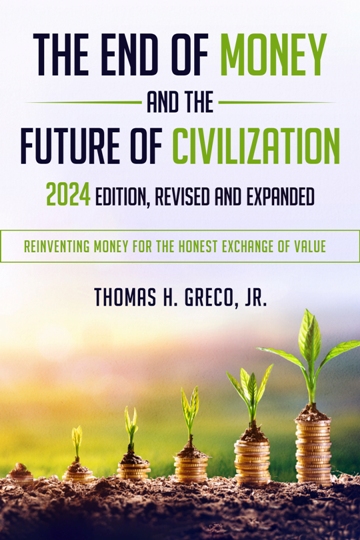
My latest book, “The End of Money and the Future of Civilization” from Chelsea Green Publishers is now in print.

Report from the field – Koh Phangan 2

Another report on my recent experiences in Thailand, a few ideas, and comments on the recent US Presidential election, nonviolent communication, social organizing.

Notes From the Field – Thailand

October 28-29, 2008

Relaxing on Koh Phangan

Much as I like Penang, I’m happy to be away from the bustle and noise of Georgetown for a while. I woke this morning to the sound of gentle rain hitting the roof of my seaside bungalow in Koh Phangan. With my Malaysian visa about to expire, I took it as an opportunity to visit Thailand again, choosing to return to the island (koh) that I visited last year. Koh Phangan in comparison to its better-known near neighbor, Koh Samui, is still relatively unspoiled. Although tourism is its economic base, it has not yet been overbuilt and overrun by upscale resorts and high rise condos. There is still a lot of open space and the typical accommodations consist of modest bungalows strung out along the various beaches.

A major attraction of Koh Phangan is the “full moon party” that attracts the twenty-something party crowd. I guess it was inevitable that ambitious entrepreneurs would augment that attraction by staging “half-moon” and “dark moon parties,” as well. Fortunately, that scene is easily avoided as it happens mainly at the south end of the island near Had Rin. The remainder of the island offers various levels of peace and quiet, nice beaches and clean water. Expenses are a bit higher here than in Penang but still affordable. I’m sure I could find ways to economize if I were to commit to a longer stay. It’s off season now so it’s a buyer’s market for lodgings. I dare say that ninety percent of the units are vacant right now.

The only sizeable village on the island is Thong Sala, located on the western side. That’s where the ferry docks are. It has all the usual conveniences – shops, restaurants, banks, cafes, and a nice night market where one can get a good cheap meal. I prefer to stay to the north and not too far away from Thong Sala at one of the many bungalow places that line the shore. The place I’m at is fairly new and clean and has screened windows, a rarity in these parts. It has no A/C, only a fan, but that’s quite adequate as it doesn’t get too hot here and there’s usually a breeze off the ocean.

The antipode to the party scene is the yoga/health spa scene. There is a sizeable cluster of people who come to the island for yoga workshops, personal growth, healing, and spiritual development. I first learned about Koh Phangan from my Italian friend, Michele, whom I met at Auroville last year. He had come here earlier that year to do yoga at the popular Agama Center which has a loose affiliation with the Ananda Yoga Resort where one can find various health oriented offerings like vegetarian food, yoga classes, sauna, massage, and a seven day colon cleanse program.

I came to the island last year prior to my visit to Bali. I liked it but was able to stay for only two weeks. Michele was not on the island at that time so I had to discover it on my own. This time, he is here so I have the advantage of being guided and introduced to people by someone who has spent a lot of time here.

The Bank Bailout Scam

What can you expect when a fox is appointed to manage the hen house? Our current Treasury secretary, Henry Paulson, was formerly the CEO of Goldman Sachs, one of the most powerful financial institutions in the world. His appointment to that post was clearly intended to enable a continuation of the long trend of greater concentration of power and wealth in elite hands.

Recent moves by the U.S. Treasury make that ever more obvious. In an article in Saturday’s (Oct. 25) New York Times, Times economic columnist, Joe Nocera, reveals what he calls “the dirty little secret of the banking industry”–namely, that “it has no intention of using the [government bailout] money to make new loans.”

Nocera explains that the Paulson plan to hand over $250 billion [in money borrowed into existence by the government] to the biggest banks, in exchange for non-voting stock, was never really intended to get them to resume lending to businesses and consumers, as was stated. That was just window dressing. The real purpose of the bailout is to engineer a rapid consolidation of the banking industry by enabling at public expense a wave of takeovers of smaller financial firms by the most powerful privileged banks. Examples, so far:

JPMorgan’s recent government-backed acquisition of two large competitors, Bear Stearns and Washington Mutual; the takeover of Merrill Lynch by Bank of America, Wachovia by Wells Fargo and, National City by PNC.

There’s more to come, and by deciding which banks get handouts and which don’t the entire consolidation process is being orchestrated from the top.

Expatriate Living

An “expatriate” is one who lives outside of his/her homeland. That term should not be confused with “ex-patriot,” who is someone who once was patriotic but is no longer. Not that the two are mutually exclusive, of course, but let’s not go off on that tangent just now. The “expat” lifestyle suits me very well. Besides enabling me to stretch the purchasing power of my small pension, there are social, educational, cultural, and even spiritual benefits to living abroad. That’s especially true when one gets away from the areas that are dependent upon tourism and immerses oneself for extended periods of time in the daily routines of ordinary people, which is something I feel I’ve barely started to do. It has been said that “travel broadens on,” but I would venture to say that living abroad tends to make one less nationalistic, more humanistic, and more appreciative of the things that all people have in common.

Communicating

When I left the U.S., I suspended my Verizon cell phone account. Their rates for international service are quite unreasonable in comparison to what’s available in Asia. Mobile phone dealers are everywhere here and the competition is fierce, so some phones and most services can be had pretty cheaply. The common practice here is to buy your own phone then buy a SIM card from one of the many service providers, then buy minutes of call time. As I understand it, you pay only for outgoing calls, not incoming, but there is an expiration date on your outgoing call time the duration of which depends on how big a block of time you buy. In Malaysia ten Ringgit was good for ten days, thirty Ringgit for thirty days.

Cheap as it is in Malaysia, service in Thailand seems even cheaper. To avoid high roaming charges on my Malaysian service, I did as I was advised by other travelers and bought another SIM card when I got to Hat Yai, my first stop in Thailand. The SIM card is a tiny electronic chip that slips into a slot just beneath the phone’s battery. Anyone can install it in about ten seconds. People at my guest house directed me to a shop right next door where I paid 50 baht (about $1.50) for a SIM card. I then “topped-up” my card at the guest house with 100 baht worth of call time. At .80 baht per minute that gave me 125 minutes of domestic call time, good until December 2. At a total cost of less than 5 dollars that’s not bad. No wonder every teenage kid in Asia has a mobile phone. Oh, and I can call internationally, too, (including the U.S.) at somewhat higher but still cheap rates. If the FCC was really doing its job, we’d have similarly good, cheap, mobile service in the U.S.

In Asia, people tend to use SMS (short message system) or text messaging more than voice communication. My own usage has changed accordingly. Text messages provide a much more accurate way of communicating, can be saved in phone memory, and are very inexpensive. I have my phone set to automatically save both incoming and outgoing messages, then I occasionally delete those that I no longer need. I hardly ever make a voice call anymore.

Sicko

DVD’s of popular movies, which are surely pirated, are sold openly at very low prices in Malaysia, Thailand, India, China, and I’m sure, other parts of Asia. A couple weeks ago I picked up a few for 5 Ringgit (US$1.60) each. Among them was Michael Moore’s latest film, Sicko. It is in my opinion his best yet, and I urge everyone to see it. The film provides a clear description of the appalling state of the American “health care” system and compares it with systems in Canada, the UK, France and Cuba. If those countries are able to provide good, free health care for their people, The US should be able to do it too.

State of Fear

Browsing the small collection of books available at my resort, I came across Michael Crichton’s, State of Fear. Reportedly a bestseller, it looked to be the most interesting amongst the available titles (aside from the two copies of Tolstoy’s War and Peace). It did not at first register with my conscious mind, but I was reminded a few days later, when I recommended it to him, that Peter Etherden, my good friend and colleague in the UK, had urged me a few years ago to read this book. Coincidence? Following my recommendation to him, Peter came back with: “I have been trying to persuade colleagues to read State of Fear since it first came out in 2004…when I found to my surprise that all the references in the extensive endnotes checked out. Prior to reading it I had believed the environmentalists’ case without looking into the data and the premises behind their claims.”

In this book, Crichton tells a whale of a tale. It’s quite engaging fiction, but it’s also designed to inform, just, as, Peter notes, was much of Charles Dickens’s work. In this case, the bad guys are money grubbing con men who have control over a major environmental organization. The plot revolves around the good guys and gals who attempt to foil the heinous criminal plans of the con men to create major disasters that can be blamed on human-induced climate change. These are crimes that are intended to pump up the “state of fear,” which is the underlying theme of the book. One of Crichton’s main characters argues, rather convincingly, that the global warming theory is not well supported by the actual scientific evidence, which Crichton provides for the reader in abundance.

When Peter first began expressing his doubts a few years ago about the global warming theory I thought he had gone over to the dark side because by then everybody “knew” that global warming was an irrefutable fact. Now, with the widespread viewing of Al Gore’s polemical film, An Inconvenient Truth, that “fact” is even more firmly entrenched in the public mind. I personally was an early believer in the global warming effect of the buildup of greenhouse gases (mainly carbon dioxide) and the prospect of abrupt climate change. That belief was based on my 1982 reading of John Hamaker’s book, The Survival of Civilization. Hamaker argued that this was a natural cycle with a period of about one hundred thousand years. He said it might be exacerbated by human activities, but was essentially quite independent of them. Hamaker’s evidence was paleontological, based on the physical examination of glacial ice cores and fossils.

His prediction was that the greenhouse effect would lead to more turbulent weather patterns in the temperate zones and eventually bring on another ice age. That seemingly paradoxical prediction was explained as follows:

More solar energy trapped in the atmosphere causes greater amounts of water to be evaporated from the oceans and lakes; this vapor causes greater cloud cover which migrates toward the poles covering more of the polar and temperate zones, blocking the sun’s energy and causing cooling in those regions. The result is greater wind shear – storms, tornados and hurricanes at the interface between the tropics and the temperate zones, and ultimately, global cooling and glaciation. And what drives this process of CO2 buildup in the first place? The depletion of minerals in the surface soils which cause plant growth to be less intense. And how does glaciation correct that? By bringing new minerals to the surface, which stimulates new plant growth, which takes more CO2 out of the atmosphere, which reverses the greenhouse effect, which causes the glaciers to recede. Hamaker’s prescription for ameliorating the effects of those changes – remineralize the soil by grinding up rocks (glacial till) and spreading the dust over fields and forests.

Well, it sort of made sense to me, though I did not dig very deeply into the subject. Subsequent studies by mainstream scientists, we are being told, confirm the CO2 buildup and the global warming phenomenon. The CO2 figures cited by Crichton confirm the buildup showing an increase from 316 parts per million in 1958 to 376 ppm in 2002. That’s an increase of 60 ppm or about 19 percent in 45 years. Crichton’s character minimizes the importance of that amount of change, but I find the argument less than compelling. Hamaker argued that the rate of CO2 increase is exponential (changing at an accelerating rate) not linear (changing at a constant rate), something that doesn’t show up in the limited data provided by Crichton. As for the global warming effect, Crichton argues against it by showing that, while some places have gotten warmer, others have actually gotten cooler. But if Hamaker’s thesis is correct, that is to be expected. It begs the question, is there a locational pattern to the places that have gotten cooler, and what are the geographical and weather variables that might explain that pattern?

Well, I don’t know, maybe we have global warming, maybe global cooling, maybe climate change, maybe not, but one thing seems clear – we’ve been making a mess of our planet with deforestation, urban sprawl, and pollution of many kinds that makes living in many places quite unpleasant or even downright dangerous. We ought to do something about that. But let’s get back to the main theme – fear. Is there a conspiracy to make us ever more fearful? Conspiracies abound, but anyone who tries to reveal the evidence of them is ridiculed and lumped into the category of paranoid nut cases. But there will always be wolves in sheep’s clothing and foxes getting into hen houses, who all the time try to tell us “There ain’t nobody here but us chickens.”

Crichton’s own “nutty professor” argues in the book that starting in 1989 there was a “major shift” in the media’s use of terms like crisis, catastrophe, plague, disaster, dire, unprecedented, and dreaded, and that it was all deliberate hype because “politicians need fears to control the population.” With the collapse of the “Communist menace,” a whole string of other threats have been trotted out as replacements. Whether it is real or imagined, climate change is one of them.

Power politics is no more than a big protection racket. As H. L. Mencken observed more than 70 years ago, “The whole art of practical politics is to keep the populace alarmed, and hence clamorous to be led to safety, by menacing it with an endless series of hobgoblins – all of them imaginary.” The power elite will always pose as our saviors, offering new plans and programs that they say will protect us or save us. They tell us there is no alternative (TINA). It’s time we started cooperating to create alternatives that reflect our own values and ideals and promote the common good. Remember the words of President Franklin Roosevelt: “We have nothing to fear but fear itself.”

The Monetary Education Project Enters a New Phase

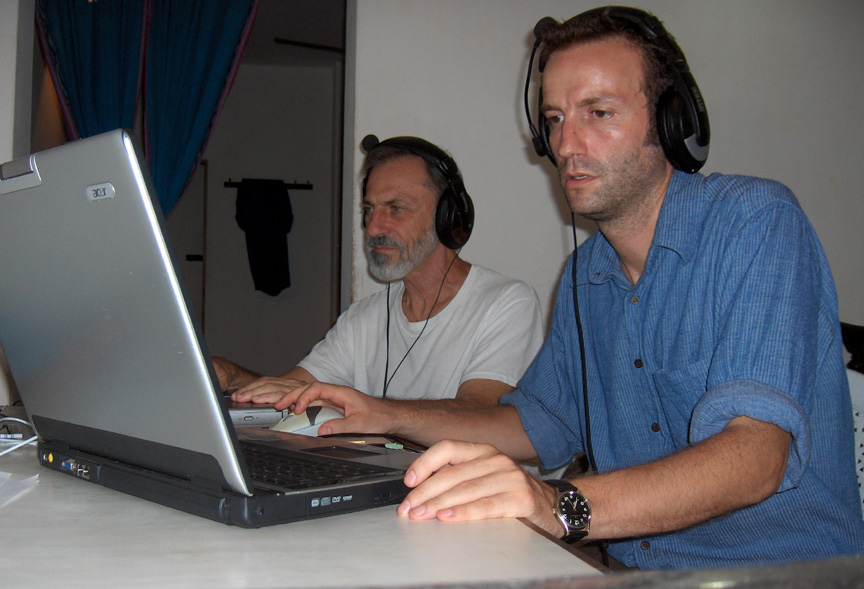
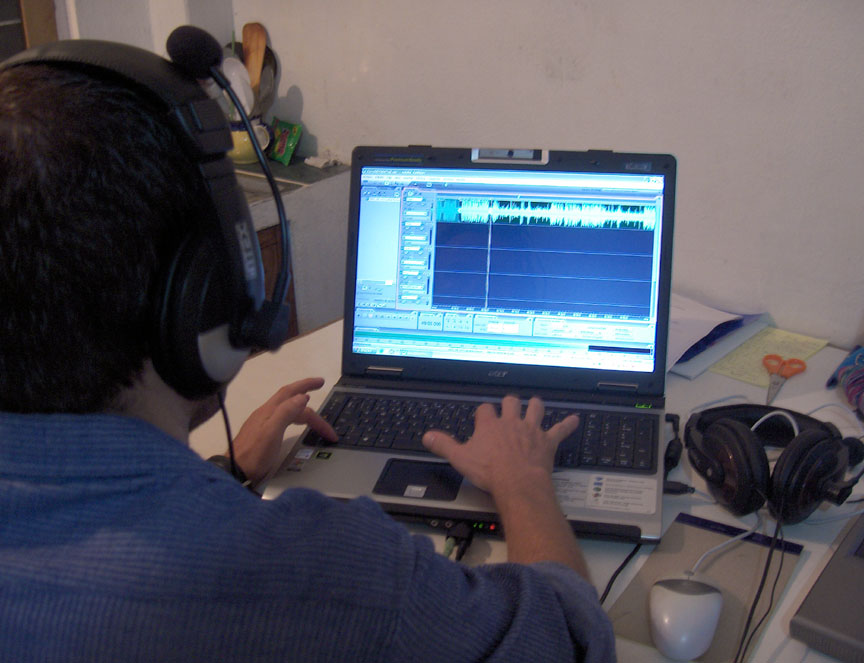
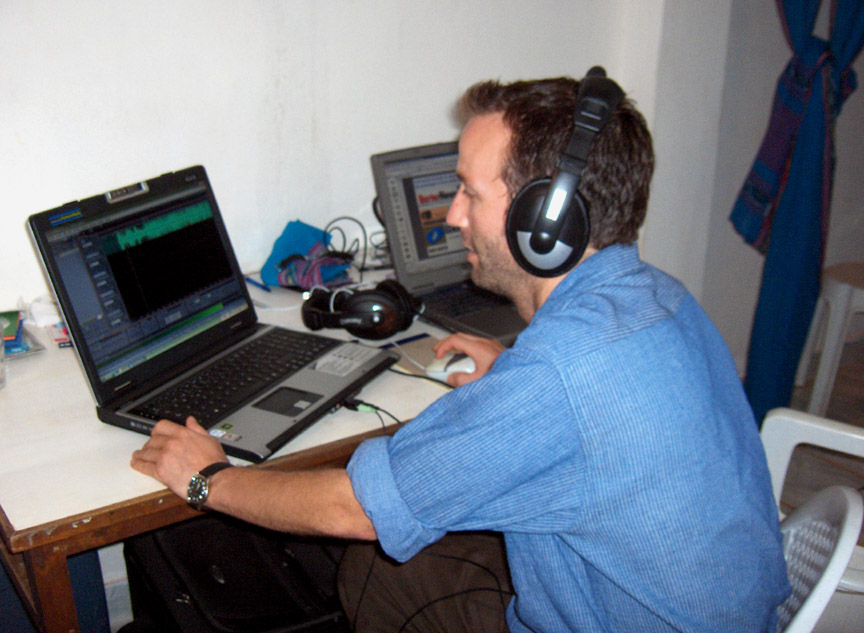
The Monetary Education Project is making good progress with the help of Manuel who brings his expertise in editing audio files. Over the past several days, Manuel and I have worked together to prepare some more effective slide shows by merging Power Point files with sound tracks made by editing some previously recorded audio files of my presentations. The pictures below show us at work in my cottage at Auroville, India.
Audio editing 45

4650tgmadjsm.jpg

4647edscrnadjsm.jpg

New Page About Malaysia Conference Presentation

I’ve posted a new page (at the right) about my presentation at the Gold Dinar Conference. See 2007 Tour Reports: Malaysia Conference.

Upcoming Presentation in Kuala Lumpur

Thomas Greco will be a presenter at the International Conference on Gold Dinar Economy July 24 – 25.

The title of his presentation will be The End of Money and the Liberation of Exchange.

First Report from California

The past week has been intensely busy here in California, filled with presentations and meetings with colleagues from all over the world who have gathered here for our complementary currency conference last Thursday (May 31) and the general conference of BALLE (Business Alliance for Local Living Economy), June 1 and 2 at the University of California-Berkeley.

Last Tuesday I gave a presentation to the Sonoma County BALLE chapter in Sebastopol. That presentation was recorded but the link is no longer functional.

The proceedings of the complementary currency conference were recorded and will be made available later on. Here below is the substance of my own opening remarks.

2007 BALLE pre-conference on Complementary Currencies – May 31, 2007

Opening Statement by Thomas H. Greco, Jr.

I think it may be fair to say that we are gathered here today because we are all passionate about change, particularly economic change, and we all seem to agree that non-governmental currencies and exchange alternatives have an important role to play in achieving the kind of change that will lead to healthier communities, greater satisfaction of basic needs, a dignified and fulfilled life for all people, and a more peaceful, sustainable world.

That’s a tall order. Can it be achieved?
I’m confident that it can.

What we’re about here is more than adjustments to the prevailing system, more than gimmicks and Band-Aids. What we hope to create is an entirely new paradigm. I think we all share a feeling that the world is sorely in need of a truly transformative change in the way we humans relate to one another and to the Earth of which we are a part. But what are we doing, what can we do that is truly transformative?

I receive numerous messages from people all over the world asking me to comment on their essays, articles, books and ideas. I try to respond as best I can to as many as I can, but the burden is overwhelming. I see in these offerings a great urge to make things better, but I also see, repeated over and over again, the same misconceptions and false starts. This is not surprising because this business of money and banking has become such a tangled ball of string that it is hard to discern the fundamental principles and truths in it.

But we have the benefit of a few keen minds who have unraveled this ball of string and who have documented for us the essential points that need to be understood if we are to make the kind of progress in transforming the exchange process that the survival of civilization requires. I speak of E.C. Riegel, Heinrich Rittershausen, Ulrich von Beckerath, Walter Zander, and Hartley Withers, to mention a few. Hardly anyone today has ever heard of these people. But I have taken it as my mission to collect the best of these materials, to make them available on the web, and to apply their insights in the design of alternative exchange systems. You can find these resources at reinventingmoney.com.

My main point is that we need to reach a level of understanding that will enable us to move beyond the present plateau of significant but still modest achievement. We have behind us twenty-five years of experience and experimentation with LETS systems, loyalty programs, and local currencies of various kinds and colors.Where are we with all of that?

Well, there have been some small-scale successes and currency alternatives have been getting increasing publicity. The public mind is being opened up to see the possibility at least of using some payment media other than the accustomed and universal political monies provided us by banks and governments. That’s well and good. Where do we go from here?

A couple weeks ago I received in the mail from Europe a screenplay, which I dutifully read. The author had clearly done a lot of study on the money question and understood pretty well how the dominant system of money and banking works. That encouraged me to read on. The main plot line involved a sage old man explaining these things to his college educated grand-daughter. So far so good. The climax of the story is reached when the old man reveals to her the “secret of money.”

But what the author considered to be the secret of money was pretty bland in relation to what I consider to be the secret of money.

So, what is that secret?
From my research and study over almost three decades, I have come to conclude that the real secret of money is this:

MONEY IS NOTHING MORE THAN CREDIT. Another way to put it is that THERE IS NO MONEY.

These statements challenge our logic because history and our experience of money tells us that money is a THING. But if it is a thing, what is its essence? Is it scraps of paper? Is it electrons residing on a bank’s computer? Money is really a thing of the past.

What we have today in place of money is an information system. But information must be about something, and that something is credit. The paper notes, the electrons that register “deposits” in your bank account are mere manifestations or carriers of information, just as your drivers license is evidence of your authorization to operate a motor vehicle. Do you have credit? How much credit do you have? What does this credit enable you to do? It enables you to buy.

So modern money is credit. It is your credit and my credit. By our participation in the established credit system, we authorize one another to buy. But we have the possibility of creating alternative, parallel credit systems. We have the power to give credit to whomever we are willing to trust. And by doing so, we can free ourselves from the juggernaut that is destroying our planet, rending the social fabric, subverting democratic government, driving nations to war, and impoverishing an ever greater proportion of the world’s population.

The way forward to a peaceful, harmonious and equitable order is the liberation of our collective credit from monopoly control and the implementation of direct credit clearing within a mutual, cooperative framework. We need to build our own circle of trust.

What banks do today is to create deposits or spendable credits by making loans. This process is called “monetization.” It amounts simply to this: it is the conversion of frozen value into value that can be spent. The bank monetizes the value of your collateral assets when it grants you a loan. It essentially converts the value of say, your house, into a demand deposit that you can then spend.

If banks can do that, so can we. And here is the real revolutionary potential of our alternative exchange movement — when we start to monetize the value of our own labor and resources according to our own criteria, without the “help” of conventional banks, when we organize ourselves into circles of trust within which we give each other credit, when we do this in a responsible way over a broad network of exchange communities that include the broadest possible membership, then we will have set in place the cornerstone of economic democracy that can enable the emergence of a world order that is cooperative, humane, and peaceful, an order propelled not by fear and violent conflict over resources, but a world order propelled by love, service, sharing, and respect for the sacredness of all life.

# # #

Bob Meyer of Barter News Reports on Greco Activities

Complementary Currencies Expert, Tom Greco, Speaking Globally

By Bob Meyer

Tom Greco, author of the book Money (Understanding and Creating Alternatives to Legal Tender), consultant, educator and the founder and director of the Community Information resource Center (CIRC), continues to tirelessly move forward in educating the public on complementary currencies and monetary theory. He gave a presentation in Tucson just this past week (March 13) on Money, Power, Democracy and War. [more…]