Upon the recent completion and publication of my new Chapter 20—Exchange, Finance, and the Store of Value, for the revised edition of my book, The End of Money and the Future of Civilization, I loaded it into NotebookLM and asked it to create a video overview. I continue to be amazed at the quality of the output that this AI tool produces. Here it is:
Real economic growth cannot continue forever in a finite world; we can no longer afford to waste limited resources on wars, destructive competition for dominance, and other wasteful projects undertaken by political leaders and idealogues. It is time we learned to work together peacefully and to live within the Earth’s energy budget.
Tim Morgan makes the case in his writings about Surplus Energy Economics.
What can we do about it? The first necessity is to take action to transcend “the engine of destruction” that is the global, usury-based, debt-money regime. How that can be done is outlined in my various writings, especially my book, The End of Money and the Future of Civilization.
Chapter 15 is the latest Chapter in my new updated and expanded edition of The End of Money and the Future of Civilization. The link to this chapter is now listed along with the other previously published chapters on the book page along with links to the audio narrations by Ken Richings. Scroll down to find Chapter 15 there or click here to go directly to the PDF file.
This short video about Sarvodaya describes with great clarity the pathway toward creating a decentralized, peaceful, convivial society that Gandhi and others have envisioned, and the Symbiotic Culture that Richard Flyer has for a long time been working on and writing about.
Covering the history of centralized banking, the danger of today’s concentration of wealth in the hands of a few who are working to completely control humanity; and the need to reinvent money, devolve power to local communities, and create honest “home-grown” means of payment (liquidity). His highly acclaimed book, The End of Money and the Future of Civilization, is being revised, updated, and expanded to reveal how the dysfunctional money system operates, and how to reinvent money to enable the honest exchange of value. New chapters are being posted serially on Future Brightly, on his website, as well as on his Substack and Medium channels. Almost all his writings and accumulated resources for researchers and monetary innovators can be downloaded free at BeyondMoney.net.
You can view or download the video here or on Podbean
To satisfy my curiosity about AI, and ChatGPT in particular, I’ve been posing certain questions to it and been pleasantly surprised by the results. ChatGPT uses information that was publicly available online up to September 2021, so the responses that it generates will not include recent changes.
Here is one of my requests which, while much shorter, pretty well summarizes what I myself have written about the matter. I present it here for your information and your comments.
THG: Summarize the unique features of the work of Thomas H. Greco, Jr. on money and economics.
ChatGPT:
5/5 Thomas H. Greco, Jr. is known for his groundbreaking work on money and economics, focusing on alternative monetary systems and local economies. Some of the unique features of his work include:
Decentralized Monetary Systems: Greco advocates for the development of decentralized and community-based monetary systems that empower individuals and local communities to create their own means of exchange. He emphasizes the importance of currencies that are not controlled by centralized authorities like governments or banks.
Complementary Currencies: Greco promotes the idea of complementary currencies, which are designed to work alongside national currencies to facilitate local transactions and trade. These currencies are often tailored to specific communities or regions and can help stimulate local economies.
Democratization of Money Creation: He challenges the conventional model of money creation by banks and governments. Greco believes in the democratization of money issuance, allowing communities to create their own money based on real value and resources.
Mutual Credit Systems: Greco’s work includes the concept of mutual credit systems, where participants can extend credit to one another within a network. This can foster cooperation and exchange without the need for traditional banking intermediaries.
Localized Economies: He emphasizes the importance of localized economies that prioritize community resilience and sustainability. Greco’s work encourages communities to rely more on local production and resources to reduce dependency on distant supply chains.
Interest-Free Economics: Greco criticizes the conventional practice of charging interest on loans and believes that interest-free systems could lead to more equitable distribution of wealth and resources.
Advocacy for Change: Through his writings and lectures, Greco advocates for individuals, communities, and governments to explore and implement alternative economic and monetary systems. He believes that a shift away from the current monetary paradigm could lead to more just and sustainable economies.
In summary, Thomas H. Greco, Jr.’s work revolves around reimagining money and economics by proposing alternative monetary systems, promoting decentralized currencies, advocating for interest-free economies, and encouraging the development of localized, community-based economic structures. His ideas challenge conventional economic thinking and aim to create more resilient, equitable, and sustainable societies.
# # #
Update: Monday, August 28, 2023 This iteration is a bit more complete:
Thomas H. Greco, Jr. is known for his unique contributions to the fields of money and economics, particularly in the realm of alternative currencies and monetary systems. Some of the key features of his work include:
Local and Complementary Currencies: Greco emphasizes the importance of local and complementary currencies as tools for promoting economic resilience and community development. He advocates for the creation of currencies that are tailored to specific communities or regions, helping to stimulate local economic activity and reduce dependence on centralized national currencies.
Decentralization of Money Creation: A central theme in Greco’s work is the decentralization of money creation. He believes that allowing communities to create their own currencies empowers them to meet their specific needs, bypassing the traditional centralized banking system and enabling greater control over their economic destiny.
Credit Clearing Systems: Greco explores the concept of credit clearing systems, which facilitate transactions without the need for traditional currency. These systems work by enabling participants to exchange goods and services directly based on mutual credit agreements, reducing the reliance on scarce official currency.
Integral Theory and Economics: Greco integrates principles of integral theory into his economic thinking, considering not only economic factors but also social, ecological, and cultural dimensions. He emphasizes the need for a holistic approach to economics that takes into account the interconnectedness of various aspects of human life.
Monetary Reform Advocacy: Greco is an advocate for monetary reform, particularly in response to issues such as inflation, financial instability, and wealth inequality. He proposes alternative monetary systems that prioritize stability, fairness, and sustainability.
Educational Efforts: Beyond his academic work, Greco is involved in educational efforts to raise awareness about alternative currencies and monetary systems. He has authored books and conducted workshops to help individuals and communities better understand and implement these concepts.
Focus on Empowerment: One of the overarching themes of Greco’s work is empowering individuals and communities to have a greater say in their economic affairs. He believes that by rethinking the way money is created and circulated, people can gain more control over their economic lives and reduce their vulnerability to systemic financial crises.
Sustainability and Resilience: Greco’s work aligns with the principles of sustainability and resilience. By promoting local economies and alternative currencies, he aims to create systems that are more environmentally friendly and less susceptible to the boom-and-bust cycles of traditional monetary systems.
In summary, Thomas H. Greco, Jr.’s work on money and economics revolves around the development of local and complementary currencies, decentralization of money creation, credit clearing systems, integral theory integration, monetary reform advocacy, educational initiatives, empowerment, and a focus on sustainability and resilience. His ideas challenge conventional economic thinking and offer potential solutions for creating more equitable and community-driven economic systems.
What You Need to Know About Money. Currency, Credit, and Exchange
Abstract: There remains today, even among economists and “experts,” a general lack of understanding about the essential nature of money, currency and credit, and sound principles of their creation and management. This article provides a point-by-point summary of fundamental concepts and basic principles of exchange, it outlines the systemic defects and destructive nature of the dominant political, central banking, interest-based, debt-money system, and describes the ways in which honest and effective exchange media can be created on a decentralized basis outside of the banking system and in lieu of political money. A wider understanding of these points will lead to the widespread creation of honest exchange mechanisms and the devolution of financial, economic and political power that can change the course of civilization from self-destruction toward peace, justice, freedom and harmonious relationships.
The essential nature of money/currency A currency is a credit instrument, i.e., a promise to deliver valuable goods and/or services.
Basis of Issue A currency must therefore be issued into circulation on the basis of some value foundation, i.e., goods and/or services that the issuer is ready, willing, and able to sell immediately or in the near future.
Purpose of a currency The sole purpose of a currency is to facilitate the reciprocal exchange of value in the market. It is not a measure of value, nor is it a savings medium.
Reciprocal Exchange Reciprocal exchange is the voluntary exchange of one sort of value for another in the market.
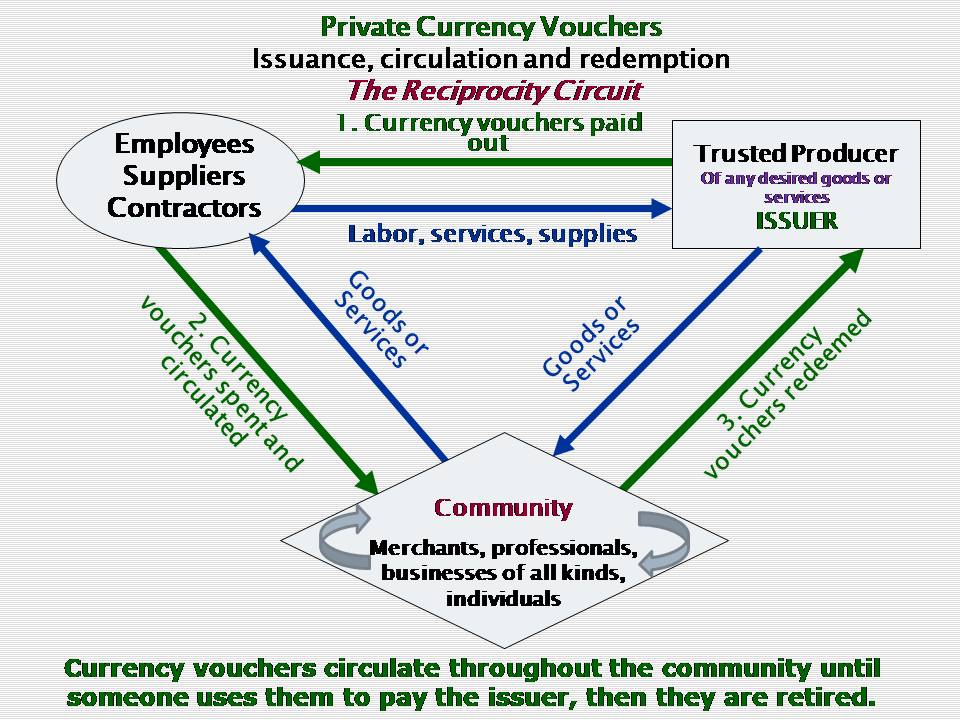
Issuance A currency enters into circulation when a provider of value offers it to another seller who accepts it as payment for their own goods or services, i.e., it is spent into circulation, not sold for fiat political money.
Circulation If it is to serve as a currency, a credit instrument must circulate freely and can change hands many times before eventually returning to the issuer for redemption, not for political money, but for the goods or services that are the issuer’s stock in trade.
Redemption and Extinction A currency is redeemed and extinguished when the reciprocity circuit has been closed, i.e., when the issuer accepts it back as payment for the goods and/or services that they are prepared to deliver immediately or in the near term.
Liquidity Liquidity is quite simply the ability to pay, i.e., having a payment medium that is widely accepted.
Monetization Monetization is the process of converting the value of an illiquid asset into a liquid form, i.e., a form that can be used as a payment medium (money/currency).
Who is qualified to issue a currency? Since a currency is a promise to deliver value, only producers and providers of real value are qualified to issue a currency.
Fallacious myths about money
The belief that money must be issued and controlled by governments and/or central banks.
The belief that banks collectively should have a monopoly on the allocation of credit.
The belief that interest is a necessary element in money creation and finance. How is conventional political money issued, and who issues it?
Virtually all political fiat monies are created by banks when they grant loans.
What are the flaws in political money system, and what are their impacts?
Most bank loans are made on an improper, or inadequate, basis or foundation.
Government and central bank currencies are no longer defined in terms of any real concrete value unit.
Thus, most political money is illegitimate and dishonest.
The interest that banks charge on loans far exceeds the cost of providing the service of monetizing the value of the collateral assets. This causes debts in the aggregate to grow exponentially over time making it impossible for all borrowers to repay what they owe, and making it certain that some must fail.
The concentration of money power in the hands of ever larger banks, in collusion with central governments, concentrates financial, economic and political power in the hands of an elite “super class” and undermines democratic government.
Assertions and Prescriptions
To preserve any semblance of social justice, economic equity, individual freedom, and democratic government, power must devolve to people in their various communities. The only feasible way of achieving that is through the creation of independent and honest mechanisms for exchanging value.
Such honest mechanisms include private currencies issued by providers of real value, and credit clearing associations that allocate credit on a sound basis to producers of real value, and enable them to exchange value without reliance on bank borrowing or the use of political money.
Such systems are not new; they have long existed and need only to be optimized, standardized, and networked together to provide means of exchange that are locally controlled yet globally useful.
The future will see the proliferation of entities that organize and enable the allocation of interest-free exchange credit to small- and medium-sized enterprises (SMEs) that are the backbone of resilient and sustainable community economies.
Standard procedures and protocols for credit allocation and management will emerge that will allow the effective networking of those entities into a global “internet of exchange” using credit that is locally controlled but globally useful.
In this interview I provide a succinct description of the present central banking, interest-based, debt money system and its dysfunctional nature, the global crisis that it has created, and what we can do to transcend it.
In October of last year (2022) I gave a remote presentation to the 6th Biennial RAMICS International Congress in Bulgaria. RAMICS is the Research Association on Monetary Innovation and Community and Complementary Currency Systems, which includes both academics and practitioners. In my illustrated presentation titled, Private and complementary currency systems: purposes, principles, practices, and performance, I provided a concise summary of key points and fundamental principles that need to be understood in order to transcend the dysfunctional and destructive political money system by decentralizing the control of credit and creating honest and effective, non-political exchange media. Here is an abstract of its contents.
Through the generous assistance and editing work of Ken Richings, the presentation is now available for viewing on YouTube. ______________ Peace or Empire?
Dennis Kucinich at Rage Against the War Machine At the February 19 anti-war rally in Washington, DC, former US Congressman Dennis Kucinich made an inspired call for peace, justice, compassion, and an end to corruption in government. I don’t believe that any reasonable person of good would disagree with his message. In a subsequent message, Can they ‘repeal’ the dead? Ask Orwell, Kucinich recounts the criminal invasion of Iraq by the US in 2003, the lies which were used to justify it, and its tremendous cost in material resources and lost lives. Another major consequence has been an erosion of trust in the US government both at home and abroad.
The achievement of peace in the world requires mutual respect and good faith negotiations, but unfortunately, peace is not the goal of those who have for some time been in control the US government under administrations of both parties, rather, they are bent on achieving “full spectrum dominance” and have chosen to restart the Cold War in hopes of weakening Russia and forcing it into line with the agenda of the New World Order in which the Western powers control all the Earth’s resources. If you want to get a more accurate picture of what’s actually been going on in eastern Europe, pay attention to former Marine and UN nuclear weapons inspector, Scott Ritter starting with his post, Give peace a chance.
And to round out the story of why the world is now on the brink of an unprecedented catastrophe, listen to the ever insightful Noam Chomsky, still sharp and coherent at age 94, speak about Putin, Ukraine, China, and Nuclear War. ______________________ Disturbing Thoughts (about the economy)
John Mauldin is “a visionary thinker, a noted financial expert, a New York Times best-selling author.” I’ve been a subscriber to his Mauldin Economics newsletter for at least a couple years. This edition seems particularly important, especially the section titled, “We’re Going to Have a Crisis.”
Citing the recent bank failures and the government’s decision to insure even the uninsured depositors, Mauldin observes that deposits will inevitably be withdrawn from smaller banks and placed in banks that are considered “too big to fail.” He argues that a major change is needed but that, “Our political system is sadly not up to the task. The current structure is all we have, and it won’t improve until a crisis forces change.” He quite emphatically concludes that “…the situation demands changes. Which means—and I don’t say this lightly—we’re going to have a crisis which will give us that change.”
Mauldin continues with an analysis of the developing crisis, particularly with regard to small banks’ exposure to declining asset values in commercial real estate. You can read the entire newsletter at Mauldin Economics. ___________
In April the Sonoran desert blooms, the fragrance of orange blossoms fills the air along with that of creosote bush, Palo Verde and a host of other plants. The winter chill has gone and the summer heat has not yet arrived. It is a particularly pleasant time to be here. I hope you are enjoying your home turf as much as I am mine.
The first edition of my book, The End of Money and the Future of Civilization, was published by Chelsea Green Publishing in 2009. While it remains as relevant today as it was when first published the printed book has been out of print for several years. But, having had the rights reverted to me by my publisher, I am making the entire book available for free in PDF format. You can read it or download it HERE. If you would like a hard copy of the first edition used copies can still be found on Amazon.com, Abe books, Thrift books and elsewhere.
Better still, you can avail yourself of the new revised and expanded 2024 edition which I have been working on for almost two years and is almost complete. Eighteen chapters have already been posted and can be freely read or download HERE.
My previous books, as published, may be freely accessed in digital format by clicking the title below.



 as relevant today as it was when first published the printed book has been out of print for several years. But, having had the rights reverted to me by my publisher, I am making the entire book available for free in PDF format. You can read it or download it HERE. If you would like a hard copy of the first edition used copies can still be found on Amazon.com, Abe books, Thrift books and elsewhere.
 Better still, you can avail yourself of the new revised and expanded 2024 edition which I have been working on for almost two years and is almost complete. Eighteen chapters have already been posted and can be freely read or download HERE.
 Beyond Money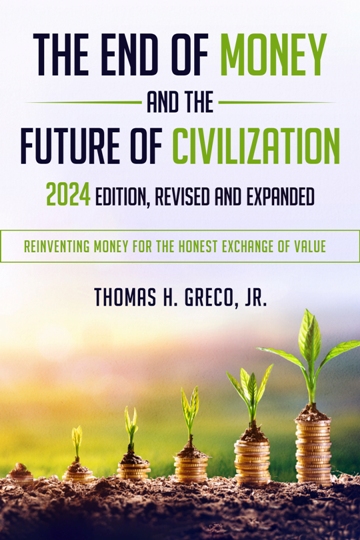
 Beyond Money