I subscribe to Alex Krainer’s Trend Compass channel on Substack, as well as his YouTube channel. Krainer provides historical lessons which highlight persistent patterns that impact our lives today. He recently published a two part essay on the West under oligarchs which describes today’s reality, which is the prevalence of oligarchic governments in the West hiding behind a facade of democracy. You can read them on Krainer’s Substack or view his video about it on YouTube, but I’ve taken the liberty of asking Google’s NotebookLM to provide this 7 minute video overview to whet your appetite.
And today I asked NotebookLM to generate another video overview (below) of Krainer’s Part 2 which tells the modern story of the oligarch’s takeover of Russia following the collapse of the Soviet Union in the 1990s, and describes how Vladamir Putin after his election as President, managed to reestablish government control and the rule of law. Can the US and other so-called Western “democracies” learn the lessons and do likewise?
My interview on the Pelle Neroth Taylor show on Thursday, May 30, 2024 was recorded and is now available. My portion of the show can be heard here, and a transcript can be seen here.
This is a wide-ranging conversation about the problems with the present political system of money and exchange, and the decentralized exchange mechanisms that have been developing in parallel with it, including both commercial and grassroots currencies and credit clearing exchanges.
In this issue: * Chapter 8—The Separation of Money and State * Upcoming interview on TNT Radio * Six Lessons Learned About Community Currencies * Mutual Credit Panel Discussion * Symbiotic Culture ____________________ Readers have already seen the first two items in the posts below. Here are the remaining three items: ____________________ 6 Lessons Learned from 40 years of experimentation with local and community currencies.
Over the past several decades, many local and community currencies have come, and most of them have gone. By observing all that, and by my own research and experience with Tucson Traders and LETS Sonora, I’ve discovered several fundamental principles that have led me to the prescriptions I have been offering. Here is a partial list:
1. A community currency, to be truly effective, must be more than a local version of the existing political fiat currency. 2. A community currency must be created independently of the banking system. 3. A community currency can be created by local producers of real value in the form of vouchers that they can spend into circulation. 4. The amount of vouchers spent into circulation must not exceed the amount that an issuer is able to redeem by delivering goods and services within a few months’ time. 5. Such voucher currencies may wander away from the local community, but they must eventually return to the community to be redeemed by the issuer. 6. Voucher currencies must have an expiration date or demurrage fee to stimulate a healthy velocity of circulation, and to guarantee their timely redemption.
Zachary Marlow, founder of the Moneyless Society initiative, has recently posted the video of a panel discussion on mutual credit which he hosted several weeks ago. I was one of the panelists, along with Matthew Slater, Dil Green, and Matthew Schutte. You can view it on YouTube. ___________________ Birthing the Symbiotic Age
Here is something that is truly different from the way most of us are accustomed to thinking about positive social, economic, and political change.
Richard Flyer has been working for decades to facilitate the emergence of what he calls a “Symbiotic Culture.” Inspired in large part by his involvement with the Sarvodaya movement in Sri Lanka, Richard has been describing in his new book an “Ancient Blueprint for a New Creation.” The book, which is being published in sections, goes beyond theoretical reasoning or wishful thinking, it is a story or Richard’s journey of discovery and his real-world experience in acting as a catalyst to help that “new creation” to come about. In a recently published section titled, Chapter 7, Part 2, The Conscious Community Network and Local Food Ecosystem,Richard describes how the Northern Nevada Local Food System Network was able to emerge out of his one-on-one conversations with six “super connectors,” showing them how their common interests could be served by connecting their individual “silos” and cooperating for the benefit of all. He reports that, “Through these six people’s networks alone, we expanded the playing field for our food network to almost one hundred organizations and the fifty thousand people they were connected to!” In explaining the success of the network, Richard described it this way:
“A Symbiotic Network is not a separate organization. Instead, it is a community-wide, multi-hub, network-centric ecosystem — really an “organism” — where power is shared by the stakeholders.”
It’s a virtuous, purpose-based network for mutual benefit, where participants ask, “What can I give?” It’s not a fixed coalition where each organization only wants to “get” something.
It’s a unique “umbrella” or “meta-network” designed to enhance the work and provide tangible benefit to each member organization and the whole community – not just another competing silo.
It’s a completely independent network, not controlled by an existing non-profit, business, or local government.
It’s an informal consortium that connects and proliferates the good in a region in one or more multiple domains (e.g., around food, education, health care, neighborhoods, arts and culture)—not a formal organization with a formal board of directors, executive director, CEO, employees, and budget.”
I am confident that if you read or listen to all three sections of his Chapter 7, you will want to go back to the beginning of the book to hear the rest of Richard’s remarkable story. ____________ Wishing you a pleasant summer, Thomas
I am scheduled to be interviewed by Bruce de Torres on his World Stage program on Saturday, February 24, 2024 during the first segment of the program from 2 PM to 3 PM Eastern time (11 AM to Noon Pacific time, Noon to 1 PM Arizona time). You can tune in to listen live at https://tntradio.live/.
Chapter 4, Central Banking and the Rise of the Money Power is now available here on this website, complete with end notes, along with previously published chapters 1, 2, and 3. Click on the links below to access the text and the audio narration directly. Additional chapters will be posted as they are completed here. Watch for Chapter 5 to be posted in about two weeks.
As always, your comments and suggestions will be welcomed. Thomas
Give me the power to create the money and make it legal tender and I can become owner of the entire world. — T. H. Greco, Jr.
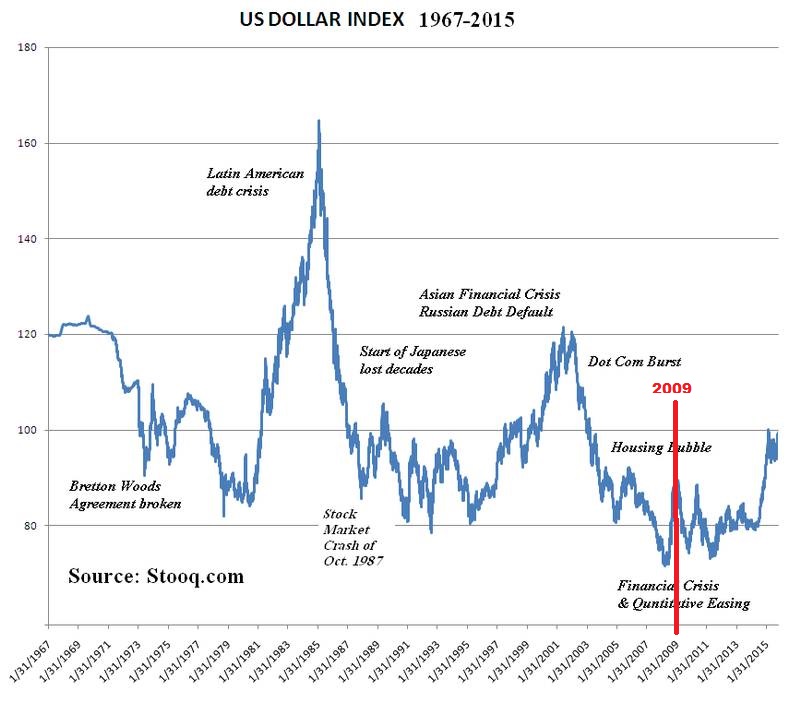
In 2009, while in the process of making the final edits to my book, The End of Money and the Future of Civilization, my editor took issue with my assertion that the declining value of the US dollar would continue indefinitely. He cited the increase in “value” of the dollar in the foreign exchange markets that was occurring at that time as evidence of my “error.”
I responded that the “value” of the dollar compared to other political currencies did not reflect its true value in relation to the real economy, i.e., what a dollar could buy, because all national currencies suffer from the same defects (improper and excessive issuance and the “growth imperative”), and virtually all of them are losing “purchasing power” because of it. The fluctuations in their market values relative to one another result from political and monetary policy decisions taken in their respective countries, not from any increase in their real value.
I argued that what the world has been experiencing in recent years is unprecedented. Never before in recorded human history has there been such a unitary system of money, banking and finance upon which the economies and peoples of virtually every nation of the world have come to depend.
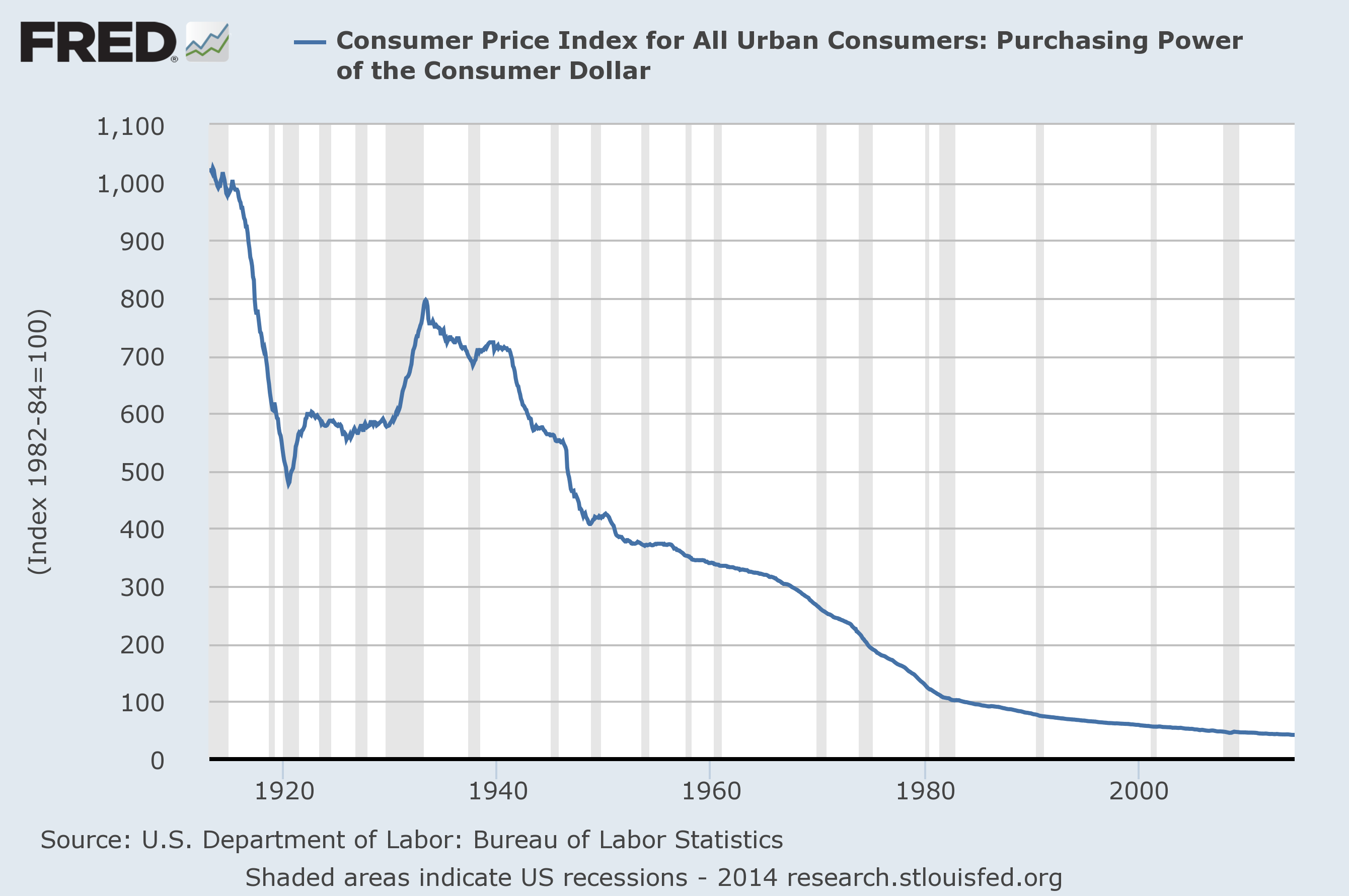
The long-term trends were, and remain, clearly evident and even worse than shown in the above graph. I referred my editor, among other things, to this Max Keiser video to drive home that point and to show that the Consumer Price Index (CPI) is being manipulated to make the decline in purchasing power look less bad than it actually is. Fortunately, that video is still available on YouTube. The mountain of evidence that has been accumulated during the years since the publication of my book has made it patently clear that my assertions were correct. The cost of living due to the debasement of the US dollar has not only continued to increase but has accelerated with the extreme measures that were taken during the pandemic years. Thus, the real value of the dollar, i.e., its purchasing power, has continued to decline even more rapidly than before, as indicated by the recent upturn in the CPI shown in the graph below.
If a strong dollar is in the interests of maintaining confidence and perpetuating the global system, the central banks of the western alliance will rally to support it. If currency inflation is causing prices to rise too rapidly in one place, the effects will be shifted to another place. In efforts to limit inflation overall, the productive sectors of the economy will be starved for credit, causing sound businesses to fail and more jobs to be sacrificed. People who have lost their livelihood are in no position to demand higher wages. Indeed, they will fight with one another to get whatever they can garner from a weakened economy. I argued at the time, and still maintain that the businesses that survive will be the huge corporations that enjoy favored treatment in receiving government bailouts and credit from banks and that those corporations will continue to grow ever larger through acquisitions, consolidations, and market dominance.
Cancer and the Debt Growth Imperative
One of humanity’s most dreaded diseases is cancer, which is tissue growth that has become uncontrolled and purposeless. It is growth of the wrong sort and in the wrong places which eventually kills itself as it kills the body of its host. Such has also been the nature of much of the economic growth that the world economy has experienced over the past many decades.
The debt-growth, economic-growth imperative that I have written so much about and summarized in The Usury Conjecture, can be visualized by thinking of the financial economy as a balloon that is attached to an air tank that is relentlessly filling the balloon with air. If you squeeze the balloon at one point to try to stop its expansion, it will simply bulge out somewhere else. In this analogy the air is debt, and the pressure in the air tank is generated by the interest that is applied to the “loans” that banks make to create fiat debt-money. The ever-growing debt must show up either in the private sector or in the public sector.
Those few who control the interest-based, debt-money regime have historically been given everything they’ve asked for to keep this flawed and destructive system alive. They have amassed enormous financial, economic and political power and are intent on owning and controlling everything. Nothing is sacrosanct; all will be sacrificed on the altar of Mammon because of this Faustian bargain between the money powers and the political powers that was struck centuries ago.
But despite the powerful tools at their disposal, they cannot forever avoid the inevitable. As the long-term negative trends continue and the symptoms become ever more severe, the people, communities, and independent producers who are adversely affected will get serious about rediscovering and inventing ways to escape. They will deploy their own honest and effective means of exchange and finance that will ultimately displace the old dysfunctional and destructive political system of money and finance.
Fortunately, the honest and effective systems of exchange and finance that I’ve long been describing in my books, The End of Money and the Future of Civilization, and Money: Understanding and Creating Alternatives to Legal Tender, are already available and are being employed at the margins of the economy. While their scale of operation is still relatively modest, it is inevitable that as improvements are made and their necessity becomes ever more evident, efforts to decouple from the dominant monetary and financial regime will continue to intensify, money banking and finance will be reinvented, and the chaos that now reigns will give way to a better world for all.
What You Need to Know About Money. Currency, Credit, and Exchange
Abstract: There remains today, even among economists and “experts,” a general lack of understanding about the essential nature of money, currency and credit, and sound principles of their creation and management. This article provides a point-by-point summary of fundamental concepts and basic principles of exchange, it outlines the systemic defects and destructive nature of the dominant political, central banking, interest-based, debt-money system, and describes the ways in which honest and effective exchange media can be created on a decentralized basis outside of the banking system and in lieu of political money. A wider understanding of these points will lead to the widespread creation of honest exchange mechanisms and the devolution of financial, economic and political power that can change the course of civilization from self-destruction toward peace, justice, freedom and harmonious relationships.
The essential nature of money/currency A currency is a credit instrument, i.e., a promise to deliver valuable goods and/or services.
Basis of Issue A currency must therefore be issued into circulation on the basis of some value foundation, i.e., goods and/or services that the issuer is ready, willing, and able to sell immediately or in the near future.
Purpose of a currency The sole purpose of a currency is to facilitate the reciprocal exchange of value in the market. It is not a measure of value, nor is it a savings medium.
Reciprocal Exchange Reciprocal exchange is the voluntary exchange of one sort of value for another in the market.
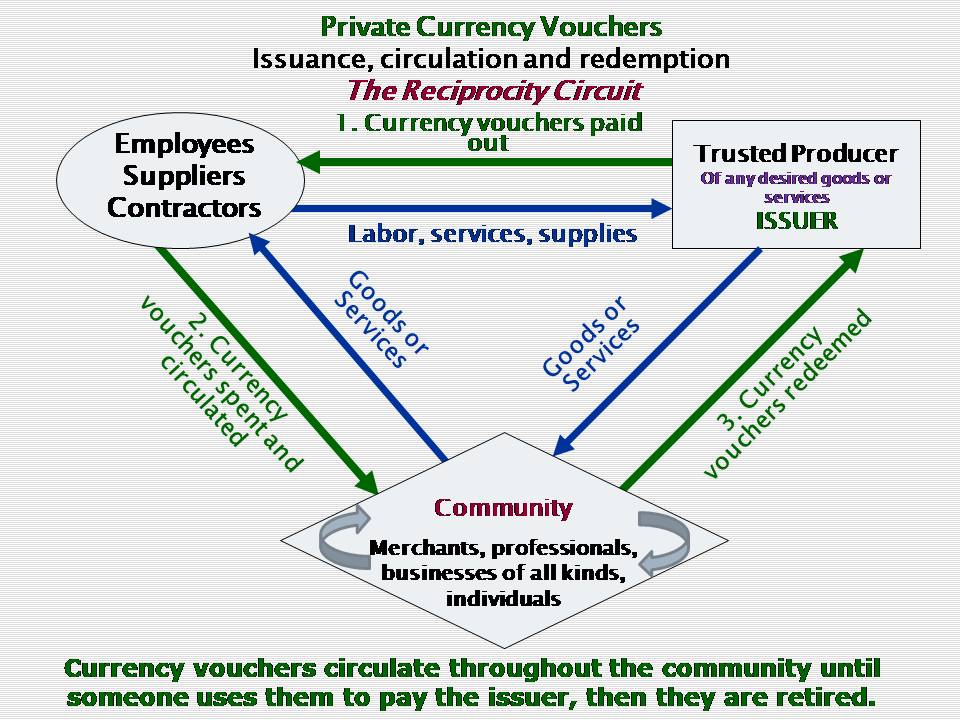
Issuance A currency enters into circulation when a provider of value offers it to another seller who accepts it as payment for their own goods or services, i.e., it is spent into circulation, not sold for fiat political money.
Circulation If it is to serve as a currency, a credit instrument must circulate freely and can change hands many times before eventually returning to the issuer for redemption, not for political money, but for the goods or services that are the issuer’s stock in trade.
Redemption and Extinction A currency is redeemed and extinguished when the reciprocity circuit has been closed, i.e., when the issuer accepts it back as payment for the goods and/or services that they are prepared to deliver immediately or in the near term.
Liquidity Liquidity is quite simply the ability to pay, i.e., having a payment medium that is widely accepted.
Monetization Monetization is the process of converting the value of an illiquid asset into a liquid form, i.e., a form that can be used as a payment medium (money/currency).
Who is qualified to issue a currency? Since a currency is a promise to deliver value, only producers and providers of real value are qualified to issue a currency.
Fallacious myths about money
The belief that money must be issued and controlled by governments and/or central banks.
The belief that banks collectively should have a monopoly on the allocation of credit.
The belief that interest is a necessary element in money creation and finance. How is conventional political money issued, and who issues it?
Virtually all political fiat monies are created by banks when they grant loans.
What are the flaws in political money system, and what are their impacts?
Most bank loans are made on an improper, or inadequate, basis or foundation.
Government and central bank currencies are no longer defined in terms of any real concrete value unit.
Thus, most political money is illegitimate and dishonest.
The interest that banks charge on loans far exceeds the cost of providing the service of monetizing the value of the collateral assets. This causes debts in the aggregate to grow exponentially over time making it impossible for all borrowers to repay what they owe, and making it certain that some must fail.
The concentration of money power in the hands of ever larger banks, in collusion with central governments, concentrates financial, economic and political power in the hands of an elite “super class” and undermines democratic government.
Assertions and Prescriptions
To preserve any semblance of social justice, economic equity, individual freedom, and democratic government, power must devolve to people in their various communities. The only feasible way of achieving that is through the creation of independent and honest mechanisms for exchanging value.
Such honest mechanisms include private currencies issued by providers of real value, and credit clearing associations that allocate credit on a sound basis to producers of real value, and enable them to exchange value without reliance on bank borrowing or the use of political money.
Such systems are not new; they have long existed and need only to be optimized, standardized, and networked together to provide means of exchange that are locally controlled yet globally useful.
The future will see the proliferation of entities that organize and enable the allocation of interest-free exchange credit to small- and medium-sized enterprises (SMEs) that are the backbone of resilient and sustainable community economies.
Standard procedures and protocols for credit allocation and management will emerge that will allow the effective networking of those entities into a global “internet of exchange” using credit that is locally controlled but globally useful.
Unlike, government and central bank fiat currencies which promise nothing but their acceptance as tax payments, private currency vouchers promise to be redeemed for real valuable goods and services. If the issuer is trustworthy and can be counted on to honor their pledge of redemption, their currency vouchers can provide traders with an exchange and payment medium that is superior to government and central bank fiat monies. Such honest currencies are neither novel nor odd, but have a long history and are an absolute necessity for the decentralization of economic and political power and the emergence of a peaceful and equitable social order.
So what sorts of entities can be trusted to keep their promises, how do they put their currencies into circulation, are such currencies legal, have such currencies ever been issued before? In brief, a currency voucher is spent into circulation when the issuer offers it as payment to a supplier, employee or a creditor, who accepts it as such. In the United States and most other “free” countries, private currency vouchers are entirely legal and there are numerous historical instances of their issuance and circulation. These questions and many other details have been fully answered over the years in my various writings and presentations, most of which have been posted or linked on my website, https://beyondmoney.net/. Particularly relevant are my book, The End of Money and the Future of Civilization, as well as my 2021 presentation, Transcending the present political money system–the urgent need and the way to do it, and my 2021 webinar series, Our Money System – What’s Wrong with it and How to Fix it.
A few years ago I wrote up a proposal for a private currency voucher that I call the Solar Dollar which attracted some significant interest. My intention was twofold, one, to provide an independent payment medium for a local community, i.e., a currency that can be created outside of the banking system and thus empower participants in a local economy by compensating for shortages and mal-distribution of government fiat money, and two, to incentivize the shift of energy production, sales and usage toward solar and other renewable sources of electric power. My hope was that some electric utility company somewhere would implement the plan and become a model for others utilities to follow. That, unfortunately, has not yet happened but I am confident that it, or something like it, eventually will. In the meantime, I’ve continued to publicize it, and in 2021 I was invited to give a presentation titled, Solar Dollars–Empowering Communities While Powering Communities With Renewable Energy, for a virtual conference that was sponsored by the Zero Carbon Lab at the University of Hertfordshire (UK). Later that year, under the good auspices of Professor Ljubomir Jankovic, my original white paper was revised and published with the title, Solar Dollars: A Complementary Currency that Incentivizes Renewable Energy, in the academic journal, Frontiers in Built Environment.
Overall, the primary objective of my work has been, and remains, the decentralization of financial, economic, and political power. The most promising strategy for achieving that is the design and deployment of private credit currencies that are spent into circulation by trusted issuers that are ready, willing, and able to redeem their currencies promptly for the real goods and services that are their normal stock in trade. By breaking the credit monopoly that the banking cartel presently holds, and empowering producers and sellers of real value, it then becomes possible to reverse the longstanding trend toward ever greater power and wealth in the hands of the global elite who have captured the machinery of finance, economics, and government.
The Solar Dollar is a special case and example of a private credit currency issued by a trusted producer and provider of real value, but similar objectives could be achieved by companies in other lines of business, for example, by:
The issuance of local Farm Produce Dollars that would be spent into circulation by a single local farmer or jointly by a cooperating group of local farmers and ranchers, or by
The issuance of local Shelter Certificates that are spent into circulation by a single local owner of rental property or jointly by a cooperating group of local owners of rental property, or by
The issuance of Service Certificates by a local provider of some sort of professional or household services, or jointly by a cooperating group of such service providers, or by
The issuance of currency vouchers by all of the above producers/providers and others who band together to cooperatively issue a sound complementary currency under a common “brand.” Such a currency would provide a means of payment that is not only independent of the banking system but solidly backed by the combined production and distribution capacity of all participating businesses. (Many “community currencies” have been created over the years in many places around the world but virtually all of them are “sold” for government fiat currencies which defeats the main objective of creating a currency that is independent of government and the banking system).
All of these currency vouchers or credits are able to circulate as payment media throughout their local communities to enable trading despite any scarcity or unavailability of official money. There are many historical and contemporary examples of such private credit instruments, so most of what I’m suggesting has already been shown to be workable. The main problem I have observed is getting producers of real value to recognize the power they already have and to exercise it on their own behalf and that of their communities.
“The stream of political monies from the beginning to the present day runs deep and dirty, yet to suggest that money can spring from any other source is to surprise if not even to dismay. So has tradition dulled men’s senses. No matter how often the state fails to supply a virtuous money system, men rush back to it in desperation and beg it to try again. Indeed, until we learn that the money power resides in us, we must abjectly beg the state to give us an exploitative system because we cannot return to a moneyless civilization. Yet, no matter how often and earnestly the state tries to provide a true money system, it must fail because of an inherent antipathy between the money issuing power and the taxing power. A money issuer must be a seller who bids for money, not a taxer who requisitions it in whole or in part, as politically expedient and without a quid pro quid.” — pp. 25-26.
Political democracy cannot work without economic democracy; and the money power is the franchise of the latter. — p. 35
It is the false concept of political money power that converts citizens into petitioners, and makes government a dispenser of patronage instead of a public servant. This power of patronage utterly destroys the democratic system of government – since the people cannot be both petitioners and rulers.” — pp. 78-79
Throughout my career as a monetary theorist, educator, and advisor, taking up where Riegel and others have left off, I have tried to influence producers, entrepreneurs, and social organizers toward effective action based on sound principles of credit allocation and management. But superstitious myths die hard and old habits are difficult to break. The great majority of people remain in thrall to official currencies. That is what the oligarchs depend upon to keep us in debt and under their control. I have learned to be patient and await the changes in financial, economic, and political conditions that will open people’s minds to adopting self-help and cooperative approaches to getting our needs met, specifically, the need for free and fair exchange of value in the marketplace.
Surely, the day will come, and is rapidly approaching, when the failures and demands of the dominant global central banking, political, interest-based, debt-money regime will become so clearly evident and abysmal that the only peaceful option will be for we-the-people to implement our own systems of exchange and finance grounded in our own initiative and judgment in allocating credit based on productive capacity and trustworthiness.
Issuance, circulation and redemption of Private Currency Vouchers
One of my most popular posts has been, There once was a river …an allegorical tale of money and credit, in which I’ve tried to show how we have all become slaves to money and those who control money. Using water in this little fable to represent money, I’ve also tried to show that we the people can free ourselves by thinking outside the box to overcome our fixation on the sort of money that has been provided for us and over which we have lost all control.
Every metaphor of course is limited and what I am hoping that readers/listeners will come to understand is that there are alternatives to conventional money that we can use to reduce, and eventually eliminate our dependence upon conventional political money. It is credit that is the foundation of an honest system of exchange and we have the power to give credit to each other in accordance with our own values and objectives, outside of conventional banks and without charging interest.
You can access the story on my website (audio with transcript) or on YouTube (audio). Or listen here.
The first edition of my book, The End of Money and the Future of Civilization, was published by Chelsea Green Publishing in 2009. While it remains as relevant today as it was when first published the printed book has been out of print for several years. But, having had the rights reverted to me by my publisher, I am making the entire book available for free in PDF format. You can read it or download it HERE. If you would like a hard copy of the first edition used copies can still be found on Amazon.com, Abe books, Thrift books and elsewhere.
Better still, you can avail yourself of the new revised and expanded 2024 edition which I have been working on for almost two years and is almost complete. Eighteen chapters have already been posted and can be freely read or download HERE.
My previous books, as published, may be freely accessed in digital format by clicking the title below.






 Beyond Money