Here’s another report from RT television about the reasons for the NATO invasion of Libya and the overthrow of the Gadhafi government.

Here’s another report from RT television about the reasons for the NATO invasion of Libya and the overthrow of the Gadhafi government.
Posted in Developing Alternatives, Geo-politics, The Political Money System
Tagged Gadhafi, Gold Dinar, Libya
One of my correspondents recently alerted me to a review of David Harvey’s book, The Enigma of Capital, and the crises of capitalism. I’ve not seen the book, but if the review is a faithful description, the book seems to be well worth reading.
I’m not inclined to frame my analyses and prescriptions in terms of competing ideologies because that leads to immediate resistance by the true believers on one side or another. Rather, we need to encourage people to think outside of their comfortable boxes by pointing out implicit assumptions and evident dysfunctions, and suggesting structural as well as policy changes that show promise of providing better outcomes.
Of course, what constitutes a better outcome will always be a point of disagreement based on the fundamental values, attitudes, and beliefs that different segments of society hold dear (e.g., the 1% vs the 99% that the Occupy movement has been highlighting). Besides that, our desires and expectations must ultimately adjust to the reality of our planetary limits to physical growth.
Based on the review, the points that I may agree or disagree with Harvey about are inserted in red in the review below.
The Enigma of Capital, and the crises of capitalism, By David Harvey
Review by Andrew Gamble
Friday, 30 April 2010
Andrew Mellon, the US Treasury Secretary during the Great Crash of 1929 and one of America’s richest men, observed that in a crisis assets return to their rightful owners. Nothing much has changed. As the present crisis has mutated from a banking crisis to a fiscal crisis and a sovereign debt crisis, bonuses continue to be paid, while the people of Greece and Iceland suffer huge cuts in jobs and services.
As the head of Citibank helpfully pointed out, “Countries cannot disappear. You always know where to find them.” Once the bubbles are burst, expectations about asset values are dashed, optimism gives way to despair, and wealth is ruthlessly redistributed. Capitalism survives by purging itself of debt and loading the costs of adjustment on the weak and the poor.
[I agree, but something needs to be said about HOW it purges itself of debt. We’ve seen very clearly in this latest cycle how the capitalists have come away whole by pushing the debt off onto the public sector by means of government bailouts. That has cause severe fiscal (budgetary) problems for governments, which now are pressured to cut spending. That is where the weak and the poor (including the “middle class”) get fleeced and sacrificed because the cuts are typically made in social spending and programs that promote the common good.]
For David Harvey, this is the latest of the great structural crises which have punctuated the development of capitalism and which signify that major limits have been reached to further growth. Crises on this view are inherent in capitalism itself, and the means by which it renews itself. Only a periodic clear-out of debt and unproductive activities creates the basis for a further leap forward.
Harvey is less interested in the detail of how the 2007-8 crisis unfolded than in understanding it as a manifestation of how capitalism works. Over the last two decades, he has become a leading exponent of classical Marxist political economy, his work known for its exceptional clarity and for integrating spatial categories into the theory of capital accumulation.
Capitalism in the last 200 years has proved itself by far the most dynamic and productive economic system known to history, but the wealth comes at a price, both for human beings and increasingly for the natural environment.
Periodically, capitalism over-expands and overshoots, encountering limits it cannot immediately transcend. This is a system which must keep expanding by at least 3 per cent a year. What drives it is the hope of profit, and this impulse comes to shape all social relations as well as nature. During booms, capital accumulates very fast, but the amount of surplus generated becomes harder and harder to absorb. The investments that have been made in the boom fix capital in all sorts of ways, in buildings, cities, regions and countries, as well as in labour forces and ways of organising production.
After a time many of these past investments no longer yield a high return and sometimes no return at all. This is what precipitates the crisis. It may take the form of a profits squeeze, caused by militant labour wresting gains from capital, or by factors depressing the rate of profit, or by too little demand. Harvey argues that the present crisis is particularly hard to resolve because it comes after a long period in which real incomes in the US have stagnated, while the wealth of the property-owning elite has soared.
The gap between what labour was earning and what it would spend was covered by credit. The average debt of per household, including mortgage repayments, was $40,000 in 1980. By 2007 it was $130,000. Getting this debt down and restarting the economy is a huge task.
[I too have been preaching that the limits to growth have been reached, and yes, however one might choose to characterize an economic system (capitalist, socialist, or otherwise), there must be a periodic “clear[ing]-out of debt and unproductive activities,” for the system to maintain its vitality, but not necessarily to make way for further growth.
I’m wondering if Harvey’s book adequately explains the phenomenon of “expansion and overshoot,” and whether or not that would also occur under his conception of a alternative non-Capitalist system. I’m also wondering about the basis for his statement that, “This is a system which must keep expanding by at least 3 per cent a year.” I’ve seen estimates that run closer to 6%. My own belief is that the proximate driver of continual economic growth is the compounding of interest that is a fundamental feature of our global monetary system, and that the surplus that is created by the economy goes largely into capital concentration and profit-seeking reinvestment, rather than to increased and more equitable consumption. Thus, we see starvation and want amidst plenty.]
Harvey is pessimistic that growth can be restarted without the infliction of quite unimaginable hardships on the many of the world’s poorest people. Capitalism survives by socialising losses and distributing gains to private hands. Harvey devotes a large part of his argument to show how this is done through the close ties of the state and finance. He calls it the state-finance nexus.
[Yes, this is an increasingly obvious point. I’m glad to see that Harvey is highlighting the “state-finance nexus.” I trace that back to the founding of the Bank of England in 1694, which established the pattern of central banking and government-banking collusion that has since spread around the world and culminated in a rather monolithic regime. But there are cracks beginning to form.]
This is not a conspiracy: both sides of the relationship need one another and support one another. There are frictions and conflicts, but in the end they work together because this is the only system anyone knows or thinks can be made to work. Michael Bloomberg, as Mayor of New York, commissioned a report which declared that excessive regulation in the US was threatening the future of the financial sector in New York.
The financial crash of 2008 destroyed the credibility of the financial growth model put in place after the last great capitalist crisis in the 1970s. It has also, as Harvey notes, put a question-mark over the continuance of US hegemony, because of the shift in the balance of the global economy towards the rising powers of India and China.
He thinks that the accumulated rigidities over the last cycle have become so great that only a very fundamental restructuring can restore the basis for renewed economic growth. But the pressure for an early return to business as usual are very great, threatening an early return of credit and debt as the only way to fuel the economy, and the eruption of another crisis in a few years.
Harvey argues that each major capitalist crisis has been worse than the last one, and more difficult to surmount. He accepts that capitalism, with all its resilience and inventiveness, is quite capable of overcoming this crisis too; but he is sceptical, and believes that this is the moment that a revived anti-capitalist movement can seize the opportunity to put forward a realistic alternative to capitalism as a way of organising the economy.
[Yes, it is evident that each successive cycle is more extreme than the last. The financial system based on interest-bearing debt is shaking itself apart.
It seems odd that he attributes “resilience and inventiveness” to capitalism. These are human qualities that might thrive in a variety of circumstances. The question is how, specifically, to support them. ]
This is perhaps where the argument is least convincing. The anti-capitalist left is fragmented and not particularly numerous. Radical political responses during previous capitalist crises have often favoured the right. The rise of China and India, both of which have continued to grow through the recession, suggests that the fundamental shift in the balance of the global economy is only just beginning, and if it continues is likely to provide huge potential for growth and absorption of surplus, provided certain political conditions are met.
This will not be easy but is certainly possible. Marx thought that no social order ever perishes before all the productive forces for which there is room in it have developed. On the evidence Harvey himself provides, capitalism still has a long way to go before that is the case, and no gravediggers are in sight.
[What are the physical limits to the application of those “productive forces?” It is evident that the masses of India and China cannot possibly achieve the levels of consumption and way of living that have prevailed in the West. The emphasis must shift from capital accumulation and increasing consumption to more equitable distribution and better quality of life for all.]
But this book is a welcome addition to the literature on the crisis. It provides a lucid and penetrating account of how the power of capital shapes our world, and sets out the case for a new radicalism and a vision of alternatives. What we need, he argues, is not just a new world but a new communism, following the failure of the old – although he does accept ruefully that using “communist” as a political label may not bring instant success in the United States.
[I guess we will need to read the book to see what Harvey has to propose in making the “case for a new radicalism and a vision of alternatives.”]
Andrew Gamble is Professor of Politics at the University of Cambridge and author of ‘The Spectre at the Feast’ (Palgrave Macmillan)
[Annotated comments by Thomas H. Greco, Jr.]
Posted in Finance and Economics, Geo-politics, The Political Money System
Tagged Caapital, capitalism, Harvey, The Independent
From the beginning of the NATO offensive against the Gadhafi regime in Libya, there has been a lot of buzz about the real reasons behind the Western powers’ agenda for regime change. This article from the New American sketches a plausible explanation. It may have had more to do with Gadhafi’s new money plan than it did about Libya’s oil riches.—t.h.g.
Gadhafi’s Gold-money Plan Would Have Devastated Dollar
Written by Alex Newman
Friday, 11 November 2011 10:15
It remains unclear exactly why or how the Gadhafi regime went from “a model” and an “important ally” to the next target for regime change in a period of just a few years. But after claims of “genocide” as the justification for NATO intervention were disputed by experts, several other theories have been floated.
Oil, of course, has been mentioned frequently — Libya is Africa‘s largest oil producer. But one possible reason in particular for Gadhafi’s fall from grace has gained significant traction among analysts and segments of the non-Western media: central banking and the global monetary system.
According to more than a few observers, Gadhafi’s plan to quit selling Libyan oil in U.S. dollars — demanding payment instead in gold-backed “dinars” (a single African currency made from gold) — was the real cause. The regime, sitting on massive amounts of gold, estimated at close to 150 tons, was also pushing other African and Middle Eastern governments to follow suit.
And it literally had the potential to bring down the dollar and the world monetary system by extension, according to analysts. French President Nicolas Sarkozy reportedly went so far as to call Libya a “threat” to the financial security of the world. The “Insiders” were apparently panicking over Gadhafi’s plan.
“Any move such as that would certainly not be welcomed by the power elite today, who are responsible for controlling the world’s central banks,” noted financial analyst Anthony Wile, editor of the free market-oriented Daily Bell, in an interview with RT. “So yes, that would certainly be something that would cause his immediate dismissal and the need for other reasons to be brought forward [for] removing him from power.”
According to Wile, Gadhafi’s plan would have strengthened the whole continent of Africa in the eyes of economists backing sound money — not to mention investors. But it would have been especially devastating for the U.S. economy, the American dollar, and particularly the elite in charge of the system.
“The central banking Ponzi scheme requires an ever-increasing base of demand and the immediate silencing of those who would threaten its existence,” Wile noted in a piece entitled “Gaddafi Planned Gold Dinar, Now Under Attack” earlier this year. “Perhaps that is what the hurry [was] in removing Gaddafi in particular and those who might have been sympathetic to his monetary idea.”
Investor newsletters and commentaries have been buzzing for months with speculation about the link between Gadhafi’s gold dinar and the NATO-backed overthrow of the Libyan regime. Conservative analysts pounced on the potential relationship, too.
“In 2009 — in his capacity as head of the African Union — Libya’s Moammar Gadhafi had proposed that the economically crippled continent adopt the ‘Gold Dinar,’” noted Ilana Mercer in an August opinion piece for WorldNetDaily. “I do not know if Col. Gadhafi continued to agitate for ditching the dollar and adopting the Gold Dinar — or if the Agitator from Chicago got wind of Gadhafi’s (uncharacteristic) sanity about things monetary.”
But if Arab and African nations had begun adopting a gold-backed currency, it would have had major repercussions for debt-laden Western governments that would be far more significant than the purported “democratic” uprisings sweeping the region this year. And it would have spelled big trouble for the elite who benefit from “freshly counterfeited funny-money,” Mercer pointed out.
“Had Gadhafi sparked a gold-driven monetary revolution, he would have done well for his own people, and for the world at large,” she concluded. “A Gadhafi-driven gold revolution would have, however, imperiled the positions of central bankers and their political and media power-brokers.”
Adding credence to the theory about why Gadhafi had to be overthrown, as The New American reported in March, was the rebels’ odd decision to create a central bank to replace Gadhafi’s state-owned monetary authority. The decision was broadcast to the world in the early weeks of the conflict.
In a statement describing a March 19 meeting, the rebel council announced, among other things, the creation of a new oil company. And more importantly: “Designation of the Central Bank of Benghazi as a monetary authority competent in monetary policies in Libya and appointment of a Governor to the Central Bank of Libya, with a temporary headquarters in Benghazi.”
The creation of a new central bank, even more so than the new national oil regime, left analysts scratching their heads. “I have never before heard of a central bank being created in just a matter of weeks out of a popular uprising,” noted Robert Wenzel in an analysis for the Economic Policy Journal. “This suggests we have a bit more than a rag tag bunch of rebels running around and that there are some pretty sophisticated influences,” he added. Wenzel also noted that the uprising looked like a “major oil and money play, with the true disaffected rebels being used as puppets and cover” while the transfer of control over money and oil supplies takes place.
Other analysts, even in the mainstream press, were equally shocked. “Is this the first time a revolutionary group has created a central bank while it is still in the midst of fighting the entrenched political power?” wondered CNBC senior editor John Carney. “It certainly seems to indicate how extraordinarily powerful central bankers have become in our era.”
Similar scenarios involving the global monetary system — based on the U.S. dollar as a global reserve currency, backed by the fact that oil is traded in American money — have also been associated with other targets of the U.S. government. Some analysts even say a pattern is developing.
Iran, for example, is one of the few nations left in the world with a state-owned central bank. And Iraqi despot Saddam Hussein, once armed by the U.S. government to make war on Iran, was threatening to start selling oil in currencies other than the dollar just prior to the Bush administration’s “regime change” mission.
While most of the establishment press in America has been silent on the issue of Gadhafi’s gold dinar scheme, in Russia, China, and the global alternative media, the theory has exploded in popularity. Whether salvaging central banking and the corrupt global monetary system were truly among the reasons for Gadhafi’s overthrow, however, may never be known for certain — at least not publicly.
# # #
Posted in Finance and Economics, Geo-politics, The Political Money System
Tagged Gadhafi, Gold Dinar, Libya, NATO, regime change, The New American
Here is an article I came across that provides some further insights about the current mood of the people and the Occupy movement.—t.h.g.
The Re-Greening of Our Hearts (Part 1)
By Jack Adam Weber – Guest Writer for Wake Up World. 14th October 2011
Here we are in the thick of Occupy Wall Street, with the movement and its message spreading worldwide, loud and clear: No more collusion by government and Big Business. No more tax cuts for the already rich and dirty. No more destruction of our planet for the bad habit of bullying-billionaire-ism, an epidemic disease attacking the weak of heart and low morale.
In the first weeks of the ongoing Fukushima disaster I read too many editorials describing the choice between a nuclear or more sustainable future as hinging on the monetary cost to multinational companies, government, and taxpayers. Does it also make you squirm in your skin to hear our world fixated on economic gain at any cost, with the real possibility of environmental collapse as well as species and human extinction from toxic waste streams given secondary concern? Do you care more about remaining “competitive” in the international marketplace above the survival and health of your children and family?
I have reached my limit of political puppet talk to distract attention from and justify the destruction of life on Earth. I could give a crap about the International Marketplace, whatever it is. Come to think of it, I think we should downsize the mythic International Marketplace by 90% (I’d still like to have curry powder to cook with) and replace it with hundreds of regional festivals where we all camp out and envision a new, locally-based future. Camp Headquarters will be biking distance from your home!
We need a new paradigm for living and doing business on Earth, not just an adjustment of the current system. We need a modus operandi that is eco-centric not solely human-centric. This orientation forms the crux of Deep Ecology, which perceives nature as sacred, not primarily a commodity for human progress and development. By granting Nature a right to live and thrive, we grant the same to humanity. We can no longer pretend as though nature is forever indispensable [sic.] and able to re-grow itself no matter the pace at which we use it up. Or that some fantastic messianic miracle of technology is going to save us and regenerate what we have denigrated. Even if there were such a technology, what kind of world would remain in the aftermath?
Posted in Emerging paradigm, Geo-politics, The Political Money System
Tagged bailout, Occupy Wall Street
Occupy Wall Street and the many related offshoot occupations are raising a lot of questions. These will not be quickly answered, but one thing is clear–increasing numbers of people are fed up with the political and economic status quo. They are not only expressing their dissatisfaction and disgust, but they are looking for ways to make positive changes that will benefit everyone, not just the few who are presently in control.
Michael Hudson is one of the few university economists who understands the systemic nature of our global economic malaise, and is willing to speak frankly about it. The following is a recent interview that is worth watching.–t.h.g.
Posted in Exchange Design, Geo-politics, The Political Money System
Tagged Michael Hudson, Occupy Wall Street
Because of the way in which its people have responded to the financial crisis, tiny Iceland has drawn a lot of attention lately. Some pertinent information about this was provided in a previous post. Prof. Margrit Kennedy, author of Interest and Inflation Free Money, traveled to Iceland recently on a fact-finding tour. Her report below provides some additional insights. –t.h.g.
A Visit in Iceland
Margrit Kennedy. 23 September 2011
[English translation by Prof. Philip Beard, Ph.D.]
When I read an article two months ago about the state bankruptcy in Iceland and the public’s refusal to accept the government’s debt retirement plan, as a result of which the three largest banks became insolvent, I decided to travel to Iceland. I wanted to find out whether the new, popularly-elected 25-member Council, whose job was to formulate proposals for a new constitution, had made any statements regarding the monetary or financial system. No such news had shown up in the several reports and English translations I’d gathered.
So a week ago, off I flew, after having received a few contact addresses from friends and having made three appointments with “Constitutional Council” members via email. I stayed in Reykjavik from 9/13 till 9/19 and then went for a day to Solheimar, Iceland’s only eco-village, whose director had supplied me with these council members’ addresses.
Hardly had I arrived at my Reykjavik hotel when the first of my interlocutors showed up: Salvör Nordal. A professor of ethics at Reykjavik University, she answered my questions patiently, and in about the first half hour filled me in on what all my later conversations would confirm: No, no one had said anything about the systemic monetary roots of the crash. The Council’s discussions revolved around laying new groundwork for their democracy, environmental protection and protection of the commons, more transparency in governmental affairs and thereby better regulatory capacities. She was glad to hear and watch my short presentation on the topic “Money rules the world! — But who rules the money?”, and immediately said, “You must meet my friend in the finance ministry. For sure, she’ll be fascinated by what you’ve got to say.” Then she departed. It was Tuesday evening.
The next day I met the man who had been elected to the Council with the most votes, the economist Prof. Sylfarson. We had a short, congenial conversation of about an hour in which I learned that from where he stood, the situation in Iceland had returned to “normal”. Before the crash everything had been more or less exaggerated: salaries, the value of the Icelandic crown, housing prices, the standard of living. In his opinion his countryfolk were still doing well (which corresponded to my own first impressions), and Iceland was now catching up to the rules that every other European democracy had been practicing for decades, e.g. universal suffrage, transparency of public budgets, environmental laws, etc.
And no, the monetary system had not come under discussion. Monetary matters remained pretty much as they had been, except that an index was now being applied to loans in order to reduce excessive credit demands.
He had never heard of complementary currencies, though he was very interested in the couple of examples I described to him and asked me to send him more information.
My third conversation partner was the young singer Svarvar, a friend of friends who had witnessed the so-called “revolution” but hadn’t taken part in it. His opinion was that people had just been venting their fury at having all gotten poorer again, but he hadn’t seen much in the way of new values being adopted.
I could see, though, that the money theme fascinated him. He brought a few of his friends to my talk at Reykjavik University that I had been invited to give by the dean of the engineering and natural sciences faculty, Kristin Vala Ragnarsdottir, and some of her colleagues. They were all astonished that the room they’d chosen for the lecture turned out much too small. But the concierge had already figured from the many phone calls he’d received that we would need a larger room, and had arranged for it.
It took a little time to get the crowd moved to the new room, but an atmosphere of high spirits and goodwill prevailed. Obviously the 150-200 guests, many overflowing into the hallways, expected I’d be talking to them about something important. And I later learned that two translators had already published parts of my first book in Icelandic; they proudly showed me their published articles, replete with graphs. They didn’t know each other, but had each motivated a sizeable number of people to come to the talk. I could tell from their questions how deeply concerned they were about this topic, and I agreed to meet with the “hard core” of a few grassroots groups on Sunday evening at one of their gathering places to discuss action strategies.
That evening at dinner I had the pleasure of a conversation with the personal adviser of the Economics Minister about the drama that had led up to the near-total collapse of Iceland’s financial and economic system. This evening was the preparation for my discussion with the minister and the government’s chief economic adviser on Monday, shortly before leaving Reykjavik.
It was an important meeting for me, and for these two leading specialists as well. As it turned out, they had never before so clearly perceived the role of interest and compound interest in the lead-up to the collapse, even though they’d been confronted with it practically every day since 2006. And their serious countenances showed that they were taking it to heart. Their comments indicated however that it would take considerable time before these new insights could be applied to political practice. Germany, they said with mild regret, had no doubt been among the hardest hit by the whole matter. [Translator’s note: It’s unclear how this last sentence relates to the preceding line of thought.]
But I did have the feeling that they were open to new solutions. Most impressive for me was the evening I spent with representatives of perhaps seven grassroots initiatives, of whom at least three had been trying for years to get the money topic on people’s radar screens, with little prior but now greater success, to judge by their growing membership figures and the fact that they’re now “being heard” in the media.
The main topic was action strategies. Lots of concrete questions: How can we change this and that? What’s the best way to introduce complementary currencies? How can we reduce the debt burden that’s been forced upon our poorer citizens?
I told of our experiences with barter circles, regional currencies, and the WIR system, and described our successes in the Chiemgau and Vorarlberg regions. And I promised to send them written summaries of the key ingredients.
In any event we shall stay in contact, exchanging news of problems and successes. As I left I had the feeling of having sown some seeds – having nourished the hope and the knowledge that new pathways lie before us, and what they might look like.
Overall a newcomer to this country notices little of its bout with bankruptcy. You do see several unfinished skyscraper projects, especially near the seacoast and on the way to the airport. But very few people or neighborhoods look genuinely poor.
With the help of the 2.1-billion euro credit from the IMF, the country has once again just barely avoided total breakdown. Now people are rolling up their sleeves and saying, “We’ll make it back.” I certainly hope they will, because I have become very fond of the Icelanders in the week I spent with them.
The best, most concrete outcome of this trip would be for the grassroots groups to enjoy a new level of attention, understanding, and perhaps even active support for their efforts at introducing new systems – systems that prove that we can run our monetary affairs without interest.
# # #
Here is a link to a tv interview of Prof. Kennedy by Egill Helgason, which was aired on Icelandic television on Sunday the 25th of September 2011: http://silfuregils.eyjan.is/2011/09/26/fjarmalakerfi-sem-leidir-til-glotunar/
Posted in Global Economy, The Political Money System
Tagged financial crisis, Iceland, Margrit Kennedy
Once more, Congressman and Presidential candidate, Ron Paul has championed the cause of honesty and freedom, this time by introducing a bill (H.R. 1098) that would promote free competition in currency and end the monopoly control of money and finance by the banking and political elite. Seth Lipsky’s article below tells the story.
I’ve not read the bill, so I don’t know the details, and I don’t expect it to get very far in a Congress that is, by and large, bought and paid for by the same interests that the bill seems to challenge, but its very existence and the fact that is getting some media coverage could go a long way toward educating the public about the vital issues and systemic flaws that are involved in the money system.
The survival of democracy and the future of civilization depend on, one way or another, on liberating the credit commons from monopoly control. Action from the bottom up (the organization of private, free exchange alternatives) combined with action from the top down (popular pressure for legislative action) might eventually be sufficient to crack the nut.—t.h.g.
Ron Paul, Upping the Ante in His Campaign for Liberty, Hoists the Flag of Hayek
Offers a Bill To Allow Free Competition in Currencies
By SETH LIPSKY, Special to the Sun | September 29, 2011
http://www.nysun.com/opinion/ron-paul-upping-the-ante-in-his-campaign/87502/
The first time I met Friedrich Hayek was in 1980 at California, where he was staying at the home of another economist. Then a young editor for the Wall Street Journal, I’d asked to call on the Nobel laureate for a book review I was writing. His host invited me for dinner. Before the meal, Hayek and I retreated, alone, to the far end of the host’s living room, for a chat.
We were but a few minutes into our conversation when, suddenly, Hayek clapped a hand over his nose and mouth and started coughing convulsively, before slumping onto the couch. I raced back to the host to exclaim that Professor Hayek seemed to be in trouble, only to be told that it was okay, he was just taking his snuff. A jolt of the divine herb, it seems, and the sage was back on his feet.
Hayek died 12 years later at the age of 93. I never came to know him well. But this week I found myself imagining that were his long-ago collapse-into-a-coughing fit to occur in front of me today, I’d whip out a copy of a new bill in Congress, H.R. 1098, called the Free Competition in Currency Act of 2011, and wave that under the great economist’s nose. It’s hard to think of anything, even a pinch of the strongest snuff, being a greater pick-me-up for his spirits.
For Hayek was an advocate of, among other things, private money — competing currencies — and HR 1098 would end a ban on them that has obtained here in America since the Civil War. The new bill in Congress, introduced in March by Rep. Ron Paul, would repeal the legal tender laws, prohibit taxation of certain coins and bullion, and clean up other sections of our coinage laws.
It is not a measure the Congress is going to pass in a hurry. But it is being nursed by advocates of monetary reform, and it would be unwise to discount it entirely. Few, after all, gave Congressman Paul much of a chance to win passage of a measure to audit the Federal Reserve, but when it eventually passed it was with an overwhelming, bipartisan vote. It may yet be enforced by the courts.
The Free Competition in Currency Act is far more important. It comes amid a historic collapse in the value of the dollar to less than a 1,600th of an ounce of gold. The dollar has gained a bit of value in recent days, but it is still worth less than a sixth of what it was worth as recently as, say, the start of President George W. Bush’s first term.
One of the things the government has done in the face of that collapse is seek to enforce a prohibition against private “uttering” — that is, putting into use — of coins of gold, silver, or other metal as current money and making or even possessing likenesses of such coins. H.R. 1098 would end the ban on private uttering of coins and, presumably, stop any current prosecution of such uttering.
The drive for the bill is animated, if only in part, by the case of Bernard von NotHaus, who was convicted in March of issuing a private medallion called the Liberty Dollar. The government prosecuted von NotHaus even though the coins he issued were made of silver and are today worth much more, in terms of Federal Reserve Notes, than when they were issued.
What the government is doing in the Von NotHaus case is seeking to suppress sound money in order to protect the unsound, fiat money the government has been issuing via the Fed. A federal judge in North Carolina has agreed to consider post-conviction motions to throw out the von NotHaus verdict, partly on the argument that the Constitution does not enumerate a power of Congress to outlaw privately-minted coins, which were widely produced in America’s early decades.
H.R. 1098 would go way beyond the Von NotHaus case, by asserting the virtue of the idea of private money as a system. The idea was sprung by Hayek not long after he won his Nobel Prize, in the mid-1970s. He started with a lecture. He later wrote, in a slim volume called “Denationalization of Money,” that he’d been in “despair about the hopelessness of finding a politically feasible solution to what is technically the simplest possible problem, namely to stop inflation.”
“The further pursuit of the suggestion that government should be deprived of its monopoly of the issue of money opened the most fascinating theoretical vistas and showed the possibility of arrangements which have never been considered,” he wrote. He came to the view that a plethora of privately issued money would enable mankind’s millions to find their own mediums of exchange, and good money would end up driving out bad.
Hayek concluded “Denationalization of Money” by calling for what he termed “a Free Money Movement comparable to the Free Trade Movement of the 19th century.” He came to the view that the gold standard was not the solution, though it was “the only tolerably safe system” if the management of money were going to be the preserve of the government.
The Free Competition in Currency Act got an early hearing in Congress this month in the House Subcommittee on Monetary Policy. The hearing wasn’t widely attended, but there was testimony by the president of the Foundation for the Advancement of Monetary Education, Lawrence Parks, and by a professor at George Mason University, Lawrence White, who talked about how FedEx and UPS’s private competition with the Post Office has brought benefits to American consumers. He extended the analogy to money.
It’s too bad Hayek couldn’t have been at the hearings. He viewed the denationalization of money as the “cure” for “recurrent waves of depression and unemployment that have been represented as an inherent and deadly defect of capitalism.” In other words, as a cure for ills like the current crisis. How Hayek, who once called for a global debate on socialism versus capitalism, would have thrilled to the moment, pausing only for the occasional pinch of his favorite snuff.
# # #
This article, Iceland’s On-going Revolution, by Deena Stryker, provides additional information and inspiration.
Posted in Developing Alternatives, Geo-politics, The Political Money System
Tagged Deena Stryker, Iceland
A recent article by Stephen Leahy titled, Data Shows All of Earth’s Systems in Rapid Decline, sounds a dire warning. As the pace of ecosystem decline and species extinctions accelerates, the prospects of human survival on planet Earth grow ever dimmer.
What has money to do with all that? Everything!
As one of my favorite economists, Kenneth Boulding, has said, “Anyone who believes exponential growth can go on forever in a finite world is either a madman or an economist.” Unfortunately, it seems that they are the ones who are running the world. Those who control the creation of money have the power to control everything else. Thus, our political leaders are in thrall to the top level financial establishment and the orthodox economists who perpetuate the myth that the debt money system is giving us the best of all possible worlds. Of course, the rest of us, though ignorance and inattention, have also been deluded and complicit in their malfeasance.
Economists, by and large, still worship the “Growth God,” arguing that all of society’s ills can be solved by further increasing material production and consumption.
That is sheer folly.
Population, atmospheric carbon dioxide, and debt are three things that have long been growing exponentially. All of these are causes of the global mega-crisis, but the most fundamental of these, and the one most subject to human amelioration is debt.
As I’ve been describing it in my recent presentations (see, e.g., my slide show, Financial Planning in the Emerging Butterfly Economy), the global debt-money system, based as it is on lending money into circulation at compound interest, is the DRIVER of the mega-crisis. This, because it has inherent in it a debt-growth imperative. As interest on debts accrues with the passage of time, more debt must be created in order to keep the supply of money in circulation sufficient for older debts to be repaid (with interest). The always deficient supply of money in circulation puts continual pressure on companies and individuals to increase their production as they attempt to earn enough money to pay what they owe. Ultimately, it is impossible for all debts to be paid. Hence, throughout the modern era, we have seen overall debt growing much faster than GDP or any other measure of real economic output.

Total Debt for All Sectors--US Economy
Time is running out on the “Caterpillar Economy.” Like the caterpillar, the global economy must eventually reach a maximum size, cease its destructive consumption and growth, and morph into something that is sustainable and ecologically benign–the “Butterfly Economy.”
We must either give up the practice of lending at interest (usury, riba) and embrace monetary and financial systems that enable the butterfly economy to emerge, or see the world descend into chaos as nature applies her own correctives upon the Earth and its inhabitants.
Yes, it IS possible.–t.h.g.
We now have the results of the first-ever audit of the Federal Reserve. What it reveals is astounding and outrageous.
Senator Bernie calls it “socialism for the rich,” but it’s not merely “socialism for the rich,” it’s wholesale looting of our common wealth by the people who run the world. This blows sky high all arguments in favor of an “independent” central bank. Independence in this case means allowing an unelected self-serving elite to take what they want free from any effective oversight or control by the people or the people’s representatives.
The list of institutions that received the most money from the $16 trillion Federal Reserve bailout can be found on page 131 of the GAO Audit and are as follows..
Citigroup: $2.5 trillion ($2,500,000,000,000)
Morgan Stanley: $2.04 trillion ($2,040,000,000,000)
Merrill Lynch: $1.949 trillion ($1,949,000,000,000)
Bank of America: $1.344 trillion ($1,344,000,000,000)
Barclays PLC (United Kingdom): $868 billion ($868,000,000,000)
Bear Sterns: $853 billion ($853,000,000,000)
Goldman Sachs: $814 billion ($814,000,000,000)
Royal Bank of Scotland (UK): $541 billion ($541,000,000,000)
JP Morgan Chase: $391 billion ($391,000,000,000)
Deutsche Bank (Germany): $354 billion ($354,000,000,000)
UBS (Switzerland): $287 billion ($287,000,000,000)
Credit Suisse (Switzerland): $262 billion ($262,000,000,000)
Lehman Brothers: $183 billion ($183,000,000,000)
Bank of Scotland (United Kingdom): $181 billion ($181,000,000,000)
BNP Paribas (France): $175 billion ($175,000,000,000)
An excellent article on this story, from which the above list was obtained, can be found on Countercurrents.org.–t.h.g.
The first edition of my book, The End of Money and the Future of Civilization, was published by Chelsea Green Publishing in 2009. While it remains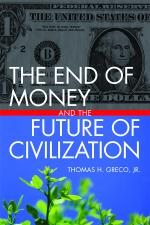 as relevant today as it was when first published the printed book has been out of print for several years. But, having had the rights reverted to me by my publisher, I am making the entire book available for free in PDF format. You can read it or download it HERE. If you would like a hard copy of the first edition used copies can still be found on Amazon.com, Abe books, Thrift books and elsewhere.
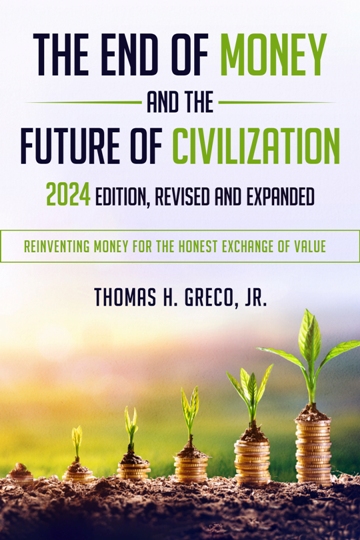 Better still, you can avail yourself of the new revised and expanded 2024 edition which I have been working on for almost two years and is almost complete. Eighteen chapters have already been posted and can be freely read or download HERE.
My previous books, as published, may be freely accessed in digital format by clicking the title below.
Money: Understanding and Creating Alternatives to Legal Tender (2001)
New Money For Healthy Communities (1994)
Money and Debt: a Solution to the Global Crisis (1980)
Collectors may find used and some new print copies of my books as published, on amazon.com and elsewhere online. Start by clicking on the title below:
Money: Understanding and Creating Alternatives to Legal Tender (2001)
 Beyond Money
 Beyond Money