Upon the recent completion and publication of my new Chapter 20—Exchange, Finance, and the Store of Value, for the revised edition of my book, The End of Money and the Future of Civilization, I loaded it into NotebookLM and asked it to create a video overview. I continue to be amazed at the quality of the output that this AI tool produces. Here it is:
This short video about Sarvodaya describes with great clarity the pathway toward creating a decentralized, peaceful, convivial society that Gandhi and others have envisioned, and the Symbiotic Culture that Richard Flyer has for a long time been working on and writing about.
Jem Bendell, former professor and founder of the Initiative for Leadership and Sustainability (IFLAS) at the University of Cumbria (UK) has a highly credentialed background that is impressive by any measure. After a life changing experience, he embarked upon a different life path, delving deeply into diverse disciplines, including the latest climate science, that led to his writing, in 2023, his book, Breaking Together: A freedom-loving response to collapse, in which he summarized his startling conclusions:
“The collapse of modern societies has begun. That is the conclusion of two years of research by the interdisciplinary team behind Breaking Together. How did it come to this? Because monetary systems caused us to harm each other & nature to such an extent it broke the foundations of our societies. So what should we do? This book describes people allowing the full pain of our predicament to liberate them into living more courageously & creatively. They demonstrate we can be breaking together, not apart, in this era of collapse. Jem Bendell argues that reclaiming our freedoms is essential to soften the fall & regenerate the natural world. Escaping the efforts of panicking elites, we can advance an ecolibertarian agenda for both politics & practical action in a broken world.
Jem has since abandoned academia and his “illustrious career of delusion” in favor of a different path that embraces reality and includes practical decentralized actions of adaptation. Breaking Together is available as a free download, but if you would like to get a taste of it before plunging into his 500 page volume, I highly recommend that you listen to this two-part interview in which he quite articulately explains his main ideas, and how we can, by working together, adapt to the inevitable and ongoing collapse of our present version of civilization, and in the process build a better one. Interview Part 1; Part 2.
The work of Richard Flyer puts my own work, and that of Jem Bendell and others within a more comprehensive and foundational context.
In a recent message, Richard Flyer alerts readers to a short video that he posted a couple years ago on his YouTube channel to explain his work of empowerment and societal change. By his own description, “It not only provides solid content about building Symbiotic Cultures and Networks, but it really captures the Spirit, enthusiasm, and hope we need now more than ever—the possibility and reality of Fractal Community Empowerment. It was released more than a year before the book Birthing the Symbiotic Age: An Ancient Blueprint for a New Creation came out on Substack as a weekly series. It shares many of the stories of on-the-ground grassroots movements I have been affiliated with, including San Diego, CA, and Reno, NV, as well as the Sarvodaya Shramadana movement of Sri Lanka – and their relevance today.”
This is the latest chapter to be published of my new 2024 edition of The End of Money and the Future of Civilization. It continues the story begun in the previous chapter of how money has evolved and changed its character over time.
Here is a brief excerpt:
Money has become merely an accounting system, a way of “keeping score” in the economic “game” of give and take. —Thomas H. Greco, Jr.
Let us begin by summarizing the evolution of the various kinds of money that have been used to mediate reciprocal exchange:
The circulation of gold and silver coins gave way to paper banknotes that were redeemable for gold or silver coins, which made the notes essentially warehouse receipts for gold on deposit.
Then, banks began to lend bank notes into circulation based on the pledge of collateral assets (some valuable and others not) other than gold, some of which included government obligations (bonds, notes, etc.).
But ALL notes were redeemable in gold. This became known as the “fractional reserve banking” system.
Bank account balances (checkable bank “deposits”) increasingly took the place of paper bank notes, and bank customers began to write checks against their deposits instead of using bank notes to make payments.
As banks created ever greater amounts of non-bona-fide money based on national government debts and other illegitimate collateral assets, the fiction of gold-backing and redeemability could no longer be supported, and governments reneged on their promise to redeem their currency for gold. This broke the final link between political fiat money and the real economy of valuable goods and services.
But, despite that, the emergence of credit clearing to offset credit obligation against credit claims was a major leap forward in facilitating the reciprocal exchange of value.
You can now read or listen to the entire chapter at Future Brightly:
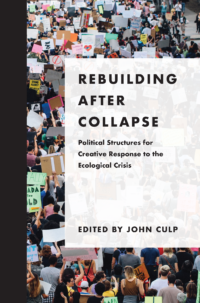
As society grapples with the reality of
climate change, many believe that technology will somehow save the planet. As
this book argues, that is not enough: larger-scale collaboration, coordination,
and funding is needed. Individuals and groups, even with significant personal
resources, will not be able to reverse the present course of ecological
disaster. What our endangered planet needs is broadly supported community
action, which is what happens when people come together and organize for the
common good. What we need, in short, is political structures and actions. The
essays in this book examine the political structures that have led to our
present crisis and offer concrete lessons from the U.S., Japan, Brazil, and
Greece, that can, if heeded, bring us back from the brink and toward an
ecological civilization.
This book of essays emerged out of some of the presentations
that were given at a major conference, Seizing
an Alternative: Toward an Ecological Civilization. that was organized by Center
for Process Studies and held at Pomona College (CA) in June 2015 and attended
by more than 1500 people. It includes two of my own essays, Greece and the Global Debt Crisis, and How Private Currencies and Credit Clearing
Exchanges Can Help Save Civilization, as well as essays by John Cobb, Ellen
Brown, Gayle McLaughlin and several others.
The full list of contents and order form can be found here.
The book can also be ordered on Amazon.com
Les Squires is a multi-dimensional consultant and IT systems wizard. He has a special interest in developing web-based networking tools that have important implications for web-based exchange platforms. Here below is a recent message in which he invites anyone and everyone to use his Ning development environment to build their own communities. It would be very useful if readers of this blog would try it out and leave their evaluative comments here. – t.h.g.
If you are interested in building communities using the Ning development environment, please let me know. We have created about 40 communities, starting in India over the last 4 months and working now for the next two months from Slovenia. You’ve probably heard me say, reminiscent of Field of Dreams, “Build the community and they will trade!” To this end, I’ve set up an number of Ning executive chats — we’re pooling resources to build the most effective communities we can build. If you’d like to see a sample site created just 3 days ago at the PODIM conference in Maribor, Slovena, go to http://podim2008.ning.com — would something like this facilitate your community development? Can widgets for trading be far behind??
The first edition of my book, The End of Money and the Future of Civilization, was published by Chelsea Green Publishing in 2009. While it remains as relevant today as it was when first published the printed book has been out of print for several years. But, having had the rights reverted to me by my publisher, I am making the entire book available for free in PDF format. You can read it or download it HERE. If you would like a hard copy of the first edition used copies can still be found on Amazon.com, Abe books, Thrift books and elsewhere.
Better still, you can avail yourself of the new revised and expanded 2024 edition which I have been working on for almost two years and is almost complete. Eighteen chapters have already been posted and can be freely read or download HERE.
My previous books, as published, may be freely accessed in digital format by clicking the title below.


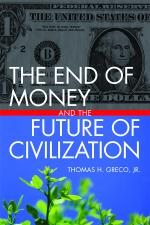 as relevant today as it was when first published the printed book has been out of print for several years. But, having had the rights reverted to me by my publisher, I am making the entire book available for free in PDF format. You can read it or download it HERE. If you would like a hard copy of the first edition used copies can still be found on Amazon.com, Abe books, Thrift books and elsewhere.
 Better still, you can avail yourself of the new revised and expanded 2024 edition which I have been working on for almost two years and is almost complete. Eighteen chapters have already been posted and can be freely read or download HERE.
 Beyond Money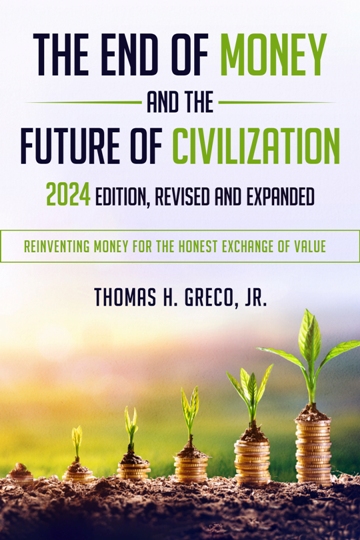
 Beyond Money