Tag Archives: debt

No Time to Be Complacent–Fifty Statistics About the U.S. Economy

Global Research provides some interesting facts that make it clear that we are at the end of an era in economics, finance, and the industrial economy.

The article, Desperate Financial Situation, Biggest Debt Bubble in World History: Fifty Statistics About The U.S. Economy, begins with the statement

Most Americans know that the U.S. economy is in bad shape, but what most Americans don’t know is how truly desperate the financial situation of the United States really is.  The truth is that what we are experiencing is not simply a “downturn” or a “recession”.  What we are witnessing is the beginning of the end for the greatest economic machine that the world has ever seen.  Our greed and our debt are literally eating our economy alive.  Total government, corporate and personal debt has now reached 360 percent of GDP, which is far higher than it ever reached during the Great Depression era.  We have nearly totally dismantled our once colossal manufacturing base, we have shipped millions upon millions of middle class jobs overseas, we have lived far beyond our means for decades and we have created the biggest debt bubble in the history of the world.  A great day of financial reckoning is fast approaching, and the vast majority of Americans are totally oblivious.

I should add that billionaire financier George Soros has projected that total U.S. debt will soon reach 500% of GDP. Governments are not going to fix the problem. It is time for people to look to their own resources and creativity and begin organizing in their communities to assure their survival and thrival as we make the transition to a steady-state economy and a more equitable, harmonious society.

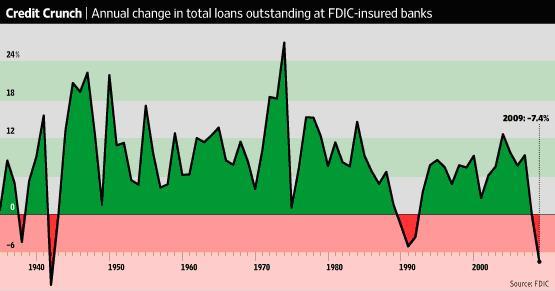
Banks Starving Business While Monetizing Government Debt

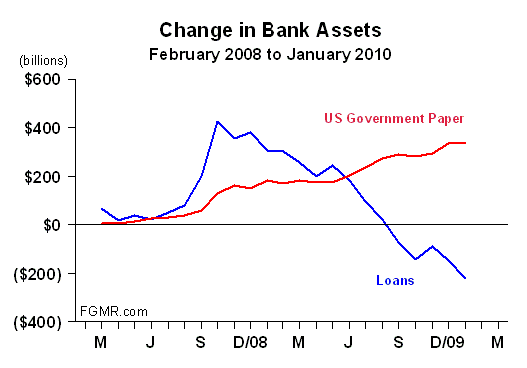
As usual, credit (money) is being lavished on the parasitic elements of the economy while the productive sector is being starved. A report from James Turk’s Free Gold Money Report draws upon a Wall Street Journal article (Lending Falls at Epic Pace) which includes two charts that make that plain. Here they are below along with a couple quotes. –t.h.g.

What Are Banks Doing with Their Depositors’ Money?

“So if the banks are not making loans, what are they doing with depositor money?

Well, they are still lending, but not to businesses and consumers.  They are lending to the federal government.

Banks don’t lend directly to the federal government of course, but buying US government paper accomplishes the same thing in the end.”

“Instead of depositor money being used to stimulate economic activity in the private sector by lending to businesses and consumers, the banks are helping to fund the growing federal deficits.  This re-allocation of resources has a negative long-term impact on the economy.  Depositor money is not being used for productive purposes like building manufacturing plants and making other investments that will create jobs and grow the economy.  It is being spent by the government, which consumes in the present and does not invest for the future.”

Happy Talk About the Economy–What are the Facts?

Is that daylight we’re seeing at the end of the recession tunnel, or is it the headlight of an oncoming train?

The “ticker guy” shows some charts that seem to answer that question. See it here.

The Great Inflation of 2010

Bill Bonner is absolutely correct in calling the monetization of debt The Grandest of Larcenies. He points out that, “Rather than honestly repaying what it has borrowed, a government merely prints up extra currency and uses it to pay its loans. The debt is “monetized”…transformed into an increase in the money supply, thereby lowering the purchasing power of everybody’s savings.”

As I argue in my new book, The End of Money and the Future of Civilization, enabling governments to spend more than they take in is half of the purpose of the central banking regime, the other half being to give the banking elite the privilege of charging interest on the people’s own credit.

As Bonner further points out,  “Of course, the Fed will not want to do such a dastardly deed; but it will do it anyway.” They are desperate to keep the game going and the only other alternative is to let interest rates rise as government seeks to sell more of its debt to increasingly reluctant lenders abroad.

Government, for its part, must either cut its profligate spending or raise taxes, or both. From the rhetoric coming out of Washington, it is clear that social programs, like Social Security and Medicare, are on the chopping block, but not sacred cows like military spending or bailouts for banks and corporate dinosaurs–the empire must be preserved.  Trial balloons for new taxes are now being floated. Is a VAT (value added tax) on the horizon?

As in the Weimar Republic between the World Wars, the politicians and bankers today may decide that hyper-inflation is the least onerous of their available options. The middle-class can say goodbye to their hard-earned savings.

National Debt Clock Needs More Digits

According to the Associated Press, the national debt clock maintained by the Durst Organization on a billboard near Times Square in New York City has run out of digits now that the national debt has for the first time exceeded $10 trillion. That’s more than $86,000 for each American family. Whom do we owe it to? Not to ourselves as the “powers that be” would like us to believe, but to all those who own dollars and U.S. Government bonds, notes, and bills. Yes, some are held by pension funds, but vast amounts are held by foreign central banks, especially China, Japan, and the OPEC countries.

An item that appeared in Yahoo News, dated Wed Oct 8, reports that “The late Manhattan real estate developer Seymour Durst put the sign up in 1989 to call attention to what was then a $2.7 trillion debt.” Two more digits will shortly be added to enable the debt to be tracked up to one quarter quadrillion dollars. One must wonder what the dollar will be worth by then.

The Inevitable End of the Central Banking and Political Money Regime

The present disorder in the financial markets and the cascading failures of financial institutions come as no surprise. Those who recognize the impossibility of perpetual exponential growth and who understand how compound interest is built into the global system of money and banking expect the continuation of periodic “bubbles” and “busts,” each of increasing amplitude until the systems shakes itself apart.

Engineers call this phenomenon, “positive feedback.” Such a system cannot find equilibrium. Imagine a heating system in which the thermostat, sensing a rise in temperature, calls for more heat instead of less. Such is the nature of the debt-money system. The imposition of interest on the debt by which money is created, demands that more debt be created. Such is the debt imperative which gives rise to a growth imperative. Among other things, it prevents the emergence of a steady state economy.

Is this the final round? Who can say? Can the system be saved yet one more time? Maybe.

Under the central banking regime which has become all but universal in countries around the world, money has been politicized. The collusion between politicians and international bankers enables governments to extract wealth from the economy by deficit spending and banks to extract wealth by charging interest on money as they create it by making loans. These two parasitic elements take wealth away from productive members of society and lavish it on military adventures, international intrigues, wasteful boondoggles, and financial finaglers.

When the system spins out of control what will come out of the chaos? It is impossible to predict but here are two strong possibilities. When the dollar collapses the financial and political elite class will certainly try to orchestrate a new global monetary regime based on the same old mechanisms for centralizing power and concentrating wealth in their own hands, seeking to complete the New (feudal) World Order which has been abuilding for the past three hundred years. Another possibility is the emergence of the kind of decentralized, democratic, and sustainable system we have been advocating for a long time.

We had better get ready to seize the opportunity that accompanies this impending crisis.

How? By organizing ourselves in our local communities and affinity groups to reclaim the credit commons, to create interest-free, non-dollar, non-bank exchange mechanisms and payment media. This is not as hard as it seems We already know how to do it. All it takes is organization and will.

Back to the current crisis, we should consider the possible actions of America’s creditors. According to Paul Joseph Watson & Yihan Dai, in and article in Prison Planet (http://prisonplanet.com/) dated Friday, September 19, 2008, “China Finance, China News and Chaobao Financial News, all state owned media outlets, slammed the Fed for taking action that will only make long term economic conditions worse and devalue the dollar by “creating money that does not exist which leads to the inflation of liquidity,” a policy contrary to China’s position as a holder of vast reserves of US dollars.”

Central banks have one true function, that is to manage the effects of the parasitic drain, to decide who will pay the price, who will feel the pain. They can either (1) restrict credit, thus causing recessions, bankruptcies and unemployment; or (2) they can expand credit and inflate the money supply by monetizing debts (either public or private) that are uncollectible.

Given China’s position as one of the United States’ biggest creditors, it is in a powerful position to determine the outcome of the current and future financial crises. If they don’t like the restructuring plan that the financial elite wants to put in place, they can kick over the table by dumping their dollar holdings and causing the value of the dollar to crash through the floor. Organized others acting in cooperation might do the same.

“The king is dead, long live the king.”

My upcoming book, “The End of Money,” due to be published early next year by Chelsea Green, will elaborate these points.

t.h.g.

The Worsening Debt Crisis – An Interview With Michael Hudson

Michael Hudson is a very astute observer of economics, finance, politics, and history.
When he speaks everyone should pay attention.

I strongly recommend that anyone who wishes to understand, not just economics and finance, but our general socio-political predicament should read his entire interview.

I agree with his statement that “The economy has reached its debt limit and is entering its insolvency phase. We are not in a cycle but the end of an era. The old world of debt pyramiding to a fraudulent degree cannot be restored.

He says “the only basis for borrowing more is to inflate the price of real estate that is being pledged as collateral for mortgage refinancing.” That was the reason for the banks creating the real estate bubble in the first place, to provide a basis for lending ever more credit (debt-money) into circulation.

The political debt-money system contains a debt and growth imperative because of the compound interest that is attached to loans. To keep the game going there are two choices, expand debt by lending to the government sector (by running budget deficits), or expand debt by lending to the private sector (liberal lending to enable people to buy whatever (real estate, stocks and other securities, commodities, education (student loans), cars and other stuff, what else?)). When incomes are not sufficient for the debt burden to be carried, defaults occur. Defaults can be denied and deferred by various tricks — e.g., refinancing to reduce payments by extending length of repayment. When a financial institution has such extreme cash flow problems as to be unable to continue denial, the government will come in with a bailout plan that leaves the taxpayer to foot the bill. Now, it becomes the public sector’s turn to carry the expanding debt burden.

I am in full agreement with Hudson’s claim that, “It is pure hypocrisy for Wall Street’s Hank Paulson to claim that all this is being done to “help home owners.” They are vehicles off whom to make money, not the beneficiaries. They are at the bottom of an increasingly carnivorous and extractive financial food chain.”
The parasitic nature of the system becomes ever more evident. Either the host becomes increasingly sick and eventually dies, taking the parasites with it to the grave, or the host will act on the increasingly strong signals of malaise and find a way to expel the parasites or keep them in check. Nature shows us that co-existence is a possibility but only if the parasites are held within certain bounds. The New Deal of FDR was a temporary expedient to do just that. One could argue that FDR saved Capitalism.

Hudson clearly states what I have been trying to get across to people: “What people still view as an economic democracy is turning into a financial oligarchy. Politicians are looking for campaign support mainly from this oligarchy because that is where the money is. So they talk about a happy-face economy to appeal to American optimism, while being quite pragmatic in knowing who to serve if they want to get ahead and not be blackballed.”

So don’t expect Obama to do much different.

Hudson correctly observes that “financial interests have replaced the government as society’s new central planners.”
They control politics and everything else. – t.h.g.

Money and Power

What the world needs now is practical approaches to resolving the problem of power.

The key question is “who decides?” Right now, the process has been rigged so that a self-serving few decide for the many. How are they able to do that?
The key is MONEY.

Did George Bush and Tony Blair come begging to the people to donate money so they could attack Iraq?
Did they even ask us to pay higher taxes so they could fight this war?
Obviously, they did not. Bush even LOWERED taxes, especially for “his base,” the rich and well-connected.
How is it possible for expensive wars to be fought without raising taxes?

William Patterson and his cohorts figured that one out more than 300 years ago when the Bank of England was founded. They had no trouble selling the idea to King William III. The deal was this: The King got the money he needed to fight his war against France, while the financiers got the privilege of printing bank notes and lending them into circulation.
This perversion of the monetary system has since been “perfected” and spread almost universally to every country around the world. The power to control the creation and allocation of money (which is nothing more than credit) is the basis for all political power.
Until we do something about that, nothing much is going to change.

Fortunately, it is possible to restore “the credit commons” through voluntary, free market approaches. How? By establishing credit clearing associations that can be networked together worldwide.

LETS prototypes have given thousands of people some idea of how credit clearing works. Now we must take mutual credit clearing to the mainstream and build it to scale. E. C. Riegel had the vision but not the tools; we now have both the vision and the tools. Read my book, The End of Money and the Future of Civilization, view my presentations and interviews on this site, https://beyondmoney.net/, read the works of E. C. Riegel (free downloads at https://reinventingmoney.com/library/. Start by reading his Private Enterprise Money) and explore the other important resources listed in the Library.

[Updated, March 26, 2017]