Category Archives: Basic Concepts

Thomas Greco’s Video Interview with Daniel Pinchbeck

Here are some segments of an interview I had with Daniel Pinchbeck during the Economics of Peace Conference in Sonoma, California in October of 2009. This interview was recorded by Haig Varjabedian

You can watch the entire interview in four parts on Vimeo.

Daniel Pinchbeck is an author and the  founder of  RealitySandwich.com, a website forum regarding experiences and initiatives surrounding the evolution of consciousness.

I also did an interview with Regina Meredith of Conscious Media Network.

West Coast Tour Presentations

My speaking tour of the west coast began with the Economics of Peace conference in Sonoma, California, and continued with stops in Portland, Seattle, Salt Spring Island, BC, Whidbey Island, and Vashon Island, Washington. Most of these have been recorded and will eventually be posted.

My Seattle presentation at Elliott Bay Bookstore is available for viewing now. It was video-recorded by Todd Boyle who has inserted the slide graphics and posted it on vimeo. I’ve added a link to it on the sidebar to the right under My Audio-visual Presentations.

Modern Trade and Barter – How It Works

IMS is one of the leading trade exchange operators in the United States. It’s a publicly traded company that has in about 24 years grown from one local trade exchange into a network of more than a dozen trade exchanges scattered around North America. The IMS website contains a five minute video that does a pretty good job of explaining how commercial trade exchanges work. View it here.

More Interviews

Over the past few months I’ve given many interviews in which I answer questions and discuss my ideas about money, the exchange process, and how to make the transition to a steady-state economy and a more just and peaceful world. I try to post links to those interviews here on my blog. You’ll find them in the sidebar to the right under “My Audio-visual Presentations.”

One of these, is an 11 minute excerpt titled, Towards a Credit Commons with Thomas H. Greco, Jr., posted on the New Dimensions Radio website at the New Dimensions Café. You can download it from there. The full interview is scheduled to air during the week of September 23-29, 2009. Check the New Dimensions website for radio stations in your area, or to find out about other Listening Options.

I’ve also just posted the interview I did with Joyce Riley for her Power Hour radio show on June 30, 2009, and will soon be posting a follow-up interview with her that was recorded on July 29. That program will also feature commercial trade exchange operator, Annette Riggs (Community Connect), who answers questions about the practical details of operating a private cashless trading system.

Interview on GreenPlanetFM

On May 4 I was interviewed by Tim Lynch of New Zealand’s GreenPlanetFM radio program. You can lsiten to it here.

New Zealand Follow-up

Deirdre Kent and conference organizer Laurence Boomert have provided a link to audio records of the New Zealand Community Currencies Conference 2009 that was held in Whanganui April 17-19th.

Here is their note:
Here is a link to the audio recording of our keynote speaker Thomas Greco at the conference.
http://miscellaneous-sonstiges.blogspot.com/2009/04/thomas-greco-talk-on-radio4all-notes.html
Click on the link in the yellow box then scroll to the bottom of the new page and click on the red download arrow – enjoy

Audio recordings of other speakers at the conference will also soon be available and a bit later we will have the videos that go with the talks.
The written resource document that records the different models of currency brought forward at the conference will soon
be available.

I’ve also now posted the photos to my photo gallery. — t.h.g.

What’s Wrong About the Political Money and Banking System?

To cut through all of the peripheral points, the main problems with the political money and banking system are:
1. The issuance of money on improper bases, mainly government debt, real estate, and assets of questionable value.
Principle: Money should be issued on the basis of goods and services already in the market or shortly to arrive there. All other needs (capital formation and consumer spending) should be financed out of savings.
2. Legal tender laws that force acceptance at par of debased political currencies.
Principle: Legal tender laws should be abolished. Only the issuer of a currency should be required to accept it at par. In the absence of legal tender, debased currencies will either be refused or pass at a discount in the market.
3. The charging of interest on credit money that is created as “loans.”
Principle: Money should be created interest free as a generalization of trade credit that facilitates the exchange of goods and services.

— t.h.g.

My 2 Minute Elevator Speech

I’ve added to this site my “Two Minute Elevator Speech About Solving the Money Problem.” You can find it under My Audio-visual presentations in the list at the right, or just click here.

The Inevitable End of the Central Banking and Political Money Regime

The present disorder in the financial markets and the cascading failures of financial institutions come as no surprise. Those who recognize the impossibility of perpetual exponential growth and who understand how compound interest is built into the global system of money and banking expect the continuation of periodic “bubbles” and “busts,” each of increasing amplitude until the systems shakes itself apart.

Engineers call this phenomenon, “positive feedback.” Such a system cannot find equilibrium. Imagine a heating system in which the thermostat, sensing a rise in temperature, calls for more heat instead of less. Such is the nature of the debt-money system. The imposition of interest on the debt by which money is created, demands that more debt be created. Such is the debt imperative which gives rise to a growth imperative. Among other things, it prevents the emergence of a steady state economy.

Is this the final round? Who can say? Can the system be saved yet one more time? Maybe.

Under the central banking regime which has become all but universal in countries around the world, money has been politicized. The collusion between politicians and international bankers enables governments to extract wealth from the economy by deficit spending and banks to extract wealth by charging interest on money as they create it by making loans. These two parasitic elements take wealth away from productive members of society and lavish it on military adventures, international intrigues, wasteful boondoggles, and financial finaglers.

When the system spins out of control what will come out of the chaos? It is impossible to predict but here are two strong possibilities. When the dollar collapses the financial and political elite class will certainly try to orchestrate a new global monetary regime based on the same old mechanisms for centralizing power and concentrating wealth in their own hands, seeking to complete the New (feudal) World Order which has been abuilding for the past three hundred years. Another possibility is the emergence of the kind of decentralized, democratic, and sustainable system we have been advocating for a long time.

We had better get ready to seize the opportunity that accompanies this impending crisis.

How? By organizing ourselves in our local communities and affinity groups to reclaim the credit commons, to create interest-free, non-dollar, non-bank exchange mechanisms and payment media. This is not as hard as it seems We already know how to do it. All it takes is organization and will.

Back to the current crisis, we should consider the possible actions of America’s creditors. According to Paul Joseph Watson & Yihan Dai, in and article in Prison Planet (http://prisonplanet.com/) dated Friday, September 19, 2008, “China Finance, China News and Chaobao Financial News, all state owned media outlets, slammed the Fed for taking action that will only make long term economic conditions worse and devalue the dollar by “creating money that does not exist which leads to the inflation of liquidity,” a policy contrary to China’s position as a holder of vast reserves of US dollars.”

Central banks have one true function, that is to manage the effects of the parasitic drain, to decide who will pay the price, who will feel the pain. They can either (1) restrict credit, thus causing recessions, bankruptcies and unemployment; or (2) they can expand credit and inflate the money supply by monetizing debts (either public or private) that are uncollectible.

Given China’s position as one of the United States’ biggest creditors, it is in a powerful position to determine the outcome of the current and future financial crises. If they don’t like the restructuring plan that the financial elite wants to put in place, they can kick over the table by dumping their dollar holdings and causing the value of the dollar to crash through the floor. Organized others acting in cooperation might do the same.

“The king is dead, long live the king.”

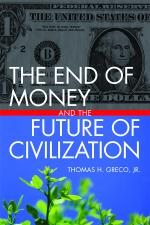
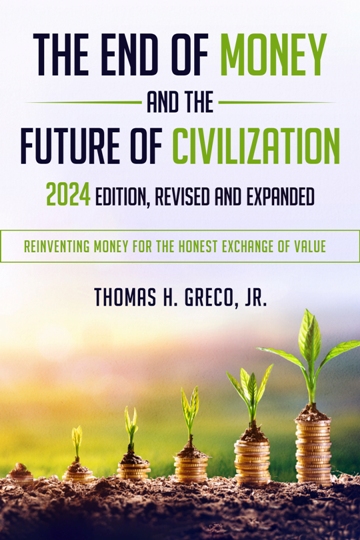
My upcoming book, “The End of Money,” due to be published early next year by Chelsea Green, will elaborate these points.

t.h.g.

Will the Real Alan Greenspan Please Stand Up

It is well know that Alan Greenspan was in his younger days a follower of Ayn Rand. It may not be so well known that he was also a self-proclaimed advocate of free banking and the “gold standard.” This article of his from 1966 offers some very good insights about the fraud that governments perpetrate upon the people by means of deficit spending and their collusion with the banking (credit) monopoly. It is extremely ironic that he eventually became the head of the central bank that he earlier denounced.

While Greenspan argues for the gold standard as a way of imposing discipline upon both government and bankers, he does not seem to oppose the banking monopoly. As I have argued before, while gold might play a role as a measure of value, there is no need to use it as a payment medium nor to revert to a fractional reserve system that relies upon gold reserves. There are better, more refined ways of addressing the money problem.- t.h.g.

GOLD AND ECONOMIC FREEDOM

By Alan Greenspan

[From Rand, Ayn, et al, Capitalism, the Unknown Ideal. New York: New American Library, 1966. Also The Objectivist, July 1966.]

An almost hysterical antagonism toward the gold standard is one issue which unites statists of all persuasions. They seem to sense — perhaps more clearly and subtly than many consistent defenders of laissez-faire — that gold and economic freedom are inseparable, that the gold standard is an instrument of laissez-faire and that each im­plies and requires the other.

In order to understand the source of their antagonism, it is neces­sary first to understand the specific role of gold in a free society. Money is the common denominator of all economic transactions. It is that commodity which serves as a medium of exchange, is uni­versally acceptable to all participants in an exchange economy as payment for their goods or services, and can, therefore, be used as a standard of market value and as a store of value, i.e., as a means of saving.

The existence of such a commodity is a precondition of a division of labor economy. If men did not have some commodity of objec­tive value which was generally acceptable as money. they would have to resort to primitive barter or be forced to live on self-­sufficient farms and forgo the inestimable advantages of specializa­tion. If men had no means to store value, i.e., to save, neither long-range planning nor exchange would be possible.

What medium of exchange will be acceptable to all participants in an economy is not determined arbitrarily. First, the medium of ex­change should be durable. In a primitive society of meager wealth, wheat might be sufficiently durable to serve as a medium, since all changes would occur only during and immediately after the harvest, leaving no value-surplus to store. But where store-of-value con­siderations are important, as they are in richer, more civilized societies, the medium of exchange must be a durable commodity, usually metal. A metal is generally chosen because it is homogeneous and divisible: every unit is the same as every other and it can be blended or formed in any quantity. .Precious jewels, for example, are neither homogeneous nor divisible.

More important, the commodity chosen as a medium must be a luxury. Human desires for luxuries are unlimited and, therefore, luxury goods are always in demand and will always be acceptable. Wheat is a luxury in underfed civilizations, but not in a prosperous society. Cigarettes ordinarily would not serve as money, but they did in post-World War II Europe where they were considered a luxury. The term “luxury good” implies scarcity and high unit value. Having a high unit value, such a good is easily portable; for instance, an ounce of gold is worth a half-ton of pig iron.

In the early stages of a developing money economy, several media of exchange might be used, since a wide variety of commodities would fulfill the foregoing conditions. However, one of the com­modities will gradually displace all others, by being more widely acc­eptable. Preferences on what to hold as a store of value, will shift to the most widely acceptable commodity, which, in turn, will make it still more acceptable. The shift is progressive until that commodity becomes the sole medium of exchange. The use of a single medium is highly advantageous for the same reasons that a money economy is superior to a barter economy: it makes exchanges possible on an incalculably wider scale.

Whether the single medium is gold, silver, seashells, cattle, or tobacco is optional, depending on the context and development of a given economy. In fact, all have been employed, at various times, as media of exchange. Even in the present century, two major com­modities, gold and silver, have been used as international media of exchange, with gold becoming the predominant one. Gold, having both artistic and functional uses and being relatively scarce, has always been considered a luxury good. It is durable, portable, homo­geneous, divisible, and, therefore, has significant advantages over all other media of exchange. Since the beginning of World War I, it has been virtually the sole international standard of exchange.

If all goods and services were to be paid for in gold, large pay­ments would be difficult to execute, and this would tend to limit the extent of a society’s division of labor and specialization. Thus a logi­cal extension of the creation of a medium of exchange, is the devel­opment of a banking system and credit instruments (bank notes and deposits) which act as a substitute for, but are convertible into, gold.

A free banking system based on gold is able to extend credit and thus to create bank notes (currency) and deposits, according to the production requirements of the economy. Individual owners of gold are induced, by payments of interest, to deposit their gold in a bank (against which they can draw checks). But since it is rarely the case that all depositors want to withdraw all their gold at the same time, the banker need keep only a fraction of his total deposits in gold as reserves. This enables the banker to loan out more than the amount of his gold deposits (which means that he holds claims to gold rather than gold as security for his deposits). But the amount of loans which he can afford to make is not arbitrary: he has to gauge it in relation to his reserves and to the status of his investments.

When banks loan money to finance productive and profitable en­deavors, the loans are paid off rapidly and bank credit continues to be generally available. But when the business ventures financed by bank credit are less profitable and slow to payoff, bankers soon find that their loans outstanding are excessive relative to their gold re­serves, and they begin to curtail new lending, usually by charging higher interest rates. This tends to restrict the financing of new ven­tures and requires the existing borrowers to improve their profitabil­ity before they can obtain credit for further expansion. Thus, under the gold standard, a free banking system stands as the protector of an economy’s stability and balanced growth.

When gold is accepted as the medium of exchange by most or all nations, an unhampered free international gold standard serves to foster a world-wide division of labor and the broadest international trade. Even though the units of exchange (the dollar, the pound, the franc, etc.) differ from country to country, when all are defined in terms of gold the economies of the different countries act as one­ so long as there are no restraints on trade or on the movement of capital. Credit, interest rates, and prices tend to follow similar pat­terns in all countries. For example, if banks in one country extend credit too liberally, interest rates in that country will tend to fall, inducing depositors to shift their gold to higher-interest paying banks in other countries. This will immediately cause a shortage of bank reserves in the “easy money” country, inducing tighter credit standards and a return to competitively higher interest rates again.

A fully free banking system and fully consistent gold standard have not as yet been achieved. But prior to World War I, the bank­ing system in the United States (and in most of the world) was based on gold, and even though governments intervened occasion­l1y, banking was more free than controlled. Periodically, as a result of overly rapid credit expansion, banks became loaned up to the limit of their gold reserves, interest rates rose sharply, new credit was cut off, and the economy went into a sharp, but short-lived re­cession. (Compared with the depressions of 1920 and 1932, the pre­-World War I business declines were mild indeed.) It was limited gold reserves that stopped the unbalanced expansions of business ac­tivity, before they could develop into the post-World War I type of disaster. The readjustment periods were short and the economies quickly re-established a sound basis to resume expansion.

But the process of cure was misdiagnosed as the disease: if shortage of bank reserves was causing a business decline — argued eco­nomic interventionists — why not find a way of supplying increased reserves to the banks so they never need be short. If banks can con­tinue to loan money indefinitely — it was claimed — there need never be any slumps in business. And so the Federal Reserve System was organized in 1913. It consisted of twelve regional Federal Re­serve banks nominally owned by private bankers, but in fact government sponsored, controlled, and supported. Credit extended by these banks is in practice (though not legally) backed by the taxing power of  the federal government. Technically, we remained on the gold standard; individuals were still free to own gold, and gold continued to be used as bank reserves. But now, in addition to gold, credit extended by the Federal Reserve banks (“paper” reserves) could serve as legal tender to pay depositors.

When business in the United States underwent a mild contraction in 1927, the Federal Reserve created more paper reserves in the hope of forestalling any possible bank reserve shortage. More disastrous, however, was the Federal Reserve’s attempt to assist Great Britain who had been losing gold to us because the Bank of England refused to allow interest rates to rise when market forces dictated (it was politically unpalatable). The reasoning of the authorities involved was as follows: if the Federal Reserve pumped excessive paper re­serves into American banks, interest rates in the United States would fall to a level comparable with those in Great Britain; this would act to stop Britain’s gold loss and avoid the political embarrassment of having to raise interest rates.

The “Fed” succeeded: it stopped the gold loss, but it nearly destroyed the economies of the world, in the process. The excess credit which the Fed pumped into the economy spilled over into the stock market — triggering a fantastic speculative boom. Belatedly, Federal Reserve officials attempted to sop up the excess reserves and finally succeeded in braking the boom. But it was too late: by 1929 the speculative imbalances had become so overwhelming that the at­tempt precipitated a sharp retrenching and a consequent demoraliz­ing of business confidence. As a result, the American economy col­lapsed. Great Britain fared even worse and rather than absorb the full consequences of her previous folly she abandoned the gold standard completely in 1931,( tearing asunder what remained of the fabric of confidence and inducing a world-wide series of bank fail­ures. The world economies plunged into the Great Depression of the 1930’s.

With a logic reminiscent of a generation earlier, statists argued that the gold standard was largely to blame for the credit debacle which led to the Great Depression. If the gold standard had not ex­isted, they argued, Britain’s abandonment of gold payments in 1931 would not have caused the failure of banks all over the world. (The irony was that since 1913, we had been, not on a gold standard, but on what may be termed “a mixed gold standard”; yet it is gold that took the blame.)

But the opposition to the gold standard in any form — from a growing number of welfare-state advocates – was prompted by a much subtler insight: the realization that the gold standard is incom­patible with chronic deficit spending (the hallmark of the welfare state ). Stripped of its academic jargon, the welfare state is nothing more than a mechanism by which governments confiscate the wealth of the productive members of a society to support a wide variety of welfare schemes. A substantial part of the confiscation is effected by taxation. But the welfare statists were quick to recognize that if they wished to retain political power, the amount of taxation had to be limited and they had to resort to programs of massive deficit spend­ing, i.e., they had to borrow money, by issuing government bonds, to finance welfare expenditures on a large scale.

Under a gold standard, the amount of credit that an economy can support is determined by the economy’s tangible assets, since every credit instrument is ultimately a claim on some tangible asset. But government bonds are not backed by tangible wealth, only by the government’s promise to pay out of future tax revenues, and cannot easily be absorbed by the financial markets. A large volume of new government bonds can be sold to the public only at progressively higher interest rates. Thus, government deficit spending under a gold standard is severely limited.

The abandonment of the gold standard made it possible for the welfare statists to use the  banking system as a means to an unlimited expansion of credit. They have created paper reserves in the form of government bonds which — through a complex series of steps — the banks accept in place of tangible assets and treat as if they were an actual deposit, i.e., as the equivalent of what was formerly a deposit of gold. The holder of a government bond or of a bank deposit created by paper reserves believes that he has a valid claim on a real asset. But the fact is that there are now more claims outstanding than real assets.

The law of supply and demand is not to be conned. As the supply of money (of claims) increases relative to the supply of tangible assets in the economy, prices must eventually rise. Thus the earnings saved by the productive members of the society lose value in terms of goods. When the economy’s books are finally balanced, one finds that this loss in value represents the goods purchased by the government for welfare or other purposes with the money proceeds of the government bonds financed by bank credit expansion.

In the absence of the gold standard, there is no way to protect savings from confiscation through inflation. There is no safe store of value. If there were, the government would have to make its holding illegal, as was done in the case of gold. If everyone decided, for example, to convert all his bank deposits to silver or copper or any other good, and thereafter declined to accept checks as payment for goods, bank deposits would lose their purchasing power and government-created bank credit would be worthless as a claim on goods. The financial policy of the welfare state requires that there be no way for the owners of wealth to protect themselves.

This is the shabby secret of the welfare statists’ tirades against gold. Deficit spending is simply a scheme for the “hidden” confisca­tion of wealth. Gold stands in the way of this insidious process. It stands as a protector of property rights. If one grasps this, one has no difficulty in understanding the statists’ antagonism toward the gold standard. [emphasis added]