Category Archives: Developing Alternatives

Mid-October Newsletter – 2013

In this issue

   November travel to Turkey and beyond

   Summer tour report, Part 2. Sweden and England

   Bangla-Pesa Charges Dropped

   The Geo-political Struggle

On the move again

I’ve been invited to give a presentation at the 4th Green Economy Conference, Green Economy and Commons, 16-17 November 2013, in Istanbul, Turkey. As a panel member on the 16th, my topic will be, Reclaiming the Credit Commons: the Key to a Green Economy and Global Harmony.

Now, as we approach the end of a very busy and demanding year, I’m feeling the need for rest and renewal, so my intention is to travel onward from Turkey to southeast Asia where I will take a lengthy sabbatical. I will try to remain in touch, but don’t be surprised if email messages are not answered promptly. If your communication is really important, mark it “urgent” and keep trying, or Skype me.

European tour report — Part 2, Sweden and England

Following the Hague conference, I travelled to Sweden for a two week stay (June 24 to July 8) during which time I gave presentations and met with community currency activists in Gothenborg, Lindsberg, Gotland, and Stockholm.

My Gothenborg presentation, titled The Economics of Peace, Justice and Sustainability: Toward a New Convivial World Order, was held in a lovely old church that has been converted into a community center and café that provides, among other things, services to the city’s homeless population. One of my Swedish hosts and main tour organizer, Marianne Påsse, sent out a report on that event. Here is an slightly adapted version of it:

We had a wonderful evening yesterday! We were around 50 people, including us. I was content with that (I had no idea of how many might come)! The evening started with a mini-concert; a leading violinist (Helga Hussel) accompanied by Barbro Fridén on accordion, playing Pearls of World Music. It was lovely listening to them in that very nice building, good acoustics!

After that I spoke a little…making a bridge between Charles Eisenstein’s recent presentation (Approx. 25% of the audience were listening to him in the same building some weeks ago) and Thomas. I also asked the audience to raise their hands if they needed translation of some expressions (happened just 2 or three times…once at the very first picture).

Thomas presented a power point show with very well selected pictures. He spoke about them and…it is good to be able to read at the same time (Microphone is necessary). He spoke for approximately one hour, and people were very interested and kept him busy for another ½ hour, until I closed the session (it was late). The questions were very accurate and in depth. People came up to me afterwards and thanked for a very interesting evening. Afterwards Yoshi and Jackie had an evening meal and chat at our place. And today we pack for Lindsberg! So, we are very pleased!

At a summer gathering at an intentional community in Lindsberg I lead two workshops on successive days, each one beginning with a slide presentation. These were titled, Building Resilient Communities: A New Paradigm for Community Development, and The Global Financial Meltdown: Its Causes, and Opportunities for Localized Restructuring. The participants in each of these sessions were few in number but enthusiastic.

As it happened, I was in Sweden at the right time to participate in the Almedalen Week on the island of Gotland. This has become an annual event that brings together a wide variety of business people, politicians, academics, grassroots activists and ordinary folks. You can learn more about this remarkable event at http://www.almedalsveckan.info/.

I had no official role in the Almedalen proceedings, but was able to attend a few of the 2,000+ organized sessions and got to shake hands and chat a bit with the U.S. Ambassador to Sweden, Mark Brzezinski (son of Zbigniew Brzezinski who was National Security Adviser to President Jimmy Carter).

I finished up my Sweden tour in Stockholm, where I was hosted by an American friend who has been living there for several years with his Swedish wife and young son. In Stockholm I got to meet some of the main figures in the JAK Bank, a unique financial institution that since 1970 has been providing interest-free loans. They together with a few other groups organized an event for me which attracted a sizeable crowd, where I repeated the presentation I gave in Gothenborg.

My photos from Sweden can be found at Sweden 1, and Sweden 2.

England (July 8 – July 20)

I may at times complain about it, but I love Britain, and this time I had the opportunity to be in the Lake District at a time when the weather was simply superb (“the first real summer we’ve had in seven years,” the locals told me).

The focal point of my visit was a full day workshop (July 12), Unlocking Local Wealth, held at Cumbria University in Lancaster, an event organized by the Institute for Leadership and Sustainability (IFLAS) of the University of Cumbria Business School, in association with the New Economics Foundation, the United Nations Non-Governmental Liaison Service, and Impact International. The event was billed as “a one day workshop with world experts on alternative currencies and exchange systems.”

That workshop was preceded the day before by a gathering in which most of the same “world experts” came together to “clarify an action research agenda, explore ideas for collaboration, begin grant mapping,” and provide “feedback on one key new initiative (Eurocat).” Then, that evening, there was a public event titled, Starting Your Own Currency: Why and How? sponsored by (IFLAS ) in association with Lancaster’s Ethical Small Traders Association. This event featured a keynote presentation by John Rogers followed by my response and a general discussion.

Here are the links to videos that were recorded during that event:

Jem Bendell introduces the keynote

Keynote by John Rogers, co-author of People Money

Keynote response by  Tom Greco, author of The End of Money and the Future of Civilization

Along with a few other colleagues, I had the pleasure of enjoying a few more days of discussions and Jem’s hospitality at his home overlooking Lake Windermere.

My England photos are here:

I’ll report the final portion of my tour (Greece (July 20 – August 21)) in the next edition of my newsletter

Bangla-Pesa Charges Dropped

I reported earlier that one our close associates, Will Ruddick, along with several of the local currency activist there in Kenya had been arrested and their Bangla-Pesa currency project shut down. I’m happy to report that finally, the charges against them have been dropped. You can read about it here. (A very interesting earlier account that describes their ordeal can be found here.

This is great news, not only because the threat of punishment has been removed, but because this important development project may again have a chance to improve the lot of poor micro-entrepreneurs in Kenya and to demonstrate the power of the local credit clearing model in alleviating poverty. The Bangla-Pesa project is the most significant complementary currency project that I am aware of and has the potential to become THE model for other communities to follow. It deserves strongest support.

[Update. This just in from Will: We won! The official court order to release us was just released last week and can be seen here: http://koru.or.ke/Bangla-Pesa-Dream-Nov Not only have we been acquitted but we’ve been given a relaunch date of November 23rd to restart the program

Will adds, We’ve also created this 3 minute cartoon to explain how these programs form an effective barrier against poverty and market stagnation: http://www.youtube.com/watch?v=UaspBGmsdLE Please share widely.

The community is really excited and ready to move forward.]

The Geo-political Struggle

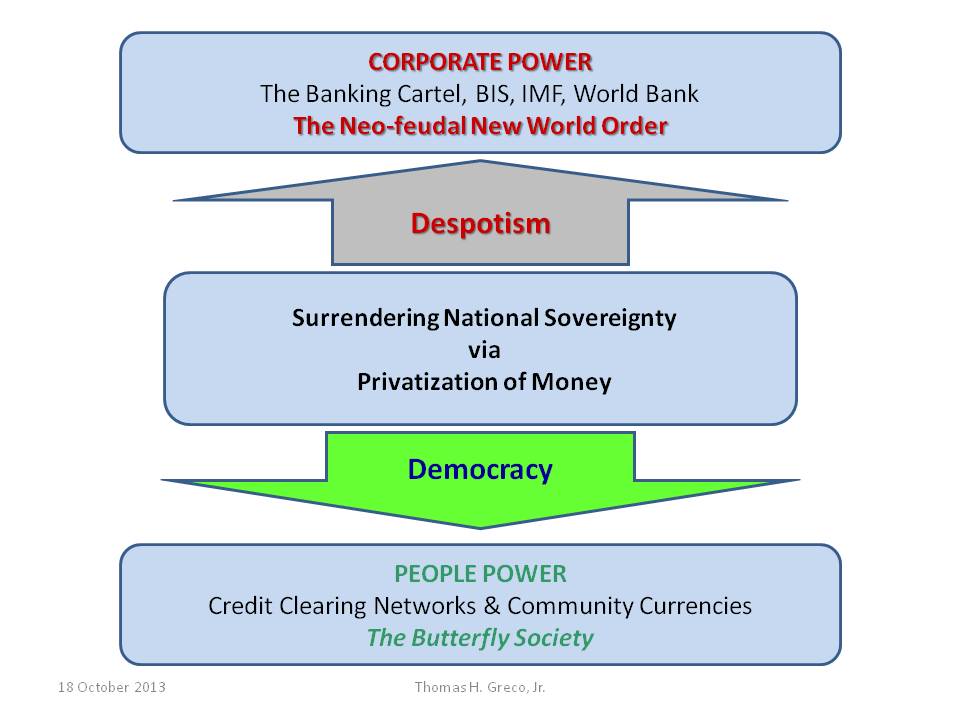
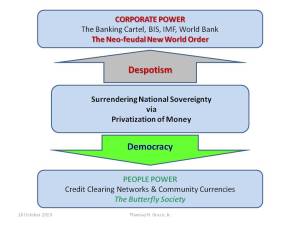
Alvin Toffler observed more than 30 years ago that the power of nation states was in decline and predicted that the trend would continue. It is clear that national governments are ceding sovereignty, not to global democratic institutions, but to transnational corporate entities resulting in a New (fascist) World Order that bypass all the checks on power that have been built into democratic governments over the past three centuries. George Monbiot’s recent article, Elite Insurgency, articulates some current features of that shift.

And Karen Hudes has revealed that World Bank corruption is an inherent element in the global Elite takeover. After Twenty one years at the World Bank, she has blown the lid off the cover-up of the corrupt global financial regime. Watch this interview with Karen: http://youtu.be/M4VGoXV5vYg . A longer interview in four part can be seen here.

These are a few pertinent quotes from her interviews:

“This is a massive cover-up; this makes Watergate look like tidally-winks.”

“Big boys who think they own the world.”

“We don’t have a democracy here.”

 “The Federal Reserve has “gamed” the capital markets.”

“This whole country is so corrupt, you can’t begin to imagine. I can’t tell this to the people because the press is owned by those thugs”

“Stakeholder analysis” identifies a “super entity” of ownership and control.

All of that is very troubling, but we have a choice—to  build our own (democratic) new world order from the bottom up, community-by-community. PowerShiftWe cannot be complacent; we must reduce our dependence upon corporate controlled mega-systems, especially banks, and secure the availability of the necessities of life within our local regions.
#     #     #

Newsletter – October 2013

In this issue

  • Changes
  • European tour reportPart 1, the Hague Conference

It’s been quite a while since my last newsletter went out in early June. Since then, a great deal has been accomplished. My European tour, which spanned nine weeks from mid-June to the latter part of August, was successful, productive, exciting, and I might add, exhausting. I’ll say more about that below, but most recently, I provided a remote presentation (via Skype) to a group assembled at Kalikalos on Mt Pelion in Greece as part of the week-long workshop titled Occupy Money. Then, toward the end of September, I participated in the 34th Annual International Convention of the International Reciprocal Trade Association (IRTA) in Las Vegas where I shared the podium with Annette Riggs and Rob van Hilten in a panel session about Understanding Diverse Exchange System Models: From Bitcoin and Berkshares, to Transparent Credit Clearing Networks. Unfortunately, that session was not recorded, but the slides that I prepared as talking points can be seen here. Needless to say it was not possible to cover them all in the short time provided.

Upon my return to Arizona from Europe I had to begin searching for another residence, since the house where I had been renting a room is no longer available. I’ve just moved into another shared housing arrangement which I hope will turn out to be suitable, at least temporarily.

This uprooting, combined with the let-down that followed the summer’s excitement, has caused me to deeply ponder the questions, What’s next? and Where do I want to be? While my energy level is not what it once was, I still enjoy relatively good health and am able to adapt to different environments so long as they provide a reasonable level of comfort for living and working. I’m growing impatient to hear opportunity’s knock, still hoping to involve myself in a breakthrough project that is adequately funded, with an able and energetic team that can achieve results that are on a par with the best business start-ups.

European Tour Report—Part 1, June, 2013

The first 4 weeks of my tour were a whirlwind of presentations, workshops, interviews and discussions. I’ll skip the details and report only the highlights, starting with the Hague conference, then report on the rest of the tour in my next newsletter.

The Netherlands and 2nd International Conference on Complementary Currency Systems (CCS)

It was a great pleasure to again visit (for the third time) STRO in Utrecht and to discuss with Henk van Arkel and the STRO team our various projects and common interests. STRO, with projects in several countries, is one of the most effective organizations working in the area of sustainable economics, community empowerment, and exchange alternatives. Together with Time/bank The Hague, they sponsored my first tour presentation (on June 18) for practitioners and social entrepreneurs. My slide show was titled The Exchange Revolution: Taking complementary currencies and moneyless trading to a new level, which described the various issues that must be considered in creating and managing alternative exchange mechanisms.

The CCS Conference in Den Hague far exceeded my original high expectations. I’m very encouraged and inspired by the quality of the presentations and discussion sessions that occurred during the entire 5 days of the conference. It seems that the movement has reached a new high level of competence and increasing cohesion, and seems poised to achieve significant results in both the theory and practice of community empowerment through the creation of systems for providing local liquidity. That, of course, is a prerequisite to transcending the growth imperative and transitioning to a steady-state economy. I expect that progress will be very rapid from this point onward.

Presentations, documents, and interviews from the Academic portion (June 19 and 20) of the Conference are available toward the bottom of this link. You will find what I think is a pretty good interview with me here, and brief video interviews of 27 presenters from Day 3 (policy makers day) can be found on the YouTube channel of Qoin. More video recordings by Hagen Schmidt of some of the sessions are to be found at this link.

As usual, I took many photos to document my travels and events. The pictures of the Netherlands portion of the tour can be found at this link.

Practitioner Sessions

Among the practitioner sessions that I participated in during the final two days of the conference were the following.

* Intertrading. One of the two discussion groups I proposed in the “open space” was about networking credit clearing exchanges together and development of the necessary intertrading protocols. We had quite a lively and productive discussion, which has become an ongoing process since Sebastiano Scrofina set up a Google group for that purpose. If you want to view the posts or join the discussion, go to this link.

* Measures of value and Units of account. Another session I lead was about measures of value and units of account. This also resulted in a lively discussion. Thanks to Zsuzsanna Szalay, we have a voice recording made with a digital recorder. You can download the file from this link.

* Business Models for Complementary Currencies. Daniel Neis provided input for a session on business models. Pertinent links are provided in his post to a Google group which he has started for discussion on that topic. You can read it, and join the conversation by going to this link.

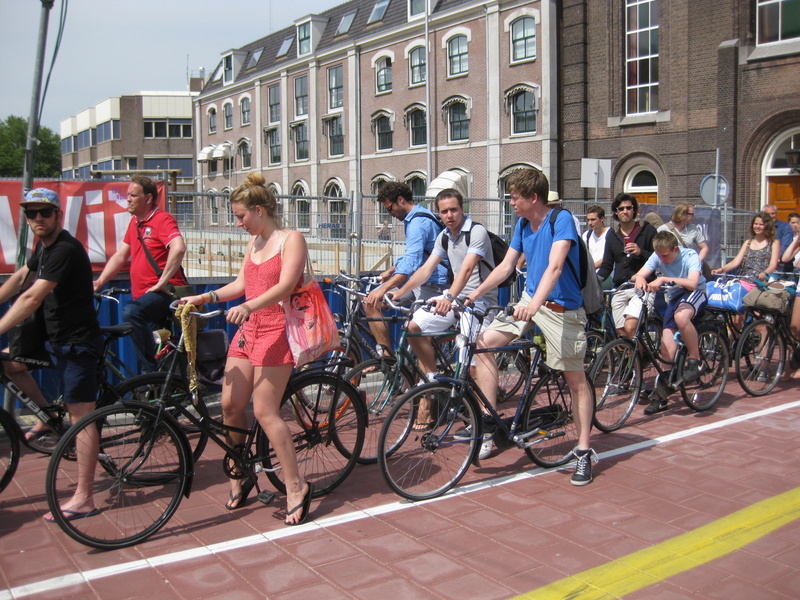
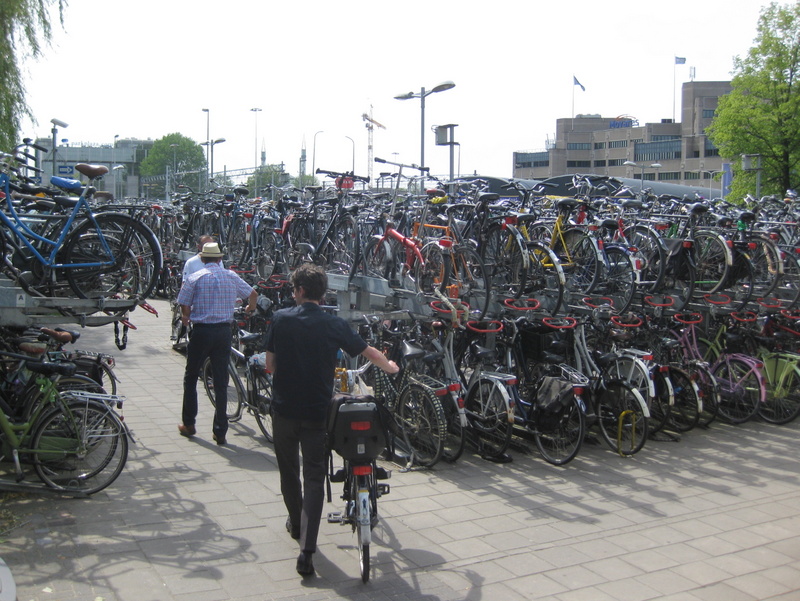
As a side note, it always amazes me to see how effectively the DutchIMG_2753 deal with personal transportation. Besides having a very efficient network of trains, trams, and buses, their use of bicycles exceeds that of any other people I’ve visited, even urban Chinese. They make bike travel safe and convenient by providing many bike “roads” that keep bike traffic IMG_2754physically separated from motor vehicle traffic, and by providing huge amounts of space for bike parking at train stations and other locations.

I hope you are all enjoying the cooler Fall weather.

Thomas

Excitement mounts over upcoming IRTA Convention!

The International Reciprocal Exchange Association (IRTA), the premier association of the commercial “barter” industry, has been for more than forty years promoting the interests of small and medium sized enterprises by assisting its member trade exchanges to provide them with liquidity and effective opportunities for moneyless trading.

Since 2005, IRTA has been reaching out to the wider grassroots community of researchers, developers, and organizers of private currencies and complementary exchange mechanisms and has broadened its advocacy to include them.

The upcoming 34th Annual International Convention of the IRTA in Las Vegas will provide a unique opportunity for social entrepreneurs and monetary activists to further consolidate programs of cooperation with the well-established commercial “barter” sector of the moneyless exchange movement. The Convention will be held from Sept. 19 thru 21 at the Venetian Resort in Las Vegas.

Along with IRTA President and experienced trade exchange operator Annette Riggs, and Rob van Hilten, Executive Director of QOIN, a consultancy for community currencies, I will be a panelist in a Saturday session (September 21) titled Understanding Diverse Exchange System Models: From Bitcoin and Berkshares, to Transparent Credit Clearing Networks. This session will consider three basic topics of discussion:

Bitcoin, the good, the bad, and the ugly.

The benefits and limitations of cash-based local currencies.

The emerging global exchange network.

There is still time to register for this important event. You can get details about the convention program and secure your place by visiting the IRTA website at http://www.irta.com/.

#     #     #

Charges dropped, Bangla-Pesa prepares to re-launch in Kenya

In June, I reported the launch and abrupt shutdown of an exciting community development project in a poor suburb of Mombasa, Kenya. The Bangla-Pesa voucher system, conceived and organized by American aid worker Will Ruddick and several local micro-entrepreneurs, is intended to provide additional liquidity that makes it possible for unmet needs of local residents to be satisfied out of their own excess productive capacity.

After a mere two weeks of operation, the Government of Kenya arrested Ruddick and five local micro-entrepreneurs, charging them with forgery. Amidst an indignant outcry from the global development and complementary currency community, the case bounced around through the Kenyan bureaucracy and on Friday, the central bank finally dropped the charges.You can read about this latest development on the Koru Kenya website.

Now, the way appears to be clear for this project to move forward and to build upon its early success. The Bangla-Pesa project is in my opinion one of the most promising current developments in the realm of alternative exchange and community development and deserves wide support as other similar communities line up to replicate it.

Here are 6 short and inspiring videos that tell the whole story. I suggest that you view them all starting with the background of the Bangla-Pesa up through the State’s withdrawing the case. These videos are automatically played in sequence.–t.h.g.

Community-based, citizen-led solutions: Greece shows the way.

Regarding effective community initiatives, you might want to read this inspiring article from Der Spiegel about two Greek women in Athens who have done some remarkable social action things: People Power: Young Greeks Team Up to Combat Crisis.
This story shows what Greeks can do, and are doing, to make things better for themselves, aside from government policies and actions, by organizing “self-help initiatives to provide free medical care, repair street lighting and monitor public spending.”
The rest of the world might follow their lead. read about it here.

Understanding the “big picture” of change

The past several decades have seen the emergence of diverse movements that seek to address specific problems and provide general improvements to society. Environmentalists have been trying to stop pollution, climate change and resource depletion; civil libertarians seek to stop the abuse of basic human rights and the erosion of democratic institutions; humanitarians are trying to end hunger, disease, and degrading treatment like human trafficking, genital mutilation and genocide, to name a few.  And yet, the juggernaut rolls on, destroying more forests, polluting more water, concentrating more power and wealth in fewer hands. The need for change is obviously becoming more urgent, but why isn’t it happening?

This latest post by Tom Atlee helps to frame both the fundamental problem and broad approaches to transformation. Please give it your careful attention– then take appropriate action.

Surveillance and parasitism harm society’s collective intelligence

Government of Kenya attacks self-help program in Mombasa slums

In an unbelievably heavy handed move, the Government of Kenya last week arrested an American aid worker and five local micro-entrepreneurs for operating a complementary exchange system in a poor suburb of Mombasa.

The recently launched Bangla-Pesa voucher system is intended to provide additional liquidity that makes it possible for unmet needs of local residents to be satisfied out of their own excess productive capacity. In just two weeks of operation, the amount of goods and services traded among the members of the Bangla-Pesa network increased substantially. Now, the program is shut down and six people are facing seven years in prison.  Why? Is this simply a case of ignorance on the part of government officials, or an attempt to keep poor people poor and dependent upon inadequate or even exploitative systems that are controlled by bankers and politicians ? The answer to that will become clear as this case develops. Your help is needed to get this matter resolved in favor of freedom, justice, and rationality. Here is the official appeal from American aid worker Will Ruddick.

Dear Friends, Family and Supporters,

End Africa’s dependence on Aid through Complementary Currencies. Eradicate poverty and keep six people from seven years in prison.

Click here to support this program and watch our videos.

Bangla-Pesa, a complementary currency program in one of Kenya’s poorest slums, needs your help. This innovative program gave participants the ability to create their own means of exchange so micro-business owners could trade what they have for what they need. In two weeks, the program already showed great success. But the Central Bank of Kenya has deemed the program illegal and is pursuing a legal battle against its organizers, despite enthusiastic community support.

These six people face charges that could put them in prison for as much as seven years:
·         Alfred Sigo a youth activist.
·         Emma Onyango a grandmother and community business owner.
·         Rose Oloo a grandmother and community business owner.
·         Paul Mwololo a grandfather and community business owner.
·         Caroline Dama a mother and volunteer.
·         Will Ruddick a new father and program founder.
We need help raising funds for legal fees and to bring this program back to life so it can help people throughout Africa in expanded form via mobile phones.
Our goal is to raise 47,000 Euros over the next 47 days.

Click here to read more and donate:
http://igg.me/p/bangla-pesa/x/31801
Spread the word!
Sincerely,
Will Ruddick, Bangla-Pesa Program Founder

Complementary currency conference shaping up to be a landmark event

The Conference on Complementary Currency Systems that will be held 19-23 June in The Hague, Netherlands, is shaping up to be a significant landmark in the development of currencies and exchange processes. It will bring together practitioners and theoreticians from all over the world. The following message that came in recently from Edgar Kampers, one of the organizers, highlights the program for just one of the five days. Anyone involved in, or having a serious interest in this field, will probably want to be there.

Are you eager to learn about the future of currencies? Or are you keener to know how complementary currencies can support the local economy and build communities? Are you intrigued by digital currencies like Bitcoin, Freicoin and Ripple?

Then join the 2nd International Conference on Complementary Currency Systems on Friday 21st of June. It will bring a fresh perspective on local currencies like the Brixton Pound, Bristol Pound, Chiemgauer, Berkshares and the Calgary Dollars! It will explore several amazing time banks and time credits systems like Spice, Fureai Kippu and De Makkie!

The conference will be held in The Hague, The Netherlands and will bring together world-leading experts including Bernard Lietaer, Thomas Greco, Jem Bendell, Bart Jan Krouwel, Shann Turnbull and Tony Greenham.
Step into the world of complementary currencies, join the conference!

Join today at http://www.iss.nl/forms/ccs_conference_governement/
Or learn more at qoin.org/conference_english/
Twitter @CcsConference13, #CCSconf13
Prezi http://bit.ly/12qzePu

Developing a framework for an equitable, harmonious and sustainable global society

The current global mega-crisis is forcing us to confront the flaws and inconsistencies inherent in the present dominant structures of economics, money, and finance. As a result, we have before us a great opportunity to open up a conversation that admits to consideration ideas and proposals that may have heretofore be rejected out of hand as radical, impractical, or utopian, ideas like those put forth by Mahatma Gandhi three quarters of a century ago.

My good friend and scholar, Rajni Bakshi, has recently articulated that possibility and those ideas in her article, Civilizational Gandhi. You can download the full article here. I also recommend her article, Replacing Keynes With Gandhi.

Ms. Bakshi is the Gandhi Peace Fellow at Gateway House: Indian Council on Global Relations based in Mumbai, India.

#     #     #

How to protect your “nest egg” while making your communty more resilient

This podcast featuring Michael Shuman, Jenny Kassan, and Elizabeth Ü, is a “must watch.” It clearly explains the options available to savers, investors, and entrepreneurs.