Category Archives: Developing Alternatives

New Money: A Creative Opportunity for Business

Every so often, I’ll browse though something I wrote previously. This article,  New Money: A Creative Opportunity for Business, was originally published in Perspectives on Business and Global Change (World Business Academy), Vol 11, No 3, September, 1997, and later included in the anthology The New Business of Business: Sharing Responsibility for a Positive Global Future, by Willis Harman and Maya Porter (Berrett-Koehler, 1997).

It is still pertinent and timely. You can find it in the sidebar under Resources, Monographs, or click here.

End of Money Excerpt on Reality Sandwich

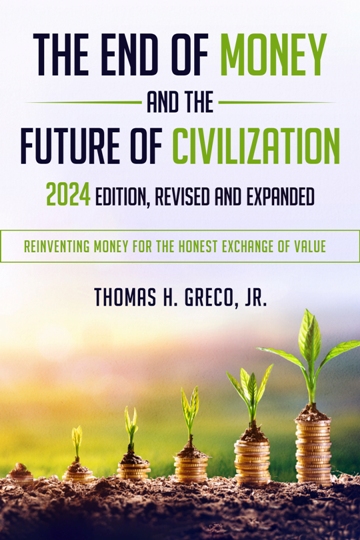
An excerpt from my book, The End of Money and the Future of Civilization, has been published on Reality Sandwich. Is is one of the more important chapters, which contains a prescription for community empowerment and enhanced self-determination. That chapter, A Regional Economic Development Plan Based on Credit Clearing,  is also here on this site under “Excerpts.”

Interview on GreenPlanetFM

On May 4 I was interviewed by Tim Lynch of New Zealand’s GreenPlanetFM radio program. You can lsiten to it here.

New Zealand Follow-up

Deirdre Kent and conference organizer Laurence Boomert have provided a link to audio records of the New Zealand Community Currencies Conference 2009 that was held in Whanganui April 17-19th.

Here is their note:
Here is a link to the audio recording of our keynote speaker Thomas Greco at the conference.
http://miscellaneous-sonstiges.blogspot.com/2009/04/thomas-greco-talk-on-radio4all-notes.html
Click on the link in the yellow box then scroll to the bottom of the new page and click on the red download arrow – enjoy

Audio recordings of other speakers at the conference will also soon be available and a bit later we will have the videos that go with the talks.
The written resource document that records the different models of currency brought forward at the conference will soon
be available.

I’ve also now posted the photos to my photo gallery. — t.h.g.

How Mobile Phones are Changing Banking and Finance. Money Next?

This story suggests the enormous possibilities inherent in the new mobile phone technologies and networks. – t.h.g.

How mobile phone banking is empowering the poor

13 Feb 2009 15:11:00 GMT

Written by: Natasha Elkington

Six years ago on a whim, I was lucky enough to buy a farm with two friends in my native Kenya. The farm borders the Shimba Hills National Reserve, high above the coastal plain. It’s an enchanting other world, but also very remote. As I live in Britain at the moment we’ve hired a caretaker, Samuel, to protect the land from squatters and wild game that occasionally breaks through the fence looking for food.

The problem is how to pay Samuel when the nearest bank is 50 km (30 miles) away in Mombasa. The answer – as improbable as it sounds – is by mobile phone. Two years ago, a new phenomenon hit Kenya that allows money to be transferred between people using text messaging called M-PESA (pesa means money in Swahili).

This system, known as “branchless banking”, lets people set up remote bank accounts that are accessed through their mobile phone or other technology.

It’s a financial revolution that has taken Kenya by storm and will probably do the same across the rest of the continent by giving Africa’s poor access to financial services for the first time. Africa has seen phenomenal growth in mobile phone subscribers – with 278 million users by the end of 2007, according to Britain’s Department for International Development (DFID).

M-PESA, which was set up by Vodaphone and funded through DFID, now has 5 million users in Kenya, more than all the bank accounts. It is being expanded to support salary payments, bill payments and social benefit payments. Poverty experts say a lack of access to banking hampers people’s ability to improve their incomes and pay for healthcare and education, whilst holding back countries’ economic growth.

This is true especially in Kenya, where a large part of the population don’t have bank accounts because they live in remote areas, don’t have proper addresses, don’t have funds to maintain an account or don’t have the education to deal with a bank. But with the introduction of M-PESA, people are beginning to feel more financially empowered.

It works like this. A registered user can put money into their account at an M-PESA agent and send it to other mobile phone users by SMS instruction. The recipient can then retrieve the money from another agent. These outlets include local mobile dealers, petrol stations, supermarkets and kiosks.

This service has also literally been a life-saver! Two months ago, Samuel sent a text telling me his wife was having a difficult labour and he had to rush her to hospital. The next text I received was that his wife was in critical condition. Right away I called my friend in Kenya who was already on the case and in a matter of minutes we were able to send money to Samuel whose wife received immediate attention and is on the road to recovery. Unfortunately, the baby could not be saved.

But if we had not been able to send money to Samuel so fast, he would have almost certainly lost his wife too. This vital technology is changing how people in developing countries live their lives, has the potential of easing the burden of poverty and can be a way to advance microfinance projects.

Britain’s International Development Secretary Douglas Alexander announced this week that the government is embarking on a £1.4 million ($2 mln) three-year project that will lay the foundations for financial services to be made available through new and emerging technology across Africa and Asia – including Kenya, Tanzania, Pakistan, Nigeria, India, Bangladesh and Ghana.

“A lack of access to finance in some parts of the developing world stifles entrepreneurship, stunts development and leaves people trapped in a poor, cash-only society,” Alexander said. “It is the world’s poorest who could benefit from this most … A rapid increase in access to financial services could lift millions out of poverty and help change their lives forever.”

It is predicted that mobile-phone banking could add as many as a billion banking customers to the system in five years because it is relatively inexpensive to set up and there is no need to invest in new infrastructure because it uses the existing mobile phone network.

From Reuters AlertNet http://lite.alertnet.org/db/blogs/55868/2009/01/13-151104-1.htm

A Report on WIR by Susan Witt

A new page has been added to this blog, containing a recent report by Susan Witt on the WIR credit clearing association that has been operating in Switzerland for more than 70 years. Now called the WIR Bank and providing conventional banking services, WIR is an important case for monetary reformers and free exchange advocates to study. While there may yet be some deficiencies in its operating policies, WIR has proven over a long period of time the effectiveness of direct clearing of credits between buyers and sellers as an alternative to conventional bank-created debt-money.

An English translation by Prof. Philip Beard of Prof. Tobias Studer’s WIR and the Swiss National Economy can be downloaded from Lulu. com for $3.

An Annotated Précis, Review, and Critique of Prof. Tobias Studer’s WIR and the Swiss National Economy by Thomas H. Greco, Jr. and Theo Megalli can be found on another page on this blog.

Brazil, Argentina abandon US dollar

Look for more bilateral agreements like this in the near future. This is a logical thing to do so long as neither country is abusing their currency too badly and the countries have a balance in their trade with one another. Their currencies will quickly find their way back home.
I expect these bilateral agreements to evolve into multilateral agreements that use the credit clearing process to net out accounts amongst the central banks.

The surprising thing here is that the central banks of Brazil and Argentina seem to be taking a course that is independent of the global banking fraternity. Read the article here. — t.h.g


Brazil, Argentina abandon US dollar

Brazil and Argentina have launched a new payment system in their bilateral trade, doing away with the US dollar as a medium of exchange.

The two Latin American nations started the Payment System on Local Currency (SML) on Monday following a last month agreement inked by their presidents to use local currencies in a bid to end transaction in dollars.

On Thursday, Argentine Central Bank President Martin Redrado and his Brazilian counterpart Henrique de Campos Meirelles signed the enforcement of the agreement for the SML, under which exports and imports between the two countries will take place with the Brazilian real (BRL) and the Argentine peso (ARS).

Les Squires Announces New Web-based Community Building Platform

Les Squires is a multi-dimensional consultant and IT systems wizard. He has a special interest in developing web-based networking tools that have important implications for web-based exchange platforms. Here below is a recent message in which he invites anyone and everyone to use his Ning development environment to build their own communities. It would be very useful if readers of this blog would try it out and leave their evaluative comments here. – t.h.g.


If you are interested in building communities using the Ning development environment, please let me know. We have created about 40 communities, starting in India over the last 4 months and working now for the next two months from Slovenia. You’ve probably heard me say, reminiscent of Field of Dreams, “Build the community and they will trade!” To this end, I’ve set up an number of Ning executive chats — we’re pooling resources to build the most effective communities we can build. If you’d like to see a sample site created just 3 days ago at the PODIM conference in Maribor, Slovena, go to http://podim2008.ning.com — would something like this facilitate your community development? Can widgets for trading be far behind??

A Comment and Critique of Congressman Ron Paul’s Statement on Competing Currencies

A Comment and Critique of Congressman Ron Paul’s Statement on Competing Currencies

Thomas H. Greco, Jr. February 18, 2008

My recent message, which included the text of Congressman Ron Paul’s Statement on Competing Currencies, drew a flurry of responses, some positive and some negative. That’s fine because now I know I’ve got people’s attention.

Now I would like to explain why I think his message is so important and why I decided to circulate it. There are several good reasons I did not mention in my introduction.

I intended from the start to write a detailed critique of Congressman Paul’s monetary agenda, but I did not want to delay its circulation. I’ll include at least a portion of that critique toward the end of this message. I will outline what I agree with and what I disagree with, adding some points about implementation strategies that I think have better chances of success than the political approach which Congressman Paul and other monetary reformers find it difficult to see beyond.

The truth of Lord Acton’s warning that “power corrupts” becomes more evident every day, so anything that enables the ever-increasing concentration of power must be exposed and disabled. Although it is not widely recognized, the monopolistic control of the money system is primary among these.

So my reasons are these:

1. Ron Paul’s message has made the money issue, for the first time in decades, part of the mainstream political dialog. His candidacy for the office of president, and his demonstrated ability to raise significant amounts of money from a grassroots constituency have attracted some mainstream media attention, enabling his statements on money to get some major exposure.

2. Congressman Paul’s statement explicitly exposes the fact that we have “a government-instituted banking cartel that monopolizes the issuance of currency,” and makes the case that competition in currencies is necessary to restoring democracy in America.

3. His statement calls for “eliminating legal tender laws.” People need to understand that legal tender laws play an essential role in empowering and enriching central governments and banking elites at the expense of the people and democratic governance. Legal tender laws amount to, quite simply, a license to steal. They enable the federal government to spend virtually any amount of money for wars and favors to crony corporations without regard to its limited tax revenues. Chronic deficit-spending creates debt that will never be repaid. It takes value out of the economy by diluting the money supply with legalized counterfeit. Eliminating legal tender is the single most important step in reining in abusive central government and restoring the balance of power.

Do I believe that repeal of legal tender is a likely prospect? Under the present circumstances I put the probability at nil, as I do the chances of getting any kind of political solution to the money problem. But we must look ahead to a time when it will be possible to establish truly democratic government in which people hold power at the local level and the upward assignment of responsibilities is only provisional and temporary. Just as the separation of church and state was a huge step forward, which was enshrined in the United States Constitution, and is generally accepted as a fundamental tenet of democracy, so too the separation of money and state will need to be explicitly enshrined in a new or amended constitution.

4. He correctly states that, “In the absence of legal tender laws, Gresham’s Law no longer holds.”

Under legal tender laws, which force acceptance of “bad money,” “bad money” drives “good money” out of circulation. In the absence of legal tender laws, the bad money will be rejected or discounted in the marketplace leaving in circulation only “good money,” money that people trust.

5. The Paul message includes some current and historical anecdotes that provide additional insights into the dimensions of the money problem. Specifically, he refers to various government actions that were designed to eliminate free exchange by shutting down competing exchange media.

Anyone who seeks to establish community currencies or other alternative exchange processes, needs to be cognizant of these potential hazards.

Now, for my critique:

Anyone who has been following my work knows that I have repeatedly made clear my opposition to using gold as money. While gold (or silver) might serve as an objective measure of value, there is no need to revert to gold as a payment medium. But even in the role of value measure, gold has serious shortcomings, not the least of which is the fact that the market for gold is manipulated by the large holders of gold. I made these points in my 2007 Malaysia presentation http://video.google.com/googleplayer.swf?docId=-1399011433067824706&hl=en.

The traditional functions which money is supposed to serve must be segregated. For my brief recent statement on this see, https://beyondmoney.wordpress.com/new-chapters/fundamentals-of-alternative-currencies-and-value-measurement/

The exchange of real value, which money is supposed to facilitate, has evolved beyond money. This is the fact that the “gold bugs,” and almost everyone else, fail to recognize. As I’ve described in my presentation on The Evolution and Transformation of Money, the highest stage of evolution in the exchange process is direct credit clearing. This is a process by which accounts payable (resulting from purchases) are offset by accounts receivable (resulting from sales) within a circle of associated buyers and sellers.

This approach has the added advantages of bypassing all the sales tax issues associated with using commodities, including gold, as exchange media.

So, in brief, all kinds of “money” are obsolete. All that is required now is a system that provides for the democratic allocation and management of credit. If we insist on using the term money, we must say that money is nothing more than credit.

The local, democratic management of credit and the establishment of networks that connect those local credit clearing entities into regional and global trading unions provides the means for establishing true economic and political democracy and a dignified life for all.


How to Include Employees in the Credit Clearing Process

Since employees are also consumers, and since labor is a major component at every level of the supply chain from retail to wholesale to manufacturing to basic commodity production, it is essential that ways be be found to include wages and benefits in the process of cashless exchange. The matter is complicated by the various legislative restrictions on how, and in what form, employees must be paid. While it may not be possible in many cases to substitute local currencies or trade (“barter”) credits for cash wages, it probably IS possible to pay employee bonuses and benefits in alternative exchange media.

In his comment to an article on this topic that appeared in Bob Meyer’s BarterNewsBlog, Harold Rice says, “Barter however IS a good way to pay staff benefits, thereby allowing you pay for chiropractic, dental, optometric expenses Etc. with before tax trade dollars.”

This is a topic that merits much more research and discussion.