Category Archives: Education

How To Be An Effective Leader?

By Thomas H. Greco Jr.

Professor Carroll Quigley was a historian and theorist who was renowned as a professor at the School of Foreign Service at Georgetown University, where he taught many famous and influential people including Nancy Pelosi and former President Bill Clinton, who often publicly praised him.[1] In his role at Georgetown, he focused largely upon preparing his students to be effective leaders. He argued that knowledge is not sufficient for an effective leader, but that understanding is the vital thing, saying further that it requires possession of techniques that fortunately, can be taught.

I write this post mainly for the benefit of aspiring citizen leaders and the “cultural creatives”[2] among us, but it is incumbent upon anyone preparing to play a leadership role in any sector of society and walk of life to delve into the details and apply those techniques in their work. So, what are those techniques? I asked Copilot to summarize the techniques that Quigley taught.

Here below is what Copilot answered. I urge leaders to be particularly diligent in applying Core Technique 8 in their work.

Copilot:
Carroll Quigley’s distinction between knowledge and understanding leads directly into a set of executive techniques he believed could be taught and cultivated. While he never published a single, formalized list, his lectures and writings—especially The Evolution of Civilizations—make the techniques quite clear. They form a coherent system for training leaders who can synthesize complexity, make sound judgments, and coordinate human effort.

Below is a structured synthesis of the techniques Quigley consistently emphasized.

Core Technique 1: Pattern Recognition Across Time

Quigley taught leaders to see recurring structures in history, institutions, and human behavior.

  • Identifying the stages of institutional development (instrument → institution → vested interest → reform).
  • Recognizing when systems drift from serving their original purpose.
  • Seeing long-term causal chains rather than isolated events.

This technique builds the leader’s ability to anticipate rather than merely react.


Core Technique 2: Structural and Functional Analysis

Understanding, for Quigley, meant grasping how systems actually work, not how they are described.

  • Mapping the real power structure behind formal arrangements.
  • Distinguishing between nominal authority and operative authority.
  • Analyzing the functions institutions perform, not the rhetoric surrounding them.

This technique trains leaders to diagnose problems at their root rather than treating symptoms.


Core Technique 3: Integrative Thinking

Quigley insisted that an executive must be able to combine knowledge from many domains into a coherent whole.

  • Synthesizing economics, sociology, psychology, technology, and history.
  • Holding multiple variables in mind simultaneously.
  • Seeing how changes in one domain propagate through others.

This technique is the foundation of strategic judgment.


Core Technique 4: Decision-Making Under Uncertainty

Executives, he said, must make decisions even when knowledge is incomplete.

  • Evaluating trade-offs rather than waiting for perfect information.
  • Prioritizing based on long-term consequences.
  • Using heuristics grounded in historical understanding.

This technique prevents paralysis and cultivates responsible action.


Core Technique 5: Coordinating Human Effort

Quigley emphasized that leaders succeed not by knowing more facts but by mobilizing the knowledge of others.

  • Delegating effectively.
  • Creating channels for information flow.
  • Building trust and shared purpose.

This technique turns understanding into organizational capability.


Core Technique 6: Critical Evaluation of Assumptions

Quigley trained students to question the hidden premises behind policies, ideologies, and institutional narratives.

  • Identifying unexamined assumptions.
  • Testing them against historical evidence.
  • Replacing them with more accurate models.

This technique protects leaders from dogmatism and groupthink.


Core Technique 7: Civilizational Perspective

Perhaps his most distinctive contribution: leaders must understand the civilizational context of their decisions.

  • Seeing how technologies, weapons systems, and economic structures shape political possibilities.
  • Understanding the rise and decline of civilizations.
  • Recognizing when a society is in a phase of expansion, conflict, or institutional decay.

This technique gives leaders a sense of proportion and responsibility.


Core Technique 8: Moral and Institutional Responsibility

Quigley believed leadership required a moral dimension grounded in service to the community.

  • Understanding the purpose of institutions.
  • Acting to preserve the social fabric.
  • Resisting the drift toward vested interests and exploitation.

This technique anchors power in ethical stewardship.


Bringing It Together

Quigley’s “techniques of understanding” form a unified discipline:

  • See patterns
  • Analyze structures
  • Integrate knowledge
  • Decide under uncertainty
  • Coordinate people
  • Question assumptions
  • Think civilizationally
  • Act responsibly

They are the techniques of a statesman, not a clerk.


[1] https://www.conservapedia.com/Carroll_Quigley. Accessed March 4, 2026

[2] https://universespirit.org/cultural-creatives-what-are-cultural-creatives-and-what-is-this-universe-spirit-online-community-about#What_are_Cultural_Creatives. Accessed March 4, 2026
Truth, Propaganda and the Media

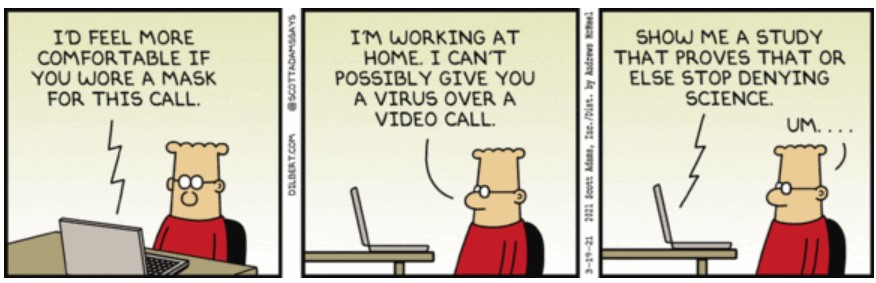
Today I received a link from a correspondent in Ireland that featured this Dilbert cartoon.

I think that clearly sums up the the main thing that divides people in today’s pandemic world. There are those who still trust “the system,” including the media, the government and medical establishment, and those who don’t. Each faction has their own good reasons for their position. What can possibly bridge the divide?

Ultimately, I think it comes down to emotion. People believe what they want to believe and will hold fast to that belief until the weight of evidence becomes sufficiently dissonant to flip them. That threshold level is different for different people. We also are inclined to screen out evidence that runs counter to our preconceived notions and to add more weight to evidence that supports them, this is known as “confirmation bias.” Then there is the fact that competing interests send out messages that are designed to promote their particular agenda. This is the stuff of advertising and propaganda, and those that have a bigger megaphone tend to drown out competing messages. Thus the battle for freedom of speech continues and becomes ever more crucial.

# # #

Who’s Reset will it be?

The oligarchs, plutocrats, and technocrats have a plan for you. It’s been called the “New World Order,” and now, “The Great Reset” which is being promoted by the World Economic Forum. Despite their high sounding rhetoric, you and I will have no role in formulating this plan, rather it is self-elected “global leaders” who will “come together to design a common recovery path and shape the Great Reset.”

It is imperative the people around the world come together now to plan our own future, one that is based on our own common values, needs, and a shared vision of how humans can live in harmony with nature and with each other. One current initiative that intends to facilitate that effort is “The Greater Reset” which is upcoming starting Monday, January 25th and continuing through Friday, January 29th.

Our World. Our Way.

The Greater Reset Activation: January 25th – 29th, 2021

“The Greater Reset is the world’s collective response to the World Economic Forum’s Initiative: The Great Reset.

“We offer an alternative to the WEF’s top-down, centralized, authoritarian vision. Our desire is to help all people find community and liberty by providing practical steps and knowledge for co-creating a world that respects individual liberty, bodily autonomy, and choice. We invite you to join us for 5 days of discussion about the diverse opportunities available for those who seek to live in harmony with humanity and the planet, while respecting our innate freedom.”

You can get program details, and sign up for “The Greater Reset” at https://thegreaterreset.org/

Orthodoxy and the meaning of events

Orthodoxy and the meaning of events is the title of an article recently published by Richard K. Moore, author of Escaping the Matrix: how We the People can change the world, and numerous insightful articles that are helpful in making sense of the present state of our world.

Here are some excerpts:

When something dramatic happens, we want to know what it means. We want answers to questions like: Why is it happening? How important is it? What will happen next? Where is it heading? What does it all mean?

In the mainstream narrative, the orthodox narrative, a clear meaning is always provided, right along with the news of the dramatic event itself. Like on the morning of 9/11, when the video of the explosions was first being shown, there was already a banner going across the screen: America under attack by Al Qaeda. And soon after: They want to destroy our democracy. 

This prompt assignment of meaning to an event has an important psychological effect. The first plausible explanation someone hears tends to fix in the subconscious, and resists being displaced by later explanations. That’s why the orthodox meaning is provided promptly, is repeated endlessly, and is reinforced from a variety angles by the various media genre, such as news broadcasts, talk shows, official announcements, comedians, documentaries, interviews, newspapers, etc.

It is easy to see why followers of the mainstream media would consider themselves to be well informed citizens. On any big public topic, they know what it means, and from that framework they can discuss this or that development from a knowing perspective, with a sense of knowing what they’re talking about. 

The world of the mainstream narrative is to a large extent a closed universe. Its stories and their meanings cover the whole scope of ‘what’s important’ and there’s no room for alternative explanations to find a place there. If a contrary explanation emerges from some non-mainstream source, there are many reasons why the explanation will be dismissed. First: ‘We already have an explanation for that’. Perhaps next: ‘Who are you that thinks you know better than the world’s experts?’ Every source that is non-mainstream is automatically suspect.

Moore goes on the say that:

In the orthodox world big changes always come as a response to some unexpected crisis (eg Pearl Harbor, 9/11, WMDs, 2008 collapse, COVID). A crisis is identified, it is given a meaning, and changes are announced. And then another crisis comes along, and again we get big changes. Each crisis comes with its own little meaning story, unrelated to the meaning of the crisis that came before or the one that comes after. Society stumbles along, it seems, always responding to unexpected crises. 

If someone observes that there is a pattern in such sequence, they are dismissed as paranoid or a “conspiracy theorist,” and that “conversations of any significant kind are nearly impossible across the boundary of the orthodox bubble.”

So much of each person’s worldview is based on the trust they have in the sources of the information they regularly consume, whether is MSNBC, Fox News, the BBC, New York Times, the Washington Post or other long established sources with big reputations. But it has been well documented how the media channels throughout the world have been gradually absorbed into a few mega-corporations, and how the owners of those channels use them in the process of Manufacturing Consent to the demands of the elite class that they represent, and their power has become greatly enlarged in the years since Edward Herman and Noam Chomsky, described it in their book by that name. That, and other aspects of the decline of western civilization since the 1970’s is also well documented in a video I watched recently titled, HEIST Who Stole the American Dream.

Richard Moore’s article concludes with his views on how people with differing beliefs about reality might talk with one another in a productive way. I strongly recommend that readers take the time to digest the entire article which can be found on Moore’s website.

#     #     #

New Podcast Episode 9–Jose Francisco Garcia Mazcorro

Episode 9 A conversation with Jose Francisco Garcia Mazcorro

Jose Francisco Garcia Mazcorro (Pepe) (Born in July 1982), is a scientist and educator who from 2000 to 2005 studied Veterinary Medicine and, in 2011, received a PhD degree from Texas A&M University.

Upon his return to Mexico in 2012, Pepe and his wife, Alicia, who also holds a PhD from the same university, started a program they called “Free Science Classes.” Pepe currently spends most of his academic life working on various research projects related to the human and animal microbiome. He also has an interest in Social Philosophy and published a book on that subject in 2007.

In this podcast interview, Pepe describes his work of taking science directly to children, provides some insights into Mexico’s current political situation and the implications of the election in 2018 of President Andres Manuel Lopez Obrador (AMLO), and discusses the status of the COVID “pandemia” in Mexico, its consequences, and possible remedies to avoid an even more complicated scenario in the years ahead. You can learn more about Pepe and his work at his personal website athttps://sites.google.com/site/josefgarciamazcorro/home. Pepe also recommends this video about social distancing.


How to get the job done!

Several months ago while hiking in Sabino Canyon near Tucson I noticed out of the corner of my eye something astonishing. Fortunately, I happened to have my phone with me so I recorded it. I’ve recently taught myself some video editing skills so now I am able to share the experience. The video below clearly shows what can be achieved when there is coordinated action working toward a common objective. Are humans as smart as ants?

A prime example of stigmergy

You can also find it on YouTube at https://youtu.be/Vg-8J72Jp-Y. Help it go viral.

A conversation with Ron Whitney

In our latest Beyond Money Podcast we explore with Ron Whitney the evolution of the commercial trade exchange industry, which over the past 50 years has proven the workability of credit clearing as a way of doing business without the need for money payment.

Ron operated his own trade exchange for 15 years, and since 2007 has taken on the role of President and CEO of IRTA, the International Reciprocal Trade Association, the premier trade association of, and advocate for, the commercial trade exchange industry.

Ron shares his vast knowledge and insights about the current challenges, prospects, and opportunities, including a description of the benefits of trade exchange membership and the increasing use of Universal Currency (UC) to enable purchases and sales over an extended trade exchange network.

This interview can be found at: http://beyondmoney.libsyn.com/ron-whitney-irta, or https://soundcloud.com/user-27167973/ron-whitney-irta.

You can find links to all of our Beyond Money Podcasts in the menu at the top of this page or at https://beyondmoneypodcast.wordpress.com/.

Aaron Schwartz, revolutionary genius

I could not help but be moved by watching this documentary about the life and death of Aaron Schwartz. Aaron fought for justice and for open access to the information commons. We all owe him a great debt of gratitude.

Newsletter — Summer 2015

Upcoming Ireland Events and My Remaining Tour Itinerary
My Activities in Greece, an abbreviated sketch
The Greek Crisis
Sardex

The summer has gone pretty much according to the plan I laid out in my Spring Newsletter, with of course the inevitable addition of things that have popped up spontaneously. I’m sorry I’ve been too busy to report about all of it, even though I’m sure many of my readers would want to know. My main reason for writing now is to highlight the agenda for the remainder of my summer tour in case some of you happen to be in the neighborhood of Ireland, Scotland or England. I hadn’t really planned to visit Italy but here I am—in Rome after visits to Tuscany and Sardinia (more on that below). I’m now in Ireland for the final events of my summer tour.

Here’s what I’ll be doing.
_________________________________________________
Ireland Events and My Remaining Tour Itinerary
25 to 27 August 2015. I’ll be at Cloughjordan Ecovillage to participate in the P2P Summer School program on The Art of Commoning. Then on Friday, 28 August, I will give a lecture at Trinity College, Dublin, followed by a panel discussion. And on Saturday, 29 August, I will conduct a workshop at the same venue. Here are the details.
Friday August 28th 19:00 – 21:00
Talk: The Liberation of Money and Credit
Where: CONNECT (Formerly CTVR) Dunlop Oriel House, 34 Westland Row, Trinity College Dublin, Dublin.
On the evening of Friday August 28th, Thomas Greco will give a presentation on The Liberation of Money and Credit, outlining the fundamental importance of reclaiming the credit commons and showing how communities and businesses can reduce their dependence on bank borrowing and conventional, political forms of money. After the talk Thomas will join a panel with Michel Bauwens and Kevin Flanagan of the P2P Foundation, Dr Rachel O’Dwyer of Trinity College Dublin and Graham Barnes of Feasta for a Q&A session.

Saturday August 29th 10:00 – 16:00
Workshop: The Exchange Revolution: Taking Complementary Currencies and Moneyless Trading to a New Level
Where: CONNECT (Formerly CTVR) Dunlop Oriel House, 34 Westland Row, Trinity College Dublin, Dublin.
On Saturday, Thomas will run a workshop for currency activists, practitioners, researchers, and social entrepreneurs on The Exchange Revolution: Taking complementary currencies and moneyless trading to a new level, also at the CONNECT venue in Dublin. Anyone with a specific interest in developing and extending the impact of community currencies, mutual credit, and other complementary exchange mechanisms is invited to attend.
Both events are sponsored and hosted by CONNECT (formerly CTVR – http://www.ctvr.ie/), at their Dublin city centre venue and supported by Feasta, the Foundation for the Economics of Sustainability (http://www.feasta.org) and P2P Foundation Ireland.
Both Dublin events are free but people are asked to register at:
http://www.eventbrite.com/e/beyond-money-events-with-thomas-greco-tickets-18131016358
Tuesday, 1 September, at Queens College, Belfast
Evening Lecture, Communities, Currencies and the Commons: Democratising money creation & enterprise after the Euro-Greek crisis, with Thomas Greco at Queens College, (Senate Room) at 7.30pm (registration at 7.15pm) hosted by the School of Law partnered by Positive MoneyNI. The talk will be followed by panel discussion.
Coordinator – William Methven, methvenwilliam@gmail.com

From Belfast, I will travel to Edinburgh, Scotland for a few days of exploring, then to London. I’m scheduled to fly back to San Francisco on September 9.
_________________________________________________
My Activities in Greece, an abbreviated sketch
Altogether, I spent a little more than three weeks at the Kalikalos Holistic Summer School during the months of June and July. Kalikalos is located on the Mt. Pelion peninsula where the views are spectacular, the mountain villages delightful, and the nearby beaches inviting, all of which provides a good balance of work, play and living in community with people from diverse places. In this ever-changing community of students, workshop leaders, volunteers, facilitators-in-residence, and staff, everyone pitches in to prepare meals, clean up, and share their special gifts. The daily program routine leaves plenty of time for recreation and many people choose to go down the mountain to the beach in the afternoons (about a 20 minute ride) or to hike the ancient donkey trails that connect the villages. Healthy living is a fundamental aspect of the Kalikalos experience with plenty of opportunity for yoga, meditation, tai chi and whatever other modes of centering people care to share. Meals are vegetarian and based mainly on fresh whole foods and traditional Greek ingredients—local olives. olive oil, feta cheese, locally baked bread, tomatoes, cucumbers, and vegetables from Kalikalos’ own gardens.
During my first week there I gave two presentations and conducted sessions in which we played two of my simulation games, Money Monopoly and Free Exchange. Then in July during the workshop on Solidarity Economy, I participated in most of the sessions and gave two presentations on the money problem and exchange altenatives.

While my work on exchange alternatives in Greece has been mostly with private groups and activists, I have developed proposals for creating domestic and community liquidity at all levels ranging from the bottom upward to include grassroots initiatives, business associations, municipal governments, and even the national government. I will be publishing specific details about these proposals in the near future. I am also continuing to work with colleagues in Volos on laying out the framework for a nationwide network of localized credit clearing exchanges.
During the last weekend in July I conducted a two day workshop in Athens for a sizable group of participants interested, or active in programs to create complementary liquidity. In the first session our discussions were based on my slide show on the Greek situation, and in the second, my presentation on the issues that need to be addressed in Taking Moneyless Exchange to Scale. That slide show is posted on my website at https://beyondmoney.net/wp-content/uploads/2015/07/workshop-athens.ppsx.

On Wednesday, July 29, I was interviewed on Porto Kali internet radio in Athens (in English with Greek translation). You can listen to it at http://wp.me/a43RA-Ge. _________________________________________________
The Greek Crisis
The Greek debt crisis has been all over the news lately so most everyone is aware of it, but most people are not aware of the underlying causes or what is being done to the Greek nation by the financial and political powers-that-be. Several of my recent posts at http://beyondmoney.net have dealt with that topic. In addition, there have been some very good recent articles that clearly explain it. These three are especially enlightening:
GREECE’D: We Voted ‘No’ to slavery, but ‘Yes’ to our chains, by investigative reporter Greg Palast.
The Rest of the Story About Greece: EU’s economic demands seek to derail small business and local communities, paving the way for multinational corporate giants.

• Ellen Brown’s fine article “Guerrilla Warfare Against a Hegemonic Power”: The Challenge and Promise of Greece

And if you want to understand the larger agenda of which the Greek situation is indicative, be sure to listen to Ellen Brown’s interview with Dr. Paul Craig Roberts, Greece-y Mess – 07.08.15, at http://itsourmoney.podbean.com/e/greece-y-mess-070815/
_________________________________________________
Sardex
Last week I had occasion to visit the Italian island of Sardinia and spend a few hours meeting with the founders and managers of a commercial trade exchange called Sardex.
I’ve known about Sardex since almost its beginning five years ago and have corresponded over the past few years with Giuseppe Littera, one of its founders, but this was the first opportunity I’ve had to get an inside look at their operation. I came away with a better understanding of how they operate and the impression that the Sardex structures, procedures, and protocols come closer to optimal than any other trade exchange I’ve seen. It appears to be a developing model that can be both scalable and replicable.
You can read my brief but more complete report here, and. you can get a pretty good picture of the distinctive features of Sardex by viewing Giuseppe Littera’s presentation (in English) that was made at a conference in Volos, Greece, in 2014. You can view it here.
_________________________________________________
All best wishes for a playful and enjoyable summer,
Tom

Money and Society: Free university-level online course being offered

A free online course (MOOC) in Money and Society is being offered by Professor Jem Bendell, PhD (IFLAS) and Matthew Slater, under the aegis of the Institute for Leadership and Sustainability of Cumbria University. The four lessons of the course, intended to” explode myths about the history, nature, present and future of money,” will commence 16 February 2015 and conclude 18 March 2015. For details and registration go to http://iflas.blogspot.com/2014/12/money-and-society-mooc.html.

This event has concluded but recordings of the four sessions can be found at https://matslats.net/money-society-mooc