Category Archives: Emerging paradigm

New Ways to Pay and Be Paid

I had a Skype chat recently with Ken Banks who pointed me to an excellent article about m-Pesa, a system operating in Kenya that uses mobile phones to provide an easy way of making payments. The article is, The Invisible Bank: How Kenya Has Beaten the World in Mobile Money, by Olivia O’Sullivan.

In his introduction to the article, Ken Banks says this:

 Click a few keys, exchange a few numbers, and it’s done. With just a mobile phone and a registration with Safaricom, Kenya’s mobile service giant, you can pay for anything in seconds – no cash, no long journeys to towns to reach a bank, and no long lines when you get there. This is m-Pesa, the revolutionary approach to banking which is changing economies across Africa. The service allows customers and businesses to pay for anything without needing cash, a bank account, or even a permanent address.

Here is a brief description from the article itself

So how does it work? m-Pesa relies on a network of small shop-front retailers, who register to be m-Pesa agents. Customers come to these retailers and pay them cash in exchange for loading virtual credit onto their phone, known as e-float. E-float can be swapped and transferred between mobile users with a simple text message and a system of codes. The recipient of e-float takes her mobile phone into her nearest retailer when she wants to cash in, and swaps her text message code back for physical money. There are already more m-Pesa agents in Kenya than there are bank branches.

This case demonstrates how any credible entity (like a phone company or power company) can now become a depository “bank” that enables credits denominated in any chosen units (hopefully, objectively defined units like phone minutes or kilowatt hours) to be easily transferred from one account to another via cell phones.

Networks of existing storefronts (like 7-Eleven convenience stores) are being added on top of cell phone technology to enable deposits into and withdrawals from any account. That could potentially be done in any desired currency. As an example, 7-Eleven stores in Thailand have begun to accept payments for purchases made online. The advantage is that no credit card is required. I’ve used this service myself when I booked flights online with NOK Airlines, a Thai low cost carrier. Once booked, one has 24 hours within which to trot on over to any conveniently located 7-Eleven and pony up payment, usually in cash. In my case, I paid in Thai Baht notes that I drew from a nearby ATM using my debit card and drawn on my credit union account in Arizona. 7-Eleven also sells prepaid cell phone minutes. They could easily add acceptance of cash payments to add credits denominated in any desired units to an account (i.e., deposits).

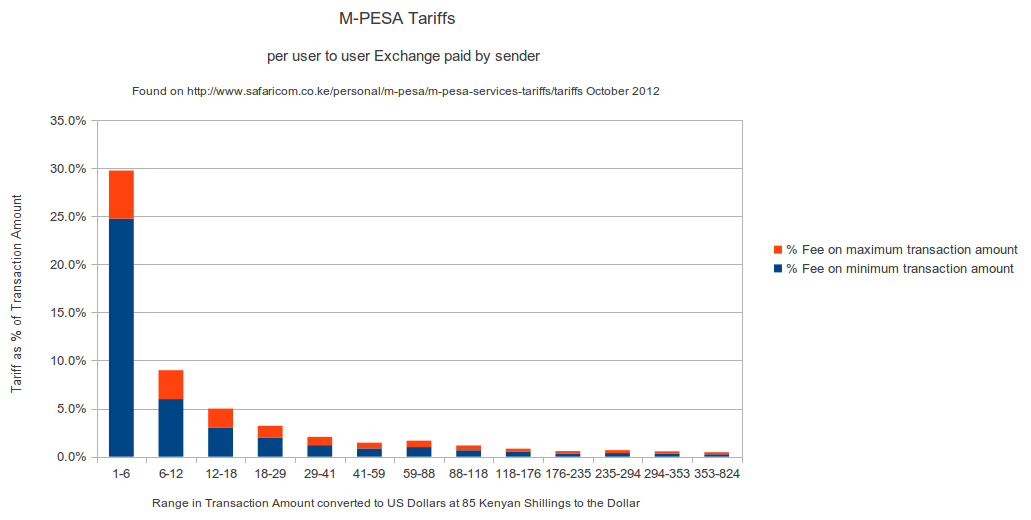
While m-Pesa fees are relatively high for small transactions, that is likely to improve as competing companies enter the field.

Here, is a chart of the m-Pesa fee schedule.

(Chart prepared by Will Ruddick)

The monetary and financial revolution is just a matter of putting existing components together. The hardest part will be in negotiating the minefield of laws, regulations, and taxation policies that protect existing monopolies and fiefdoms. But once begun, it will be increasingly difficult to stop this snowball from rolling downhill. –t.h.g.

Reclaiming the Credit Commons

Following my participation in the Commons Conference in Berlin two years ago, I was asked to contribute a chapter to an anthology titled, The Wealth of the Commons: A world beyond market & state.

This book is a “new collection of 73 essays that describe the enormous potential of the commons in conceptualizing and building a better future.” At long last, the English edition has now been published and can be ordered from Leveller’s Press.

I think this chapter is one of the most succinct and information-rich essays I’ve ever written, so I’ve posted it here on this site. You can download the pdf file here: Reclaiming the Credit Commons.

It is also available in Greek here. and in French here or at Ecoattitude –t.h.g.

Competing currencies essential to freedom

This appeal by Congressman Ron Paul is perhaps the most important proposal by an American politician in the last 100 years.
I’m glad to know that Congressman Paul is not limiting his proposal to gold and silver currencies.

The most liberating means of payment is “mutual credit clearing” through independent non-bank associations of businesses and individuals.

Of course, the credit in such accounts needs to be denominated in some objective units, which could be specified weights of gold or silver, but better still, would be an “index unit” based on a “market basket” of basic commodities that are widely and freely traded.

My four books on the subject, and my websites, provide coverage of pertinent concepts and history, and full details on my prescriptions for businesses, communities, and governments.–t.h.g. 

Legalize Competing Currencies

I recently held a hearing in my congressional subcommittee on the subject of competing currencies.  This is an issue of enormous importance, but unfortunately few Americans understand how the Federal Reserve and Treasury Department impose a strict monopoly on money in America.

This monopoly is maintained using federal counterfeiting laws, which is a bit rich.  If any organization is guilty of counterfeiting dollars, it is our own Treasury.  But those who dare to challenge federal legal tender laws by circulating competing currencies– at least physical currencies– risk going to prison.

Like all government created monopolies, the federal monopoly on money results in substandard product in the form of our ever-depreciating dollars.

Yet governments have always sought to monopolize the issuance of money, either directly or through the creation of central banks. The expanding role of the Federal Reserve in the 20th century enabled our federal government to grow wildly larger than would have been possible otherwise.  Our Fed, like all central banks, encourages deficits by effectively monetizing Treasury debt.  But the price we pay is the terrible and ongoing debasement of our money.

Allowing individuals and business to use alternate currencies, especially currencies backed by gold and silver, would expose the whole rotten system because the marketplace would prefer such alternate currencies unless and until the Fed suddenly imposed radical discipline on its dollar inflation.

Sadly, Americans are far less free than many others around the world when it comes to protecting themselves against the rapidly depreciating US dollar.  Mexican workers can set up accounts denominated in ounces of silver and take tax-free delivery of that silver whenever they want.  In Singapore and other Asian countries, individuals can set up bank accounts denominated in gold and silver.  Debit cards can be linked to gold and silver accounts so that customers can use gold and silver to make point of sale transactions, a service which is only available to non-Americans.

The obvious solution is to legalize monetary freedom and allow the circulation of parallel and competing currencies.  There is no reason why Americans should not be able to transact, save, and invest using the currency of their choosing.  They should be free to use gold, silver, or other currencies with no legal restrictions or punitive taxation standing in the way.  Restoring the monetary system envisioned by the Constitution is the only way to ensure the economic security of the American people.

After all, if our monetary system is fundamentally sound– and the Federal Reserve indeed stabilizes the dollar as its apologists claim–then why fear competition?  Why do we accept that centralized, monopoly control over our money is compatible with a supposedly free-market economy?  In a free market, the government’s fiat dollar should compete with alternate currencies for the benefit of American consumers, savers, and investors.

As Austrian economist Ludwig von Mises explained, sound money is an instrument that protects our civil liberties against despotic government. Our current monetary system is indeed despotic, and the surest way to correct things simply is to legalize competing currencies.

#     #     #

Occupy World Street, Ross Jackson’s Anthem for the movement

Ross Jackson is more than a thought leader and visionary; here he is performing a song he wrote for the Occupy Movement. I think it is both inspiring and entertaining, an excellent companion to his recent book by the same name. You can learn more about the Occupy World Street agenda at the website,  http://occupyworldstreet.org/.

Who’s Left, who’s Right, and who should issue money?

I have in my possession, a copy of a copy of an essay by E. C. Riegel, one of many that I gleaned from the files of Spencer MacCallum who had the foresight to rescue Riegel’s literary legacy from oblivion, and the good sense to make his insightful works on money and freedom generally available. The article titled, The Right Is Still To Come, is transcribed below. It bears no date, but I would guess that it was probably written sometime between 1945 and Riegel’s death in 1953.

In the very first paragraph, Riegel sets forth the essential target of his argument, saying, “The professed socialists and the professed anti-socialists are united as monetary socialists in the common superstition that money springs from the State.” I long ago took Riegel’s argument to heart and have taken up the cause of dispelling that superstition, most notably in Chapter 8, The Separation of Money and State, in my book, The End of Money and the Future of Civilization.

I personally try to avoid using imprecise terminology and political clichés that are emotionally charged and tend to get in the way of rational thinking. Riegel, on the other hand, can be forgiven for some slight indulgence in political rhetoric that seems to us perhaps judgmental and outdated.  Keep in mind that he lived in tumultuous times that were scarred by two world wars, the great depression, and the rise of totalitarian governments bearing the various labels of fascist, communist, or socialist (any critique of Capitalism in the west at that time was overwhelmed and suppressed in a number of ways). These are the terms that defined people’s loyalties, as nations contested violently with one another to decide how people should be governed. The reader should not be put off by Riegel’s framing his arguments in terms of left, right, socialist, capitalist, and collectivist. His writings clearly show that he was, after all, a champion of peace, freedom, and social justice.

The emphasis of particular sections in the following essay has been added by me to highlight major points.–t.h.g.

THE RIGHT IS STILL TO COME by E.C. Riegel

On the left stands the socialist, back of him stand a hundred capitalists.  All society is composed of conscious and unconscious socialists.  The professed socialists and the professed anti-socialists are united as monetary socialists in the common superstition that money springs from the State.  The birth of the Right awaits disillusionment from this all-confounding fallacy.

There are advocates of many different money reforms but none renounces the basic error of the socialization of the money system.  To none of the believers in free enterprise does it seem incongruous to leave the State in complete control of the medium whereby free enterprise must articulate.  The right to freely contract and the sanctity of contract is seen as cardinal to free enterprise.  Yet, to leave to the State the power to alter contracts by altering the meaning of the money unit in terms of which all contracts are expressed, does not seem to professed capitalists contradictory.  Thus the State exercises its most vicious interventionism by making itself a party to all contracts, an unbidden and perverting party.

Some would limit, by various devices, the amount of “money” the State should issue.  Others would limit the amount of “credit money” that business men should issue.  Still others would abolish the later entirely, counting only government issues as genuine money.  None would abolish so-called money issues by government, leaving the money issuing power to the only true issuers, the private enterprisers.

With monetary socialization accepted, the choice is confined to different methods of perversion.  There is no monetary Right and since free money is basic to a free economy, there is no philosophy of the Right.  To merely complain against the drift toward socialism does not make one a true anti-socialist.  To propose or support political money reforms does not make one’s surrender to socialization any less abject, nor betrayal of free enterprise less vicious.

The trend toward socialism was set when business men accepted the cry, better called superstition, that money issuance and control are functions of political government—the political money system.  That fallacy, until exploded, makes the progressive socialization of the entire economy inevitable.  The pace of this perversion is not determined by the amount of resistance offered by the alleged opponents of socialism, but by the degree that the State indulges its perversive power by emissions of false money into the blood stream of business.

The pace of this perversion is quickening all over the world; a huge flood of water-money threatens to inundate all.  Can we preclude disaster by bringing those who call themselves anti-socialists over from the Left to the yet unoccupied Right?  Can we induce businessmen to think and act in terms of the economic means rather than the political means?  Can we build an economic statesmanship?  In short, can we sell capitalism to capitalists?  If we can we will save private enterprise and the social order.  If not, the deluge.

Painful as it may be to change habits of thought, (if indeed, prevailing money ideas can be called the product of thought) the triumph of free enterprise over socialism and tyranny can be accomplished only by the renunciation of the fallacy of political money power and the assertion of exclusive power of private enterprise to control and issue money.  When we realize that the political money system has operated almost from the beginning of money, it may be seen what a break with tradition this proposal involves.

The long existence of the political money system does not, however, imply continuity of operation or vindication.  There have been countless instances of the breakdown of national money units through excessive dilution of the money stream by the State.  All money circulations have been a mixture of genuine money issued by private enterprisers and spurious issues by the State.  Following these breakdowns the State set up new money units and repudiated the old.  During the transition from the old to the new, exchange has been kept alive by resort to other national units that were still relatively stable.

What makes the present inflationary crisis unprecedented is the universality of the decline of political money units and that the U.S. dollar, the strongest unit, is being subjected to blood transfusion to sustain other units.  Thus the superstructure of the entire political money system is being bolstered by timbers taken from the foundation with the ultimate result that the whole structure will collapse together.  It is therefore imperative that we change superstitious money ideas for rational ones before it is too late to avoid worldwide chaos.

Why no State Can Issue Money

To understand money is to understand why it cannot spring from any government, national, state or city.

The purpose of money is to obviate the necessity for contemporary delivery of value by both parties to an exchange transaction and thus greatly expand exchange.

By means of money its issuer is enabled to purchase values from any supplier, who, in turn, is enabled to do likewise, the money ultimately reaching a supplier who has need of the issuer’s values and thus the reciprocating trader is found and exchange is completed and the money retired.  Account is balanced by passage of value both ways, the medium, money, having no value.

Money can be issued only by a buyer who later, as seller, redeems his issue.  He must, to stay in business, bid for money with value because that is his only way of gaining income. He must price his values competitively or he can make no sale.  Thus, by his circumstance of being a private enterpriser he is ideally suited to issue and redeem money.

Contrast the State’s situation.  It is not a trader; it does not sell.  It needs not bid for money; it merely requisitions it by taxation. Since it has no way of redeeming money by open competitive bidding, it cannot issue it and its professed money issues are inescapably spurious.

The power and need to issue money is inherent in private enterprisers and thus it operates under natural checks and balances, while to the State it is entirely unnecessary and unnatural and no amount of fixing can supply the requisites that it lacks, nor is there the slightest reason for undertaking such artificiality.  The State would never have gotten into its present unnatural position of its own necessities, for, it always had its taxing power, before the advent of money, to levy in kind and under money exchange to levy on money.  It was forced into its anomalous position by the ignorance of businessmen who, not understanding money resorted to the superstitious belief that it needed the State’s imprimatur.

In spite of all the abortiveness of the political money experience professed friends of private enterprise and self-styled anti-socialists continue their efforts to perpetuate it by added gadgets.  None has contributed in the slightest degree toward liberating private enterprise from it.  Private enterprisers do not even know that, as bank borrower they are money issuers.  They think that their participation in the money system is a secondary one and that even this depends upon a grant from the State.  The truth is that every money unit ever issued has come from private enterprisers and that no money has ever or ever can be issued by any state.  The only thing that makes it possible for the delusive political money system to operate at all is that the true money issued by businessmen serves as a host for the parasite issues of government to feed upon.  No government could build a money circulation of itself anymore than a farmer can produce watered milk from the pump alone.  In this metaphor government is the pump and private business is the cow.

How the political Money System Sabotages Private Enterprise

Every businessman knows that stock splits involve an increase in the number of shares without an increase in capital.  What he does not understand is that so-called money issues by government are but money splits involving merely an increase in the number of units without an increase in the money supply.  The analogy ends there.  In stock splits the corporation does not rob the stock holder.  In the process of money splits the government issues them by taking goods and services out of the market, thus robbing the economy, thereby depreciating the power of each money unit.  This is called inflation and inflation is in turn defined, naively, as “too much money chasing too few goods”, whereas it is but the same amount of real money mixed with spurious money with the economy robbed in the sum of the spurious money.

With the so-called capitalist world deluded into thinking that what government issues is money, the process of sabotaging the economy has open sesame.  It enables the State to practice paternalism and paternalism is the mother of socialism.

#     #     #

Liars for LIBOR: Betrayal of the public trust, one more chapter

News of another mega-scandal broke last week reveling again the corrupt nature of the global system of money and banking. In the video below, former New York State Governor and Attorney General, Eliot Spitzer discusses the LIBOR scandal with investigative reporter Matt Taibbi. According to Wikipedia, LIBOR stands for “The London Interbank Offered Rate.” It isthe average interest rate estimated by leading banks in London that they would be charged if borrowing from other banks.” The LIBOR has wide ranging effects on the rates that ordinary people must pay on various types of loans. Falsification of LIBOR results in higher costs for everyone and illicit profits for big banks.

E. C. Riegel had an answer to the money problem, which he summarized in the following brief essay. The word valun is one he coined, which stands for “value unit,” and he pronounced val-yoon. My own work has been greatly influenced by Riegel, and my prescriptions for a decentralized, locally controlled network of interest-free credit clearing exchanges draws from and extends Riegel’s proposals (See my book The End of Money and the Future of Civilization).

I Am the Valun by E. C. Riegel

I am the valun, the universal money unit.

My mission is to unite all men on the economic plane, regardless of their political differences, and to enable them to govern government.

I bring to trade a common language and thus make commerce homogeneous.

I liberate the artisan and the trader from political money control and thus defeat authoritarianism.

I deny to government the power to finance war without the people’s direct and conscious financial support and thus fortify their will to peace.

I facilitate trade, induce technological improvement, increase wealth and leisure.

I conserve the profit motive in the production of wealth but deny it in the creation of money.

I am the creature and servant of every man who would render service useful to his fellows.

From his pen I spring, but by the monetary exploiter or the state I cannot be generated.

I am homogeneous because I am homo-generated.

I guarantee to everyman freedom to labor and the full rewards thereof with preservation of his right to freely choose his vocation and with full respect for the dignity of his personality.

I am the implement of freedom, prosperity and peace to all men throughout the world.

I am the surprise weapon against the enemies of private enterprise and human rights — the friend of the individualist, the foe of collectivist.

 #     #     #

Newsletter July 2012

Dear friends,

I know we’re all overloaded with information these days, so I’ll keep this brief.

In this issue:

Summer in Tucson

Presentations and Interviews

Public Banking in America

Fall Tour

Recent Blog Posts

Commons Anthology

Nuclear Power

Summer in Tucson

Summers in Tucson can be a challenge. June is the hottest (and driest) month with daytime high temperatures averaging around 100 degrees, but with many days 5 to 10 degrees hotter than that. July can be just as hot, but by then we can expect the start of the eagerly awaited summer monsoons. These are not the sustained rains that fall in the tropics, but (usually) brief thunderstorms that provide some relief from the blazing sun and oppressive heat, and we can always count on the temperatures dropping by thirty degrees or more overnight. Like winters in the north, summers here are a time of reduced activity and indoor pursuits, like reading. A couple of the books that I’ve read recently that I highly recommend are David Sloan Wilson’s, Evolution for Everyone, and Malcolm Gladwell’s, Outliers. Both of these books challenge established beliefs in a way that I find fascinating, and both tells stories that are very engaging.

Presentations and Interviews

In March I conducted a teach-in for Move On and Occupy Tucson, presenting my ideas about The Emerging Butterfly Society, then, later in the month traveled to San Diego under the sponsorship of Activist San Diego & Women Occupy San Diego, where I gave a presentation titled, Occupy the Commons: Reclaiming Our Birthright. That was followed up with a workshop titled, Complementary Exchange Systems: Preparing to Launch, which I conducted for a small group of social entrepreneurs who are now in the process of starting up a local exchange system for their community.

Also in March, I was a guest on Catherine Austin Fitts’ monthly Solari Report program on which we discussed various approaches to value exchange and investments that bypass conventional banking and financial institutions. Catherine, who was Assistant Secretary of Housing in the first Bush administration, is a knowledgeable investment advisor. See her website at http://www.solariadvisors.com/ .

In April, I was invited to do a brief interview for Bloomberg TV’s program, In Business with Margaret Brennan. Later, I traveled to Philadelphia to attend the Public Banking Institute conference (see details below).

May and June included another presentation at the Sustainable Tucson monthly meeting, an interview by Jay Taylor on his webcast program, Turning Hard Times into Good Times, on Voice America internet channel (download it from https://beyondmoney.net/wp-content/uploads/2012/05/thomasgreco20120522jaytaylor.mp3), and an interview by Marcus Matthews from London, England, on his webcast program, The Money Maverick.

Public Banking in America

During the last weekend in April, The Public Banking Institute (http://www.publicbankinginamerica.org/ ) hosted their inaugural conference, Public Banking in America, in Philadelphia. It was one of the best conferences I’ve attended in many years—very well organized, excellent speakers, and intelligent and energetic participants. I had the privilege of having been invited to speak. My presentation was titled, A New Paradigm in Exchange and Finance: the End of Financial Crises, Trade Wars, and Economic Exploitation. Other presenters include Ellen Brown, PBI President and author of Web of Debt, Gar Alperovitz, Professor of Political Economy at the University of Maryland, Paul Hellyer, former Canadian Minister of National Defence and founder of the Canadian Action Party, and Bill Still, producer of The Money Masters videos, among others. All presentations were video recorded and will eventually be posted. You can find them here: http://www.publicbankinginamerica.org/speakers.htm

PBI is all about promoting Banking in the Public Interest and is fostering the widespread establishment of state-owned banks modeled after the bank of North Dakota. This from the PBI website explains their main mission:

Public banking frees the credit potential of public revenues and then harnesses this public wealth to create sustainable, abundant and affordable credit. This credit — our credit – supports our economy and citizens if it is then used to build economic capacity (think renewable energy, sustainable agriculture, etc. — things that private banks do not fund). PBI is committed to public banking becoming a mainstay to support the new economy.

As PBI matures as an organization, I expect that the scope of its mission will expand to include other more fundamental approaches to community empowerment and economic development.

Fall Tour

I continue to enjoy good health and am considering the possibility of a Fall tour of Europe and the UK to conduct workshops and presentations for groups that have been following my work and have a serious interest in the approaches that I have been advocating. Preliminary discussions have been positive but my decision will depend on booking enough stops to cover my expenses and provide a small honorarium. If your group, or some other that you know of, would like to be included, please contact me at thgreco@mindspring.com .

Recent Blog Posts

I’d like to call your attention to some recent posts to my blog that I think are especially important. Two of these present some of E. C. Riegels most important ideas, along with my commentary on them. They are E. C. Riegel’s Money Quiz and the True Money System, and The Language of Money and Accountancy. I’m planning to post more of Riegel’s incisive writings over the coming months, so please watch for them.

I also suggest that you follow the insightful work of Tom Atlee, expert facilitator and advocate for group intelligence. I’ve excerpted one of his recent articles at, What and whom do we really depend upon?. Finally, my post about Cyclos, Cyclos, worth another look?? , has elicited a number of comments, including some from the Cyclos developers. These comments contain much valuable information for those of you who are searching for a suitable software platform for your exchange system.

Commons Anthology

The long-awaited English version of the commons anthology is now expected to be published in September from Levellers Press under the title The Wealth of the Commons: A World Beyond Market and State. At that time, I will be posting the text of my chapter on https://beyondmoney.net/. I think it is one of the best articles I’ve ever written, so please watch for it.

Nuclear power

This video featuring Ed Asner makes some powerful arguments showing the insanity of the proposed nuclear power plant in Florida. Please watch it and pass it on. It is not only Florida that is at stake, it’s the health and financial well-being of everyone on the Planet. http://tomazgreco.wordpress.com/2012/03/05/ed-asner-the-insanity-of-floridas-proposed-nuclear-plant/

Wishing you all an pleasant summer,

Thomas

What and whom do we really depend upon?

 Tom Atlee’s recent article (excerpted below) is a BRILLIANT statement of both truth and necessity. I believe that sharing, cooperation, and restructuring are now gaining speed. The impending disintegration of the money/banking/finance sector will force us to “take off” soon. Let’s hope that we can generate enough “lift” before we run out of runway.–t.h.g.

Emerging EcoNomics #3: The New Sharing Economy

One of the key features of “the new economy” is sharing.  More and more people are sharing housing, cars, bikes, tools, meals, skills, money, books, ideas, music, energy, recreation, projects, transportation, knowledge, problem-solving, visions, jobs, ownership, clothes, stories, time…

Sharing is a resource in hard times as well as a source of intrinsic meaning and satisfaction any time.  To an increasing number of people, sharing offers compelling alternatives to the corporate-dominated money-saturated whole-society bustle we normally think of as “the economy”.

….

The existing economy is designed to get us to look out for ourselves so that we’ll consume, compete and work at paying jobs.  It nurtures the illusion that we are independent, building lives for ourselves in a world where everyone else is out for themselves, too.  Closer examination, however, suggests that such independence is largely a myth, a well-promoted appearance obscuring our profound dependence on the competitive buy-and-sell economy which, in turn, conceals our dependence on nature, culture, and each other.

….

In the existing economy we experience obligations not primarily to our neighbors, our communities or the natural world that supports everything we do.  We experience obligation to our employers, to governments, and to banks, credit card companies, and other institutions of higher lending.

This entrenched economic dependence hides the fact that we are fundamentally INTERDEPENDENT:  We need each other.  We are intimately connected to intricately interdependent natural world.  And we are co-creating the conditions of our lives and the prospects for our future, whether we know it or not.

….

…. Once we become grounded in quality of life rather than quantities of stuff or money, the possibilities for sharing expand exponentially, creating a sense of abundance even in the presence of some physical scarcity.

Whether or not we are inclined to share more with each other, one thing we all share nowadays is destiny.

Read the rest of the article…

If we must have the corporation, let it be “B”

Few people are yet aware of it, but there is a new form of organization that seeks to transform the behavior of the corporation to make business a force for change that servers the common good. The B Corporation is “a new type of corporation that meets rigorous and independent standards of social and environmental performance, accountability, and transparency.” 

Here’s a letter from the B Lab team that recounts the recent history and announces the upcoming retreat.—t.h.g.

It was twenty years ago today . . .

Actually, it was five years ago this week that the curtain rose on the B Corp movement.
At the invitation of then BALLE executive director and current RSF Social Finance CEO Don Shaffer, we were given an opportunity to share the vision of B Corp in a plenary setting before we had any business being given the stage.  As if sensing the moment, 13 leaders of the sustainable business community with whom we had been gestating the concept for more than a year, said that if the curtain was rising on B Corp, then they wanted to be on stage for the first performance.

Our memory is (other than Jay being uncharacteristically brief in his introductory remarks) mostly of being humbled that these leaders, already recognized as such by their peers, were willing to stand up and lend their credibility to something so unlikely and audacious.  But, then, that is what leaders do.

We remember (perhaps correctly) Jeff Mendelsohn characteristically bounding to take the mic first to explain why New Leaf Paper was becoming a Founding B Corporation.  Or maybe it was Mike Hannigan (Give Something Back) who led off as our unofficial local host?  Or maybe everyone appropriately deferred to Judy Wicks (White Dog Café) as BALLE’s co-founder?  They were joined by Matthew Bauer (Better World Telecom), Ben Bingham (now 3 Sisters Sustainable Investments), Jason Salfi (Comet Skateboards), Scott Leonard and Matt Reynolds (Indigenous Designs), Elizabeth Guman (now Strategy Arts), Mal Warwick (Mal Warwick Associates), and competitors cum collaborators Adam Lowry (Method), Gregor Barnum and Jeffrey Hollender (Seventh Generation).  We are sure (and sorry) that we are forgetting some who were leading that day.

It is wonderful to be here.  It’s certainly a thrill.

It’s hard to believe this all began from a standing start five years ago.  Although, it wasn’t a standing start was it.  The sustainable business movement, the local living economies movement, socially responsible business and investing movements, microfinance, clean tech, organics, green building et al were all long-standing and vibrant.  Myriad thought and action leaders too numerous to mention have inspired and influenced each of those on stage and the now more than 500 Certified B Corps in countless ways.  The community of B Corps will hopefully inspire and influence the next generation of leaders whose names we don’t yet know and whose ideas we can’t yet imagine.

With the 5th anniversary of the B Corp on our minds and our October Champions Retreat approaching, we are feeling the need to reflect and to hear your reflections on where we’ve been and where we may be headed.  Whether you’d like to share a memory, a vision, or a concern, a hope, an idea, or a suggestion, please share it with us or post it on our internal B Corp community listserve – which you can access here.

In five short years, together we have built a vibrant and diverse community of more than 500 leading businesses across 60 industries, 40 states, and now 8 countries.  More than 2,000 other sustainable businesses are using the standards we’ve developed together to measure what matters most and to help them benchmark their performance and increase their impact.  Together, we have passed legislation — that a former president of the American Bar Association calls ‘the first, real, original, constructive thought in the corporate governance world in 25 years’ – in 7, no, now 8 states, as today benefit corporation legislation was enacted in Louisiana by Republican Governor Bobby Jindahl.  Much more has been accomplished (the launch of GIIRS and a national ad campaign to name a few) and, of course, since much more remains yet to be done.

I don’t really want to stop the show.

So stay tuned, enjoy the summer, share your reflections and visions and make sure you put October 3rd-5th on your calendar to join your fellow leaders in Half Moon Bay for our Champions Retreat as we focus our collective energy on the power of collective action and create plans for what we can do together that we can’t do alone.

Thanks to all who have led the way and given this community an opportunity to serve.  Thank you to the 13 who taught the band to play.  And thank you all for making playing so well together.

Be the change,

Jay, Bart, Andrew and the B Lab team
jay@bcorporation.net

Toward a sane economics

This TEDx video by Peter Joseph, creator of the Zeitgeist movies series, contrasts two opposing economic frameworks that need to be considered in transcending our present global predicament. He shows that the entire incentive structure of the dominant paradigm of political economy is all wrong, and outlines some of the necessary attributes of a sustainable earth-friendly economy.

The presentation does not get into the how-to-do-it, but provides a good starting point for working out the necessary transition to what I’ve been calling “The Butterfly Economy. My basic prescription for that involves radical sharing, collaboration, restructuring, and rebuilding our society from the bottom, on up, household to neighborhood, to community, to bioregion, including all of our non-geographic affinity groups. Begin with the people and businesses you already know and trust.

Please take ten minutes to view the video.