Category Archives: Emerging paradigm

Usury and the Money Problem, a Message to Faith Communities

The Fellowship of Reconciliation (FOR) is an international interfaith movement that has been working for peace, justice and nonviolence for almost a century. As a result of meeting Ray Foss during my tour of Oregon and Washington about a year ago, I reconnected with FOR. Ray has lately been instrumental in raising the issues of “usury” and “the money problem” amongst various faith-based communities. I think it is largely through his efforts that a recent issue of Fellowship, the magazine of FOR, had a major focus on Rethinking Money.

Starting with a fine editorial by Mark C. Johnson, FOR executive director, that section of the magazine contains articles by both Ray and myself. My article Money, Usury, and the Economics of Peace, can be read online.

The arguments against the practice of usury/interest go way beyond scriptural prohibitions. It is now obvious to anyone who cares to see, that there are solid economic and social arguments that should be sufficient to persuade any rational person that our present system of money and finance, based as it is on compound interest (usury), is not only unjust, but also destructive to the natural environment, the social fabric, and the common good.

World debt has been growing much faster than any measure of economic output, even GDP (gross domestic product), which includes not only the production of goods, but also the production of “bads.” The financial crises we are seeing in various countries and economic sectors are evidence that the debt burdens have grown far beyond what can be borne by either the private sector or by governments.

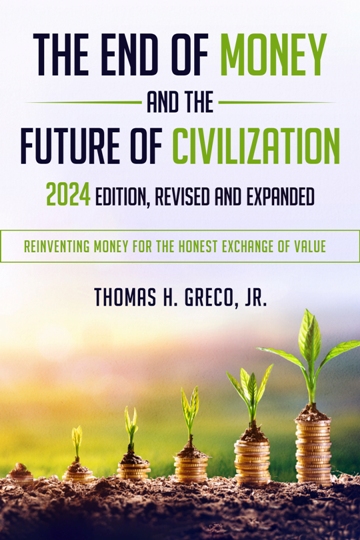
The growth of debt must stop. A new economic and financial order must soon emerge, if not consciously and deliberately, then it will happen on its own through the descent into chaos. If political and financial leaders cannot accept the end of the old order of things, then the people themselves must take the lead to develop new arrangements that build a peaceful, more equitable society, from the bottom up. How that might be done s the subject of the latter (prescriptive) chapters of my book, The End of Money and the future of Civilization.

Recognizing Interdependence

Money is supposed to be our servant, but it has become our master. A major step in liberating ourselves is the recognition that “we are all in this together,” that the entire web of life is based on intricate patterns of co-dependence and symbiosis.

Tom Atlee of the Co-Intelligence Institute, in his Independence Day musings, provides a useful history of the “interdependence movement,” and it various proponents. Here is an excerpt:

For countries as well as individuals, independence is a dramatic move from dependence into a more self-defined, self-created life.

The next developmental step takes us into greater INTERdependence – bringing ourselves into increasingly mutual, peer, give-and-take relationships with others.

Nature has been developing interdependence as an art form for billions of years.  Animals like us depend on plants for oxygen; plants depend on us for carbon dioxide.  Flowers feed bees with nectar; bees pollinate flowers.  Rabbits feed foxes; foxes keep rabbits from destroying their own habitat and starving.

We humans have our own ways of being interdependent.  With each passing year, global economics, technology, media and mobility have woven us all together.  On the other side of the coin, climate change, ocean exploitation, terrorism and wind-borne toxins and radiation have taught us — or should be teaching us — how relative our boundaries are and how solidly real our shared destiny.

As the fundamental fact of interdependence becomes increasingly obvious, we are slowly learning how to use it consciously to further our collective well-being. We are developing new forms of mutuality, community, synergy, sustainability and co-intelligence which empower us to make our shared fate a good one.

Declarations of Interdependence and Interdependence Days can help us remember just how important and valuable interdependence is.

You can read the rest of Tom’s message here.

Money and Life: An exciting upcoming documentary

 I’ve had the honor to be included in the list of people interviewed for a new documentary film, Money and Life, which has been in preparation for more than two years. Scheduled for release early next year, it is being billed as “A story about money that will change your life.” Judging from the official description and recently released trailer below, it looks like it just might live up to that billing.—t.h.g.

MONEY & LIFE is an essay style documentary that investigates the many faces of money. This cinematic odyssey takes us on a journey, exploring the origins of money to connecting the systemic dots on the current global financial crisis and how we got here. But most importantly looking at what is emerging in the so-called New Economy.

In addition to exploring perspectives on money and the workings of the money system we ask the viewer to engage and examine their own assumptions and beliefs about money, attempting to unearth and make visible the implicit and explicit agreements we have made around money and how it has come to govern our lives in ways that create suffering and dissatisfaction. The central thesis is understanding that different monetary designs produce different results in human society and in the natural world. If that is really so, then what is possible?

We interview an all-star cast of deeply engaged global citizens.

You can view the trailer here:

http://vimeo.com/moogaloop.swf?clip_id=24227019&autoplay=true


The Emergence of Self-Organizing Systems of Exchange

Joseph Jaworski is the author of Synchronicity: The Inner Path of Leadership. In a message today from the publisher announcing the second edition of the book, I noted the reference to Jaworski’s “Four Principles to Access the Source of Innovation.” Although I’ve not yet read the book, I did take a look at the blog entry that describes the principles.

This is an excerpt of what it says:

At the heart of what Joseph Jaworski discovered during this fifteen-year journey as a way to understand and access the Source of wisdom and creativity – the place from which profound innovation flows – are these four principles:

 1. There is an open and emergent quality to the universe; a group of simple components can suddenly re-emerge at a higher level of self-organization as a new entity with new properties.

2. The universe is a domain of undivided wholeness; both the material world and consciousness are parts of the same undivided whole.

3. There is a creative Source of infinite potential enfolded in the manifest universe; connection to this Source leads to the emergence of new realities.

4. Humans can learn to draw from the infinite potential of the Source by choosing to follow a disciplined path toward self-realization and love, the most powerful energy in the universe. The words of philosopher Pierre Telihard de Chardin speak well to this principle. “Someday, after mastering the winds, the waves, the tides, and gravity, we shall harness the energies of love and then, for a second time in the history of the world, man will have discovered fire.”

Perhaps you own experience, like mine, will attest to the truth inherent in those principles.

I was particularly struck by the first principle and the statement that, a group of simple components can suddenly re-emerge at a higher level of self-organization as a new entity with new properties. This is highly relevant to the transition process that is currently underway in the world, especially the reinvention of money. In Chapter 17 of my book, The End of Money.., I describe the four basic elements required for A Complete Web-Based Trading Platform. These elements are:

1. A marketplace

2. A social network

3. A means of payment

4. A measure of value or pricing unit

These components are indeed “re-emerging” (based on our changing collective consciousness) “at a higher level of self-organization.” We are seeing more widespread recognition that:

  • money is nothing but a systems of accounting for credits and debits,
  • that it is the people’s collective credit that supports every national currency and payment medium,
  • that the creation of money based on interest-bearing debt requires continual expansion of debt, which drives economic growth that has become dysfunctional and destructive,
  • that we no longer need to depend upon banking wizardry to provide the monetary and financial means for exchanging goods and services and actualizing our productive capacity.

We now have many web-based marketplaces and social networks, numerous private currencies and payment systems that use direct credit clearing, and increasing recognition that there is an urgent need for a measure of value that is independent of any fiat currency or central bank.

As I pointed out in my chapter, there are a number of “disruptive technologies” that are emerging to completely change the nature of money and banking. These are:

  • Direct credit-clearing among buyers and sellers
  • The use of the Internet to create Web-based marketplaces
  • Transparency in Web-based accounting, information, and exchange systems
  • Strong identity verification
  • Secure encryption of information over the Internet
  • Social networking
  • Reputation ratings of vendors and buyers that are continually updated and available on-demand
  • The reemergence of mutual companies, co-responsibility, and localized Web-based markets

“It is not any of these individually but all of them in combination that will, I believe, result in structures that will provide superior performance in mediating the exchange process. Worsening economic and financial conditions, such as those experienced in 2007 and 2008, will create enhanced market opportunities for this sort of nonpolitical trading platform, and will assure their eventual implementation and wide acceptance.”

#     #     #

Coping, caring, and building community

As the financial and economic ground continues to shift beneath our feet, it becomes ever more imperative that we reduce our dependence upon the institutions and structures that we have come to depend upon and take for granted. The financial tsunami of 2008 and the continuing aftershocks should be a wakeup call. The sock markets may be up (for now), but that should not be taken as comforting evidence that everything is “getting back to normal.” As billionaire financier George Soros said in his recent book, “This crisis …has brought the entire [financial] system to the brink of a breakdown, and it is being contained only with the greatest difficulty. This will have far reaching consequences. It is not business as usual but the end of an era.” (The New Paradigm for Financial Markets: The Crash of 2008 and What it Means. p. 81).

The total outstanding credit for all sectors in the U.S. economy was 160% GDP in 1929, 260% in 1932. By comparison, we entered the 2008 crash at 365%, and Soros believes this will rise to about 500% of GDP within the next few years.

What seems to be in prospects for the foreseeable future for the vast majority of people in the developed world, especially the United States, is diminished purchasing power. This the result of simultaneous trends of underemployment or unemployment, rising prices of basic necessities due to currency debasement (inflation), and systematic attacks on the middle-class by the political establishment.

How do we cope with all of that? It is, of course, as the proverb says, both a challenge and an opportunity. I have suggested before that society is on the verge of metamorphic change that offers the promise of a more peaceful and harmonious world in which basic needs are met and everyone has the opportunity to realize their fullest potential. But it will take the right kind of action to make that vision a reality. It will require that we take sharing and cooperation to new levels, and that we create new structures that can serve the common good. An essential part of that is building community.

On that score, I take inspiration from Richard Flyer and the Conscious Community Network. Richard recently posted a list of 37 ways to build community. No Act is Too Small! You can click on that link to learn more, but I have extracted the 37 ways here for your convenience. I’m sure Richard won’t mind.—t.h.g.

1. A smile and a wave will go a long way.

2. Each morning, ask where you can make a difference.

3. Find the good in others instead of their faults – start in your home and on your street.

4. Become aware of hidden needs on your street – isolated seniors;

youth needing mentors, single parents; etc.

5. Start a community garden.

6. Practice forgiveness.

7. Surprise a new neighbor by making a favorite dinner – and include the recipe.

8. Slow down and enjoy the present moment.

9. Don’t gossip.

10. Start a monthly tea group.

11. Play cards with friends and neighbors.

11. Start a babysitting cooperative.

12. Form a group of neighbors to walk their dogs together.

13. Seek to understand.

14. Start a carpool.

15. Have family dinners and read to your children.

16. If you grow tomatoes, plant extra for a lonely elder who lives nearby – better yet, ask him/her to teach you and others to can the extras.

17. Turn off the TV, Play Station, PSP, and talk with family, friends, and neighbors.

18. Bless your food with gratitude.

19. Know that love is not a feeling but a courageous choice.

20. Ask neighbors for help and reciprocate.

21. Talk to your children or parents about how their day went.

22. Say hello to strangers.

23. Create a neighborhood newsletter.

24. Organize a neighborhood clean-up.

25. Be a model and demonstrate the virtues you want to see in the world.

26. Be a peacemaker.

27. Talk to the mail carrier.

28. Shoot some ‘hoops with neighbor children.

29. Support local merchants.

30. Speak kindly and listen carefully

31. Hire young people for odd jobs.

32. Form a tool cooperative with neighbors and share ladders, rakes, snow blowers, etc.

33. Grow your own food.

34. Be real. Be humble. Be respectful.

35. Offer to watch your neighbor’s home or apartment while they are away

36. Be of service to all.

37. Go to http://www.consciouscommunity-reno.org/ to share your stories.

Adapted from http://bettertogether.org.

Stop Chasing the Buck and Change Your Luck

Cashless trading based on credit clearing is moving into its next stage of development, the optimization and scale-up stage.

Established groups and associations are beginning to recognize the importance and urgency of disengaging from conventional structures of money and banking, reclaiming “the credit commons,” and reorganizing the exchange of value under local community control. One such association is Green America, formerly known as Coop America, which has recently established  The Green America Exchange  as a way of offering cashless trading opportunities to members of their Green Business Network.

GAEx uses the GETS trading platform which has been developed by Richard Logie, a long-time commercial trade exchange operator and leader in the industry. While the GETS software is proprietary, it seems to have the functionality needed for cashless trading within the exchange. According to Logie, the platform also has the capability needed for networking similar exchanges together into a larger more widespread trading community.

In response to a request from the Green America administration I’ve written the following article for posting (in four parts) on the Green America Exchange blog. For your convenience, I’ve also posted it below.–t.h.g.

Stop Chasing the Buck and Change Your Luck

Thomas H. Greco, Jr.

Most small and medium sized businesses (SMEs) these days are having a hard time financially–sales are down, costs are up, and bank credit is unavailable, all of which is symptomatic of the stagflation that besets the American economy.

Our present predicament is no accident of nature, nor is it a temporary condition; it is the expected result of a flawed system of money, banking and finance. We have allowed the banks to control our credit and charge us interest for the “privilege” of accessing some of it as bank “loans.” The fact is that the dollar regime, like every other political currency, collectivizes credit. It is the people’s collective credit that supports each national currency, but the allocation of that credit is determined by forces beyond popular control, and an inordinate proportion of it is used to fund the war machine and to enrich corporate fat cats, all to the detriment of peace, equity, and the common good.

But we need not be victims of a system that is so obviously failing us. We can learn to play a different game. It is possible to organize an entirely new structure of money, banking, and finance, one that is interest-free, decentralized, and controlled, not by banks or central governments, but by businesses and individuals that associate and organize themselves into cashless trading networks. This is a way to reclaim “the credit commons” from monopoly control and create healthy community economies that can enhance the quality of life for all.

In brief, any group of traders can organize to allocate their own collective credit amongst themselves, interest-free. This is merely an extension of the common business practice of selling on open account—“I’ll ship you the goods now and you can pay me later,” except it is organized, not on a bilateral basis, but within a community of many buyers and sellers. Done on a large enough scale that includes a sufficiently broad range of goods and services, such systems can avoid the dysfunctions inherent in conventional money and banking and open the way to more harmonious and mutually beneficial trading relationships that enable the emergence of sustainable economies and promote the common good—a true economic democracy.

This approach is no pie-in-the-sky pipedream, it is proven and well established. Known as mutual credit clearing, it is a process that is used by scores of commercial “barter” companies around the world to provide cashless trading for their business members. In this process, the things you sell pay for the things you buy without using money as an intermediate exchange medium. Instead of chasing dollars, you use what you have to pay for what you need. It’s as simple as that. Unlike traditional barter, which depends upon a coincidence of wants and needs between two traders who each have something the other wants, mutual credit clearing provides an accounting for trade credits, a sort of internal currency, that allows traders to sell to some members and buy from others. According to the International Reciprocal Trade Association (IRTA), a major trade association for the industry, “IRTA Member companies using the ‘Modern Trade and Barter’ process, made it possible for over 400,000 companies World Wide to utilize their excess business capacities and underperforming assets, to earn an estimated $12 billion dollars in previously lost and wasted revenues.”

Perhaps the best example of a credit clearing exchange that has been successful over a long period of time is the WIR Economic Circle Cooperative. Founded in Switzerland as a self-help organization in the midst of the Great Depression (1934), WIR provided a means for its members to continue to buy and sell to one another despite a shortage of Swiss francs in circulation. Over the past three quarters of a century, in good times and bad, WIR (now known as the WIR Bank) has continued to thrive. Its more than 60,000 members throughout Switzerland trade about $2 billion worth of goods and services annually.

Now the Green Business Network of Green America, is offering that kind of opportunity to its membership through Green America Exchange, GAEx. While still in the formative stages, Green America Exchange has the potential to become, not merely a lifeboat for SMEs in difficult times, but a model for a new paradigm in business.

The challenge for any network, of course, is to achieve sufficient scale to make it useful. The bigger the network, the more opportunities it provides for cashless trades to be made. In the early stages, it may require some help to find those opportunities, but as the members discover each other and become aware of what each has to offer, the value proposition becomes ever more evident and more businesses are attracted to it. Like Facebook, Twitter, My Space and other networks that are purely social, cashless trading networks will eventually grow exponentially –and that will mark a revolutionary shift in political as well as economic empowerment. It will be a quiet and peaceful revolution brought on, not by street demonstrations or by petitioning politicians who serve different masters, but by working together to use the power that is already ours—to apply the resources we have to support each other’s productivity and to give credit where credit is due.

Through participation in an exchange network that is open, transparent and democratic members enjoy the benefits of:

  • A reliable and friendly source of credit that is interest-free and community controlled.
  • Less need for scarce dollars.
  • Increased sales.
  • A loyal customer base.
  • Reliable suppliers.

What will it take to make mutual credit clearing networks go viral the way social networks have? That is the key question, the answer to which has heretofore remained elusive. While the WIR has been an obvious success, it seems to have been intentionally constrained and prevented from spreading beyond Swiss borders, and while commercial “barter” has been significant and growing steadily, it is still tiny in relation to the totality of economic activity.

As they are operated today, commercial trade exchanges are self-limiting and typically impose significant burdens upon their members. These include onerous fees for participation, exclusive memberships, limited scale and range of available goods and services within each exchange, the use of proprietary software, and insufficient standardization of operations which limits the ability of members of one trade exchange to trade with members of other exchanges.

Virtually all commercial trade exchanges are small, local, and operated as for-profit businesses. Small scale, local control, and independent enterprise are all desirable characteristics, but when it comes to exchanging valuable goods and services, something more is needed. What the world needs now is a means of payment that is locally controlled but globally useful.

Here are the things that I think are needed for cashless trading based on mutual credit clearing to go viral:

  1. Members need to offer to the network, not only their slow moving merchandise and luxury services, but their full range of goods and services at their usual prices. This will assure the value of the internal trade credits and make them truly useful.
  2. Like any “common carrier,” trade exchanges should make membership open to all with little qualification.
  3. Lines of credit (the overdraft privilege) must be determined according to each member’s ability and willingness to reciprocate, measured for example, by her record of sales into the network.
  4. Trade exchanges must be operated for and by the members in a way that is transparent and responsive.
  5. Members must exercise their duties to provide proper oversight and supervision of those assigned to manage the exchange.

As soon as there is a model exchange that has mastered these dimensions of design and operation, its success will inspire others to follow suit and the rapid growth phase will begin, leading eventually to an internet-like global trading network that will make money obsolete. Perhaps Green America Exchange will become that model.

#     #     #

Thomas H. Greco, Jr. is a writer, networker, and consultant, specializing in cashless exchange systems and community economic development. A former engineer, entrepreneur, and tenured college professor, he is widely regarded as a leading authority on free-market approaches to monetary and financial innovation, and is a sought-after advisor and speaker at conferences internationally. He is the author of many articles and books, including The End of Money and the Future of Civilization (Chelsea Green, 2009) and Money: Understanding and Creating Alternatives to Legal Tender (Chelsea Green, 2001). His blog, https://beyondmoney.net/, and website, http://reinventingmoney.com/, are valuable resources that provide detailed explanations and prescriptions for communities, businesses, and governments.

The World’s Ominous Reckoning

For those of you who missed my article titled, The World’s Ominous Reckoning, that was published in the Reality Sandwich web magazine, I’ve posted it directly on this site. You can find it here.–t.h.g.


The rise (and fall) of the global elite

Although it misses some of the fundamental phenomena that are at work in the world today, like resource depletion, environmental pollution, climate change, institutional breakdown, and the shift toward a steady-state, no-growth economy, this article from the Atlantic is worth a quick read (The Rise of the New Global Elite).

It highlights the growing gap between the super-rich and everyone else, pointing out the peculiar attitudes and rationalizations of the former and the apparent passivity of the latter.

In my opinion, the oligarchs and their minions give themselves far too much credit for their success. It may be true that they are clever, industrious, and hard-working, but so too are con men, embezzlers, and a goodly number of thieves and other criminals. Is it clever and industrious to appropriate for oneself (by force, intimidation, bribery, or manipulation), resources that are by nature the birthright of all (“the commons”), or to use one’s “insider” position to abuse a public trust? Far too many fortunes have been made that way.

The Atlantic article concludes “The lesson of history is that, in the long run, super-elites have two ways to survive: by suppressing dissent or by sharing their wealth. It is obvious which of these would be the better outcome for America, and the world. Let us hope the plutocrats aren’t already too isolated to recognize this.”

The thing that distinguishes a cancer cell from a normal cell is its alienation from the general body—from the “spirit,” if you will, that gives coherence in a living organism. A plutocracy that is alienated from the spirit of the community, like a cancerous tumor, cannot survive for long, it will eventually perish along with its host. –t.h.g.

A 93 year old French war hero’s call to (non-violent) arms

A January 3 article (The little red book that swept France) in one of Britain’s leading newspapers tells of the phenomenal success of a small book written recently by a 93 year-old war hero which urges people to resist the “insolent, selfish power of money and markets.”

Here are a few excerpts:

“They dare to tell us that the State can no longer afford policies to support its citizens,” Mr Hessel says. “But how can money be lacking … when the production of wealth has enormously increased since the Liberation (of France), at a time when Europe was ruined? The only explanation is that the power of money … has never been so great or so insolent or so selfish and that its servants are placed in the highest reaches of the State.”

“I would like everyone – everyone of us – to find his or her own reason to cry out. That is a precious gift. When something makes you want to cry out, as I cried out against Nazism, you become a militant, tough and committed. You become part of the great stream of history … and this stream leads us towards more justice and more freedom but not the uncontrolled freedom of the fox in the hen-house.”

It is high time that ethics, justice and a sustainable balance prevailed…”

I hope the book (Indignez vous! (Cry out!)) will soon be available in English.

New memes for a new society

Economic transformation is coming on so fast it’s impossible to keep up with it all. Among the most significant developments are changing attitudes about work, saving, investing, and communication. A vexing question heretofore has been “how to finance projects that promote the common good?”

Fortunately, people seem increasingly willing to invest their resources in projects that have evident potential for creating a better world, without any promise of providing any direct personal return on investment.

This phenomenon, called crowd sourcing, has spurred the recent emergence of several websites that connect projects with donors. One of the most popular of these is Kickstarter.com.

One of the new offerings on that site is, Symbionomics: Stories of a New Economy, a project of film maker Alan Rosenblith, who produced the film, The Money Fix, which features comments by a number of monetary “experts,” including yours truly.

This project is important because it seeks to change the way people think about economics, politics, and society, as expressed in this excerpt from their project site:

Icons for the Twelve Memes

We’ve outlined 12 patterns (or memes) of the new economy, and are creating simple, memorable icons for each one.

They will help us express new and sometimes abstract ideas. We are inspired by efforts like The Noun Project to create a language of universal symbols licensed into the creative commons.

Alan has become a good friend whose work I admire and support. I am suggesting that others consider supporting this project as well. — t.h.g.