Category Archives: The Political Money System

My 2 Minute Elevator Speech

I’ve added to this site my “Two Minute Elevator Speech About Solving the Money Problem.” You can find it under My Audio-visual presentations in the list at the right, or just click here.

Notes From the Field – Thailand

October 28-29, 2008

Relaxing on Koh Phangan

Much as I like Penang, I’m happy to be away from the bustle and noise of Georgetown for a while. I woke this morning to the sound of gentle rain hitting the roof of my seaside bungalow in Koh Phangan. With my Malaysian visa about to expire, I took it as an opportunity to visit Thailand again, choosing to return to the island (koh) that I visited last year. Koh Phangan in comparison to its better-known near neighbor, Koh Samui, is still relatively unspoiled. Although tourism is its economic base, it has not yet been overbuilt and overrun by upscale resorts and high rise condos. There is still a lot of open space and the typical accommodations consist of modest bungalows strung out along the various beaches.

A major attraction of Koh Phangan is the “full moon party” that attracts the twenty-something party crowd. I guess it was inevitable that ambitious entrepreneurs would augment that attraction by staging “half-moon” and “dark moon parties,” as well. Fortunately, that scene is easily avoided as it happens mainly at the south end of the island near Had Rin. The remainder of the island offers various levels of peace and quiet, nice beaches and clean water. Expenses are a bit higher here than in Penang but still affordable. I’m sure I could find ways to economize if I were to commit to a longer stay. It’s off season now so it’s a buyer’s market for lodgings. I dare say that ninety percent of the units are vacant right now.

The only sizeable village on the island is Thong Sala, located on the western side. That’s where the ferry docks are. It has all the usual conveniences – shops, restaurants, banks, cafes, and a nice night market where one can get a good cheap meal. I prefer to stay to the north and not too far away from Thong Sala at one of the many bungalow places that line the shore. The place I’m at is fairly new and clean and has screened windows, a rarity in these parts. It has no A/C, only a fan, but that’s quite adequate as it doesn’t get too hot here and there’s usually a breeze off the ocean.

The antipode to the party scene is the yoga/health spa scene. There is a sizeable cluster of people who come to the island for yoga workshops, personal growth, healing, and spiritual development. I first learned about Koh Phangan from my Italian friend, Michele, whom I met at Auroville last year. He had come here earlier that year to do yoga at the popular Agama Center which has a loose affiliation with the Ananda Yoga Resort where one can find various health oriented offerings like vegetarian food, yoga classes, sauna, massage, and a seven day colon cleanse program.

I came to the island last year prior to my visit to Bali. I liked it but was able to stay for only two weeks. Michele was not on the island at that time so I had to discover it on my own. This time, he is here so I have the advantage of being guided and introduced to people by someone who has spent a lot of time here.

The Bank Bailout Scam

What can you expect when a fox is appointed to manage the hen house? Our current Treasury secretary, Henry Paulson, was formerly the CEO of Goldman Sachs, one of the most powerful financial institutions in the world. His appointment to that post was clearly intended to enable a continuation of the long trend of greater concentration of power and wealth in elite hands.

Recent moves by the U.S. Treasury make that ever more obvious. In an article in Saturday’s (Oct. 25) New York Times, Times economic columnist, Joe Nocera, reveals what he calls “the dirty little secret of the banking industry”–namely, that “it has no intention of using the [government bailout] money to make new loans.”

Nocera explains that the Paulson plan to hand over $250 billion [in money borrowed into existence by the government] to the biggest banks, in exchange for non-voting stock, was never really intended to get them to resume lending to businesses and consumers, as was stated. That was just window dressing. The real purpose of the bailout is to engineer a rapid consolidation of the banking industry by enabling at public expense a wave of takeovers of smaller financial firms by the most powerful privileged banks. Examples, so far:

JPMorgan’s recent government-backed acquisition of two large competitors, Bear Stearns and Washington Mutual; the takeover of Merrill Lynch by Bank of America, Wachovia by Wells Fargo and, National City by PNC.

There’s more to come, and by deciding which banks get handouts and which don’t the entire consolidation process is being orchestrated from the top.

Expatriate Living

An “expatriate” is one who lives outside of his/her homeland. That term should not be confused with “ex-patriot,” who is someone who once was patriotic but is no longer. Not that the two are mutually exclusive, of course, but let’s not go off on that tangent just now. The “expat” lifestyle suits me very well. Besides enabling me to stretch the purchasing power of my small pension, there are social, educational, cultural, and even spiritual benefits to living abroad. That’s especially true when one gets away from the areas that are dependent upon tourism and immerses oneself for extended periods of time in the daily routines of ordinary people, which is something I feel I’ve barely started to do. It has been said that “travel broadens on,” but I would venture to say that living abroad tends to make one less nationalistic, more humanistic, and more appreciative of the things that all people have in common.

Communicating

When I left the U.S., I suspended my Verizon cell phone account. Their rates for international service are quite unreasonable in comparison to what’s available in Asia. Mobile phone dealers are everywhere here and the competition is fierce, so some phones and most services can be had pretty cheaply. The common practice here is to buy your own phone then buy a SIM card from one of the many service providers, then buy minutes of call time. As I understand it, you pay only for outgoing calls, not incoming, but there is an expiration date on your outgoing call time the duration of which depends on how big a block of time you buy. In Malaysia ten Ringgit was good for ten days, thirty Ringgit for thirty days.

Cheap as it is in Malaysia, service in Thailand seems even cheaper. To avoid high roaming charges on my Malaysian service, I did as I was advised by other travelers and bought another SIM card when I got to Hat Yai, my first stop in Thailand. The SIM card is a tiny electronic chip that slips into a slot just beneath the phone’s battery. Anyone can install it in about ten seconds. People at my guest house directed me to a shop right next door where I paid 50 baht (about $1.50) for a SIM card. I then “topped-up” my card at the guest house with 100 baht worth of call time. At .80 baht per minute that gave me 125 minutes of domestic call time, good until December 2. At a total cost of less than 5 dollars that’s not bad. No wonder every teenage kid in Asia has a mobile phone. Oh, and I can call internationally, too, (including the U.S.) at somewhat higher but still cheap rates. If the FCC was really doing its job, we’d have similarly good, cheap, mobile service in the U.S.

In Asia, people tend to use SMS (short message system) or text messaging more than voice communication. My own usage has changed accordingly. Text messages provide a much more accurate way of communicating, can be saved in phone memory, and are very inexpensive. I have my phone set to automatically save both incoming and outgoing messages, then I occasionally delete those that I no longer need. I hardly ever make a voice call anymore.

Sicko

DVD’s of popular movies, which are surely pirated, are sold openly at very low prices in Malaysia, Thailand, India, China, and I’m sure, other parts of Asia. A couple weeks ago I picked up a few for 5 Ringgit (US$1.60) each. Among them was Michael Moore’s latest film, Sicko. It is in my opinion his best yet, and I urge everyone to see it. The film provides a clear description of the appalling state of the American “health care” system and compares it with systems in Canada, the UK, France and Cuba. If those countries are able to provide good, free health care for their people, The US should be able to do it too.

State of Fear

Browsing the small collection of books available at my resort, I came across Michael Crichton’s, State of Fear. Reportedly a bestseller, it looked to be the most interesting amongst the available titles (aside from the two copies of Tolstoy’s War and Peace). It did not at first register with my conscious mind, but I was reminded a few days later, when I recommended it to him, that Peter Etherden, my good friend and colleague in the UK, had urged me a few years ago to read this book. Coincidence? Following my recommendation to him, Peter came back with: “I have been trying to persuade colleagues to read State of Fear since it first came out in 2004…when I found to my surprise that all the references in the extensive endnotes checked out. Prior to reading it I had believed the environmentalists’ case without looking into the data and the premises behind their claims.”

In this book, Crichton tells a whale of a tale. It’s quite engaging fiction, but it’s also designed to inform, just, as, Peter notes, was much of Charles Dickens’s work. In this case, the bad guys are money grubbing con men who have control over a major environmental organization. The plot revolves around the good guys and gals who attempt to foil the heinous criminal plans of the con men to create major disasters that can be blamed on human-induced climate change. These are crimes that are intended to pump up the “state of fear,” which is the underlying theme of the book. One of Crichton’s main characters argues, rather convincingly, that the global warming theory is not well supported by the actual scientific evidence, which Crichton provides for the reader in abundance.

When Peter first began expressing his doubts a few years ago about the global warming theory I thought he had gone over to the dark side because by then everybody “knew” that global warming was an irrefutable fact. Now, with the widespread viewing of Al Gore’s polemical film, An Inconvenient Truth, that “fact” is even more firmly entrenched in the public mind. I personally was an early believer in the global warming effect of the buildup of greenhouse gases (mainly carbon dioxide) and the prospect of abrupt climate change. That belief was based on my 1982 reading of John Hamaker’s book, The Survival of Civilization. Hamaker argued that this was a natural cycle with a period of about one hundred thousand years. He said it might be exacerbated by human activities, but was essentially quite independent of them. Hamaker’s evidence was paleontological, based on the physical examination of glacial ice cores and fossils.

His prediction was that the greenhouse effect would lead to more turbulent weather patterns in the temperate zones and eventually bring on another ice age. That seemingly paradoxical prediction was explained as follows:

More solar energy trapped in the atmosphere causes greater amounts of water to be evaporated from the oceans and lakes; this vapor causes greater cloud cover which migrates toward the poles covering more of the polar and temperate zones, blocking the sun’s energy and causing cooling in those regions. The result is greater wind shear – storms, tornados and hurricanes at the interface between the tropics and the temperate zones, and ultimately, global cooling and glaciation. And what drives this process of CO2 buildup in the first place? The depletion of minerals in the surface soils which cause plant growth to be less intense. And how does glaciation correct that? By bringing new minerals to the surface, which stimulates new plant growth, which takes more CO2 out of the atmosphere, which reverses the greenhouse effect, which causes the glaciers to recede. Hamaker’s prescription for ameliorating the effects of those changes – remineralize the soil by grinding up rocks (glacial till) and spreading the dust over fields and forests.

Well, it sort of made sense to me, though I did not dig very deeply into the subject. Subsequent studies by mainstream scientists, we are being told, confirm the CO2 buildup and the global warming phenomenon. The CO2 figures cited by Crichton confirm the buildup showing an increase from 316 parts per million in 1958 to 376 ppm in 2002. That’s an increase of 60 ppm or about 19 percent in 45 years. Crichton’s character minimizes the importance of that amount of change, but I find the argument less than compelling. Hamaker argued that the rate of CO2 increase is exponential (changing at an accelerating rate) not linear (changing at a constant rate), something that doesn’t show up in the limited data provided by Crichton. As for the global warming effect, Crichton argues against it by showing that, while some places have gotten warmer, others have actually gotten cooler. But if Hamaker’s thesis is correct, that is to be expected. It begs the question, is there a locational pattern to the places that have gotten cooler, and what are the geographical and weather variables that might explain that pattern?

Well, I don’t know, maybe we have global warming, maybe global cooling, maybe climate change, maybe not, but one thing seems clear – we’ve been making a mess of our planet with deforestation, urban sprawl, and pollution of many kinds that makes living in many places quite unpleasant or even downright dangerous. We ought to do something about that. But let’s get back to the main theme – fear. Is there a conspiracy to make us ever more fearful? Conspiracies abound, but anyone who tries to reveal the evidence of them is ridiculed and lumped into the category of paranoid nut cases. But there will always be wolves in sheep’s clothing and foxes getting into hen houses, who all the time try to tell us “There ain’t nobody here but us chickens.”

Crichton’s own “nutty professor” argues in the book that starting in 1989 there was a “major shift” in the media’s use of terms like crisis, catastrophe, plague, disaster, dire, unprecedented, and dreaded, and that it was all deliberate hype because “politicians need fears to control the population.” With the collapse of the “Communist menace,” a whole string of other threats have been trotted out as replacements. Whether it is real or imagined, climate change is one of them.

Power politics is no more than a big protection racket. As H. L. Mencken observed more than 70 years ago, “The whole art of practical politics is to keep the populace alarmed, and hence clamorous to be led to safety, by menacing it with an endless series of hobgoblins – all of them imaginary.” The power elite will always pose as our saviors, offering new plans and programs that they say will protect us or save us. They tell us there is no alternative (TINA). It’s time we started cooperating to create alternatives that reflect our own values and ideals and promote the common good. Remember the words of President Franklin Roosevelt: “We have nothing to fear but fear itself.”

The Great Wake-up Call

Sometimes it’s a severe pain in the chest, sometimes shortness of breath, other times dizziness, numbness, disorientation or loss of muscle control. These are symptoms of something seriously wrong, a warning of impending health crisis, a signal that something needs to change.

In our collective experience known as political economy, we are experiencing symptoms of distress. The real estate bubble and subsequent bust, the financial meltdown, deepening recession and inflation are all telling us that something is wrong, that something needs to change.

The mainstream media don’t tell us what or how. They are part of the system that is trying to maintain the status quo. They will give space to minor policy adjustments and legislative proposals, but not to the kinds of deep structural changes or emergent systems that can make a real difference.

Fortunately, there are independent media and information sources that are devoted to providing the kinds of information people need.

Back in June of this year I viewed an amazingly good documentary film titled, Zeitgeist. I recommend it highly. Get it here.

Most of the information in it was already known to me, and includes much of what I’ve been trying for years to tell people in my own humble way. This film is well put together and pretty accurate as far as I can tell. One aspect that was somewhat new to me was the material that shows the congruence among the various “redeemer” myths going way back B.C. That part, and some of the political material, won’t go down easily with true believers of any stripe — the devout and patriotic, but if one can keep an open mind, there is much to be learned – much that could save our lives.

Now there is an addendum to the Zeitgeist movie that focuses more attention on the “money problem,” economic imperialism, and emerging sustainable technologies. The Zeitgeist: Addendum can be downloaded from the same site or from Google.

The first twenty minutes do a creditable job of describing how our conventional political money is created. It’s a good supplement to the films Money as Debt and The Money Masters that I previously recommended.

The next part of the film features John Perkins, author of Confessions of an Economic Hit Man. He does a superb job of clearly explaining how the empire achieves dominance over other countries, giving examples from his own experience. As he describes in his book, there are three levels of action. The imperial forces first try to corrupt the country’s leaders and get them to play along, saddling their people with huge debt loads and selling off government owned assets. If that fails, they will stir up internal opposition and either overthrow or assassinate a recalcitrant leader. If that fails, the military will be sent in as a last resort.

In recent years, the reluctance to use the last option seems to have diminished, as war affords opportunities for great profits to be amassed by political cronies and well-connected companies, and the power of Congress to mount opposition to military adventures has all but evaporated.

The original Zeitgeist movie contains important information about the central banking system and the Federal Reserve. If you don’t have time to watch the entire film, a relevant seven minute excerpt can be seen here.

If you want to view particular parts of each film, you can find them on YouTube. Start with Part I.

And now there is a Zeitgeist Movement you can participate in if you feel so inclined. http://www.thezeitgeistmovement.com/

My new book will give a different perspective on the global problematique, and is unique in offering practical approaches that will enable us to “escape from the matrix.” I still expect it to be out by early next year.

Hal Turner Shows the new Amero Coin and Describes the Impending Collapse of the Dollar.

For the past several months the internet has been abuzz about the elitist plans for the North American Union and the new Amero currency. Now Hal Turner shows a coin which he purports to be an Amero coin issued by the US government. Is it? You decide.

In any case, a new currency, like the old, will manifest not as coins or bills but as ledger credits (bank deposits).

Whether or not that coin is authentic, one thing seems certain: the US dollar is headed for oblivion and a new monetary regime is being prepared by the powers that be. Wars and bank bailouts are being paid for with increasing amounts of “empty dollars.” The money supply is being inflated with legalized counterfeit at an unprecedented rate. Besides ballooning budget deficits, there is the chronic trade deficit. The US continues to import more than it exports, relying on foreign governments to buy US government bonds to finance the deficits. The value of the US dollar must therefore shrink ever more rapidly. The savings of the middle class will be wiped out. Dollar denominated assets, like bank accounts, CD’s, bonds will become increasingly worthless while your debts will remain. Price increases may be temporarily held in check by the credit crunch as more businesses fail and more people lose their jobs. But the handwriting is on the wall. It’s a credit crunch for main street but a lavish abundance of credit for Wall Street and the Military-Industrial-Banking complex. Much higher prices and lower dollar values must follow.

What to do?

Mike Adams provides some pretty good advice on his website, NatutalNews.com. Take a look at his comprehensive special report, How to Build Your Financial Safety Net.

The thing that’s missing in Adams’ report is how to protect a nest egg. How do you protect the value of the assets you have? Here are my thoughts on that.

As prices bottom out, use your money to buy selected real estate and useful things of real value.

Get out of dollar denominated securities – bank deposits, CD’s, bonds, etc. Keep only enough liquid to are satisfy demands for payment of taxes, utilities, etc.

What are the alternatives?

Buy anything that can support you and your family directly – a home, productive land, gardens, orchards, woodlots, durable clothing, equipment, knowledge, skills, books, computers, etc. Buy selected foreign currencies. You might also help to build a sustainable economy by buying an equity stake (shares) in (small and medium sized) companies that are geared toward producing necessities of life in an earth-friendly way.Some promising industries are organic farming, renewable energy, pollution remediation, and complementary medicine. Above all, make friends, nurture your communities and form new ones. As my good friend Sergio Lub says, our best security is not in money or gold or material things, but in our relationships and our willingness to help each other. The effectiveness of actions by isolated individuals is severely limited. It will take organized cooperative action to really protect ourselves and get through this transition stage. Organize mutual support networks, including local credit clearing unions and currencies. My upcoming book will provide detailed advice on how to do that, but many of the ideas are already available on this blog (Beyond Money) and my Reinventing Money website.

WIR – Current Operational Realities

Susan Witt of the E. F. Schumacher Society has recently filed a report on her trip to Basel, Switzerland, during which she queried fellow Rotarians about their experience with the WIR Bank and WIR credits. It makes for some interesting reading. I’ve posted it with her permission as a page on this blog. WIR is an important case to study. Bes sure to read the other documents about it that are on this blog and my website.

And here’s a bit of levity:

Uncertainty has now hit Japan. In the last seven days, Origami bank has folded, Sumo Bank has gone belly up and Bonsai Bank has announced plans to cut some of its branches. Yesterday, it was also announced that Karaoke Bank will go up for sale and will likely go for a song, while shares in Kamikaze Bank were suspended today after they nose-dived. While Samurai Bank is soldiering on after sharp cutbacks, 500 staff at Karate Bank got the chop and analysts report that there is something fishy going on at Sushi Bank, where it is feared that staff may get a raw deal.

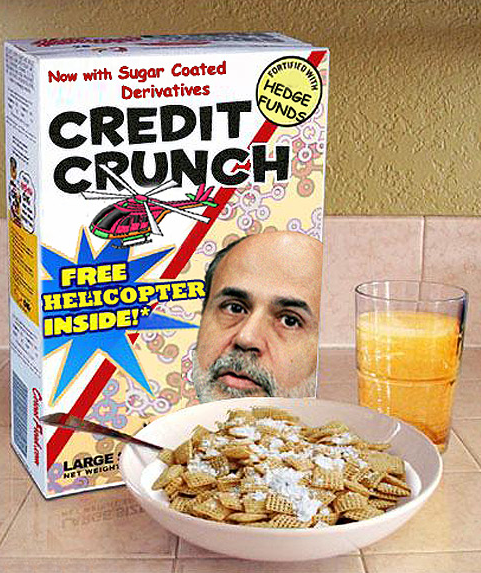
Q: George Bush was asked today “what did he think of the Credit Crunch?”
A: He replied: “It was his favorite Candy Bar.”

National Debt Clock Needs More Digits

According to the Associated Press, the national debt clock maintained by the Durst Organization on a billboard near Times Square in New York City has run out of digits now that the national debt has for the first time exceeded $10 trillion. That’s more than $86,000 for each American family. Whom do we owe it to? Not to ourselves as the “powers that be” would like us to believe, but to all those who own dollars and U.S. Government bonds, notes, and bills. Yes, some are held by pension funds, but vast amounts are held by foreign central banks, especially China, Japan, and the OPEC countries.

An item that appeared in Yahoo News, dated Wed Oct 8, reports that “The late Manhattan real estate developer Seymour Durst put the sign up in 1989 to call attention to what was then a $2.7 trillion debt.” Two more digits will shortly be added to enable the debt to be tracked up to one quarter quadrillion dollars. One must wonder what the dollar will be worth by then.

Brazil, Argentina abandon US dollar

Look for more bilateral agreements like this in the near future. This is a logical thing to do so long as neither country is abusing their currency too badly and the countries have a balance in their trade with one another. Their currencies will quickly find their way back home.
I expect these bilateral agreements to evolve into multilateral agreements that use the credit clearing process to net out accounts amongst the central banks.

The surprising thing here is that the central banks of Brazil and Argentina seem to be taking a course that is independent of the global banking fraternity. Read the article here. — t.h.g


Brazil, Argentina abandon US dollar

Brazil and Argentina have launched a new payment system in their bilateral trade, doing away with the US dollar as a medium of exchange.

The two Latin American nations started the Payment System on Local Currency (SML) on Monday following a last month agreement inked by their presidents to use local currencies in a bid to end transaction in dollars.

On Thursday, Argentine Central Bank President Martin Redrado and his Brazilian counterpart Henrique de Campos Meirelles signed the enforcement of the agreement for the SML, under which exports and imports between the two countries will take place with the Brazilian real (BRL) and the Argentine peso (ARS).

Wall Street Bailout – Rep. Kaptur Describes the Rules of the Game

How the international banking fraternity created the present credit crisis

Here’s an article by Chris Quigley that describes how the international banking fraternity created the present credit crisis – t.h.g.

The “Originate to Distribute” Basle Banking Model Created the Banking Crisis

Christopher M. Quigley, B.Sc., M.M.I.I., M.A.

In an attempt to comprehend the current “credit crisis” I decided to try to investigate its underlying causes. To my dismay I discovered that the situation did not come about by accident but was actually conceived and planned by the International Banking Fraternity in Basel, Switzerland, in 1998.

The tsunami of credit that burst onto the scene after this “Basle Accord” helped save America from a recession, enabled it to fund a war, sleep walked Europeans, politically into the Euro Zone and attempted to copper fasten the artificial state called the European Union. This crisis is no accident it was premeditated and internationally agreed.

If you don’t believe the pre-meditation involved please read the quote below from the Wall Street Journal, Nov. 27th. 2007:

“In 1998 the Basle Accord created the opportunity for regulatory arbitrage whereby banks could shift loans off their balance sheets. A new capital discipline that was designed to “improve” risk management led to a PARALLEL BANKING SYSTEM whose lack of transparency explains how the market started to seize up.

The “originate-to-distribute” model REDUCED THE INCENTIVE for banks to monitor the CREDIT QUALITY of the loans they pumped into collateralized-

loan-obligations and other structured vehicles, the rules failed to highlight contingent credit risk……With Basle II, the question is just how the markets will evolve over the next 20 years…. as the new accord will require banks to hold LESS CAPITAL”.

American history has shown that many of its great leaders saw the danger in granting banking institutions too much power over the destiny of a nation. The Basle I Accord and now Basle II indicate just how fundamentally the International Banking Groups have lost their moral compass and altered old standard banking rules. Through sleight of hand i.e. “off balance sheet accounting” they allowed the financial structure of the world to become totally unstable and risk prone. If one was cynical one would actually come to believe that in 1998 future failure was built into the matrix; failure which only the strongest and the most astute could survive.

The end result will be systematic institutional deflation on a worldwide basis. Even though cash is being pumped into the major institutions the multiples of “off balance sheet” credit are now historic, thus the corporate inflation has already occurred. What we will now experience going forward is dept collapse and with it falling mortgage issuance and restrictive commercial funding. Here in Ireland business activity has almost come to a standstill and everybody is holding their breath wondering what the next crisis will be. The only saving grace is that things are not much better in Italy, Germany, France or Spain and is actually much worse in Scotland, (where the bank of Scotland failed) England and Greece. This crisis is truly global.

As institutional deflation (due to collapsing systematic credit) and social inflation (due to the panic demand and circulation of currency) spreads around the globe those who are left holding excess negotiable resources will be in a very powerful position to soak up value assets for pennies on the dollar. Regular folk will not be able to participate in this bonanza because for them the banking credit system will be closed with nothing to offer but foreclosure and frustration. The majority will in a defensive survival mode while the privileged few will be in full scale acquisitive attack. Such was the case in the last depression. How history is repeating itself. Those who instigated the “off balance sheet” travesty knew exactly what they were doing. My advice is if you cannot beat them join them. Friends go to cash and the physical money metals as soon as you can. Contract your business and life-style expenses. Network and co-operate within a real community for the exchange of goods and services that sustain life. Before things get really bad become educated and aware. Form city and town based money circles based on the teachings of E.C. Riegel and learn how to issue community based, bearer-negotiable, split-barter, exchangeinstruments of agreed value; otherwise known as money. (Most people do not fully understand that money, in essence, is a social contract based on human trust and mutual benefit). This “crisis event” is going to get much worse before it gets better folks. There will be short periods of reprieve but the reality of the problem is so serious and fundamental that it will take years, maybe decades (as in Japan), to work through, even with a R.T.C. (B) type solution. But perhaps it is true that “every cloud has a silver lining” and that “every problem bears within it the seeds of a greater opportunity”. Maybe finally after ninety five years the good people of the United States will awake from their media induced trance and realise that too much power was usurped by an elite on the 22nd. December 1913. Peaceful, proactive and constructive community must reassert its primacy over immoral, selfish and destructive institutionalism.

The Inevitable End of the Central Banking and Political Money Regime

The present disorder in the financial markets and the cascading failures of financial institutions come as no surprise. Those who recognize the impossibility of perpetual exponential growth and who understand how compound interest is built into the global system of money and banking expect the continuation of periodic “bubbles” and “busts,” each of increasing amplitude until the systems shakes itself apart.

Engineers call this phenomenon, “positive feedback.” Such a system cannot find equilibrium. Imagine a heating system in which the thermostat, sensing a rise in temperature, calls for more heat instead of less. Such is the nature of the debt-money system. The imposition of interest on the debt by which money is created, demands that more debt be created. Such is the debt imperative which gives rise to a growth imperative. Among other things, it prevents the emergence of a steady state economy.

Is this the final round? Who can say? Can the system be saved yet one more time? Maybe.

Under the central banking regime which has become all but universal in countries around the world, money has been politicized. The collusion between politicians and international bankers enables governments to extract wealth from the economy by deficit spending and banks to extract wealth by charging interest on money as they create it by making loans. These two parasitic elements take wealth away from productive members of society and lavish it on military adventures, international intrigues, wasteful boondoggles, and financial finaglers.

When the system spins out of control what will come out of the chaos? It is impossible to predict but here are two strong possibilities. When the dollar collapses the financial and political elite class will certainly try to orchestrate a new global monetary regime based on the same old mechanisms for centralizing power and concentrating wealth in their own hands, seeking to complete the New (feudal) World Order which has been abuilding for the past three hundred years. Another possibility is the emergence of the kind of decentralized, democratic, and sustainable system we have been advocating for a long time.

We had better get ready to seize the opportunity that accompanies this impending crisis.

How? By organizing ourselves in our local communities and affinity groups to reclaim the credit commons, to create interest-free, non-dollar, non-bank exchange mechanisms and payment media. This is not as hard as it seems We already know how to do it. All it takes is organization and will.

Back to the current crisis, we should consider the possible actions of America’s creditors. According to Paul Joseph Watson & Yihan Dai, in and article in Prison Planet (http://prisonplanet.com/) dated Friday, September 19, 2008, “China Finance, China News and Chaobao Financial News, all state owned media outlets, slammed the Fed for taking action that will only make long term economic conditions worse and devalue the dollar by “creating money that does not exist which leads to the inflation of liquidity,” a policy contrary to China’s position as a holder of vast reserves of US dollars.”

Central banks have one true function, that is to manage the effects of the parasitic drain, to decide who will pay the price, who will feel the pain. They can either (1) restrict credit, thus causing recessions, bankruptcies and unemployment; or (2) they can expand credit and inflate the money supply by monetizing debts (either public or private) that are uncollectible.

Given China’s position as one of the United States’ biggest creditors, it is in a powerful position to determine the outcome of the current and future financial crises. If they don’t like the restructuring plan that the financial elite wants to put in place, they can kick over the table by dumping their dollar holdings and causing the value of the dollar to crash through the floor. Organized others acting in cooperation might do the same.

“The king is dead, long live the king.”

My upcoming book, “The End of Money,” due to be published early next year by Chelsea Green, will elaborate these points.

t.h.g.

The Worsening Debt Crisis – An Interview With Michael Hudson

Michael Hudson is a very astute observer of economics, finance, politics, and history.
When he speaks everyone should pay attention.

I strongly recommend that anyone who wishes to understand, not just economics and finance, but our general socio-political predicament should read his entire interview.

I agree with his statement that “The economy has reached its debt limit and is entering its insolvency phase. We are not in a cycle but the end of an era. The old world of debt pyramiding to a fraudulent degree cannot be restored.

He says “the only basis for borrowing more is to inflate the price of real estate that is being pledged as collateral for mortgage refinancing.” That was the reason for the banks creating the real estate bubble in the first place, to provide a basis for lending ever more credit (debt-money) into circulation.

The political debt-money system contains a debt and growth imperative because of the compound interest that is attached to loans. To keep the game going there are two choices, expand debt by lending to the government sector (by running budget deficits), or expand debt by lending to the private sector (liberal lending to enable people to buy whatever (real estate, stocks and other securities, commodities, education (student loans), cars and other stuff, what else?)). When incomes are not sufficient for the debt burden to be carried, defaults occur. Defaults can be denied and deferred by various tricks — e.g., refinancing to reduce payments by extending length of repayment. When a financial institution has such extreme cash flow problems as to be unable to continue denial, the government will come in with a bailout plan that leaves the taxpayer to foot the bill. Now, it becomes the public sector’s turn to carry the expanding debt burden.

I am in full agreement with Hudson’s claim that, “It is pure hypocrisy for Wall Street’s Hank Paulson to claim that all this is being done to “help home owners.” They are vehicles off whom to make money, not the beneficiaries. They are at the bottom of an increasingly carnivorous and extractive financial food chain.”
The parasitic nature of the system becomes ever more evident. Either the host becomes increasingly sick and eventually dies, taking the parasites with it to the grave, or the host will act on the increasingly strong signals of malaise and find a way to expel the parasites or keep them in check. Nature shows us that co-existence is a possibility but only if the parasites are held within certain bounds. The New Deal of FDR was a temporary expedient to do just that. One could argue that FDR saved Capitalism.

Hudson clearly states what I have been trying to get across to people: “What people still view as an economic democracy is turning into a financial oligarchy. Politicians are looking for campaign support mainly from this oligarchy because that is where the money is. So they talk about a happy-face economy to appeal to American optimism, while being quite pragmatic in knowing who to serve if they want to get ahead and not be blackballed.”

So don’t expect Obama to do much different.

Hudson correctly observes that “financial interests have replaced the government as society’s new central planners.”
They control politics and everything else. – t.h.g.

Will the Real Alan Greenspan Please Stand Up

It is well know that Alan Greenspan was in his younger days a follower of Ayn Rand. It may not be so well known that he was also a self-proclaimed advocate of free banking and the “gold standard.” This article of his from 1966 offers some very good insights about the fraud that governments perpetrate upon the people by means of deficit spending and their collusion with the banking (credit) monopoly. It is extremely ironic that he eventually became the head of the central bank that he earlier denounced.

While Greenspan argues for the gold standard as a way of imposing discipline upon both government and bankers, he does not seem to oppose the banking monopoly. As I have argued before, while gold might play a role as a measure of value, there is no need to use it as a payment medium nor to revert to a fractional reserve system that relies upon gold reserves. There are better, more refined ways of addressing the money problem.- t.h.g.

GOLD AND ECONOMIC FREEDOM

By Alan Greenspan

[From Rand, Ayn, et al, Capitalism, the Unknown Ideal. New York: New American Library, 1966. Also The Objectivist, July 1966.]

An almost hysterical antagonism toward the gold standard is one issue which unites statists of all persuasions. They seem to sense — perhaps more clearly and subtly than many consistent defenders of laissez-faire — that gold and economic freedom are inseparable, that the gold standard is an instrument of laissez-faire and that each im­plies and requires the other.

In order to understand the source of their antagonism, it is neces­sary first to understand the specific role of gold in a free society. Money is the common denominator of all economic transactions. It is that commodity which serves as a medium of exchange, is uni­versally acceptable to all participants in an exchange economy as payment for their goods or services, and can, therefore, be used as a standard of market value and as a store of value, i.e., as a means of saving.

The existence of such a commodity is a precondition of a division of labor economy. If men did not have some commodity of objec­tive value which was generally acceptable as money. they would have to resort to primitive barter or be forced to live on self-­sufficient farms and forgo the inestimable advantages of specializa­tion. If men had no means to store value, i.e., to save, neither long-range planning nor exchange would be possible.

What medium of exchange will be acceptable to all participants in an economy is not determined arbitrarily. First, the medium of ex­change should be durable. In a primitive society of meager wealth, wheat might be sufficiently durable to serve as a medium, since all changes would occur only during and immediately after the harvest, leaving no value-surplus to store. But where store-of-value con­siderations are important, as they are in richer, more civilized societies, the medium of exchange must be a durable commodity, usually metal. A metal is generally chosen because it is homogeneous and divisible: every unit is the same as every other and it can be blended or formed in any quantity. .Precious jewels, for example, are neither homogeneous nor divisible.

More important, the commodity chosen as a medium must be a luxury. Human desires for luxuries are unlimited and, therefore, luxury goods are always in demand and will always be acceptable. Wheat is a luxury in underfed civilizations, but not in a prosperous society. Cigarettes ordinarily would not serve as money, but they did in post-World War II Europe where they were considered a luxury. The term “luxury good” implies scarcity and high unit value. Having a high unit value, such a good is easily portable; for instance, an ounce of gold is worth a half-ton of pig iron.

In the early stages of a developing money economy, several media of exchange might be used, since a wide variety of commodities would fulfill the foregoing conditions. However, one of the com­modities will gradually displace all others, by being more widely acc­eptable. Preferences on what to hold as a store of value, will shift to the most widely acceptable commodity, which, in turn, will make it still more acceptable. The shift is progressive until that commodity becomes the sole medium of exchange. The use of a single medium is highly advantageous for the same reasons that a money economy is superior to a barter economy: it makes exchanges possible on an incalculably wider scale.

Whether the single medium is gold, silver, seashells, cattle, or tobacco is optional, depending on the context and development of a given economy. In fact, all have been employed, at various times, as media of exchange. Even in the present century, two major com­modities, gold and silver, have been used as international media of exchange, with gold becoming the predominant one. Gold, having both artistic and functional uses and being relatively scarce, has always been considered a luxury good. It is durable, portable, homo­geneous, divisible, and, therefore, has significant advantages over all other media of exchange. Since the beginning of World War I, it has been virtually the sole international standard of exchange.

If all goods and services were to be paid for in gold, large pay­ments would be difficult to execute, and this would tend to limit the extent of a society’s division of labor and specialization. Thus a logi­cal extension of the creation of a medium of exchange, is the devel­opment of a banking system and credit instruments (bank notes and deposits) which act as a substitute for, but are convertible into, gold.

A free banking system based on gold is able to extend credit and thus to create bank notes (currency) and deposits, according to the production requirements of the economy. Individual owners of gold are induced, by payments of interest, to deposit their gold in a bank (against which they can draw checks). But since it is rarely the case that all depositors want to withdraw all their gold at the same time, the banker need keep only a fraction of his total deposits in gold as reserves. This enables the banker to loan out more than the amount of his gold deposits (which means that he holds claims to gold rather than gold as security for his deposits). But the amount of loans which he can afford to make is not arbitrary: he has to gauge it in relation to his reserves and to the status of his investments.

When banks loan money to finance productive and profitable en­deavors, the loans are paid off rapidly and bank credit continues to be generally available. But when the business ventures financed by bank credit are less profitable and slow to payoff, bankers soon find that their loans outstanding are excessive relative to their gold re­serves, and they begin to curtail new lending, usually by charging higher interest rates. This tends to restrict the financing of new ven­tures and requires the existing borrowers to improve their profitabil­ity before they can obtain credit for further expansion. Thus, under the gold standard, a free banking system stands as the protector of an economy’s stability and balanced growth.

When gold is accepted as the medium of exchange by most or all nations, an unhampered free international gold standard serves to foster a world-wide division of labor and the broadest international trade. Even though the units of exchange (the dollar, the pound, the franc, etc.) differ from country to country, when all are defined in terms of gold the economies of the different countries act as one­ so long as there are no restraints on trade or on the movement of capital. Credit, interest rates, and prices tend to follow similar pat­terns in all countries. For example, if banks in one country extend credit too liberally, interest rates in that country will tend to fall, inducing depositors to shift their gold to higher-interest paying banks in other countries. This will immediately cause a shortage of bank reserves in the “easy money” country, inducing tighter credit standards and a return to competitively higher interest rates again.

A fully free banking system and fully consistent gold standard have not as yet been achieved. But prior to World War I, the bank­ing system in the United States (and in most of the world) was based on gold, and even though governments intervened occasion­l1y, banking was more free than controlled. Periodically, as a result of overly rapid credit expansion, banks became loaned up to the limit of their gold reserves, interest rates rose sharply, new credit was cut off, and the economy went into a sharp, but short-lived re­cession. (Compared with the depressions of 1920 and 1932, the pre­-World War I business declines were mild indeed.) It was limited gold reserves that stopped the unbalanced expansions of business ac­tivity, before they could develop into the post-World War I type of disaster. The readjustment periods were short and the economies quickly re-established a sound basis to resume expansion.

But the process of cure was misdiagnosed as the disease: if shortage of bank reserves was causing a business decline — argued eco­nomic interventionists — why not find a way of supplying increased reserves to the banks so they never need be short. If banks can con­tinue to loan money indefinitely — it was claimed — there need never be any slumps in business. And so the Federal Reserve System was organized in 1913. It consisted of twelve regional Federal Re­serve banks nominally owned by private bankers, but in fact government sponsored, controlled, and supported. Credit extended by these banks is in practice (though not legally) backed by the taxing power of  the federal government. Technically, we remained on the gold standard; individuals were still free to own gold, and gold continued to be used as bank reserves. But now, in addition to gold, credit extended by the Federal Reserve banks (“paper” reserves) could serve as legal tender to pay depositors.

When business in the United States underwent a mild contraction in 1927, the Federal Reserve created more paper reserves in the hope of forestalling any possible bank reserve shortage. More disastrous, however, was the Federal Reserve’s attempt to assist Great Britain who had been losing gold to us because the Bank of England refused to allow interest rates to rise when market forces dictated (it was politically unpalatable). The reasoning of the authorities involved was as follows: if the Federal Reserve pumped excessive paper re­serves into American banks, interest rates in the United States would fall to a level comparable with those in Great Britain; this would act to stop Britain’s gold loss and avoid the political embarrassment of having to raise interest rates.

The “Fed” succeeded: it stopped the gold loss, but it nearly destroyed the economies of the world, in the process. The excess credit which the Fed pumped into the economy spilled over into the stock market — triggering a fantastic speculative boom. Belatedly, Federal Reserve officials attempted to sop up the excess reserves and finally succeeded in braking the boom. But it was too late: by 1929 the speculative imbalances had become so overwhelming that the at­tempt precipitated a sharp retrenching and a consequent demoraliz­ing of business confidence. As a result, the American economy col­lapsed. Great Britain fared even worse and rather than absorb the full consequences of her previous folly she abandoned the gold standard completely in 1931,( tearing asunder what remained of the fabric of confidence and inducing a world-wide series of bank fail­ures. The world economies plunged into the Great Depression of the 1930’s.

With a logic reminiscent of a generation earlier, statists argued that the gold standard was largely to blame for the credit debacle which led to the Great Depression. If the gold standard had not ex­isted, they argued, Britain’s abandonment of gold payments in 1931 would not have caused the failure of banks all over the world. (The irony was that since 1913, we had been, not on a gold standard, but on what may be termed “a mixed gold standard”; yet it is gold that took the blame.)

But the opposition to the gold standard in any form — from a growing number of welfare-state advocates – was prompted by a much subtler insight: the realization that the gold standard is incom­patible with chronic deficit spending (the hallmark of the welfare state ). Stripped of its academic jargon, the welfare state is nothing more than a mechanism by which governments confiscate the wealth of the productive members of a society to support a wide variety of welfare schemes. A substantial part of the confiscation is effected by taxation. But the welfare statists were quick to recognize that if they wished to retain political power, the amount of taxation had to be limited and they had to resort to programs of massive deficit spend­ing, i.e., they had to borrow money, by issuing government bonds, to finance welfare expenditures on a large scale.

Under a gold standard, the amount of credit that an economy can support is determined by the economy’s tangible assets, since every credit instrument is ultimately a claim on some tangible asset. But government bonds are not backed by tangible wealth, only by the government’s promise to pay out of future tax revenues, and cannot easily be absorbed by the financial markets. A large volume of new government bonds can be sold to the public only at progressively higher interest rates. Thus, government deficit spending under a gold standard is severely limited.

The abandonment of the gold standard made it possible for the welfare statists to use the  banking system as a means to an unlimited expansion of credit. They have created paper reserves in the form of government bonds which — through a complex series of steps — the banks accept in place of tangible assets and treat as if they were an actual deposit, i.e., as the equivalent of what was formerly a deposit of gold. The holder of a government bond or of a bank deposit created by paper reserves believes that he has a valid claim on a real asset. But the fact is that there are now more claims outstanding than real assets.

The law of supply and demand is not to be conned. As the supply of money (of claims) increases relative to the supply of tangible assets in the economy, prices must eventually rise. Thus the earnings saved by the productive members of the society lose value in terms of goods. When the economy’s books are finally balanced, one finds that this loss in value represents the goods purchased by the government for welfare or other purposes with the money proceeds of the government bonds financed by bank credit expansion.

In the absence of the gold standard, there is no way to protect savings from confiscation through inflation. There is no safe store of value. If there were, the government would have to make its holding illegal, as was done in the case of gold. If everyone decided, for example, to convert all his bank deposits to silver or copper or any other good, and thereafter declined to accept checks as payment for goods, bank deposits would lose their purchasing power and government-created bank credit would be worthless as a claim on goods. The financial policy of the welfare state requires that there be no way for the owners of wealth to protect themselves.

This is the shabby secret of the welfare statists’ tirades against gold. Deficit spending is simply a scheme for the “hidden” confisca­tion of wealth. Gold stands in the way of this insidious process. It stands as a protector of property rights. If one grasps this, one has no difficulty in understanding the statists’ antagonism toward the gold standard. [emphasis added]