This little vignette written by Don Werkheiser remains one of the best concise explanations of inflation I’ve ever seen. It was published in the spring 1982 edition of Green Revolution, the journal of the School of Living a non-profit organization with which I was associated throughout the 1980s and into the early 1990s. The story helps to elucidate the nature of the dysfunctional political money system that has plagued the world for hundreds of years, but in its brevity and simplicity neglects to mention another feature of the money system that adds to our misery; that is the fact that the “Mayor” and his friends do more than spend counterfeit money into circulation, they have also established “banks” and require that other people who need money to do business must borrow their pseudo-money into circulation and pay interest on it. That enables the bankers to extract even more wealth from the rest of the people while creating an unending and unsustainable expansion of debt. I have articulated that “debt-growth imperative” in my paper titled, the Usury Conjecture.
An Honest Money Would Stop Inflation by Don Werkheiser
A rural village has no money. All trade is by barter. A farmer comes to town and deposits 10 bushels of corn with a man who has a store room. This operator gives the farmer 10 receipts, each redeemable in a bushel of corn. But the farmer asks for receipts in smaller denominations. The storekeeper gives him 40 receipts for 40 pecks. The farmer trades ten of these corn-receipts for other products; they are each accepted at the value of a peck of corn. That acceptance constitutes the issue of corn notes as money.
Such receipts are generalized credit instruments. They refer to stored corn, but not to any specific peck of corn. When the seller wants a peck of corn the receipt is redeemed. Otherwise it is spent again, and ownership of a peck of corn is conveyed to the next seller. The next day the farmer returns to town and spends 10 corn notes (each of one peck of corn in value) for his wife’s birthday present. Now the farmer has doubled the money supply in circulation, but there is no inflation; there are redeemable goods back of them.
What then is inflation? We must understand “money” and the storekeeper’s actions.
The store room owner noticed that the corn notes were accepted in trade. So he made 40 more “peck-receipts” looking just like corn-receipts and then he spent them into circulation. That is inflation–counterfeit receipts passed as valid receipts. Assume that the counterfeit receipts were accepted at face value. In that case, the counterfeiter effected a robbery of commodities equal in value to 40 packs of corn, while those who accepted them received receipts which measured the extent to which they had been robbed. So long as confidence lasts, the game would continue and receipts could be spent. New sellers would be holding empty receipts. The game would collapse when all the corn in the warehouse was redeemed, and holders of the 40 counterfeit receipts found no one who would take them in trade.
Worse could happen if the counterfeiter had the skills of a politician. If, when confronted by angry holders of his counterfeit receipts he declared himself a benefactor of the community–and showed that the original issue by the farmer was too limited, and that his own issues stimulated industry and trade (he would not mention that the farmers issue was redeemable while his own was not). He noted that most people did not want corn; they wanted a medium of trade that they could use to speed up trade. More to come.
They were told: “If the game stopped then, the holders would be losers, but if they continued, they could all buy what they wanted. In fact if they elected him Mayor he would declare pseudo-corn-notes to be legal tender, and he’d also begin a program of public works. Soon everyone would be rich.” An ignorant public agreed.
Elected Mayor, the counterfeiter issue another stock of corn-notes called “pecks” and declared them to be worth a peck of corn in the market (but not anywhere redeemable). On each note was a picture of a peck-basket, but what it contained was not specified. Just a peck of value.
The “pecks” circulated and trade increased. Then a strange thing happened. The Mayor and his agents could outbid everybody for produce and services. They also controlled the printing presses for printing “pecks.” Prices were bid up on the things the Mayor’s group approved. Workers and businessman migrated into those industries for wages and profit. The stock of other things became short. Everyone couldn’t buy what they wanted. People threatened to recall the Mayor if he didn’t improve things. So he issued more “pecks” and then more and more.
The more money people had, the less they could buy. Only the Mayor and his friends had enough — rather too much — money. They gave expensive parties, bought votes, hired police and soldiers; and gave everyone a vested interest in continuing the game, through welfare, social security, profitable contracts, and “peck-funded” jobs.
Confusion resulted. It is evident there are two kinds of money: honest redeemable money and inflatable unredeemable money. These keep our economy teetering between “prosperity” and “depression.” Have we any proof that those in charge of our money system intend to create an honest system? That would break their power. A sound alternative is for people to operate their own money system. American and world history have produced workable patterns; some are underway today.
# # #
Take note that the story does not mention any need for gold or silver backing for money to be honest. As E.C. Riegel makes plain in his book, Private Enterprise Money, “When businessmen resolve to set up a money system, they agree to hold in trust for each other goods and services that are pledged against the drafts which they have issued in the form of money. These values — that are held in trust by all for any who may present a money draft therefore — constitute a vast pool, not housed at one place, but scattered throughout the trading sphere. This vast pool of goods and services is the basis or backing for the outstanding money supply. “Reserves” and metal hoards are but window dressing. Only that which is purchasable is back of money.”
In light of the current surge in the rates of inflation in countries around the world, the dominant political monetary regime is once again being called into question. Perhaps this time there will be sufficient interest and concern about its dysfunctional and destructive nature to induce a significant surge toward the adoption of the sorts of private currency and exchange systems that we have been articulating and advocating for more than 40 years.
The Library on this website contains a number of references relating to the politics of money. Among these are Dr. Carroll Quigley’s book, Tragedy and Hope: A History of the World in Our Time (1966), and Cleon Skousen’s review of that book titled, The Naked Capitalist (1970).
Tragedy and Hope outlines in great detail the plans of the elite class of international bankers and their minions to create a New World Order under their absolute control. In my books and presentations I have often repeated this quote from Quigley’s book:
“…the powers of financial capitalism had another far-reaching aim, nothing less than to create a world system of financial control in private hands able to dominate the political system of each country and the economy of the world as a whole. This system was to be controlled in a feudalist fashion by the central banks of the world acting in concert, by secret agreements arrived at in frequent private meetings and conferences. The apex of the system was to be the Bank for International Settlements in Basle, Switzerland, a private bank owned and controlled by the world’s central banks which were themselves private corporations. Each central bank, in the hands of men like Montagu Norman of the Bank of England, Benjamin Strong of the New York Federal Reserve Bank, Charles Rist of the Bank of France, and Hjalmar Schacht of the Reichsbank, sought to dominate its government by its ability to control Treasury loans, to manipulate foreign exchanges, to influence the level of economic activity in the country, and to influence cooperative politicians by subsequent economic rewards in the business world.”
The Cold War was just a facade to give the appearance of division while the banking elite proceeded with their agenda in both camps. In Chapter 5 of The Naked Capitalist Skousen says:
Dr. Quigley bluntly confesses that the International Bankers who had set out to remake the world were perfectly confident that they could use their money to acquire the cooperation and eventual control of the Communist-Socialist conspiratorial groups. In fact, John Ruskin of Oxford had persuaded the original Rhodes-Milner Round Table Groups that the way to federate the world was along socialistic lines, i.e., by having all property, industry, agriculture, communications, transportation, education and political affairs in the hands of a small cadre of financially controlled political leaders who would organize the world and its peoples in a way which would compel everyone to do what was good for the new, world-society.
It may seem somewhat contradictory that the very people whom Marx identified as the epitome of “Capitalism” should be conspiring with the followers of Marx to overthrow traditional Capitalism and replace it with Socialism. But the record supports the Quigley contention that this is precisely what has been happening. The reason is rather simple.
Power from any source tends to create an appetite for additional power. Power coming from wealth tends to create an appetite for political power and visa versa. It was almost inevitable that the super-rich would one day aspire to control not only their own wealth, but the wealth of the whole world. To achieve this, they were perfectly willing to feed the ambitions of the power-hungry political conspirators who were committed to the overthrow of all existing governments and the establishments of a central world-wide dictatorship along socialist lines.
That may have seemed fantastic at the time but it is blatantly obvious today to everyone except those who cling desperately to their belief in the benevolence of the relative few who control money, finance, politics and virtually every other system and institution around the world. If you want an up-to-date assessment of the geopolitical situation, watch this panel discussion Interrogating Cold War 2.0,featuring Patrick Wood, Iain Davis, Catherine Austin Fitts, and Kit Knightly, who discuss “the nature of the East-West dichotomy and whether the rise of Eurasia and the fall of the West were engineered by certain factions of global elites and for what purpose.”
Now is the time for “we the people” to decide whether we will docilely follow the “masters” into their feudalist New World Order, or take responsibility to work together to build a new society of peace, justice and liberty for all based on the establishment of systems and structures that serve the common good instead of the further concentration of power and wealth. You can get an idea of how we might proceed in the realm of money and finance by reading this Draft Manifesto of Monetary and Financial Rights and Liberties.
A recent news post blames pandemic spending, a rising dollar and poor leadership for the debt crises in Sri Lanka, Lebanon, Ghana, El Salvador, Zambia, and Pakistan, but while those may be the proximate causes of the crises, there is a more fundamental underlying cause.
The real cause of debt crises in those countries, as well as worsening crises even in “developed” countries, is the flawed, dysfunctional, and destructive global interest-based, debt-money system, which is designed to extract wealth and accumulate it into the hands of a small global power elite. The system has been doing that for a very long time but now the adverse effects are becoming acute and spilling over beyond the financial and economic realms and into the political and social realms as well.
Total Global Debt as percentage of GDP
These problems will not be solved by ever greater amounts of poisonous debt. Any real cure must include massive amounts of debt forgiveness and the deployment of new systems of money, credit and exchange that are decentralized and interest-free. Such systems are described in my book, The End of Money and the Future of Civilization.
This article was excerpted from my June, 2022 Newsletter which you can view in its entirety at my Mailchimp site. You can also sign up there to receive future newsletter editions.
Reconnecting the Monetary Economy to the Real Economy Money is the “hole” that is defined by the “doughnut” of real goods and services; it is the nothing that serves only to account for that which is available in the real economy. When pseudo-money can be created by fiat, apart from anything of real value, confusion and madness ensue. — T. H. Greco, Jr.
I’ve been arguing for more than 40 years that the global system of money, banking, and finance is fatally flawed, and now its condition has become acute. Since 2008 it has been on life support. The connections between the monetary economy and the real economy have long been tenuous, but in recent years have been severed to the point of non-existence. When banks and governments can create quasi-money out of nothing without any real value basis and allocate it selectively to advance political agendas, you know the end is near. The last vestiges of budgetary restraint on federal government spending have been eliminated along with any concern about what people really need and want. The results have been the ever-increasing centralization of power at the federal level, central planning of the economy, worsening price inflation, declining purchasing power of fiat money, increasing corporate ownership of real assets, especially residential real estate, zero or negative returns on people’s savings, and increasing disparities of income and wealth. The only way this system can be perpetuated is by the complete elimination of any semblance of democratic government. As E. C. Riegel observed almost 80 years ago: “Society is in the twilight of a passing day. The state now undertakes to finance the economy, and, since a free economy is manifestly impossible where the state assumes the responsibility of supplying the money circulation, the politician is compelled to choose between fascism and communism.” – Private Enterprise Money
“Quantitative easing,” bank bailouts, and central bank purchases of securities from the debt and equity markets have been desperate, last gasp measures to try to save the dysfunctional and destructive system. At first the inflation was confined mainly to financial assets, particularly corporate stocks, as central banks intervened in the markets on the buying side. Then, with the massive bailouts and handouts that were doled out during 2020 and 2021, and the accompany lockdowns and forced closures of small businesses, price inflation shifted over to real estate prices, residential rents, commodities, and consumer goods and services. The system is doomed and must eventually give way to new, more sustainable and equitable systems of exchange and finance. Though barely noticeable, that process has been underway for some time at the micro level of communities and small businesses, but changing circumstances are now stimulating major changes at the macro level of national governments and global trade.
The connection between the real economy and the money economy must be inherent in any sustainable system of money and finance. The creation of sound exchange media (money) requires that money be spent into circulation by trusted producers of real valuable goods and services that are in the market and available to be delivered in the near-term. Money then is a mere place holder for real economic value; it is a credible promise that will be accepted as a form of payment.
The Banker’s Last Gasp and the Great Monetary Reset
While the past several decades have seen the emergence of many successful approaches to decentralizing the control of credit through private currencies and independent commercial credit clearing circles, economic and financial corporatization and globalization have proceeded to place ever tighter control into the hands of an elite class who have used their money power as a weapon of war. The Breton Woods monetary agreement established toward the end of World War II made the US dollar the world’s reserve currency and allowed the US and its western European allies to dominate and control the machinery of money and finance. But with the breakdown of that agreement and the increasing application of financial and economic sanctions we now see that some countries, notably China and Russia, are taking independent action to protect their own economies and security interests.
Another sobering thesis is being articulated by Dr. Tim Morgan at his website Surplus Energy Economics, in which he argues that, “the economy is an energy system, not a financial one,” and that “The concept of limits is replacing the paradigm of ‘infinite growth,’” and “What lies ahead is a process of adjustment – we might call it realignment – to the new reality of an economy in which the scope for expansion is constrained by limits, both to energy value and to environmental tolerance.” Morgan’s economic model, which he calls SEEDS [Surplus Energy Economics Data System], is based on the idea that continual economic growth has been possible only through the availability of the surplus energy that comes from fossil fuels. But that surplus (energy out minus energy in) is continuing to decline. For the moment, I will leave it to the reader to ponder what the implications of that might be.
This shift toward commodity backed national currencies, while not a total solution to the money problem, is a positive step toward reconnecting the means of payment to real economic value. I expect that it will eventually lead to the emergence of a new standard of value against which the value of currencies can be objectively measured. That standard will not be gold, as it was in the past, but a wide assortment, or “market basket,” of useful commodities like the one I’ve been proposing for the past 40+ years. History shows that, as exchange systems evolve, credit instruments become the primary payment media because their quantity is able to expand and contract in step with actual supplies of goods and services. Then, the commodities serve only as the measure of value and unit of account to quantify credit. Just as happened in the past with gold, I expect the commodities in a standard “basket” will serve as a new measure of value, but payments will be made using credit instruments and the credit clearing process, with perhaps, occasional settlement of residual account balances by the transfer of actual commodities. As I’ve repeatedly explained elsewhere, it is crucial that these credit instruments (currencies) be spent into circulation interest-free and on the basis of an adequate real value foundation.
In this article (available on my website or on Medium), I describe the growth imperative that is the fatal flaw inherent in the global central banking, interest-based, debt-money system; I summarize the observations that have led me to conclude that it is utterly destructive and must ultimately be replaced; and I call upon systems analysts to create realistic models of the system to prove the conjecture beyond any reasonable doubt.
This is the Usury Conjecture in a nutshell: The central banking, interest-based, debt money system that is dominant around the world today is neither stable, nor sustainable, nor fair. The creation of money based on bank lending with interest creates an imperative for debt to grow exponentially with the passage of time. That debt-growth imperative drives artificial economic growth as borrowers compete with one another to acquire enough money from the always insufficient pool of money to service their “loans.”
When I first began my intensive inquiry into money, banking, and finance more than 40 years ago, it did not take long for me to discover the essential nature of money, where it comes from and how it is created, allocated, circulated, mismanaged and abused. I was astonished that this system had been allowed to become such a dominant force that has wreaked enormous devastation upon the world over such a long period of time despite many attempts to reform it. One champion of monetary reform was Congressman Wright Patman who, as chairman of the Committee on Banking and Currency of the US House of Representatives during the 1960s, sought to educate the public about the money and banking system through the publication of the committee report titled, A Primer on Money, and a shorter extract titled, MONEY FACTS – 169 Questions and Answers on Money. These reports were produced and distributed through the Government Printing Office and were important in my early research. You won’t find any mention of them on Wikipedia, but if you want to cut through the fog of obfuscation and learn how the system really works they can be accessed through my website.
Addendum of Tuesday, June 28, 2022:
One of my correspondents recently asked if the interest that banks charge when they create money by making loans causes inflation. Perhaps this response will help to clarify the picture of our current monetary and economic predicament, and add some precision to my usury conjecture.
First of all let me make clear that, while the money needed to pay the interest on a particular loan is not created when the loan is made, the banks must create sufficient money (by making additional loans) to enable the aggregate money supply to stay ahead of loan principal repayments, otherwise the money supply will contract and cause economic depression (defaults, business failures, unemployment, etc.). Thus, the creation of money by banks on the basis of interest-bearing loans biases the entire system towards deflation (too little money), as I described in my Usury Conjecture document, https://beyondmoney.net/2022/06/03/the-usury-conjecture-on-the-centralized-interest-based-debt-money-system/.
To compensate for that, banks push hard to induce private borrowers (corporations and individuals) to take on additional debt. But there is a limit to their willingness to borrow more and to their ability to repay, therefore the national government steps in to play the role of “borrower of last resort.” From the banks’ perspective that is ideal because when a bank lends to the government (by buying government bonds, notes, or bills) it gets a guaranteed return and takes no risk of default. Politicians are all too willing to go into debt to dole out money to their corporate patrons (especially weapons and drugs makers) who fund their election campaigns, and to curry favor with the voters by throwing a few crumbs their way. The government therefore goes way beyond borrowing the amount needed to keep the money supply sufficiently pumped up to avoid deflation, and thus creates inflation by funding many things that are pure waste from a consumption and environmental standpoint. So, does interest on bank loans cause inflation? No, not directly, but indirectly as I’ve just explained.
As economist Milton Friedman has famously said, “Inflation is always and everywhere a monetary phenomenon,” and on that point, I agree with him. It’s not just the amount of money that causes inflation; it’s the basis upon which the money is issued. Price inflation is mainly caused by money debasement, which is the creation of money on an improper basis. An improper basis is any loan that is not made to enable the sale of goods and services that are readily available in the market in the near term. Thus, improper money creation is based on loans that are made to finance speculation, or to finance long term capital improvements that create consumer goods only in the far distant future, or to purchase debt instruments of the government. None of those put additional goods or services into the market for purchase in the near term; therefore you have “more money chasing the same amount of goods and services,” or money being put into circulation faster than goods and services are being produced.
It is possible for some price inflation to be caused by reductions in supplies, but that is usually limited to particular products. However, in today’s global economy there are various factors that are affecting supplies more generally, so that has become a contributing cause of the inflation that is being experienced at this time.
The Usury Conjecture on the centralized, interest-based, debt-money system Revised June 2, 2022 Thomas H. Greco, Jr.
The Usury Conjecture in a nutshell The central banking, interest-based, debt money system that is dominant around the world today is neither stable, nor sustainable, nor fair. The creation of money based on bank lending with interest creates an imperative for debt to grow exponentially with the passage of time. That debt-growth imperative drives artificial economic growth as borrowers compete with one another to acquire enough money from the always insufficient pool of money to service their “loans.”
When I first began my intensive inquiry into money, banking, and finance more than 40 years ago, it did not take long for me to discover the essential nature of money, where it comes from and how it is created, allocated, circulated, mismanaged and abused. I was astonished that this system has been allowed to become such a dominant force in the world, that it has wreaked such enormous devastation upon the world, and that it has been allowed to go on for such a long period of time. What has led me to those conclusions has been thoroughly documented in my many books, articles, and web posts.
I have long wondered why there seem to have been no serious attempts to model the monetary system that predominates today throughout the world. Then, in November 2011, I again met up with a well known economist at a conference in Michigan where we were both presenters. In his presentation he reported having conducted such a simulation in which the results showed an equilibrium state being reached. I was dubious about his conclusions but in the context of the conference there was not sufficient opportunity to raise pertinent questions or to discuss them in any depth. I later wrote to him with my questions and asked him to respond to my assertion that some of his underlying assumptions about the system that he used in his simulation might not have been realistic. That was the beginning of my attempts to more fully articulate my “usury conjecture” which over the subsequent years has gone through several revisions. I think my arguments are sufficiently well developed at this point to be useful to others in understanding the system and in designing realistic simulations and mathematical models that are able to reveal its inherent flaws.
In my critique, I did not say that his model was “wrong,” only that some of the underlying assumptions were unrealistic and his model too limited to adequately describe the system as it presently exists. Here are the points that need to be considered:
Free banking. He stated at the beginning of his presentation that his model was a simulation of the monetary system as it existed during the “free banking” era in the United States around the mid-eighteen hundreds. But we no longer live in that world, money and banking have undergone a great many changes since that time and the free banking model does not describe today’s reality. Among the very significant changes have been:
The centralization of credit allocation power in the hands of a few huge banking companies. During the free banking era, that power was greatly decentralized, there was much more competition among banks and their asset portfolios consisted mainly of loans to businesses in the bank’s own geographic region, and much less in US government bonds or loans to massive diversified corporations which did not exist at that time.
The imposition of forced circulation (by means of legal tender laws) of a unitary national currency under the Federal Reserve System that ultimately decoupled the currency from any objective measure of value (like a fixed weight of gold or silver). During the “free banking” era, each bank issued its own “brand” of bank note denominated in dollars.
The gradual elimination of the redeemability of currency for specie (gold or silver) obliterated the objective measure of value, disconnected the money economy from the real economy, and opened the door for extreme monopolization of credit and the abusive inflation of the currency.
What happens to a bank’s interest income? As I understood his presentation, he made the assumption that the banks spend all of their interest income back into the economy, but that is clearly not the case. While a portion of a bank’s revenues are used to pay employees, and cover other expenses like equipment and facilities, it seems that most of the bank’s interest income is added to capital or re-enters the economy, not as consumption spending but in the form of additional loans or as reserves deposited with the central bank that enable further loans to be made, or as payouts to bank owners who, rather than spending it on consumption, use it themselves to lend it out, adding a secondary layer of debt and interest to the economy which creates a further shortage of money available for debt repayment. All of that requires a further expansion of lending (debt) by the banks to keep the money supply expanding enough to prevent too many defaults and subsequent bankruptcies, unemployment and economic depression.
Savings and investment. What does the bank do with peoples’ savings? In his reported simulation he did not describe the accounting entries that accompany the deposit of peoples’ savings, but savings and investment are two sides of the same coin. A bank, in its role as depository (as opposed to its primary role as “bank of issue”), reallocates surplus money (savings) from those who wish to save to those who need to use it now for capital formation (expansion of production capacity), or to spend on consumer goods when there are lulls in their income streams (consumer finance). The interest banks charge on these loans far exceeds the cost of providing the service and the interest they pay to savers, which creates further imbalances in income and wealth distributions.
Debt repayment. Repayment of principal on loans naturally results in the extinction of that amount of money. As old loans are repaid, new loans must be made to keep the money supply from shrinking which would cause additional defaults and economic stagnation or depression. New loans may or may not be sufficient to compensate and maintain the money supply. There must be both banks that are willing to lend and companies and people that are willing and able to borrower, but when the private sector had taken on as much debt as it can bear, government becomes the “borrower of last resort” in order to maintain or increase the money supply.
The role of a central bank. The central banks in countries around the world may or may not be a nominal part of the government. In the US, the Federal Reserve is an independent entity owned by banking corporations that pursue their own interests. There developed long ago, with the founding of the Bank of England, a collusive arrangement between banking and government. On the government side, the agreement enables perpetual deficit spending; on the banking side, the agreement enables the emergence of a banking cartel that enjoys the privilege of lending the peoples’ own credit back to them and charging interest for it. The advertised role of a central bank is to limit inflation and promote full employment. In actuality, the role of a central bank is to enableinflation sufficient to support government budget deficits while protecting and preserving the bankers’ privilege to milk the productive economy and enlarge their own wealth and political power.
Basis of issue. Besides the need to be free of interest, money needs to be issued on a proper value basis. There have been volumes written about this point, but sound principles of commercial banking have been discarded over the years because the perpetuation of the flawed system requires it, and because those who control the machinery of money use their power to promote their own narrow interests of wealth and power. Thus, some loans that banks make are legitimate while most are not. Banks should create new money to enable the production and sale of goods that are in the market or soon to arrive there. They should not make loans for speculative purposes or to monetize government debts as they commonly do today.[i] Thus, we have a stream of legalized counterfeit that dilutes the purchasing power of all the legitimate money in circulation. This currency inflation leads to price inflation, which amounts to a “hidden tax” that disproportionately harms the middle class who have substantial amounts of savings invested either directly or in pension funds which they do not control, and this “tax” hurts low income people who need to spend the bulk of their income just to survive.
The economy. Economists and politicians speak about THE economy as if it was a unitary whole, but there are actually many economies depending on geography, social and economic class, and there are the public sector and the private sector. There may be prosperity in some sectors, while others experience recession. Distinction is commonly made between the private and the public sectors, but it is essential to also distinguish between the small and medium sized enterprises (SMEs) and entrepreneurs on one hand, and the large corporate megaliths on the other. In recent decades, banks have gotten ever larger and their lending has been directed mainly toward central governments and large corporations, while at the same time the productive small and medium sized enterprises that are the backbone of every local economy have been starved of the credit they need to finance their operations. By acting in this way, banks limit or eliminate the risks they take. In the case of lending to central government (by buying its bonds and notes), banks enjoy a guaranteed return with no risk at all. During the pandemic years the bulk of the government stimulus money went to large corporations while many small independent local enterprises were forced to close and were never able to reopen.
“Cash” held by the banks. It is misleading to say that banks are sitting on a lot of cash instead of lending it out. In fact that “cash” has been lent out to the public sector (government) in the form of treasury bills, notes, and bonds, or to the central bank which holds it as “reserves” and on which the banks receive interest.
It seems obvious that the present global money system contains inherent in it a debt-growth imperative because of the interest burden that is attached to the bank loans that form the basis for money creation. I believe that any model that purports to simulate the actual present system of money and banking must account for most of the banks’ interest income as capital which is then loaned into circulation rather than spent, and if that were the case it would show that there can be no steady state but an endless growth in debt which leads to a general growth imperative and destruction of the Earth’s ecosystem as the real economy tries to expand in step with the overall debt.
That is in fact what the empirical data suggests. Any theory in opposition to the usury conjecture must provide an alternative explanation of why the total debt in the world continues to grow exponentially at a much faster rate than population or any measure of growth in the real economy as is show in the following charts.
Figure 1 the Institute of International Finance
Finally, the inherent inequity of this money system is obvious and is becoming ever more extreme year by year. The increasing inequalities in income and wealth are not natural phenomena; they are artifacts of the system architecture and management. Mere policy tweaks cannot correct that. The creation of money as interest-bearing debt by a banking cartel pumps virtually all of the benefits of productivity increases into the hands of the top level bankers and their minions whom we naively trust to operate the system in the interests of the common good.
History is replete with stories of collapse of societies resulting from exponential growth of debts and extreme inequalities among the various classes of the population. I have long argued that since money throughout the world today is based on “loans” made by banks at interest, the exponential growth of debt is required to keep the system going. That is clearly evident in the empirical evidence of debt growth over the past 100 years and especially since 1971 when the last link of money to anything real was severed by President Nixon’s announcement that US dollars would no longer be redeemable for gold.
The global economy is a complex adaptive system, but collapse happens when a system fails to adapt in an effective way. Jubilee or periodic resets have been common throughout history going back before Biblical times. Economist Michael Hudson has had much to say about that in his various writings especially in his latest book, …and forgive them their debts. I have been arguing for “debt triage” and a long term shift of finance away from interest-bearing debt financing and toward shared equity financing but because of the concentration of political power in the hands of the vested interests, and the general lack of understanding and concern about the flaws inherent in the present systems, I see little likelihood that these measures will be implemented soon enough to avoid major economic disruptions and social and political turmoil. That leaves innovative private and community initiatives as the most promising approach to avoiding disaster.
I have taken a functional approach to solving the problems that are inherent in the present global system of money, banking and finance and argued that the supposed functions of money–means of exchange, savings medium, and measure of value, are in fact distinct from one another and must be handled separately. The exchange function which is the essential function of money should be mediated by the use of interest-free short-term credit allocated to producers in proportion to the value of goods and services they are ready, willing and able to sell within the next few months. The savings function and the investment function on the other hand are two sides of the same coin and should be provided for by the temporary assignment of savers’ funds to enterprises that will use them to expand production capacity or develop new capacity. The measure of value function needs to be provided by defining a standard of value and unit of account in terms of some selected commodity or group of commodities.
I have described numerous alternative structures and systems to serve the exchange function, including private, local, and community currencies, and decentralized credit clearing networks of buyers and sellers and have cited numerous historical and current examples. I’ve also described financing arrangements that shift the capital formation function from interest-based debt financing to shared-equity financing that shares both the rewards and the risks of business investment. These are the actions that I am confident have the ability to prevent the disastrous collapse of civilization while enabling the necessary transformation to a peaceful, healthy and regenerative society. All of this has been thoroughly articulated in my books, The End of Money and the Future of Civilization, Money: Understanding and Creating Alternatives to Legal Tender(excerpted here), and in my various articles, presentations, and interviews which can be accessed at https://beyondmoney.net/.
Addendum of Tuesday, June 28, 2022:
One of my correspondents recently asked if the interest that banks charge when they create money by making loans causes inflation. Perhaps this response will help to clarify the picture of our current monetary and economic predicament, and add some precision to my usury conjecture.
First of all let me make clear that, while the money needed to pay the interest on a particular loan is not created when the loan is made, the banks must create sufficient money (by making additional loans) to enable the aggregate money supply to stay ahead of loan principal repayments, otherwise the money supply will contract and cause economic depression (defaults, business failures, unemployment, etc.). Thus, the creation of money by banks on the basis of interest-bearing loans biases the entire system towards deflation (too little money), as I described in my Usury Conjecture document, https://beyondmoney.net/2022/06/03/the-usury-conjecture-on-the-centralized-interest-based-debt-money-system/.
To compensate for that, banks push hard to induce private borrowers (corporations and individuals) to take on additional debt. But there is a limit to their willingness to borrow more and to their ability to repay, therefore the national government steps in to play the role of “borrower of last resort.” From the banks’ perspective that is ideal because when a bank lends to the government (by buying government bonds, notes, or bills) it gets a guaranteed return and takes no risk of default. Politicians are all too willing to go into debt to dole out money to their corporate patrons (especially weapons and drugs makers) who fund their election campaigns, and to curry favor with the voters by throwing a few crumbs their way. The government therefore goes way beyond borrowing the amount needed to keep the money supply sufficiently pumped up to avoid deflation, and thus creates inflation by funding many things that are pure waste from a consumption and environmental standpoint. So, does interest on bank loans cause inflation? No, not directly, but indirectly as I’ve just explained.
As economist Milton Friedman has famously said, “Inflation is always and everywhere a monetary phenomenon,” and on that point, I agree with him. It’s not just the amount of money that causes inflation; it’s the basis upon which the money is issued. Price inflation is mainly caused by money debasement, which is the creation of money on an improper basis. An improper basis is any loan that is not made to enable the sale of goods and services that are readily available in the market in the near term. Thus, improper money creation is based on loans that are made to finance speculation, or to finance long term capital improvements that create consumer goods only in the far distant future, or to purchase debt instruments of the government. None of those put additional goods or services into the market for purchase in the near term; therefore you have “more money chasing the same amount of goods and services,” or money being put into circulation faster than goods and services are being produced.
It is possible for some price inflation to be caused by reductions in supplies, but that is usually limited to particular products. However, in today’s global economy there are various factors that are affecting supplies more generally, so that has become a contributing cause of the inflation that is being experienced at this time.
Earlier this month Prof. Richard Werner posted a video on YouTube, which I thought was quite good in explaining the way banks create money, but I felt moved to post a response to it that provides some fundamental concepts and clarifies what is required to start regional alternatives to dominant centralized banking system and political fiat monies. I recommend that you watch Werner’s 10 minute video, and then contemplate my responses.
Prof. Werner makes many good and important points in this lecture, about how money is created and allocated by huge banking institutions which gives them enormous power over governments, people and the economy. Yes, control of money needs to be decentralized and democratized. Public and community banks are important elements in achieving that but they exist within the current dominant paradigm of creating money by making loans at interest, which is a fundamental flaw that forces a growth imperative. Debt grows exponentially as time passes so there is never enough money to enable all borrowers to pay what they owe. A distinction must be made between “exchange credit” and “investment credit.” The former should be allocated without interest to producers based on the value of goods and services each is able to sell immediately or in the near-term; the latter should be the reallocation of existing money from savers to entrepreneurs. The exchange function can best be organized as credit clearing circles, like the original WIR cooperative circle that Werner mentioned, then these various circles can be networked together into a global system of exchange. I have been articulating these points and more for the past several decades, most recently in a webinar I conducted for the University of Hertfordshire in November 2021: 2021-11 Transcending the present political money system–the urgent need and the way to do it. (https://beyondmoney.net/wp-content/uploads/2021/11/2021-11-hertfordshire-preso.mp4). The Q&A that followed is at https://beyondmoney.net/wp-content/uploads/2021/12/herts-qa.mp4. _________________
Thank you for the insightful comment, Thomas. What are your thoughts on the concept of interest in general? Is a interest-based financial system doomed to always end with enormous inflation culminating in financial collapse? _________________
That’s a very good question. One must distinguish between primary interest that banks impose on “borrowers” in the process of creating debt-money, and secondary interest that is demanded by those who hold existing money when they lend it to others for whatever purpose.
The primary interest causes debts to banks to grow exponentially because the interest payments do not, for the most part, go toward consumption expenditures but to ever expanding pools of capital held by “capitalists.” Thus, the money supply available for repayment to the banks is always deficient unless the banks create more money by making more “loans” to stay ahead of the extinction of money that occurs when principal payments are made. The empirical evidence of debt growth over time clearly supports this; I call it the ‘usury conjecture,” which I hope will eventually be proven mathematically and/or through some realistic model of the system.
The so-called “business cycle” that oscillates between inflation and depression is natural result of that inherent flaw in the centralized, interest-based debt-money regime. The interest must be paid, one way or the other. Quantitative easing by the various central banks amounts to life support for that failing system. It is essential that the new system be ready to take over before the plug is pulled on the old one or it dies in a chaotic collapses.
Capital can dominate only when exchange media are scarce, either naturally (commodity money like gold and silver) or artificially (centrally controlled debt money). When exchange media are abundant there is no basis for demanding interest. That abundance derives from reconnecting to the real economy of valuable goods and services. As E. C. Riegel clearly showed, only producers are qualified to issue (credit) money. That is money that producers SPEND into circulation and is accepted by others as payment based on the issuer’s credible promise to accept it back as payment for their own goods and services that they are ready, willing and able to deliver immediately or in the near term. That credit money can take the form of currency vouchers (physical or digital) issued interest-free by individual producers, or more effectively, issued jointly by the members of credit clearing circles. Those circles can then be combined into a global network of exchange in which trade credits are allocated and controlled locally but are globally useful as payment. I outline that system toward the end of my previously mentioned webinar (https://beyondmoney.net/wp-content/uploads/2021/11/2021-11-hertfordshire-preso.mp4). Once that system is in place, interest on secondary “loans” will give way to returns on equity shares as a way of funding capital formation.
I appeared on today’s Intercoin show in conversation with crypto entrepreneurs that covered a range of interesting topics including cryptocurrencies, NFTs, exchange alternatives, and digital savings mechanisms. View and listen on YouTube, https://youtu.be/6FXsuBMG2VY.
For years I’ve been saying that we are being led, actually “driven,” toward a new global paradigm that is at once financial, economic, political and social, and I’ve been urging people to prepare for it. They naturally ask me what sorts of changes to expect and what they ought to do to be prepared. I first compiled a list of my ideas on that way back in the mid-1980s, a list that I’ve revised slightly from time to time and republished in various places. Since then the times have become increasingly “troubled” and I am convinced that the situation is quickly approaching a climax during which we-the-people who are not included in the super-class will be hard pressed to maintain any semblance of normality in our lives. We will be challenged as never before to adapt and to find ways to survive (and thrive) in the face of what I’ve been calling the global “mega-crisis” the dimensions of which include global warming, climate change, pandemics, terrorism, and financial and political malfeasance that are causing inflation, depressions, wars, loss of freedom, and that will ultimately enable the super class to engineer a “great reset” and usher in their New World Order.
Here is my latest revision of my Survival Strategies for Troubled Times.
General Strategies Do what you can to enhance your own health, resiliency and independence, but don’t try to “go it alone;” our safety, survivability, quality of life, and happiness lie in our relationships and mutual interdependence. It pays to be kind, helpful, and cooperative with those around us and to work together to build a new human-centered convivial civilization.
HEALTH, SAFETY, AND SELF-RELIANCE Learn healthy living and acquire a diversity of practical skills. Cultivate a low input lifestyle. Secure your own material needs as much as possible, and find a safe place to live.
COOPERATION AND MUTUAL SUPPORT Build mutually supportive relationships. Nurture the development of networks and self-contained, cooperative communities.
DISENGAGE Reduce your dependence upon conventional systems and structures, governments and institutions, especially those that are being used to drain away our wealth, like political fiat money. Get out of the debt trap and reduce your financial obligations, Shift yout financial resources from Wall Street investments to investments in Main Street.
BE ALERT AND BE INVOLVED Keep attuned to the changing global conditions of humanity and its habitats. Consult a variety of news sources, not just the ones whose views you typically agree with. Participate in local politics. Ask tough questions. Work with others to help solve local, regional, national, and global problems.
SPECIFIC POSSIBILITIES TO CONSIDER:
1. Food. Grow at least some of your own food, store staple food items, save seeds, plant perennial food plants, especially fruit and nut trees. Learn how to forage for wild foods – many “weeds” are edible. Support local (preferably organic) farmers.
Participate in “Community Supported Agriculture (CSA), also known as “subscription farming.” This is an arrangement in which a group of consumers contract to support an area farmer who in turn delivers their produce to the contracting group. The farmer is guaranteed a market and the consumers are guaranteed a supply of fresh wholesome food.
2. Collect valued items and useful commodities that are likely to retain their value and can be used as exchange media. Some favor gold and silver coins. In modest amounts, these may be useful in the event of hyper-inflation or collapse of the currency. I prefer to hold things that are more useful, like tools, equipment, materials, and books.
3. Get out of the large cities, if possible. Locate a country place that you can retreat to if and when it becomes necessary. Buy productive land that can support you and your family. Choose land that can provide food, clean water, and fuel. Ideally, locate near small towns where you have access to helpful neighbors and common facilities. If you lack the resources to buy land on your own, consider buying in partnership with others or organizing a Community Land Trust, a legal arrangement in which a trustee organization holds title to land while assuring secure tenure, but limits individual speculative gains.
4. Build community where you are. If you must live in a city, get to know your neighbors and organize neighborhood cooperatives and mutual-support structures. Large cities depend on a complex and well maintained infrastructure, and the importation of tremendous amounts of resources from distant places. In hard times these systems may fail, in whole or in part. Learn about critical systems like water, electricity, gas, sewage disposal, health care, and police protection. With your neighbors, plan back-up strategies and create back-up systems that will assure at least minimal life-support. Get involved in local politics and hold officials accountable.
5. Disengage financially. Begin to disengage from the conventional financial systems as much as possible. Don’t depend too much on banks or other fiduciaries, and avoid, as much as possible, the use of the conventional money system. If banks fail, you may lose your deposits, while finding that your debts remain. Convert most of your financial assets to real (tangible) assets while holding some in liquid form for payment of taxes, utilities, and other necessities that require monetary payment. Support the emerging decentralized economy that promotes humane values, equity, social justice, sustainability, and local self-determination. Help to organize and use properly issued community currencies and credit clearing exchange systems.
6. Become debt-free; kick the credit habit; pay as you go. Don’t get caught in the “usury trap.” Especially, avoid borrowing from predatory lenders and credit card companies. Do not borrow to buy consumer goods; purchase these only when you can pay for them in full. Get out of debt as quickly as you can and stay out of debt. If you must borrow, borrow from people, not banks. In a crunch, it’s better to have your debts in friendly hands, someone who won’t take advantage of your distress or press for foreclosure. If you have a home which is mortgaged or are making payments on a major durable item such as a car or truck, you might consider the following possible options:
a. Accelerate your repayment schedule by making extra principal payments out of current income.
b. Refinance using funds obtained from individuals-relatives, friends or associates to pay off the bank. You might obtain from them non-interest-bearing loans or, better yet, negotiate a contract that will allow for sharing of both the risks and benefits of ownership. You might give the new funds providers a part-ownership in the property. You, the user/occupant, would pay rent on a lease and they would receive a part of the rent in proportion to their investment. You would also buy back their investment over time.
c. In the case of a farm or multi-unit residential property, you might create a “community land trust” or LLC to hold title to the property which you would then lease back on a long term basis. Others would put up enough money to repay the bank mortgage in return for equity in the buildings or a lease hold on the land.
d. Another possibility is to sell the property and buy one you can afford to hold free-and-clear.
e. If you are in extreme debt, filing personal bankruptcy may be an option. Consult a financial advisor or lawyer for advice, which can often be obtained through non-profit organizations like councils on aging or legal aid.
7. Simplify your lifestyle and reduce your needs. Learn how to live better with less. Do it yourself, fix what you have, reuse, make-do, or do without. Share with others. Kick the shopping habit and emphasize non-material satisfactions and gifts.
8. Learn to share and cooperate. Secure your basic necessities like food and shelter by creating community and cooperative arrangements. Possibilities to consider are neighborhood associations, buying clubs, food cooperatives, shared or co-op housing, barter clubs, trade associations or mutual credit clearing exchanges.
9. Finally, engage with others to work out your own ways of securing access to the basic necessities–water, food, shelter, energy, clothing, tools and equipment, transportation, and health care, and through it all keep a positive, hopeful attitude, and make time to play, meditate, and pray.
It may not be a basic necessity for life, but mobility surely is a basic necessity for living in a modern economy and for having a decent quality of life. This fact is increasingly recognized, and in response, many cities have been subsidizing public transit, and now many are considering making public transit completely free to all riders.
Kansas City, Missouri implemented fare-free rides in response to the pandemic and then made free rides generally available in 2021. Tucson, Arizona, where a large portion of public transit costs have long been covered by the city budget, and where discounted fares have been available to certain low income groups, responded similarly to Kansas City and is now considering making zero fare rides on its Sun Tran system permanent for all.
A recent article titled, Is Universal Basic Mobility the Route to a Sustainable City?, reports that the city of Oakland, California has recently begun a pilot project aimed at providing universal basic mobility (UBM), which according to the article, involves “a combination of policies, funding, and partnerships that aim to provide all members of society with a basic level of access to mobility.”
My own extensive efforts to help cities become more sustainable have been focused largely upon finding ways to provide them with locally created means of payment that are independent of the banking system and the federal government. Local currencies have a long record, hundreds of them have been created over the past few decades, and hundreds more appeared during the Great Depression of the 1930s. A properly issued local currency can help make a local economy, not only more sustainable, but more robust and prosperous, and enhance the quality of life for local community residents. It can do this by reducing the community’s dependence upon the centralized system of money creation and allocation and handouts from the federal government, and by using its own local production of goods and services as the basis for creating sound payment alternatives to fiat money.
Proper issuance requires a basic understanding of the essence of a currency and what is required to make it sound and acceptable as a payment medium. A sound local currency is a credit instrument that is spent into circulation by a trusted provider of goods and/or services that are in regular demand. The accepting party then has a claim against the goods and services of the issuer. The issuer must be ready, willing, and able to redeem the currency, not in cash, but by accepting it back as payment for goods or services that they already have available, or soon will have available for sale.
Mobility is extremely important not only to the local economy by helping people get from their homes to the shops and their places of employment, but also to people’s physical and emotional health. Low income and disabled people are the most dependent upon public transit, so making transportation easy and inexpensive is especially important to them. On the other hand, providing those services constitutes a major expense and the question of how those expenses are to be covered remains a stumbling block.
It occurs to me that a community currency can play a role in providing universal basic mobility (UBM). The public transit agency qualifies as a trusted provider of transit services that it is ready, willing and able to provide at all times. That qualifies it to spend a currency (“Transit Tokens”) into circulation, using it to pay for goods and services that it needs for its operations, or even for services that benefit the entire community. Transit Tokens could be spent into circulation by the city government in return for work done voluntarily by citizens, work that is in the public interest, like graffiti abatement, trash pick-up, street beautification, aiding the homeless and disadvantaged, and many other things that contribute to our quality of life but for which funding is generally hard to find.
Why not keep transit fares at some modest level but accept payment not only in dollars but also in Transit Tokens? Those riders who are able to work can easily earn them and at the same time gain a sense of purpose and participation in the community. Others who are willing to volunteer may not be able to donate dollars, but most are able to do some useful work to acquire Transit Tokens which they can then donate to homeless people or to nonprofit organizations that can then distribute them to others in need.
Further, if Transit Tokens are made generally transferable they can circulate amongst local merchants and throughout the local economy to provide an exchange medium that is supplemental to the supply of dollars, giving the community a source of homegrown liquidity that boosts the local economy and makes it more self-reliant. The issuance and circulation of Transit Tokens can be a good start toward reclaiming “people power” and rebuilding our local economies and a democratic society.
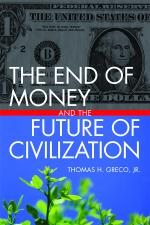
The first edition of my book, The End of Money and the Future of Civilization, was published by Chelsea Green Publishing in 2009. While it remains as relevant today as it was when first published the printed book has been out of print for several years. But, having had the rights reverted to me by my publisher, I am making the entire book available for free in PDF format. You can read it or download it HERE. If you would like a hard copy of the first edition used copies can still be found on Amazon.com, Abe books, Thrift books and elsewhere.
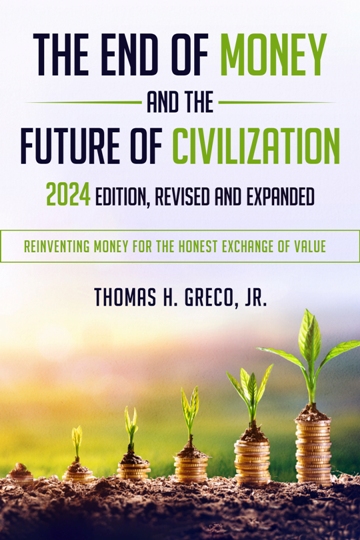
Better still, you can avail yourself of the new revised and expanded 2024 edition which I have been working on for almost two years and is almost complete. Eighteen chapters have already been posted and can be freely read or download HERE.
My previous books, as published, may be freely accessed in digital format by clicking the title below.



 Beyond Money