Chapter 16 is the latest Chapter in my new updated and expanded edition of The End of Money and the Future of Civilization. The link to this chapter is now listed along with the other previously published chapters on the book page along with links to the audio narrations by Ken Richings. Scroll down to find Chapter 16 there or click here to go directly to the PDF file.
Here are the Chapter contents:
Figure 16.1 A Typical Small Boat Harbor (Drawing by Dennis Pacheco)
The Orthodox Approach to Community Economic Development
A Comprehensive Community Economic Development Plan
Stage I: Map the Local Actors and Assets & Promote Import Substitution
Stage II: Support Structures for Localization—Saving, Investment, Finance, and Education
Stage III: New Liquidity Through Trust—Mutual Credit as a Way to Pay How It Works Key Benefits The Generation and Allocation of Trade Credits
Stage IV: The Credit of “Trusted Issuers” Can Provide a Local Alternative Currency for General Circulation
Stage V and Beyond: Transition to an Objective Measure of Value and Unit of Account
Brett Scott has recently written an article titled The Art of Crypto Kayfabe, with the added tagline “You know the cage-fight between Bitcoin and the Dollar was staged all along, right?”
That article is masterful in debunking claims that Bitcoin and similar artificial digital commodities provide an alternative means of payment to the Dollar and other political currencies. He argues that “The actual monetary system is a coercive and extractive credit vortex underpinned by powerful legal structures, military, and the commercial banking sector around the world,” and that “Capitalism isn’t some merry ye olde market. It’s a gigantic global organism built upon state foundations that uphold private property laws, allows corporations to exist, and hold the reins of a transnational money system that both expands and contracts.”
It has long been my position that a real Dollar alternative requires reclaiming the “credit commons,” i.e. community control of credit that producers and sellers of real value allocate to one another, and that credit needs to be quantified in units that are defied on the basis of a real commodity or group of commodities that are in regular demand.
My paper titled, Invoice Factoring as the Basis for a Digital Token Currency, presented at the RAMICS Conference in Rome on November 6, 2024, described how that can be done by creating a digital token currency that, unlike present-day crypto currencies, is based on, and redeemable for real goods and services. This presentation describes the structure, processes, and protocols for creating and circulating a digital voucher token currency on a continuous recurrent basis. I’ve summarized my proposal in this 12-minute video posted on YouTube.
I am pleased to present this guest editorial by my long-time friend and correspondent, Christopher Quigley. Christopher in an expert in market analysis, and a proponent of the Social Credit philosophy of C. H. Douglas. I think you will find it useful. — T.H.G.
Excerpt:
Social Credit and the End of Meta-Feudalism
The King is dead long live the King” so goes the feudal aristocratic mantra establishing power continuity. Death and birth are a part of reality and amidst the pain of death the love of life must prevail. Currently many say that American society is dying but in fact it is experiencing a transformation. — Major Clifford Douglas
The quote above, made in 1934, perhaps would have been more correct if Douglas had said that America was going through a “paradigm shift” rather than a transformation. This shift was in essence a revolution at the time, a revolution based on growing consciousness, labour unrest, social dysfunction and expanding poverty. Today this trend is still emerging with other forces driving the trend, forces such as the growth of internet learning networks and the diminished effectiveness of mass broadcasting. Thus, average Americans are finally starting to think as sovereigns again. Their enlightened thinking had stopped following the disaster of the civil war of 1861-1865. This national cessation of practical awareness allowed the then Federal micro-system to usurp the Union macro-system through credit power. As a result, today the Federal Government is now macro, and the Union of States micro, but this could change over the next 50 years.
The global elites want the real American economy to contract. They desire a constrained and hobbled society which is more dependent and demanding, more complex, more controlled, more diverse, more fractured, more locally ineffective— In a word, meta-feudal. To understand a world that is meta-feudal you should watch movies such as “Brazil,” “Rollerball,” and “Blade Runner.” These worlds are technologically advanced but disintegrated and astonishingly unequal.
The meta-powers work through fabricated “crises.” The elite set up the last economic “crisis” through the “originate to distribute” Basel banking agreement of 1998. From this model evolved the hyper property bubble of post-2000, the “credit” collapse of 2007-2008, and the market-fixing credit derivative system and asset laundering off-balance-sheet accounting protocols currently in place. The credit collapse eventually led to the new “improved” post-Covid, bailed-out banking oligarchy now in place. This club involves far fewer players than existed heretofore but the financial club that is in power is now manifestly more globally influential.
My webinar, Money, Power, Democracy, and War, that was aired on Humanity Rising last Tuesday, July 16, was recorded. In case you missed it, you can view it on YouTube. During the first 16 minutes or so, our host Jim Garrison expressed his thoughts on current national and world events; that was followed by his introduction, our presentation, and some further conversation. A few of the questions addressed were:
Why are nations continually at war when people want peace?
What do wars produce, and what do they destroy?
Who gains and who loses in war?
Where do governments get the money they need to finance war?
Is there a link between the monetary system and the political system?
In the process, I delved into some pertinent history and events that set the stage for our present deepening crisis, then began to describe the pathways towards re-empowerment of the people through decentralized initiatives involving independent means for measuring and exchanging value, beginning at the community level. Toward the end of the discussion, I offered my views on Bitcoin, cryptocurrencies, and blockchain technology. I’d be happy to have your comments. # # #
The latest chapter in my new 2024 edition ofThe End of Money and the Future of Civilization, has now been widely published. Here is an excerpt:
Erecting the ‘wall of separation between church and state’… is absolutely essential in a free society. — Thomas Jefferson
The established beliefs about money in today’s world have become a sort of religion in which a fundamental tenet holds that government must, either directly or indirectly, have power over the system of money creation and circulation. This erroneous belief has taken the world to the brink of disaster which will surely ensue unless we take steps to depoliticize money by achieving the separation of money and state.
It should be obvious by now that there will never be peace in the world so long as those who control our national governments are able to conjure up out of thin air the seemingly endless amounts of pseudo-money they need to pay for wars and whatever else might bolster their political and economic interests.
Erecting the ‘wall of separation between church and state’… is absolutely essential in a free society. — Thomas Jefferson
The established beliefs about money in today’s world have become a sort of religion in which a fundamental tenet holds that government must, either directly or indirectly, have power over the system of money creation and circulation. This erroneous belief has taken the world to the brink of disaster which will surely ensue unless we take steps to depoliticize money by achieving the separation of money and state. It should be obvious by now that there will never be peace in the world so long as those who control our national governments are able to conjure up out of thin air the seemingly endless amounts of pseudo-money they need to pay for wars and whatever else might bolster their political and economic interests.
Read all about it in Chapter8—The Separation of Money and State, the latest chapter to be published in my new 2024 edition of The End of Money and the Future of Civilization.
Further chapters will continue to be posted as they are completed. Watch for Chapter Nine to be posted soon. As always, your comments and suggestions are welcomed, Thomas
In October of last year (2022) I gave a remote presentation to the 6th Biennial RAMICS International Congress in Bulgaria. RAMICS is the Research Association on Monetary Innovation and Community and Complementary Currency Systems, which includes both academics and practitioners. In my illustrated presentation titled, Private and complementary currency systems: purposes, principles, practices, and performance, I provided a concise summary of key points and fundamental principles that need to be understood in order to transcend the dysfunctional and destructive political money system by decentralizing the control of credit and creating honest and effective, non-political exchange media. Here is an abstract of its contents.
Through the generous assistance and editing work of Ken Richings, the presentation is now available for viewing on YouTube. ______________ Peace or Empire?
Dennis Kucinich at Rage Against the War Machine At the February 19 anti-war rally in Washington, DC, former US Congressman Dennis Kucinich made an inspired call for peace, justice, compassion, and an end to corruption in government. I don’t believe that any reasonable person of good would disagree with his message. In a subsequent message, Can they ‘repeal’ the dead? Ask Orwell, Kucinich recounts the criminal invasion of Iraq by the US in 2003, the lies which were used to justify it, and its tremendous cost in material resources and lost lives. Another major consequence has been an erosion of trust in the US government both at home and abroad.
The achievement of peace in the world requires mutual respect and good faith negotiations, but unfortunately, peace is not the goal of those who have for some time been in control the US government under administrations of both parties, rather, they are bent on achieving “full spectrum dominance” and have chosen to restart the Cold War in hopes of weakening Russia and forcing it into line with the agenda of the New World Order in which the Western powers control all the Earth’s resources. If you want to get a more accurate picture of what’s actually been going on in eastern Europe, pay attention to former Marine and UN nuclear weapons inspector, Scott Ritter starting with his post, Give peace a chance.
And to round out the story of why the world is now on the brink of an unprecedented catastrophe, listen to the ever insightful Noam Chomsky, still sharp and coherent at age 94, speak about Putin, Ukraine, China, and Nuclear War. ______________________ Disturbing Thoughts (about the economy)
John Mauldin is “a visionary thinker, a noted financial expert, a New York Times best-selling author.” I’ve been a subscriber to his Mauldin Economics newsletter for at least a couple years. This edition seems particularly important, especially the section titled, “We’re Going to Have a Crisis.”
Citing the recent bank failures and the government’s decision to insure even the uninsured depositors, Mauldin observes that deposits will inevitably be withdrawn from smaller banks and placed in banks that are considered “too big to fail.” He argues that a major change is needed but that, “Our political system is sadly not up to the task. The current structure is all we have, and it won’t improve until a crisis forces change.” He quite emphatically concludes that “…the situation demands changes. Which means—and I don’t say this lightly—we’re going to have a crisis which will give us that change.”
Mauldin continues with an analysis of the developing crisis, particularly with regard to small banks’ exposure to declining asset values in commercial real estate. You can read the entire newsletter at Mauldin Economics. ___________
In April the Sonoran desert blooms, the fragrance of orange blossoms fills the air along with that of creosote bush, Palo Verde and a host of other plants. The winter chill has gone and the summer heat has not yet arrived. It is a particularly pleasant time to be here. I hope you are enjoying your home turf as much as I am mine.
Over the past few weeks I’ve begun the process of cataloging the books, pamphlets and other print materials in my unique and rather sizeable collection. The process has been greatly facilitated by using an app named CLZ Books which is able to find citations from the online database by reading the bar codes that are usually printed on the back cover or dust jacket of a book, or by manually entering the ISBN, or title, or author.
Many of the works in my collection are old enough to lack bar codes and many lack even ISBN numbers, but these can often be found in the database by manually entering the title or author. So far I’ve managed to catalog almost 200 titles. The remaining items are pamphlets and photocopies which will require more intensive effort.
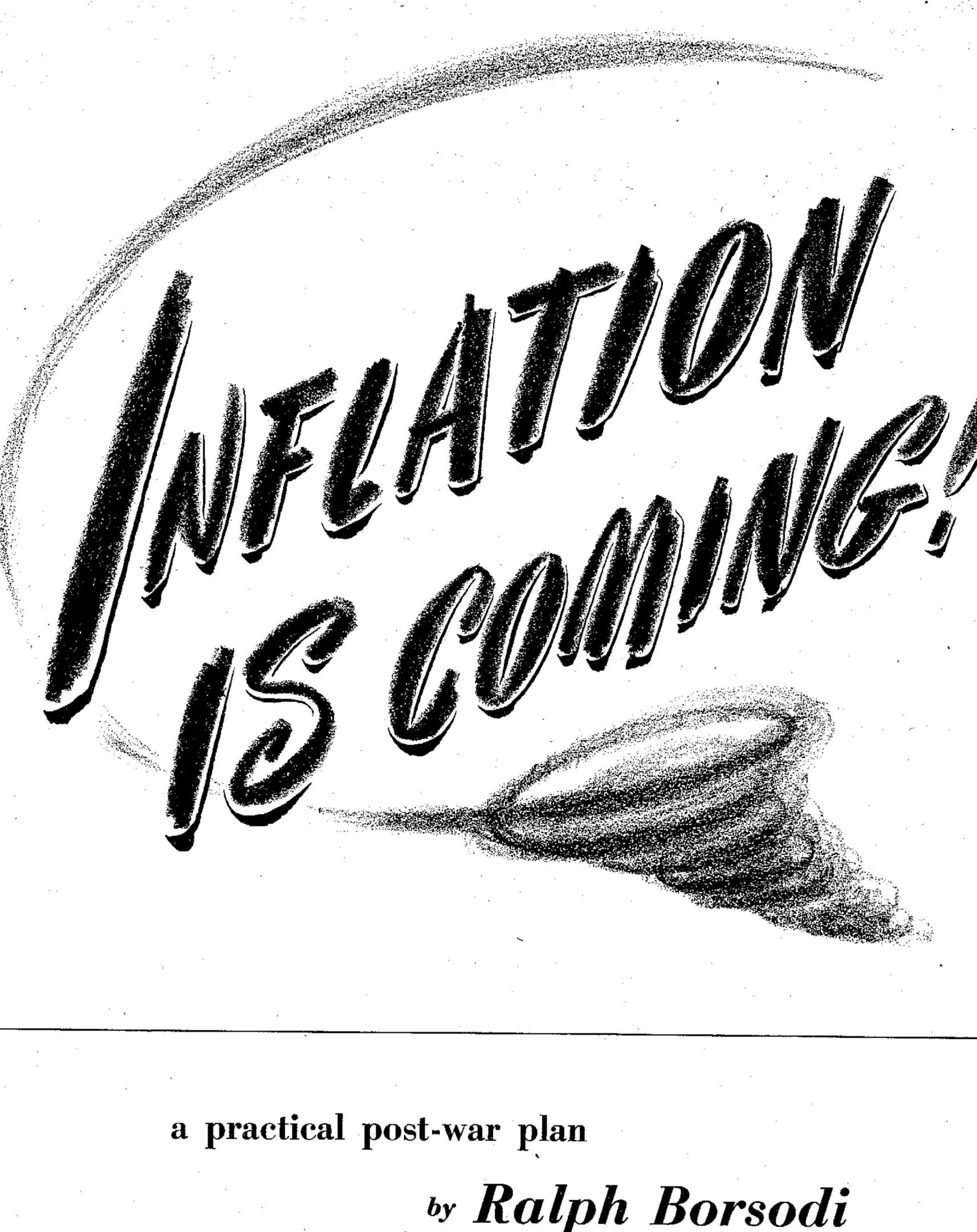
In going through this process, I’m selecting a few works to add to the digital Library on my website Beyondmoney.net. I first do a search to see if digital versions already exist somewhere on the Web. If they do, I’ll provide a link, or download them to my computer and place them on my own website. If no digital version is found, I may choose to transcribe the work, either in whole or in part, by speaking it into a voice recognition app that is able to convert it to text. An example of the former is Inflation is Coming and What to Do About It, by Ralph Borsodi, one of the people who have inspired my work. It was written in 1945, but the copy I have in my library is the 1948 version which is essentially the same. I did retrieve a PDF file of the book from the website of Cooperative Individualism, and you can read it here.
The financial and economic collapse did not happen as soon as Borsodi thought it might, nor did it quite follow the mechanism that he expected. He seems not to have anticipated the globalization of the economy, the shift of the US from the world’s greatest creditor nation to its greatest debtor, or the extent to which the US dollar would become the global reserve currency, and the enormous appetite of other countries for holding and accumulating ever greater pools of dollars. Neither did he foresee the long succession of stop-gap measures that have been rolled out by the political and monetary authorities over the subsequent decades to prop up the flawed system, such as corporate and bank bail-outs, corporate consolidations, quantitative easing, and bail-ins, and the ever greater centralization of financial, economic and political control. But Borsodi was not wrong. We can now see looming on the horizon either (1) the collapse the dollar and the global financial system, which will take the economy with it, or (2) the imposition of an ever more totalitarian government that will micro-manage every aspect of society and individual behavior.
The first of these will probably be inadvertent and unanticipated. The second has long been planned, is in the works, and is rapidly unfolding. The global power elite seem to believe that they can engineer a controlled demolition of the existing financial mechanisms and replace it with a new system that will further increase their power and wealth. Recent developments are signaling the elimination of cash money, the introduction of Central Bank Digital Currencies (CBDCs), as well as onerous demands on people in the name of public health, climate change, and other “emergencies.” We should expect to see the United States and other countries to roll out their own versions of China’s social credit system which will determine what each individual will be allowed or not allowed to do, along with some system of positive personal identification (PPI), most likely using a mandatory chip implant.
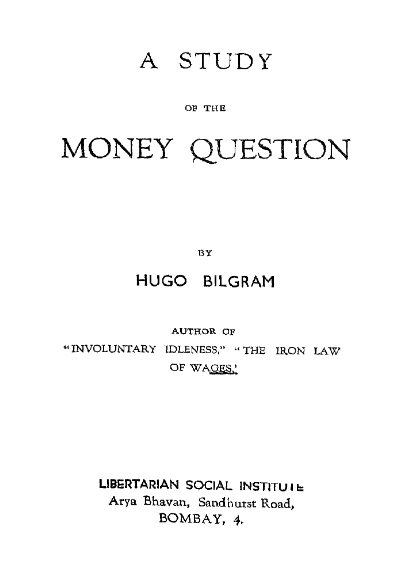
My physical book library also contains a rare copy of, A Study of the Money Question, by Hugo Bilgram. This slim volume,
published in 1894, provides some valuable insights into the essential nature of money, the necessary functions of an effective system of exchange, a critique of the banking system as it existed at the time, and Bilgram’s description of a “rational money system.” I did not expect to find it on the web so I spent a considerable amount of time transcribing it and adding my commentary, which you can read here. A subsequent search did locate a PDF file of the book on Internet Archive, which I have downloaded and added to my online Library.
I believe that both of these will be of value to serious students, researchers and innovators working in the field of money, banking, and exchange.
Unlike, government and central bank fiat currencies which promise nothing but their acceptance as tax payments, private currency vouchers promise to be redeemed for real valuable goods and services. If the issuer is trustworthy and can be counted on to honor their pledge of redemption, their currency vouchers can provide traders with an exchange and payment medium that is superior to government and central bank fiat monies. Such honest currencies are neither novel nor odd, but have a long history and are an absolute necessity for the decentralization of economic and political power and the emergence of a peaceful and equitable social order.
So what sorts of entities can be trusted to keep their promises, how do they put their currencies into circulation, are such currencies legal, have such currencies ever been issued before? In brief, a currency voucher is spent into circulation when the issuer offers it as payment to a supplier, employee or a creditor, who accepts it as such. In the United States and most other “free” countries, private currency vouchers are entirely legal and there are numerous historical instances of their issuance and circulation. These questions and many other details have been fully answered over the years in my various writings and presentations, most of which have been posted or linked on my website, https://beyondmoney.net/. Particularly relevant are my book, The End of Money and the Future of Civilization, as well as my 2021 presentation, Transcending the present political money system–the urgent need and the way to do it, and my 2021 webinar series, Our Money System – What’s Wrong with it and How to Fix it.
A few years ago I wrote up a proposal for a private currency voucher that I call the Solar Dollar which attracted some significant interest. My intention was twofold, one, to provide an independent payment medium for a local community, i.e., a currency that can be created outside of the banking system and thus empower participants in a local economy by compensating for shortages and mal-distribution of government fiat money, and two, to incentivize the shift of energy production, sales and usage toward solar and other renewable sources of electric power. My hope was that some electric utility company somewhere would implement the plan and become a model for others utilities to follow. That, unfortunately, has not yet happened but I am confident that it, or something like it, eventually will. In the meantime, I’ve continued to publicize it, and in 2021 I was invited to give a presentation titled, Solar Dollars–Empowering Communities While Powering Communities With Renewable Energy, for a virtual conference that was sponsored by the Zero Carbon Lab at the University of Hertfordshire (UK). Later that year, under the good auspices of Professor Ljubomir Jankovic, my original white paper was revised and published with the title, Solar Dollars: A Complementary Currency that Incentivizes Renewable Energy, in the academic journal, Frontiers in Built Environment.
Overall, the primary objective of my work has been, and remains, the decentralization of financial, economic, and political power. The most promising strategy for achieving that is the design and deployment of private credit currencies that are spent into circulation by trusted issuers that are ready, willing, and able to redeem their currencies promptly for the real goods and services that are their normal stock in trade. By breaking the credit monopoly that the banking cartel presently holds, and empowering producers and sellers of real value, it then becomes possible to reverse the longstanding trend toward ever greater power and wealth in the hands of the global elite who have captured the machinery of finance, economics, and government.
The Solar Dollar is a special case and example of a private credit currency issued by a trusted producer and provider of real value, but similar objectives could be achieved by companies in other lines of business, for example, by:
The issuance of local Farm Produce Dollars that would be spent into circulation by a single local farmer or jointly by a cooperating group of local farmers and ranchers, or by
The issuance of local Shelter Certificates that are spent into circulation by a single local owner of rental property or jointly by a cooperating group of local owners of rental property, or by
The issuance of Service Certificates by a local provider of some sort of professional or household services, or jointly by a cooperating group of such service providers, or by
The issuance of currency vouchers by all of the above producers/providers and others who band together to cooperatively issue a sound complementary currency under a common “brand.” Such a currency would provide a means of payment that is not only independent of the banking system but solidly backed by the combined production and distribution capacity of all participating businesses. (Many “community currencies” have been created over the years in many places around the world but virtually all of them are “sold” for government fiat currencies which defeats the main objective of creating a currency that is independent of government and the banking system).
All of these currency vouchers or credits are able to circulate as payment media throughout their local communities to enable trading despite any scarcity or unavailability of official money. There are many historical and contemporary examples of such private credit instruments, so most of what I’m suggesting has already been shown to be workable. The main problem I have observed is getting producers of real value to recognize the power they already have and to exercise it on their own behalf and that of their communities.
“The stream of political monies from the beginning to the present day runs deep and dirty, yet to suggest that money can spring from any other source is to surprise if not even to dismay. So has tradition dulled men’s senses. No matter how often the state fails to supply a virtuous money system, men rush back to it in desperation and beg it to try again. Indeed, until we learn that the money power resides in us, we must abjectly beg the state to give us an exploitative system because we cannot return to a moneyless civilization. Yet, no matter how often and earnestly the state tries to provide a true money system, it must fail because of an inherent antipathy between the money issuing power and the taxing power. A money issuer must be a seller who bids for money, not a taxer who requisitions it in whole or in part, as politically expedient and without a quid pro quid.” — pp. 25-26.
Political democracy cannot work without economic democracy; and the money power is the franchise of the latter. — p. 35
It is the false concept of political money power that converts citizens into petitioners, and makes government a dispenser of patronage instead of a public servant. This power of patronage utterly destroys the democratic system of government – since the people cannot be both petitioners and rulers.” — pp. 78-79
Throughout my career as a monetary theorist, educator, and advisor, taking up where Riegel and others have left off, I have tried to influence producers, entrepreneurs, and social organizers toward effective action based on sound principles of credit allocation and management. But superstitious myths die hard and old habits are difficult to break. The great majority of people remain in thrall to official currencies. That is what the oligarchs depend upon to keep us in debt and under their control. I have learned to be patient and await the changes in financial, economic, and political conditions that will open people’s minds to adopting self-help and cooperative approaches to getting our needs met, specifically, the need for free and fair exchange of value in the marketplace.
Surely, the day will come, and is rapidly approaching, when the failures and demands of the dominant global central banking, political, interest-based, debt-money regime will become so clearly evident and abysmal that the only peaceful option will be for we-the-people to implement our own systems of exchange and finance grounded in our own initiative and judgment in allocating credit based on productive capacity and trustworthiness.
Issuance, circulation and redemption of Private Currency Vouchers
One of my most popular posts has been, There once was a river …an allegorical tale of money and credit, in which I’ve tried to show how we have all become slaves to money and those who control money. Using water in this little fable to represent money, I’ve also tried to show that we the people can free ourselves by thinking outside the box to overcome our fixation on the sort of money that has been provided for us and over which we have lost all control.
Every metaphor of course is limited and what I am hoping that readers/listeners will come to understand is that there are alternatives to conventional money that we can use to reduce, and eventually eliminate our dependence upon conventional political money. It is credit that is the foundation of an honest system of exchange and we have the power to give credit to each other in accordance with our own values and objectives, outside of conventional banks and without charging interest.
You can access the story on my website (audio with transcript) or on YouTube (audio). Or listen here.
The first edition of my book, The End of Money and the Future of Civilization, was published by Chelsea Green Publishing in 2009. While it remains as relevant today as it was when first published the printed book has been out of print for several years. But, having had the rights reverted to me by my publisher, I am making the entire book available for free in PDF format. You can read it or download it HERE. If you would like a hard copy of the first edition used copies can still be found on Amazon.com, Abe books, Thrift books and elsewhere.
Better still, you can avail yourself of the new revised and expanded 2024 edition which I have been working on for almost two years and is almost complete. Eighteen chapters have already been posted and can be freely read or download HERE.
My previous books, as published, may be freely accessed in digital format by clicking the title below.





 Beyond Money