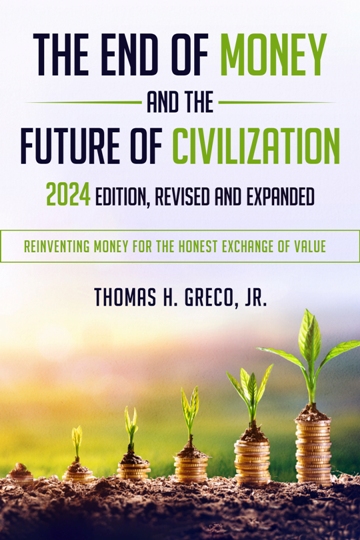
This is the latest chapter to be published of my new 2024 edition of The End of Money and the Future of Civilization. It continues the story begun in the previous chapter of how money has evolved and changed its character over time.
Here is a brief excerpt:
Money has become merely an accounting system, a way of “keeping score” in the economic “game” of give and take. —Thomas H. Greco, Jr.
Let us begin by summarizing the evolution of the various kinds of money that have been used to mediate reciprocal exchange:
The circulation of gold and silver coins gave way to paper banknotes that were redeemable for gold or silver coins, which made the notes essentially warehouse receipts for gold on deposit.
Then, banks began to lend bank notes into circulation based on the pledge of collateral assets (some valuable and others not) other than gold, some of which included government obligations (bonds, notes, etc.).
But ALL notes were redeemable in gold. This became known as the “fractional reserve banking” system.
Bank account balances (checkable bank “deposits”) increasingly took the place of paper bank notes, and bank customers began to write checks against their deposits instead of using bank notes to make payments.
As banks created ever greater amounts of non-bona-fide money based on national government debts and other illegitimate collateral assets, the fiction of gold-backing and redeemability could no longer be supported, and governments reneged on their promise to redeem their currency for gold. This broke the final link between political fiat money and the real economy of valuable goods and services.
But, despite that, the emergence of credit clearing to offset credit obligation against credit claims was a major leap forward in facilitating the reciprocal exchange of value.
For now, you can read or listen to the entire chapter at Future Brightly:
It will also be published soon here, and on my own Substack channel. Further chapters will continue to be posted as they are completed. Watch for Chapter 11 to be posted soon.
As always, your comments and suggestions are welcomed, Thomas
What You Need to Know About Money. Currency, Credit, and Exchange
Abstract: There remains today, even among economists and “experts,” a general lack of understanding about the essential nature of money, currency and credit, and sound principles of their creation and management. This article provides a point-by-point summary of fundamental concepts and basic principles of exchange, it outlines the systemic defects and destructive nature of the dominant political, central banking, interest-based, debt-money system, and describes the ways in which honest and effective exchange media can be created on a decentralized basis outside of the banking system and in lieu of political money. A wider understanding of these points will lead to the widespread creation of honest exchange mechanisms and the devolution of financial, economic and political power that can change the course of civilization from self-destruction toward peace, justice, freedom and harmonious relationships.
The essential nature of money/currency A currency is a credit instrument, i.e., a promise to deliver valuable goods and/or services.
Basis of Issue A currency must therefore be issued into circulation on the basis of some value foundation, i.e., goods and/or services that the issuer is ready, willing, and able to sell immediately or in the near future.
Purpose of a currency The sole purpose of a currency is to facilitate the reciprocal exchange of value in the market. It is not a measure of value, nor is it a savings medium.
Reciprocal Exchange Reciprocal exchange is the voluntary exchange of one sort of value for another in the market.
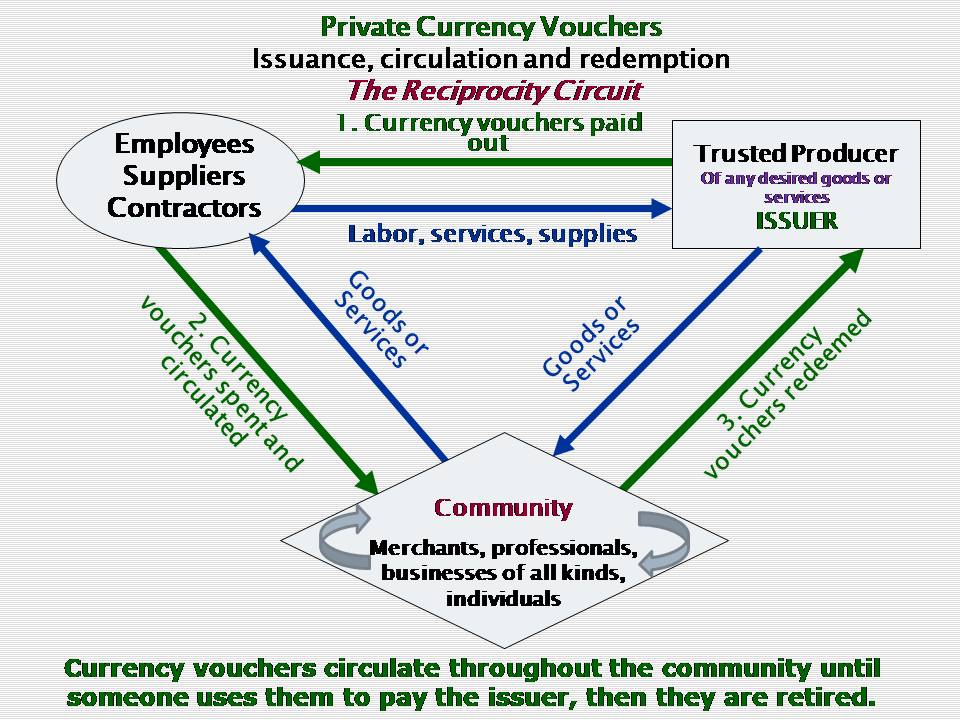
Issuance A currency enters into circulation when a provider of value offers it to another seller who accepts it as payment for their own goods or services, i.e., it is spent into circulation, not sold for fiat political money.
Circulation If it is to serve as a currency, a credit instrument must circulate freely and can change hands many times before eventually returning to the issuer for redemption, not for political money, but for the goods or services that are the issuer’s stock in trade.
Redemption and Extinction A currency is redeemed and extinguished when the reciprocity circuit has been closed, i.e., when the issuer accepts it back as payment for the goods and/or services that they are prepared to deliver immediately or in the near term.
Liquidity Liquidity is quite simply the ability to pay, i.e., having a payment medium that is widely accepted.
Monetization Monetization is the process of converting the value of an illiquid asset into a liquid form, i.e., a form that can be used as a payment medium (money/currency).
Who is qualified to issue a currency? Since a currency is a promise to deliver value, only producers and providers of real value are qualified to issue a currency.
Fallacious myths about money
The belief that money must be issued and controlled by governments and/or central banks.
The belief that banks collectively should have a monopoly on the allocation of credit.
The belief that interest is a necessary element in money creation and finance. How is conventional political money issued, and who issues it?
Virtually all political fiat monies are created by banks when they grant loans.
What are the flaws in political money system, and what are their impacts?
Most bank loans are made on an improper, or inadequate, basis or foundation.
Government and central bank currencies are no longer defined in terms of any real concrete value unit.
Thus, most political money is illegitimate and dishonest.
The interest that banks charge on loans far exceeds the cost of providing the service of monetizing the value of the collateral assets. This causes debts in the aggregate to grow exponentially over time making it impossible for all borrowers to repay what they owe, and making it certain that some must fail.
The concentration of money power in the hands of ever larger banks, in collusion with central governments, concentrates financial, economic and political power in the hands of an elite “super class” and undermines democratic government.
Assertions and Prescriptions
To preserve any semblance of social justice, economic equity, individual freedom, and democratic government, power must devolve to people in their various communities. The only feasible way of achieving that is through the creation of independent and honest mechanisms for exchanging value.
Such honest mechanisms include private currencies issued by providers of real value, and credit clearing associations that allocate credit on a sound basis to producers of real value, and enable them to exchange value without reliance on bank borrowing or the use of political money.
Such systems are not new; they have long existed and need only to be optimized, standardized, and networked together to provide means of exchange that are locally controlled yet globally useful.
The future will see the proliferation of entities that organize and enable the allocation of interest-free exchange credit to small- and medium-sized enterprises (SMEs) that are the backbone of resilient and sustainable community economies.
Standard procedures and protocols for credit allocation and management will emerge that will allow the effective networking of those entities into a global “internet of exchange” using credit that is locally controlled but globally useful.
I long ago concluded that ALL of our institutions, systems, and structures of western civilization have been thoroughly corrupted by greed and the hunger for power which are reactions to false beliefs and artificial scarcities. I take that as given and try to avoid being distracted by it while trying to keep my attention and energies focused on what I think I can do to change things. What that has meant for me has been to learn everything I could about the money system as it exists — its inherent dysfunctions and dishonesties, and to discover and develop better ways of performing the functions that money is supposed to serve, especially the function of reciprocal exchange of value. The decentralized allocation and control of credit is the key to creating an honest, efficient, and sustainable system of exchange, and there are well established ways of doing that without the need for political fiat monies. Many of these systems, like the WIR Economic Circle Cooperative and the scores of commercial trade (“barter”) exchanges, have been operating successfully for many decades or longer.
What remains to be done are: 1. The optimization of the procedures and protocols used in credit clearing systems like the scores of commercial trade exchanges now operating in many countries around the world, such as the optimizing prescriptions I’ve made in A Model Membership Agreement for a Credit Clearing Service contained in my book, The End of Money and the Future of Civilization, and, 2. The development of effective ways of dealing with interference from governments, banks, and the vested interests that is sure to come when these competing systems become big enough to be perceived as a threat to the status quo.
I consider the wave of cryptocurrencies that has emerged since the launch of Bitcoin to be attempts to address the second of these objectives by providing virtual commodities that are generated outside of the government/banking system and to hopefully provide some degree of anonymity and privacy in value exchange transactions. Those motivations are all well and good but reverting to the use of commodities, either virtual or real, as exchange media takes us back to a more primitive stage in the evolution of the reciprocal exchange process, and unlike real commodities, they have no inherent use value other than their use as media for speculation. Add to that the fact that the primary motivation in the creation of most “cryptocurrencies” or virtual “coins” has been profit seeking by their creators, and what we have now is a milieu that is littered with “shitcoins,” corruption, and fraud. It’s very difficult and time consuming to dig deeply enough to evaluate each new entry into the field, and I see no advantage in doing so.
However, the use of blockchain technology that accompanied the creation of Bitcoin may have a useful role to play in a credit clearing network or private credit currency as a way to create exchangeable “token” vouchers that represent a claim upon real valuable goods and services that the issuer has promised to deliver. Such vouchers would be real currencies.
Questions that need to answered about any currency:
Who is the issuer?
What is the value basis upon which the currency is issued?
In what units is the currency denominated?
Is the issuer, ready, willing and able to redeem the currency?
Is the issuer credit-worthy, reliable, trust-worthy?
Do they have the goods on hand or sufficient service capacity to deliver promptly?
What are the terms of redemption? In what form? When? At what rate in relation to the units specified (face value, discount, etc.?)
In what form does the currency exist? Paper notes, Physical tokens, Digital tokens, Ledger entries?
What other characteristics of the currency contribute or detract from its use as an exchange medium?
On July 12, 2021, I presented my Solar Dollar proposal as part of a two day virtual conference titled Pathways to Resilient Zero Carbon Cities, organized by Zero Carbon Lab, School of Creative Arts, University of Hertfordshire (UK). Following that presentation, I was invited to submit a paper describing my proposal for publication in an academic journal. That paper titled, Solar Dollars: A Complementary Currency that Incentivizes Renewable Energy, has now been published and can be read or downloaded at https://doi.org/10.3389/fbuil.2021.785145.
Broadly speaking, technology is the organization of knowledge, people, and things to accomplish specific practical objectives. It includes processes, practices, techniques and systems as well as things. So what are the disruptive technologies in money and finance? Or is that even the right question to be asking? Is it Bitcoin, Ethereum, and other so-called crypto-currencies? Is it the blockchain, “smart contracts,” “big data,” algorithms?
To find out, watch this 15 minute video, which was extracted and adapted from a longer recording of the presentation, I made to the International Institute of Advanced Islamic Studies, in Kuala Lumpur, Malaysia, on October 10, 2016. It describes how communities and businesses can escape the debt trap and become more resilient and self-reliant? New independent approaches to payment and reciprocal exchange are being deployed which are making conventional money obsolete.
All the perplexities, confusions and distresses in America arise not from defects in the Constitution or Confederation, not from want of honor or virtue, as much as from downright ignorance of the nature of coin, credit and circulation.
– President John Adams, from a letter to Thomas Jefferson (1787-08-25), in The Works of John Adams
As the time grows near I want to remind everyone that my workshop on innovative finance and exchange is set to begin in about 10 days time at Kalikalos Holistic Summer School in Greece (http://www.kalikalos.org/exchange-finance). It will start on the evening of 24 June and conclude on the morning of 1 July.
While it is described as a “course,” the format will be that of a workshop/colloquium in which everyone plays an active role in an intensive process of inquiry, discovery, sharing and collaboration aimed at:
1. achieving a deeper understanding of sound principles of credit, finance, and the exchange process, and,
2 developing action plans for the design and implementation of robust systems that can be widely proliferated and quickly scaled up to global dimensions.
3. assembling a knowledge base that can provide guidance to others on the same path toward achieving more equitable and sustainable economic structures.
There is still space available for those who feel moved to participate.
Details about the course, fees, and booking are at http://www.kalikalos.org/exchange-finance.
Some of the areas that we will explore include:
The essence, function, and forms of money
The concepts of currency, credit, credit clearing, liquidity, monetization, and basis of issue
Various models of private currencies and moneyless exchange
Value measurement and units of account
Exchange networks and inter-trading
Don’t let finances stop you as will be able to offer a limited amount of bursaries. Please write an application for that to our team at rachaeldavson@gmail.com.
We offer Greek participants who take part in the week-long workshop a discount of 30%. The weekend Saturday, 25 and Sunday 26 is being offered to Greeks on a Gift Economy basis which means that you offer what you are able to give. If you want to participate on these terms please send a mail to: rachaeldavson@gmail.com.
Here is my comment on a recent article titled Krugman’s Craziness that appeared in the New York Sun. –t.h.g.
Very few people today, including prize-winning economists, possess a deep knowledge of the fundamental principles of reciprocal exchange, and most of those who do are committed to maintaining the global interest-based, debt-money regime that enables an elite few to control economies and governments worldwide.
In the wake of the 2008 financial meltdown and the ongoing economic crisis, more and more people are waking up to the fact that there is something seriously wrong with our systems of money, banking, and finance, but remain mystified by it and have no idea what to do about it.
Many are calling for reform of the system via the political process, and most reformers want a return to the gold standard and favor a government monopoly over the issuance of money. Clearly, new legislation is needed to reverse the trend toward ever greater centralization of power and concentration of wealth, but such measures have no hope of passing into law so long as the “money power” is able to buy politicians wholesale. Further, since money is a human contrivance that is supposed to facilitate the exchange of value (like goods, services, and various financial claims), people should be free to use whatever payment media they find mutually agreeable. Rather than monopoly of money, either bank-controlled or government-controlled, we need competition in currency. Let us have more freedom, not less.
There are solid precedents that prove the effectiveness of private and community currencies, as well as direct clearing of credits among buyers and sellers, a process that has the potential to make money as we’ve known it obsolete. Private initiative is presently bringing to market new and creative mechanisms of exchange and finance that have the power to bring about economic and financial stability, social harmony and a dignified life for all.
In the slums of Kenya, money is especially scarce. Still, the residents are productive and have plenty of goods and services to offer one another. American social entrepreneur Will Ruddick, together with hundreds of local enterprisers, has found a way to create supplemental exchange media that enable them to trade with one another despite the lack of Kenyan shillings.
Here’s a new video about their Bangla-Pesa currency that they have created in Bangladesh, a slum area of Mombasa.
And, here’s a recent TV news report, which is described as follows:
Published on Apr 10, 2014. When news of the complementary currency branded Bangla-pesa first broke out, claims arose that it was linked to the proscribed Mombasa Republican Council, MRC, and its secessionist agenda, almost spelling doom for the project. A year later, we returned to Bangladesh slum in Mombasa county where the vouchers were first launched, and discovered that not only has the program grown in leaps and bounds, but plans were afoot to roll it out in different slum in the region.
The Conference on Complementary Currency Systems that will be held 19-23 June in The Hague, Netherlands, is shaping up to be a significant landmark in the development of currencies and exchange processes. It will bring together practitioners and theoreticians from all over the world. The following message that came in recently from Edgar Kampers, one of the organizers, highlights the program for just one of the five days. Anyone involved in, or having a serious interest in this field, will probably want to be there.
Are you eager to learn about the future of currencies? Or are you keener to know how complementary currencies can support the local economy and build communities? Are you intrigued by digital currencies like Bitcoin, Freicoin and Ripple?
Then join the 2nd International Conference on Complementary Currency Systems on Friday 21st of June. It will bring a fresh perspective on local currencies like the Brixton Pound, Bristol Pound, Chiemgauer, Berkshares and the Calgary Dollars! It will explore several amazing time banks and time credits systems like Spice, Fureai Kippu and De Makkie!
The conference will be held in The Hague, The Netherlands and will bring together world-leading experts including Bernard Lietaer, Thomas Greco, Jem Bendell, Bart Jan Krouwel, Shann Turnbull and Tony Greenham.
Step into the world of complementary currencies, join the conference!
Richard Logie has been for a long time one of the leaders in the commercial barter industry. As owner and operator of The Business Exchange in Scotland and developer of GETS, a moneyless trading platform, Richard has a wealth of knowledge about moneyless exchange in general. His presentation below provides a valuable learning tool for anyone, either in the entrepreneurial realm or at the grassroots level, who is starting or operating a currency or exchange system.
Please pay particular attention to the way in which Richard determines the credit lines to be provided to members’ accounts, the list of advantages that membership in a credit clearing exchange provides, and the elements that need to be standardized in order for exchanges to be effectively networked together.–t.h.g.
The first edition of my book, The End of Money and the Future of Civilization, was published by Chelsea Green Publishing in 2009. While it remains as relevant today as it was when first published the printed book has been out of print for several years. But, having had the rights reverted to me by my publisher, I am making the entire book available for free in PDF format. You can read it or download it HERE. If you would like a hard copy of the first edition used copies can still be found on Amazon.com, Abe books, Thrift books and elsewhere.
Better still, you can avail yourself of the new revised and expanded 2024 edition which I have been working on for almost two years and is almost complete. Eighteen chapters have already been posted and can be freely read or download HERE.
My previous books, as published, may be freely accessed in digital format by clicking the title below.





 Beyond Money